Quick Answer: Which Orifice Jet Do You Need?
For a natural-gas-to-propane fire pit conversion, you need the manufacturer-specified LP orifice jet or approved conversion kit for your exact burner and fire pit model. There is no universal jet size for every 40,000-, 50,000- or 100,000-BTU fire pit. The approved part depends on the fuel type, supply pressure, burner construction, control valve and air-mixing design.
Propane usually requires a smaller gas-metering opening than natural gas in comparable burner systems, but I would never pick a jet from a generic drill-size chart. I would confirm that the appliance is convertible, order the manufacturer-approved parts and have a qualified gas professional install and commission the complete system.
If you are wondering what orifice jets you need for a propane fire pit conversion, this guide will help you ask the right questions before buying parts. I will explain how to read the label, what the numbers on a jet might mean, why fuel pressure changes the answer and which other components may need to change. I will also show you how to estimate your propane consumption, tank runtime and operating cost once the fire pit is properly rated for LP.
My approach is simple: I separate fuel planning from gas-conversion engineering. Calculating how many gallons a 50,000-BTU fire pit burns is straightforward. Selecting a safe orifice requires the appliance manufacturer’s approved specifications. Confusing these two tasks is how a low-cost repair can turn into a serious safety problem.
For a broader overview, see my propane fire pit buying guide. If your project involves a fixed gas connection, you may also want my article on connecting a fire pit to a house gas line. Both explain choices that go beyond one brass part.
What Is a Propane Fire Pit Orifice Jet?
An orifice jet is a calibrated restriction that meters gas into the burner. It may be described as an injector, spud, main burner orifice or gas jet. It is often made of brass, although appearance is not a reliable way to identify the fuel it was designed for. The opening works with an approved gas pressure and burner arrangement to deliver a particular input rate.
I think of the orifice as one component of a complete system. The regulator controls incoming pressure, the gas valve manages delivery, the orifice meters the fuel and the burner or mixer provides the conditions needed for combustion. Electronic ignition, flame supervision and safety shutoff may add more components. If you change the jet without verifying the rest, you can create overfiring, unstable ignition, soot, overheating or leakage.


The most important point is that a jet is not selected by fire pit appearance. Two visually identical burner rings can have different internal arrangements or pressure requirements. Equally, two products advertised at 50,000 BTU per hour can use different approved injectors.
Why Are Natural Gas and Propane Orifices Different?
Propane has more usable heating energy per cubic foot than normal pipeline natural gas, and many LP appliances operate at different regulated pressures. The manufacturer designs the burner input around both the gas properties and the pressure at the metering system. That is why reusing a natural-gas orifice on propane can produce excessive fuel input and unsafe combustion.
I often see the mistaken belief that changing a hole diameter automatically completes a conversion. It does not. An approved LP kit may incorporate an air mixer, different valve parts, a pilot orifice, a compatible regulator or new identification labels. The proper combination is determined by the original equipment manufacturer, not by a general rule about brass fittings.
Can I Use the Same Jet for Both Fuels?
Usually not, unless the exact appliance uses a manufacturer-approved reversible or adjustable dual-fuel assembly. “Dual fuel” can mean that two factory versions are available, that a trained installer can convert between fuels, or that the manufacturer provides a specifically engineered dual-fuel burner. The marketing description alone does not tell you which situation applies.
I would never swap gases simply because a hose adapter fits. The fact that a connector physically mates with a valve tells you almost nothing about acceptable gas input or flame quality. Confirm the model’s fuel designation and conversion procedure before any work begins.



How Do I Find the Correct Orifice Jet for My Fire Pit?
The safest and most efficient approach is to collect the information needed for an authorized parts supplier or qualified gas technician. You do not need to dismantle the fire pit or try multiple unknown jets to perform these identification steps.
- Find the exact model and serial number. Check the rating plate and the original manual. Production revisions matter: the same brand sometimes uses different burner assemblies across model years.
- Identify the original fuel. The label may say NG, natural gas, LP, LPG or propane. Check whether a conversion is expressly allowed.
- Read the intended direction of conversion. You need an NG-to-LP kit if changing from natural gas to propane. An LP-to-NG kit is not an equivalent substitute.
- Write down rated input and gas-pressure data. This information helps confirm compatibility, but does not independently establish an orifice size.
- Request the manufacturer-approved part number. Ask if the kit includes the main orifice, air mixer, regulator, pilot components, valve parts, fittings and labels.
- Have the work installed and commissioned. A qualified professional should follow the manufacturer’s instructions and applicable local rules, including tests for gas tightness and correct operation.
What Do the Numbers Printed on Brass Jets Mean?
The small number stamped on a jet can be confusing. It might be a proprietary component identifier, a nominal hole designation or a drill-gauge reference. A “47” marking is not automatically proof that it has a No. 47 drill-sized opening or is intended for propane. The meaning varies by manufacturer and part family.
Thread fit and metering size are two different things. A jet can screw into a valve yet be entirely wrong for the appliance. I would compare the manufacturer’s part number and compatible model list, not just the brass color, the thread diameter or a marketplace description that says “universal propane orifice.”
When a seller gives a hole size but cannot provide an approved compatibility listing for the model, I treat that as insufficient information. An apparently normal flame is not a substitute for manufacturer specifications and professional testing.


Technical Comparison: Different Types of Propane Fire Pits
To understand why there is no one-size-fits-all jet, compare these common equipment arrangements. The BTU ranges are illustrative examples of product classes, not a compatibility chart or an approved orifice-sizing table. Always use the exact nameplate rating on the appliance.
| Fire pit type | Illustrative input | Typical control arrangement | Conversion consideration |
|---|---|---|---|
| Portable fire bowl | 20,000–40,000 BTU/h | Manual control, sparker or match-lit system | Frequently sold as LP-only; a field conversion may not be offered |
| Residential fire table | 30,000–60,000 BTU/h | Manual valve; some have thermocouple protection | Verify burner model, approved regulator, hose and enclosure |
| Built-in match-lit ring | 40,000–100,000 BTU/h | Approved manual valve and lighting method | Check specified LP air-mixer/orifice assembly and supply capacity |
| Safety-valve burner insert | 50,000–120,000 BTU/h | Pilot or flame-supervision controls | Main and pilot gas components may both be fuel-specific |
| Electronic ignition feature | 75,000–250,000+ BTU/h | Automatic ignition, sensing and shutdown controls | Requires model-specific engineering and professional commissioning |
The BTU figures describe common categories only. They do not identify the jet required by a particular appliance.
A very large fire feature may be designed for permanent propane storage rather than a portable exchange cylinder. The supply must deliver gas at the required rate for the full intended operating time. Cold weather, long pipe runs and other appliances sharing the system can all affect the available fuel supply.
What Gas Pressure Does a Converted Propane Fire Pit Need?
Gas-appliance manuals often state pressure in inches of water column, abbreviated in. WC. It is a much smaller pressure unit than pounds per square inch: approximately 27.7 inches WC equals 1 psi. This distinction is critical when comparing a low-pressure fire pit to the pressure inside an unregulated propane cylinder.
Some fire pit designs list natural-gas supply ranges near 3.5 to 7 inches WC and LP requirements near 8 to 11 inches WC, but these are only examples. Other appliances specify different minimums, maximums or manifold pressures. I would never substitute those illustrative ranges for the published requirements of your specific model.
| Specification | What it describes | Why it matters |
|---|---|---|
| Inlet supply pressure | Gas pressure at the appliance connection | Must remain within the approved range during operation |
| Manifold pressure | Pressure at the manufacturer-defined burner metering point | Works with the approved jet to determine gas input |
| Regulator outlet rating | The regulator’s stated pressure and flow capacity | A similar-looking regulator may not meet appliance needs |
| Burner rating (BTU/h) | Manufacturer-approved heat input on the selected fuel | Useful for fuel budgeting—not enough to select a jet |
| Propane supply capacity | Available gas vapor at the required flow | An undersized tank or line may cause poor flame performance |
The pressure in a propane cylinder varies significantly with temperature. The cylinder’s raw pressure must not be connected directly to a burner designed for regulated low-pressure LP gas. Never bypass a regulator or use a high-pressure regulator to compensate for a weak flame.
I recommend reading my companion guide, How to Check if Your Propane Fire Pit Has the Right Gas Pressure, if the burner is operating poorly. The symptoms may reflect inadequate supply capacity or another component, rather than an incorrect jet.
Which Components May Need to Change?
- Primary burner orifice: The fuel-specific metering part identified by the manufacturer.
- Air mixer or burner assembly: Some LP configurations require a purpose-built mixing component.
- Pilot and flame-sensing parts: Fuel-specific details may be required where these controls exist.
- Regulator and supply arrangement: The correct pressure, capacity and compatible fittings are essential.
- Valves and ignition equipment: Certain control packages are not interchangeable across fuels.
- Labels and instructions: A completed, approved conversion should identify the correct fuel for future owners and service technicians.
None of these parts should be selected by trial and error. If the manual does not specify a field-conversion procedure, purchasing an assortment of orifices from an online marketplace is not an acceptable substitute.
How Do I Know an LP Conversion Was Completed Properly?
I would ask the qualified installer for evidence that the entire appliance matches its approved LP configuration. “It lights and looks okay” is not sufficient. The exact test methods come from the appliance instructions and local rules, but these are the broad topics a commissioning record should cover.
| Verification | Question I would ask | Reason |
|---|---|---|
| Fuel identification | Do the parts and labels match the approved LP configuration? | Prevents unsafe future gas connections |
| Operating pressure | Were inlet and required manifold pressures verified under operating conditions? | Checks the calibrated gas supply |
| Connection integrity | Was the completed gas train checked for leakage? | Reduces the risk of unburned gas release |
| Ignition/shutoff | Do ignition, flame sensing and shutdown operate as designed? | Confirms critical controls still work |
| Flame/combustion | Are there signs of soot, flame lifting or abnormal ignition? | Identifies possible combustion faults |
| Location/ventilation | Are clearances and outdoor enclosure requirements satisfied? | Addresses heat and accumulated gas hazards |
If you smell gas, see damaged fittings or hear an unexplained hiss, do not operate the fire pit. Avoid ignition sources, move to a safe location and call the supplier or emergency services. Do not use an open flame to hunt for a leak. For general hazards, see Are Propane Fire Pits Safe?.
Propane Consumption: BTU, Gallons per Hour and Runtime
Once a fire pit is properly converted and has a confirmed LP-rated burner input, you can calculate operating costs reliably enough for budgeting. This is where simple math is useful. These calculations do not authorize selecting or altering any orifice.
I use approximately 91,500 BTU of heat energy per US gallon of propane and roughly 4.24 pounds of propane per gallon. These are rounded figures; the precise values depend on fuel composition and conditions. A standard 20-pound cylinder can contain about 4.7 gallons when properly filled, but exchange cylinders may have a smaller net fill.
My calculations assume continuous operation at the stated full-input rating. Lower manufacturer-approved flame settings may reduce consumption, but the amount does not necessarily scale linearly with the control knob position. Actual time from a cylinder may also be limited by remaining fuel, weather and vaporization capacity.
BTU Consumption and 20 lb Cylinder Runtime Chart
| LP burner input | Propane/hour | 20 lb tank runtime | Fuel for 3 hours |
|---|---|---|---|
| 20,000 BTU/h | 0.22 gal | 21.5 hours | 0.66 gal |
| 30,000 BTU/h | 0.33 gal | 14.3 hours | 0.98 gal |
| 40,000 BTU/h | 0.44 gal | 10.8 hours | 1.31 gal |
| 50,000 BTU/h | 0.55 gal | 8.6 hours | 1.64 gal |
| 65,000 BTU/h | 0.71 gal | 6.6 hours | 2.13 gal |
| 75,000 BTU/h | 0.82 gal | 5.7 hours | 2.46 gal |
| 100,000 BTU/h | 1.09 gal | 4.3 hours | 3.28 gal |
Illustrative full-input planning estimates. A high-output burner may exceed the vapor-withdrawal capability of a small cylinder, particularly in cold weather.
Look closely at the difference between a 30,000- and a 100,000-BTU fire pit. The larger burner can consume more than three times as much propane each hour. It is tempting to use an orifice change to reduce that demand, but adjusting the gas-metering system outside the approved design is not safe. If you want lower consumption, choose a properly rated model or use its approved low setting.
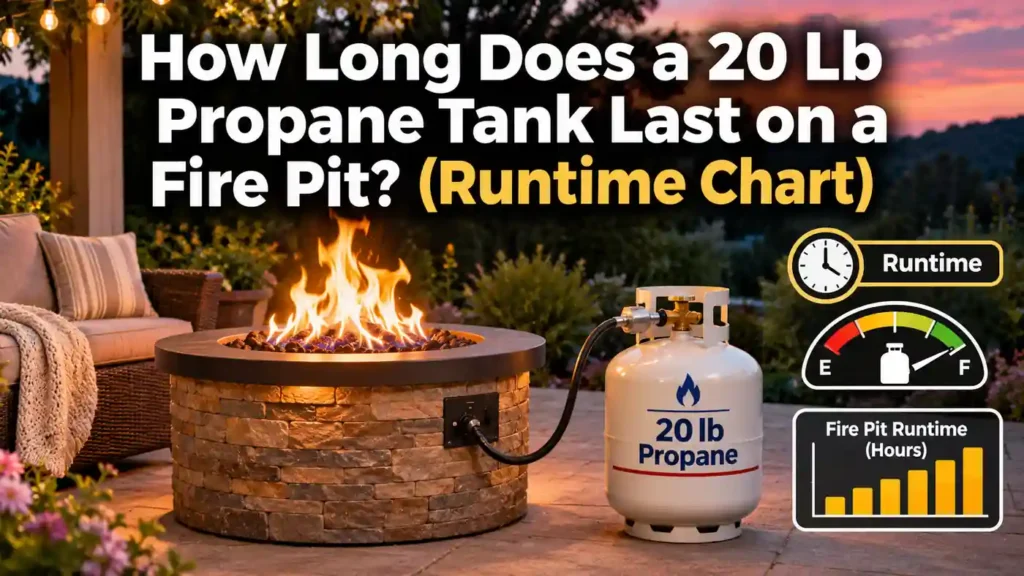
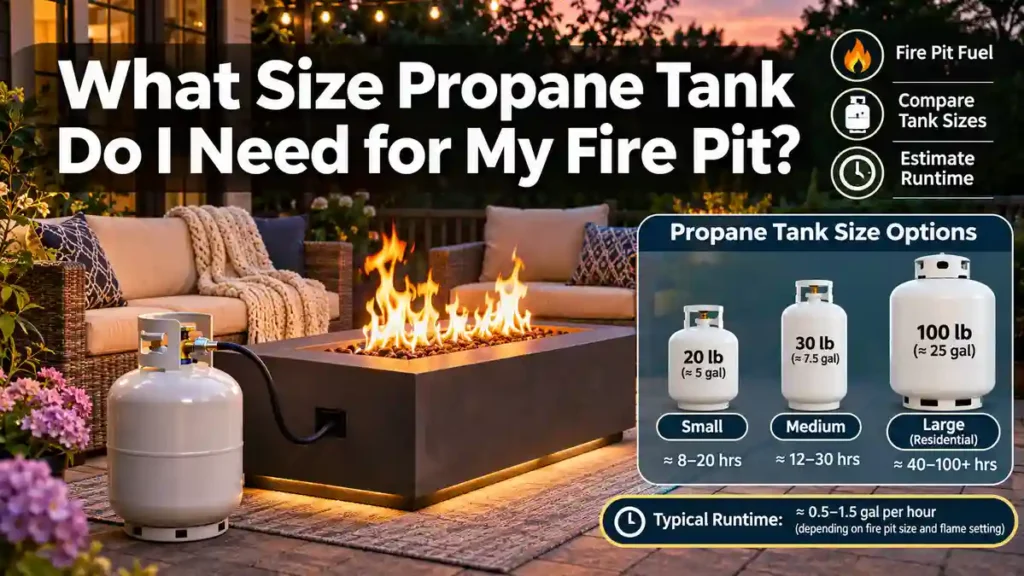
If you are comparing cylinder sizes, see What Size Propane Tank Do I Need for My Fire Pit? and my detailed 20 lb fire pit runtime chart.
Hourly Fuel Cost at Different Propane Prices
| Burner input | Gallons/hour | At $3/gal | At $4/gal | At $5/gal |
|---|---|---|---|---|
| 20,000 BTU/h | 0.219 gal | $0.66 | $0.87 | $1.09 |
| 30,000 BTU/h | 0.328 gal | $0.98 | $1.31 | $1.64 |
| 40,000 BTU/h | 0.437 gal | $1.31 | $1.75 | $2.19 |
| 50,000 BTU/h | 0.546 gal | $1.64 | $2.19 | $2.73 |
| 65,000 BTU/h | 0.710 gal | $2.13 | $2.84 | $3.55 |
| 75,000 BTU/h | 0.820 gal | $2.46 | $3.28 | $4.10 |
| 100,000 BTU/h | 1.093 gal | $3.28 | $4.37 | $5.46 |
Prices are illustrative and are not live quotes. Refilling and cylinder exchange may have different effective costs.
At $4 per gallon, a 50,000-BTU fire pit uses about $2.19 of fuel per hour at full rated input. That is useful for comparing products because the purchase price does not tell you what regular evenings on the patio will cost. When I estimate monthly expenses, I use expected burner hours and the actual retail price paid for my propane rather than the quoted price of the cylinder itself.
Worked Example: Two Evenings With a 50,000-BTU Fire Table
Suppose your fire table is genuinely rated at 50,000 BTU/h on propane and you refill at $4 per gallon. You run it for 2.5 hours on Friday and another 2.5 hours on Saturday. Here is how I would calculate the fuel and weekend cost:
- Hourly consumption: 50,000 ÷ 91,500 = 0.546 gallon per hour.
- Weekend running time: 2.5 + 2.5 = 5 hours.
- Fuel consumed: 5 × 0.546 = approximately 2.73 gallons.
- Weekend fuel expense: 2.73 × $4 = about $10.93.
- Theoretical full-cylinder time: 4.7 gallons ÷ 0.546 = about 8.6 hours with 20 pounds of propane.
Notice that five hours of use already represents well over half a standard cylinder’s nominal propane contents. If you have guests arriving next weekend, that is the kind of information I would use to decide whether a refill is needed. The practical result can be shorter than theory, so I would not plan an event around using every final ounce of fuel.
Monthly Fuel-Cost Scenarios at 50,000 BTU/h and $4/Gallon
| Typical schedule | Hours/month | Propane/month | Cost/month |
|---|---|---|---|
| One 2-hour evening each week | 8.66 h | 4.73 gal | $18.93 |
| Two 2.5-hour evenings each week | 21.65 h | 11.83 gal | $47.32 |
| Three 2-hour evenings each week | 25.98 h | 14.20 gal | $56.79 |
| One 3-hour weekend gathering | 12.99 h | 7.10 gal | $28.39 |
Uses 4.33 weeks per average month and constant full burner input. Your actual bill varies with settings, weather and refill pricing.
I also check whether my propane is purchased by refill or exchange. A cylinder marketed as a standard 20-pound exchange can contain less than 20 pounds of propane, depending on the seller and label. A partial exchange fill means less runtime than a fully filled 20-pound cylinder, even though the outside tanks look alike.
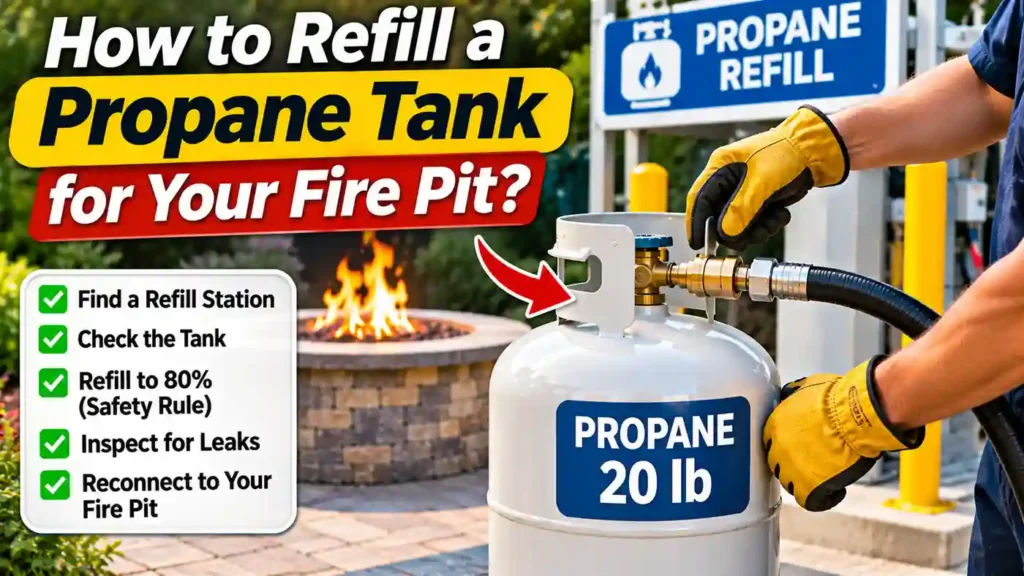
For more help comparing the true fuel cost, read How Much Does It Cost to Run a Propane Fire Pit? and How to Refill a Propane Tank for Your Fire Pit?.
Interactive Propane Fire Pit Runtime and Cost Estimator
You can use this estimator for a fire pit that already has a confirmed approved propane input rating. Enter the actual pounds of propane available, your price per gallon and an optional planning allowance. The result shows fuel use, theoretical runtime and approximate operating expense. This calculator does not determine an orifice size or authorize a gas conversion.
Change any input to update the results. A planning allowance is an illustrative budgeting margin, not a cylinder fill rule.
Calculator not updating in the WordPress preview?
Some WordPress editors or security settings prevent inline JavaScript from running. The published page may still execute it when viewed outside the editor, depending on the configuration. You can always estimate manually: each 10,000 BTU/h burns about 0.109 gallon of propane per hour. Divide your available gallons by hourly consumption to find the theoretical runtime, and multiply by your refill price for cost per hour.
What Happens When You Change Tank Size?
The next table converts a cylinder’s propane contents into gallons and illustrates the theoretical time available. These are fuel-quantity estimates, not a recommendation that every tank can safely supply every burner. A small cylinder may not vaporize fuel fast enough for a large fire pit, especially in low temperatures.
| Propane contents | Approx. gallons | At 30,000 BTU/h | At 50,000 BTU/h |
|---|---|---|---|
| 5 lb | 1.18 gal | 3.6 h | 2.2 h |
| 10 lb | 2.36 gal | 7.2 h | 4.3 h |
| 15 lb | 3.54 gal | 10.8 h | 6.5 h |
| 20 lb | 4.72 gal | 14.4 h | 8.6 h |
| 30 lb | 7.08 gal | 21.6 h | 12.9 h |
| 40 lb | 9.43 gal | 28.8 h | 17.3 h |
Assumes all listed propane can be vaporized and delivered at the required rate. Check the fire pit manual for approved cylinder and supply requirements.
For a 15-pound exchange fill, enter 15 pounds rather than 20 into the calculator. I also recommend reading Can You Use a 15 Lb Propane Tank on a Fire Pit? and What Is the Smallest Propane Tank for a Fire Pit?.
Common Fire Pit Problems That Are Not Necessarily an Orifice Problem
When a flame is weak or uneven, it is tempting to assume the jet is too small. That can be a costly mistake. Pressure, regulator performance, cylinder vaporization, a restriction, wind, burner condition and ignition issues can all affect operation. None of these symptoms justifies drilling or substituting an unapproved orifice.
| Observation | Possible category | My next step |
|---|---|---|
| Weak or shrinking flame | Insufficient supply, low pressure or control fault | Stop experimenting with parts; request professional diagnosis |
| Very large or aggressive flame | Incorrect gas components or excessive pressure | Shut down and have the setup inspected |
| Persistent soot or smoky yellow flame | Combustion or air-supply problem | Stop using the appliance until serviced |
| Flame goes out unpredictably | Ignition, sensor, wind or fuel-flow problem | Check manual stop instructions and arrange service |
| Gas odor or unexplained hiss | Potential gas escape | Leave area; contact gas supplier or emergency services |
| New jet threads in but marking differs | Part compatibility not confirmed | Do not operate until approved part number is verified |
A correctly configured propane fire pit should have stable ignition and performance consistent with the manufacturer’s instructions. If your equipment is aging, see my article on How Long Do Propane Fire Pits Last? for maintenance and replacement considerations.
My Decision Guide: Convert or Replace the Fire Pit?
I decide based on documentation first and price second. A $10 bag of generic orifices is not a bargain if the appliance has no approved LP conversion path. You also need to include professional installation, compatible supply components and any required tests in the overall cost.
| Your situation | My recommendation | Why |
|---|---|---|
| Exact model has an approved NG-to-LP kit | Consider professional conversion | Known parts and prescribed tests |
| Manufacturer sells only a matched LP burner assembly | Compare complete burner replacement | Matched components may simplify the job |
| Label expressly prohibits conversion | Do not convert | No approval for alternate fuel |
| Model plate missing or history uncertain | Do not guess the jet | Correct configuration cannot be verified |
| Only generic online jets are available | Do not select from BTU alone | Thread fit does not establish safe flow |
| Conversion costs nearly as much as a new unit | Compare a factory LP-rated fire pit | May offer clearer documentation and servicing |
I also account for where the cylinder can be stored, whether the enclosure has the proper ventilation and drainage, and whether the equipment will sit under a covering or near combustible materials. A gas conversion is not the only question; the completed outdoor installation must still meet the product instructions and local requirements.
Questions to Ask Before Ordering a Conversion Kit
- Is this specific brand, model and production revision approved for natural-gas-to-propane conversion?
- What is the complete conversion kit part number and what parts does it contain?
- Are new regulator, valve, burner mixer, pilot or ignition components required?
- What are the exact approved LP inlet and manifold pressure specifications?
- Can the intended propane tank or permanent supply deliver the required flow under local conditions?
- Who is qualified to perform the work, and what inspection or documentation is required?
- Will the finished appliance receive updated fuel identification and commissioning records?
These questions are useful even if you never plan to touch the burner yourself. They help a service provider quote the work accurately and show whether a seller is offering the approved parts rather than a vague “universal kit.”
Frequently Asked Questions About Propane Fire Pit Orifices
What size orifice do I need for a 50,000-BTU propane fire pit?
The 50,000-BTU rating alone is not enough to specify a safe orifice diameter. Different burner assemblies can use different pressure, mixing and control arrangements. Check the exact model and order the manufacturer-approved LP orifice or conversion kit.
Is a propane orifice smaller than a natural-gas orifice?
Generally, a comparable LP burner uses a smaller metering opening than an NG version because of differences in fuel properties and operating conditions. This is a general principle, not a usable sizing rule for modifying a jet.
Can I convert a natural-gas fire pit using only an orifice jet?
Some approved conversion kits are relatively simple, but others require changes to air mixing, pilot, regulator or controls. Only the manufacturer’s conversion instructions can tell you what is required for the exact model.
Can I buy a universal propane conversion orifice?
Only if the manufacturer of your specific appliance approves the exact adjustable or universal assembly. A third-party jet described as universal does not automatically meet the burner’s safety or performance requirements.
Should I drill or enlarge a jet to change flame size?
No. That can change gas flow unpredictably and increase the risk of overfiring, soot, poor combustion or unsafe ignition. Have performance problems diagnosed rather than altering the metering opening.
How long will a 20 lb cylinder last at 50,000 BTU?
A full 20-pound propane cylinder contains about 4.7 gallons. At 50,000 BTU/h, theoretical continuous runtime is approximately 8.6 hours. Actual results may be shorter due to operating settings, cylinder contents, temperature and supply limits.
Does a larger orifice always make the flame hotter?
It can increase gas delivery beyond the approved design, which is dangerous rather than a safe performance upgrade. Choose a burner with the rated heat output you need, and never try to increase it through unauthorized modifications.
Can I use a converted propane fire pit inside the house?
No conversion makes an outdoor-only fire pit suitable for indoor use. Follow its rating and installation instructions. See Can You Use a Propane Fire Pit Table Indoors? for the separate safety issues associated with indoor or enclosed spaces.
Final Takeaway: Choose the Approved LP Kit, Not a Guessed Orifice
If you ask me which orifice jets you need for a propane fire pit conversion, my answer begins with the appliance’s exact model and approved LP parts list. There is no honest universal drill-gauge answer for every fire table with a particular BTU rating. The proper jet is one part of a calibrated system involving pressure, burner design, air mixing and safety controls.
I would rather spend time confirming compatibility before ordering than try to correct an unsafe gas train after assembly. If your manufacturer does not offer a permitted conversion, I would compare a matched LP burner or a purpose-built propane fire pit instead.
Once you have a properly commissioned LP system, use the fuel tables and interactive estimator here to budget your actual propane needs. For your next question, I recommend the fire pit pressure guide, the comparison of fire pits versus fire tables, and my propane tank sizing guide. They address the practical questions that an orifice part number cannot answer.

Mike is an experienced propane technician with over 15 years of professional experience in the field. He has dedicated his career to helping customers with their propane needs, from installation to maintenance and repair. Together with Jeremy, he co-founded this website to provide useful information and guidance to customers seeking reliable propane services.