Quick Answer:
A well-maintained propane fire pit can provide many years of service, but there is no universal guaranteed lifespan. For planning, I use approximately 3–7 years for a basic steel unit and 5–10+ years for a well-built, maintained model. These are illustrative budgeting ranges, not manufacturer-tested service lives or promises. The actual result depends on corrosion, climate, usage, materials, safety, and whether compatible replacement parts remain available.
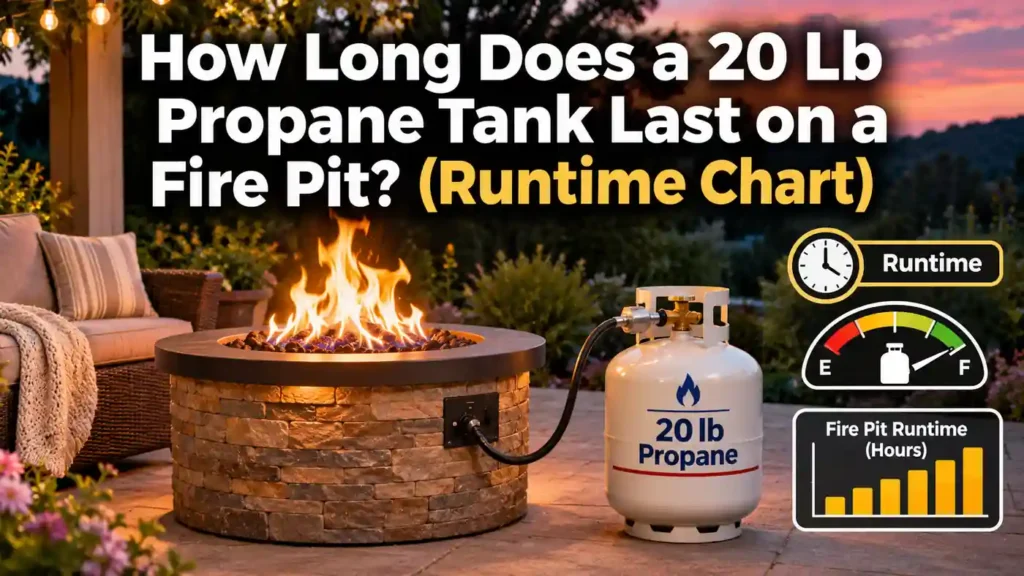
The appliance lifespan is not the same as how long its fuel lasts. A 50,000-BTU/hour fire pit running at full rated input uses roughly 0.546 gallons per hour; a nominal 20-pound fill holding about 4.7 gallons delivers an ideal estimate of 8.6 hours. That tank can be refilled or exchanged many times over the appliance’s service life.
US homeowner guide · Updated November 2026. I explain lifespan through documented maintenance principles, sample financial models and original calculations. I have not conducted an eight-year durability experiment, so I deliberately label projected lifespan as a planning assumption rather than a proven average. Actual manuals and manufacturer support control when an appliance can safely remain in use.
Estimated Lifespan by Propane Fire Pit Type
I separate the expected durability of a basic portable bowl from a premium outdoor table because they have different construction and exposure risks. Nevertheless, two similarly shaped products can last very different lengths of time. Their coating quality, gas components, weather protection and maintenance history matter more than the product category name.
| Fire pit design | Illustrative planning horizon | Typical materials | Main longevity concern |
|---|---|---|---|
| Budget portable bowl | 3–7 years | Painted or powder-coated steel | Coating wear and corrosion |
| Standard steel fire table | 3–8 years | Coated steel cabinet and burner | Seams, hinges and control housing |
| Aluminum-bodied table | 5–10+ years | Aluminum body, mixed-metal components | Fasteners, finish and gas parts |
| Concrete/composite bowl | 5–10+ years | Cast/composite enclosure and metal burner | Cracking, stains and burner service |
| Premium serviced gas feature | 8–15+ years as a budget scenario | Robust enclosure and replaceable listed parts | Service availability and exposure |
| Custom masonry installation | Project-specific; masonry may outlast burner | Masonry enclosure and approved gas burner | Separate service life for piping/burner |
Important: The ranges are not survey statistics and should not be interpreted as verified averages for specific brands. A cheaply constructed table might fail sooner; a protected and repairable steel bowl could exceed the range. A masonry surround lasting many years does not mean its ignition system or burner can safely operate indefinitely without inspection or repair.
Fire Pit Lifespan vs. Propane Tank Runtime
People asking “How long does a propane fire pit last?” can be asking two different questions. The first is how many years the fire pit itself remains safe and useful. The second is how many hours it can operate before the cylinder needs more propane. I would answer both, but I would never mix them up when planning a purchase.
| Question | Measurement | What determines the answer |
|---|---|---|
| How long does the appliance last? | Years or burner-use hours | Materials, maintenance, environment, repairs |
| How long does one propane fill last? | Hours at a stated BTU rate | Available propane and actual gas consumption |
| How long does an ignition component last? | Cycles or elapsed years | Part quality, weather and service conditions |
| How long does an enclosure last? | Years | Corrosion protection, cracking, drainage |
| How many refills are needed per season? | Gallons or cylinders | Seasonal use hours and burner setting |
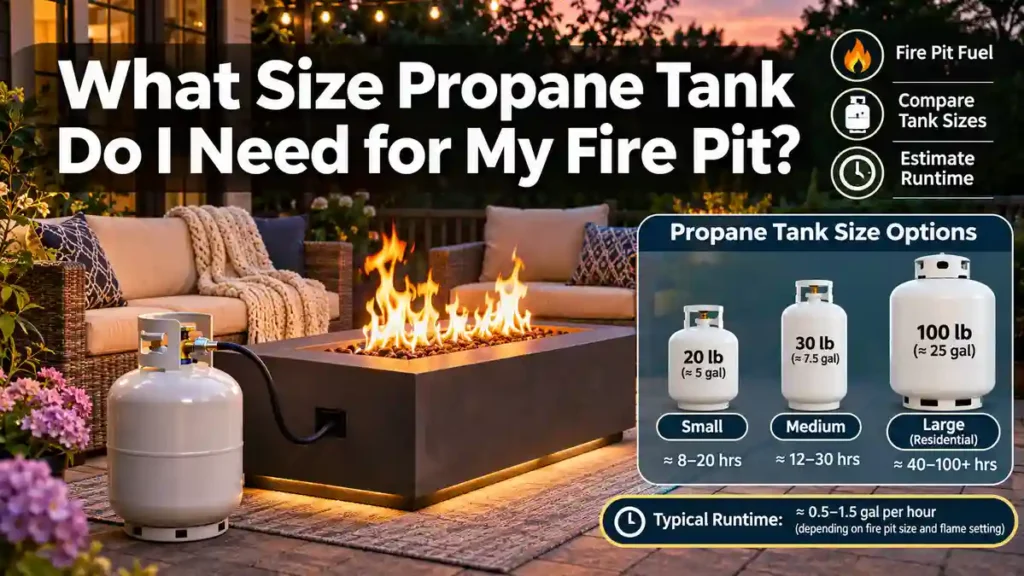
For detailed fuel calculations rather than service-life estimates, see my 20-lb tank runtime chart. For the right cylinder arrangement, use my tank-size guide. A cylinder’s recertification or requalification requirements are also separate from appliance lifespan and depend on the cylinder and jurisdiction.


Which Fire Pit Materials Last the Longest?
When I compare products, I examine the enclosure, burner, controls, and hardware separately. A “concrete” fire pit may still depend on a steel burner and an exposed igniter. An “aluminum” table might have ordinary steel hinges or brackets. The material in the marketing title is only one part of the durability picture.
| Component/material | Potential advantage | What can shorten service life | My inspection priority |
|---|---|---|---|
| Powder-coated steel body | Affordable and structurally practical | Scratched coating, standing water, salt exposure | Welds, corners, seams and rust |
| Aluminum body | Usually resistant to red rust | Coating deterioration, mixed-metal corrosion | Joints, hardware, stiffness |
| Stainless-steel burner | Can offer good corrosion resistance | Debris, unsuitable cleaning, aggressive environment | Ports, secure mounting, approved condition |
| Concrete/composite enclosure | Heavy architectural appearance | Chips, cracks, freeze/thaw, stains | Surface and manufacturer care instructions |
| Painted steel cabinet door | Easy access to fuel controls | Hinge rust and loose fittings | Door latch, alignment and ventilation |
| Electronic ignition | Convenient operation | Water ingress, connections, component failure | Function and approved replacement parts |
| Hose/regulator assembly | Supplies controlled fuel | UV, abrasion, physical damage, aging | Manual inspection and replacement instructions |
My preference in a rainy or coastal environment is to evaluate corrosion protection and drainage before aesthetics. Stainless steel resists many forms of corrosion but is not universally immune; alloy grade and conditions matter. Concrete may avoid metal-shell rust but can still crack. I would not assume that heavier equals better or that an expensive finish makes the underlying gas system safer.
For a closer comparison of furniture-like structures and portable designs, see fire pit versus fire table comparison. For a specific marketplace example, I also developed Wayfair fire pit quality guide, focused on materials, warranties and model-by-model evaluation.
Five Environmental Factors That Shorten Fire Pit Life
- Rain and trapped moisture: Water standing in seams or inside the cabinet can corrode fasteners and accelerate finish deterioration.
- Salt air: Outdoor manuals commonly recommend more frequent inspection in corrosive environments. A metal component that fares well inland may weather differently near the ocean.
- Freeze–thaw cycles: Some decorative surfaces are vulnerable when retained moisture freezes. Follow the manufacturer’s cold-weather care guidance.
- Sun and temperature cycling: Coatings and decorative finishes can fade or develop wear through prolonged exposure.
- Dust, insects and debris: Obstructed burner areas or air passages can cause unsafe operation and lead to service issues.
Manufacturer instructions commonly emphasize cooling before cleaning, keeping burner and venturi passages unobstructed, and inspecting for corrosion or damage. I would follow those instructions rather than using a generic do-it-yourself method on all burners. The precise cleaning process varies across products.
Seven Signs Your Propane Fire Pit May Be Nearing the End of Its Service Life
Aging does not always mean replacing the entire appliance. But I would stop using a unit as soon as there is evidence of an unsafe condition, and I would not assume a visible defect is cosmetic until it has been appropriately evaluated.



- Deep or structural rust: Severe corrosion in supports, burner parts or cylinder-holding components is more serious than light surface discoloration.
- Cracked structural enclosure: A crack near the burner or support points may need professional evaluation.
- Visible hose deterioration: Cracks, abrasion, kinks or questionable fittings are reasons to stop and use approved replacement procedures.
- Persistent ignition problems: Repeated failure to light should not be “fixed” by bypassing manufacturer safety controls.
- Abnormal flame pattern: Sudden changes, unusual soot or suspected air blockage require inspection rather than repeated operation.
- Loose burner/control mounting: Mechanical deterioration affects more than appearance.
- Unavailable approved repair parts: If a critical failed component has no approved replacement, continued operation may not be reasonable.
My propane fire pit safety guide covers normal precautions, placement and warning signs in more detail.
Maintenance Schedule: What I Would Check and When
I use a practical schedule as a reminder, not a substitute for a product manual. Some manufacturers may require more frequent checks or a specific service interval. If the fire pit is exposed to severe weather, salt or heavy use, I would inspect it more often.
| When | Suggested owner check | What I would do if something is wrong |
|---|---|---|
| Before each use | Look for damage, debris, blocked ventilation and obvious hose issues | Do not ignite until corrected |
| After each use | Shut down correctly, allow complete cooling, remove obvious dirt as specified | Follow the manual before covering |
| Monthly during use | Inspect exposed coating, screws, doors and drainage | Correct approved cosmetic issues or seek service |
| Beginning of season | Thorough visual inspection and prescribed gas-connection checks | Service damaged components |
| Before long-term storage | Clean and dry body, disconnect fuel as instructed | Store cylinder upright in an approved outdoor place |
| After severe storms | Check for standing water, impact, movement and burner contamination | Do not operate if damage is suspected |
For me, the best habit is to pair an inspection with the first use of the month. I inspect surfaces after cooling and before cleaning the burner. I only use the cleaning tools or procedures described in the specific manual; some product instructions differ on whether burner ports may be brushed, oiled, or serviced by the owner.
If the appliance is stored inside for the off-season and the manual permits that, disconnect the propane cylinder and store it outdoors in a suitable well-ventilated location. Do not store the cylinder indoors, in a garage or inside the house. This helps separate indoor appliance storage from safe propane storage.


How Many Gallons of Propane Does a Fire Pit Use?
Lifespan and gas consumption are different measurements, but fuel use helps me understand what a fire pit costs throughout its useful life. Propane contains approximately 91,500 BTU per US gallon. Thus, a rated 50,000-BTU/hour fire pit would theoretically use 50,000 ÷ 91,500 = 0.546 gallons per hour at maximum input.
| Rated BTU/hour | Propane gallons/hour | Ideal hours from 4.7 gallons | Hourly cost at $4/gal |
|---|---|---|---|
| 15,000 | 0.164 | 28.7 | $0.66 |
| 20,000 | 0.219 | 21.5 | $0.87 |
| 30,000 | 0.328 | 14.3 | $1.31 |
| 40,000 | 0.437 | 10.8 | $1.75 |
| 50,000 | 0.546 | 8.6 | $2.19 |
| 60,000 | 0.656 | 7.2 | $2.62 |
| 75,000 | 0.820 | 5.7 | $3.28 |
The 4.7-gallon value is an approximation for a nominally full 20-pound propane fill; it is not the internal water capacity of the cylinder. The estimate assumes continuous rated input and ideal conditions. Actual runtime varies by burner settings, available fuel and conditions. See 20-lb tank runtime chart for the more detailed fuel-use guide.
Fuel Cost Scenarios Across a Fire Pit’s Lifetime
I do not want a durability guide to make fuel seem like a minor afterthought. Even when the appliance itself is affordable, years of regular use can make the propane bill substantial. The following are planning scenarios using $3, $4 and $5 per gallon, not verified current prices at one particular retailer.
| BTU/hour | Hourly at $3/gal | Hourly at $4/gal | Hourly at $5/gal | Yearly fuel at 3 hr/week, $4/gal |
|---|---|---|---|---|
| 20,000 | $0.66 | $0.87 | $1.09 | $136.39 |
| 30,000 | $0.98 | $1.31 | $1.64 | $204.59 |
| 40,000 | $1.31 | $1.75 | $2.19 | $272.79 |
| 50,000 | $1.64 | $2.19 | $2.73 | $340.98 |
| 60,000 | $1.97 | $2.62 | $3.28 | $409.18 |
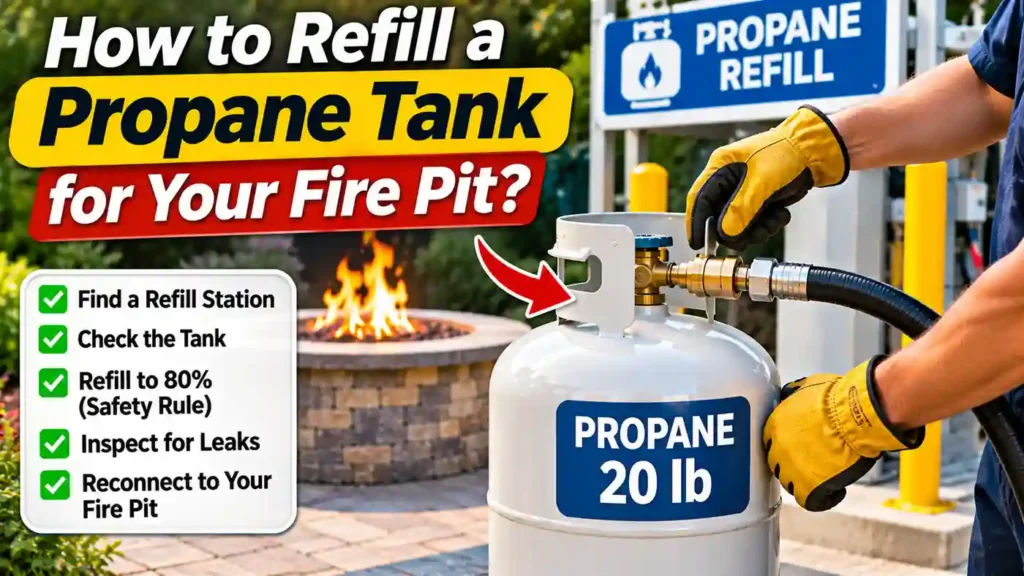
All annual scenarios use 156 burner-hours, or three hours a week for 52 weeks, at steady rated input. Your actual annual total can be lower if you rarely operate the fire pit at maximum or use it only seasonally. It can be higher if propane costs more or you entertain frequently. Compare supplier charges in the propane refill guide and explore more scenarios in hourly and monthly operating costs.
Interactive Propane Fire Pit Runtime and Ownership Calculator
Enter your fire pit’s rated or measured BTU/hour, available gallons, local propane price, weekly use and estimated years of service. This separates fuel runtime from projected lifetime ownership costs, which I find more helpful than a single lifespan number.
The output uses 91,500 BTU/gal and 52 weeks/year, assumes constant burner input and fuel price, and excludes repairs, taxes, cylinder fees and fuel remaining at retirement. It does not predict actual appliance lifespan.
The practical limit is that no simple calculator knows your future maintenance history or corrosion exposure. I would start with a conservative service-life assumption and revise it as I gain actual ownership experience. Entering 10 years is a budget scenario, not a statement that a fire pit is certified for ten years of safe use.
Worked Example: How Much Does a Fire Pit Cost Across Seven Years?
Imagine I buy a propane fire table for $400 and spend another $50 on appropriate nonfuel accessories, giving me $450 in starting costs. It is rated at 50,000 BTU/hour, and I use it for three hours a week at an assumed $4 per gallon. I choose a seven-year planning horizon because I want to know whether a cheaper model is a false economy. I do not claim it will actually last seven years.
- Hourly fuel use: 50,000 ÷ 91,500 = 0.54645 gallons/hour.
- Annual running time: 3 hours/week × 52 weeks = 156 hours.
- Annual fuel: 0.54645 × 156 = 85.25 gallons.
- Annual fuel cost: 85.25 × $4 ≈ $340.98.
- Seven-year fuel cost: approximately $2,386.89.
- Seven-year fuel plus initial nonfuel purchase: approximately $2,836.89, before any maintenance, repairs, delivery charges or taxes.
What jumps out at me is that fuel over seven years exceeds the $450 purchase by more than five times in this example. That does not mean I should buy the cheapest burner. It means purchase price is only one piece of long-run value. If a higher-quality appliance costs $200 extra but is safer to maintain and supported with approved parts, I would consider that premium in context rather than treating it as an unnecessary expense.
Cost Per Year of Ownership: Three Illustrative Lifespans
I use depreciation as a comparison tool rather than a claim about resale value. Divide equipment cost by expected years in service to get a simple annual ownership allowance. This does not include fuel, maintenance or changes in money value, but it helps compare a short-lived bargain against a better-built unit.
| Example unit | Initial nonfuel cost | Assumed lifespan | Equipment cost per year | Equipment cost per 100 use hours at 150 hr/year |
|---|---|---|---|---|
| Budget steel bowl | $180 | 3 years | $60 | $40.00 |
| Midrange fire table | $450 | 7 years | $64.29 | $42.86 |
| Premium serviced unit | $1,000 | 12 years | $83.33 | $55.56 |
The premium model still costs more per year in this particular illustration. That is not necessarily a reason to avoid it: you might prefer its design, replaceable parts or customer support. On the other hand, longevity only creates economic value when you actually use the product long enough to benefit. A $1,000 unit stored unused for years is not a bargain merely because it still looks good.
Should You Repair or Replace an Old Propane Fire Pit?
I make this decision in two stages. First: can it be made safe using the manufacturer’s approved parts and procedures? Second: if so, does the repair make financial sense? A cheap repair is not acceptable when structural damage or gas-control uncertainty remains.
| Observed problem | My first decision | Likely next step |
|---|---|---|
| Minor surface dirt/discoloration | Maintain if manual permits | Clean and inspect |
| Small cosmetic paint damage | Assess manufacturer’s permitted treatment | Avoid touching gas parts |
| Failed ignition battery | Check manufacturer instructions | Replace only as permitted |
| Damaged approved hose/regulator | Stop using | Replace with manufacturer-approved assembly |
| Burner rust or obstructed gas passages | Stop and inspect professionally as needed | Manufacturer-authorized service |
| Structural rust, unstable frame or severe cracks | Do not use | Evaluate replacement |
| Gas smell, leak or damaged valve | Stop, leave danger area | Qualified service/emergency response |
| Essential safety part no longer available | Do not improvise | Replace the appliance |
My rule is to prioritize safety and parts support over the sunk cost of the original appliance. A $50 repair on a $500 fire pit is attractive only if it fully addresses the problem using approved components. When the burner assembly is incompatible with available parts, or the body has become structurally unsafe, replacing the entire unit may be wiser.
How to Choose a Fire Pit That Has a Better Chance of Lasting
I would examine the manual, warranty and replacement-parts pathway before checkout. An impressive photo gives little evidence about weatherproofing, while a specific warranty document and serviceable burner tell me much more about the ownership experience.
- Confirm that the model is listed or certified as appropriate for its intended propane outdoor use.
- Read the manual for minimum clearances and cylinder placement, rather than assuming the design will fit.
- Inspect material descriptions for the enclosure, burner and fittings—not just the top finish.
- Look for detailed owner reports after more than one outdoor season.
- Check whether the exact approved ignition parts, hose and regulator remain obtainable.
- Read exclusions in the warranty: corrosion, normal wear and weather damage may be excluded.
- Estimate full first-year cost using propane fire pit purchase-cost guide instead of considering the sale price alone.
I would also be wary of a vague claim such as “built to last a lifetime” when it is not accompanied by specific evidence. A warranty period, a manufacturer’s recommended maintenance schedule and credible multi-season customer experience are more informative than a marketing slogan.
My Original Fire Pit Longevity Scorecard
For a quick screening, I use six criteria with a score of zero, one or two points each. This is a personal buying framework, not a standardized safety rating. A poor score does not prove imminent failure, and a high score cannot establish safety where mandatory documentation is missing.
| Criterion | 0 points | 1 point | 2 points |
|---|---|---|---|
| Material and coating | Unclear | Basic documented construction | Clearly specified corrosion-aware design |
| Water and drainage design | Unclear or concerning | Some protection | Documented appropriate drainage/cover |
| Burner access | Hard to inspect | Somewhat serviceable | Accessible per manual |
| Approved parts availability | No clear path | Seller inquiry needed | Documented service parts/support |
| Warranty clarity | Missing or very vague | Short or limited | Clear useful terms |
| Multi-season review evidence | Recurring unresolved issues | Mixed/limited evidence | Credible durable-use reports |
Out of 12, I treat 10–12 as promising, 7–9 as worth further research, and 6 or below as a prompt for caution. Regardless of the number, I would not buy a gas appliance without appropriate certification and instructions or operate a unit with unresolved safety defects.
Does Location Change How Long a Fire Pit Lasts?
Yes, potentially. I would expect material and maintenance choices to matter differently near the ocean, in a cold-winter climate and in a dry sheltered backyard. That is not a precise equation for lifespan, but it is an important ownership variable. Manufacturers warn about rust pitting, moisture and component condition, and some specifically call for closer inspection in salt-air environments.
| Environment | Primary concern | My practical emphasis |
|---|---|---|
| Coastal or salt air | Accelerated corrosion | Inspect all metal, especially mixed-metal joints |
| Wet, humid climate | Persistent moisture | Proper drying, cover and drainage |
| Cold freeze–thaw climate | Surface cracking and weather damage | Follow seasonal storage instructions |
| Dusty/windy area | Burner debris and wind disturbance | Inspect air passages and use within operating limits |
| Sheltered but outdoor patio | Lower direct exposure, not zero risk | Routine inspection and ventilation |
| Year-round heavy use | More ignition and thermal cycles | Document service and wear |
A sheltered location does not mean indoor use is safe. An appliance designed for outdoors cannot be moved into an enclosed garage, tent or room for protection while operating. If you want to extend the life of a portable unit through indoor storage, follow the product’s storage directions and keep the disconnected propane cylinder outdoors where permitted.
Frequently Asked Questions
Do propane fire pits wear out?
Yes. Materials and components can deteriorate through corrosion, heat cycles, weather, impact and ordinary wear. But routine inspection and suitable care can help prevent avoidable damage, and some components can be replaced using approved parts.
Can a propane fire pit last 10 years?
It is possible for some well-built, maintained units, but I cannot promise it. A ten-year timeline should be treated as a planning assumption unless a manufacturer provides a specific service-life statement. Regular inspections are still necessary.
What part usually fails first?
There is no universal first-failure part. Depending on design and exposure, owners may encounter ignition problems, corroded fasteners, hose damage, damaged finishes or burner issues. I would check the complete system rather than attributing every lighting problem to the igniter.
Does leaving a propane fire pit outdoors shorten its life?
Outdoor exposure can accelerate rust, coating wear and some surface damage. Use any approved cover or storage method recommended by the manufacturer, but wait until the appliance has fully cooled and do not obstruct necessary airflow while operating.
How many hours will a 20-lb propane tank last?
At a steady 50,000 BTU/hour, around 8.6 ideal hours from roughly 4.7 gallons. At 40,000 BTU/hour, around 10.8 hours. For a broader table, see 20-lb tank runtime chart.
Does a more expensive propane fire pit last longer?
Not necessarily. A higher price may reflect design, shipping weight or decorative finishes rather than stronger construction. I would assess materials, quality controls, approved parts, warranty terms and long-term feedback.
Should I replace a rusty propane fire pit?
It depends on the location and severity of corrosion. Structural rust, burner damage or compromised cylinder support deserves serious attention; do not operate until a qualified assessment confirms safe repair or replacement. Light cosmetic corrosion may have an approved treatment in the manufacturer’s instructions.
Can I change the burner to extend its life?
Only with a compatible, manufacturer-approved burner or conversion procedure as applicable. Never alter gas orifices, bypass safety controls or build an improvised gas system as a shortcut.
How do I know whether it is worth repairing?
Start with safety and availability of exact approved replacement components. Then compare the complete repair expense with the cost of a suitable new appliance. If an important safety component cannot be repaired correctly, choose replacement over improvisation.
Do fire tables last longer than fire bowls?
No automatic advantage exists. A fire table may have more enclosure components while a bowl may be more directly exposed. Material quality, weather protection, actual use and serviceability decide much more than the silhouette. See fire pit versus fire table comparison.
Bottom Line: How Long Should Your Propane Fire Pit Last?
I would plan for several years of service without assuming a fixed expiration date. Budget ranges of 3–7 years for basic steel units and 5–10+ years for better-built, maintained models can help evaluate ownership costs, but they are not verified industry averages. The correct safety decision comes from the product’s real condition, manufacturer directions and available qualified repair support.
If I were buying today, I would prioritize corrosion-resistant construction suited to my climate, clear instructions, a sensible cover or storage plan, and a real replacement-parts pathway. Then I would calculate yearly fuel costs so that a cheap purchase does not distract me from the full cost of use. To continue, read propane fire pit purchase-cost guide, hourly and monthly operating costs, propane fire pit safety guide and tank-size guide.

Mike is an experienced propane technician with over 15 years of professional experience in the field. He has dedicated his career to helping customers with their propane needs, from installation to maintenance and repair. Together with Jeremy, he co-founded this website to provide useful information and guidance to customers seeking reliable propane services.