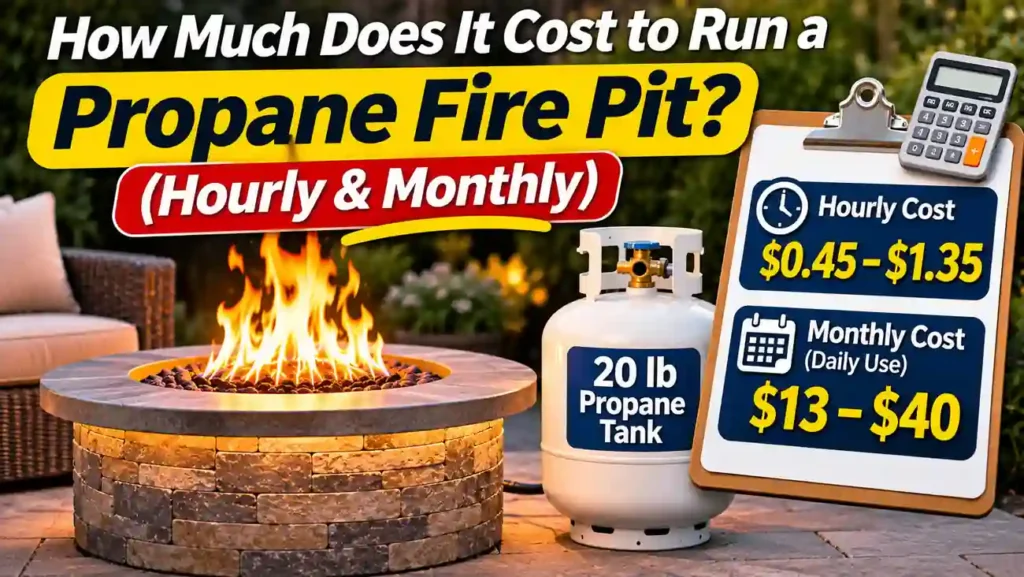
How much does it cost to run a propane fire pit? I like to start with the fire pit’s actual BTU-per-hour rating instead of its advertised size. A 50,000 BTU/hour fire table can cost about $1.64 to $2.73 per hour when propane costs $3–$5 per gallon. Your real bill depends on how long the burner is on, the actual propane price, and how much fuel was delivered in a refill or exchange.
Quick Answer
At a sample price of $4 per gallon, a propane fire pit costs approximately $2.19 per hour at 50,000 BTU/hour, or $34.97 per month when used for two hours twice a week (16 hours across four weeks). Four three-hour sessions cost about $26.23. A full 20 lb cylinder holds approximately 4.7 gallons, enough for roughly 8.6 hours at this burner input. These are illustrative costs, not current retailer quotes. The charts below show how to substitute your own fuel price and schedule.
Propane Fire Pit Cost per Hour: Quick Reference Chart
The first table translates BTU input into propane gallons burned each hour. I use approximately 91,500 BTU per gallon, a rounded reference value. This lets you calculate costs independently of a specific brand. Remember that the rating is usually maximum input; running at a lower verified input can reduce fuel use.


| Fire Pit Input | Propane Used per Hour | At $3/gal | At $4/gal | At $5/gal |
|---|---|---|---|---|
| 20,000 BTU/h | 0.219 gal | $0.66 | $0.87 | $1.09 |
| 30,000 BTU/h | 0.328 gal | $0.98 | $1.31 | $1.64 |
| 40,000 BTU/h | 0.437 gal | $1.31 | $1.75 | $2.19 |
| 50,000 BTU/h | 0.546 gal | $1.64 | $2.19 | $2.73 |
| 60,000 BTU/h | 0.656 gal | $1.97 | $2.62 | $3.28 |
| 75,000 BTU/h | 0.820 gal | $2.46 | $3.28 | $4.10 |
| 80,000 BTU/h | 0.874 gal | $2.62 | $3.50 | $4.37 |
| 100,000 BTU/h | 1.093 gal | $3.28 | $4.37 | $5.46 |
For a quick estimate, pick the row nearest your manufacturer’s rated input and multiply the hourly cost by your expected burning hours. If your fire pit is labeled 55,000 BTU/hour, calculate directly using the formula below rather than choosing a lower rating simply because its cost looks more attractive.
These numbers represent fuel only. They do not include buying the fire pit, purchasing a cylinder, maintenance, delivery, taxes, exchange markups or the cost of driving to a refill station. Keeping those categories separate makes the operating-cost comparison more transparent.
What Determines the Cost to Run a Propane Fire Pit?
1. The BTU-per-hour rating
BTU is a unit of energy. A fire pit labeled 50,000 BTU/hour can consume fuel energy at that rate when operating at the rated setting. More input generally means more propane consumed per hour. Two fire tables of similar width may have different burner ratings, so I would not use their dimensions to estimate fuel cost.
2. The price you actually pay per gallon
A $4-per-gallon refill costs less per unit of fuel than a $24 exchange containing 15 pounds of propane. The sticker price alone can hide the amount purchased. When I compare sellers, I convert each receipt into dollars per actual pound or gallon, then calculate the effective cost per hour at a known BTU input.


3. How long the burner stays on
If you light the fire pit 30 minutes before guests arrive and let it run another hour after dinner, include those periods. For monthly budgets, count all operating hours—not merely the hours when people are sitting beside it. I would rather budget slightly high than claim a misleadingly low monthly cost.
4. The flame setting and outdoor conditions
A lower flame often means a lower gas flow, but the middle position on a control knob does not necessarily mean exactly half the maximum input. Wind can also make you turn the flame up to feel warmer. Instead of assuming every medium setting saves 50%, use the manufacturer’s specifications or your measured fuel consumption.
5. The amount of propane in the cylinder
A standard 20 lb cylinder can contain approximately 20 pounds of propane when filled to its nominal capacity; a common retail exchange may supply only 15 pounds. An exchange with less fuel does not make a burner more expensive per BTU by itself, but a higher per-unit fuel price often does. I explain the different amounts in Can You Use a 15 Lb Propane Tank on a Fire Pit?.
How I Calculate Propane Fire Pit Fuel Cost
Gallons per hour = fire pit BTU/hour ÷ 91,500.
Cost per hour = gallons per hour × propane price per gallon.

Monthly fuel cost = cost per hour × hours per session × sessions per month.
These formulas are deliberately simple because they let you update the estimate when propane prices change. If you pay by the pound instead, divide the burner rating by approximately 21,500 BTU per pound, then multiply the resulting pounds per hour by your net price per pound.
Worked Example: A 50,000 BTU Fire Pit Running Four Evenings
Imagine your fire table has a rated input of 50,000 BTU/hour. You light it for three hours every Saturday and use it four Saturdays per month. Let’s assume your refill provider charges $4 per gallon, including no additional fixed fee. I would calculate the monthly bill from the actual operating time rather than try to infer it from the number of propane tanks purchased.
| Calculation | Formula | Result |
|---|---|---|
| Fuel burned per hour | 50,000 ÷ 91,500 | 0.546 gallon |
| Hours per month | 3 × 4 | 12 hours |
| Monthly gallons | 0.546 × 12 | 6.56 gallons |
| Monthly fuel cost | 6.56 × $4 | $26.23 |
| Equivalent 20 lb full fills | 6.56 ÷ 4.70 | About 1.40 fills |
A three-hour session costs approximately $6.56. Across four sessions, the fuel cost is about $26.23. Since a full 20 lb cylinder contains roughly 4.7 gallons, you would consume more than one cylinder’s nominal fuel over that month. A full cylinder plus an appropriate spare or an additional refill would be sensible planning, provided the fire pit’s approved configuration is followed.


The important detail is that monthly spending is driven by the total gallons burned. Whether you buy a full cylinder once and a small top-off later, or purchase several exchange cylinders, the physical fuel requirement is broadly the same at the same burner input. What changes is the effective price you pay for that fuel.
Monthly Propane Fire Pit Cost by Use Frequency
For an easier decision, I group usage into occasional, weekend and frequent patterns. The next chart assumes a 50,000 BTU/hour fire pit running at its rated input and propane at a hypothetical $4 per gallon. Actual monthly frequency can vary; the table uses fixed session counts so you can compare the scenarios fairly.
| Use Pattern | Sessions per Month | Hours Each Session | Total Hours | Estimated Monthly Cost |
|---|---|---|---|---|
| Occasional | 2 | 2 | 4 | $8.74 |
| Two evenings weekly | 8 | 2 | 16 | $34.97 |
| Weekly long evenings | 4 | 4 | 16 | $34.97 |
| Three evenings weekly | 12 | 3 | 36 | $78.69 |
| Daily short ambience | 30 | 1 | 30 | $65.57 |
| Frequent long gatherings | 20 | 4 | 80 | $174.86 |
What stands out to me is that two very different habits can produce the same bill. Eight short sessions of two hours consume the same theoretical amount as four sessions of four hours, assuming identical input. The calendar frequency matters less than the total hours of flame time.
For a simple household budget, I would set a monthly spending allowance and work backward to the maximum burning hours it supports. At a budget of $40, $4-per-gallon propane and 50,000 BTU/hour input, the mathematical allowance is about 18.3 hours before other costs. That becomes an easy guide for choosing which evenings to use the fire pit.
Interactive Monthly Cost Scenarios
Open a scenario matching your appliance to see how different schedules affect fuel cost. These expandable, mobile-friendly sections let readers compare several input ratings without loading additional scripts. They use $4 per gallon as the default illustration and assume continuous operation at rated input. For a different propane price, multiply the displayed amount by your own dollars-per-gallon price divided by four.
30,000 BTU/hour — expand monthly fuel scenarios
| Monthly Hours | Gallons Used | Cost at $4/gal | 20 lb Tank Equivalents |
|---|---|---|---|
| 4 | 1.31 | $5.25 | 0.28 |
| 8 | 2.62 | $10.49 | 0.56 |
| 12 | 3.93 | $15.74 | 0.84 |
| 16 | 5.25 | $20.98 | 1.12 |
| 24 | 7.87 | $31.48 | 1.67 |
| 40 | 13.11 | $52.46 | 2.79 |
40,000 BTU/hour — expand monthly fuel scenarios
| Monthly Hours | Gallons Used | Cost at $4/gal | 20 lb Tank Equivalents |
|---|---|---|---|
| 4 | 1.75 | $6.99 | 0.37 |
| 8 | 3.50 | $13.99 | 0.74 |
| 12 | 5.25 | $20.98 | 1.12 |
| 16 | 6.99 | $27.98 | 1.49 |
| 24 | 10.49 | $41.97 | 2.23 |
| 40 | 17.49 | $69.95 | 3.72 |
50,000 BTU/hour — expand monthly fuel scenarios
| Monthly Hours | Gallons Used | Cost at $4/gal | 20 lb Tank Equivalents |
|---|---|---|---|
| 4 | 2.19 | $8.74 | 0.47 |
| 8 | 4.37 | $17.49 | 0.93 |
| 12 | 6.56 | $26.23 | 1.40 |
| 16 | 8.74 | $34.97 | 1.86 |
| 24 | 13.11 | $52.46 | 2.79 |
| 40 | 21.86 | $87.43 | 4.65 |
60,000 BTU/hour — expand monthly fuel scenarios
| Monthly Hours | Gallons Used | Cost at $4/gal | 20 lb Tank Equivalents |
|---|---|---|---|
| 4 | 2.62 | $10.49 | 0.56 |
| 8 | 5.25 | $20.98 | 1.12 |
| 12 | 7.87 | $31.48 | 1.67 |
| 16 | 10.49 | $41.97 | 2.23 |
| 24 | 15.74 | $62.95 | 3.35 |
| 40 | 26.23 | $104.92 | 5.58 |
75,000 BTU/hour — expand monthly fuel scenarios
| Monthly Hours | Gallons Used | Cost at $4/gal | 20 lb Tank Equivalents |
|---|---|---|---|
| 4 | 3.28 | $13.11 | 0.70 |
| 8 | 6.56 | $26.23 | 1.40 |
| 12 | 9.84 | $39.34 | 2.09 |
| 16 | 13.11 | $52.46 | 2.79 |
| 24 | 19.67 | $78.69 | 4.19 |
| 40 | 32.79 | $131.15 | 6.98 |
If you are deciding whether to run the fire pit on low, treat the published examples as upper-setting baselines. A manufacturer-specified lower input can be substituted for the rated number. I would not promote a universal medium-flame savings percentage because valve behavior and burner design differ.
Can You Get a True Custom Calculator Without Installing a Plugin?
For a custom number, take the BTU rating on your appliance, divide by 91,500, multiply by the hours you expect to operate it, and then multiply by your actual propane price. That same sequence works for a daily, weekly or monthly estimate. I’ve kept the page’s expandable scenario controls functional without making the numbers depend on JavaScript that a WordPress editor or security filter might strip.
A more sophisticated live-input calculator can be implemented separately as a reviewed site component. Until then, the expandable tables and worked formula provide a dependable on-page way to evaluate realistic choices without implying that an untested script is running.
How Much Does a 20 Lb Propane Tank Cost to Burn Through?
A properly full standard 20 lb cylinder contains around 4.7 gallons of propane. At an illustrative price of $4 per gallon, that fuel is worth about $18.80. A 50,000 BTU/hour fire pit could theoretically burn it in about 8.6 hours at full input. Therefore the fuel cost per operating hour remains near $2.19, as our earlier formula showed.
| Fuel Supply | Approx. Propane Gallons | Theoretical Runtime at 50k BTU/h | Fuel Value at $4/gal |
|---|---|---|---|
| 5 lb remaining | 1.18 | 2.15 h | $4.72 |
| 10 lb remaining | 2.36 | 4.30 h | $9.44 |
| 15 lb exchange fill | 3.54 | 6.45 h | $14.16 |
| 20 lb full cylinder | 4.72 | 8.60 h | $18.88 |
The table compares the theoretical value of liquid propane at the same per-gallon rate, not a quote for buying those quantities from any particular store. If you pay for an exchange service, the charge includes whatever convenience and handling markup the seller uses; the effective fuel price may be substantially different.
For more context on why the same cylinder can deliver different burn hours, read How Long Does a 20 Lb Propane Tank Last on a Fire Pit? (Runtime Chart). That article explores fuel quantities, higher-output burners and the difference between calculated and real-world operating time.
Refill vs Exchange: Which Costs Less per Hour?
The biggest avoidable budgeting mistake I see is comparing a full refill and an exchange by the total ticket price alone. What matters is how much propane you receive. A cylinder sold in a 20 lb exchange program may contain 15 lb net propane. A full 20 lb refill has about one-third more fuel than a 15 lb fill, so make sure to normalize the comparison.
| Hypothetical Purchase | Propane Delivered | Total Charge | Cost per lb | Operating Cost/hour at 50k BTU/h |
|---|---|---|---|---|
| Exchange A | 15 lb | $24 | $1.60 | $3.72 |
| Exchange B | 15 lb | $28 | $1.87 | $4.34 |
| Refill A | 20 lb | $20 | $1.00 | $2.33 |
| Refill B | 20 lb | $25 | $1.25 | $2.91 |
These figures include the illustrated transaction charge as fuel cost for comparison. The operating cost per hour comes from roughly 2.326 pounds consumed per hour at 50,000 BTU/hour. The results are estimates; if the tank is not completely burned through or the actual burner input differs, the measured cost per session will also differ.
I would still consider convenience and cylinder condition. An exchange may be attractive when you need a usable cylinder quickly or when your old cylinder requires professional attention. A nearby refill station may offer lower unit cost for a sound, eligible cylinder. See How to Refill a Propane Tank for Your Fire Pit? for the safe consumer process and how to compare services.
How Flame Settings Change Hourly Cost
When a burner has an adjustable gas control, using less fuel generally lowers hourly operating cost. The tricky part is quantifying it. A knob position is not a calibrated percentage of rated gas input. If you want a credible estimate, use published low-setting specifications or measure fuel used over a known number of hours.
For illustration only, suppose a 50,000 BTU/hour burner can operate at an actual 75%, 50% or 35% of rated input. Those are hypothetical fuel-flow scenarios rather than claims about an appliance’s control positions.
| Hypothetical Actual Fuel Input | Equivalent BTU/hour | At $4/gal | 20 lb Theoretical Runtime |
|---|---|---|---|
| 100% of rated | 50,000 | $2.19/h | 8.6 h |
| 75% of rated | 37,500 | $1.64/h | 11.5 h |
| 50% of rated | 25,000 | $1.09/h | 17.2 h |
| 35% of rated | 17,500 | $0.77/h | 24.6 h |
I like to separate visible flame height from fuel measurements. Sometimes a lower setting gives enough atmosphere without maximum heat, especially on a mild evening. But wind, fire media and burner layout can change flame appearance. A warm, tall flame does not automatically prove a particular BTU rate.
Propane Fire Pit vs Wood Fire Pit: Which Costs More?
I would avoid claiming one fuel is universally cheaper. A propane pit has a calculable energy cost based on BTU input and gallons. A wood-burning pit depends on how much firewood you burn, its species and moisture content, local bundle pricing and how the fire is maintained. In some areas locally sourced firewood can be inexpensive, while packaged convenience bundles may cost more.
To make a fair comparison, choose the same number of evenings and the same approximate time outdoors. Then compare propane gallons purchased against actual firewood purchases, not the purchase price of the fire pit. Also consider the differences in smoke, cleanup, ash handling and local burning restrictions when deciding what is better for your patio.
If you prefer a quick, controllable flame for a two-hour evening, propane’s convenience may be worth the hourly cost. If you enjoy building a wood fire and have a reliable low-cost source of seasoned wood, wood may be economical. My preference would depend on the goal of the evening rather than a blanket claim about fuel prices.
Does a Bigger Propane Tank Lower the Cost per Hour?
Not by itself. At the same per-gallon price, the burner consumes the same fuel each hour regardless of whether the approved supply is a 20 lb or 40 lb cylinder. Larger capacity can reduce refill frequency, and a supplier might offer a lower unit price for larger purchases, but those are purchasing and convenience effects—not improvements in combustion efficiency.
Never substitute an oversized cylinder simply to chase lower fuel costs. A fire pit may specify a particular cylinder capacity, valve, regulator and installation arrangement. Your fire pit manual and applicable safety rules decide which cylinders are permitted. The companion guide What Size Propane Tank Do I Need for My Fire Pit? covers those compatibility concerns.
Cold Weather, Wind and Hidden Cost Differences
Propane vaporizes inside a conventional cylinder to supply a vapor-withdrawal fire pit. In cold conditions, particularly with a high-demand burner and a partially depleted cylinder, vaporization may become a limiting factor. If a flame gets weaker, that does not necessarily mean the fuel has all been consumed. It also does not justify heating the cylinder or overriding the regulator.
Wind changes how warm people feel. Even if gas input stays constant, you may turn the flame higher to compensate for heat lost to the air. That is why identical two-hour sessions can have different measured fuel use. Use only wind protection approved by the appliance manufacturer and preserve required clearances.
An unattended fire pit is a poor way to use fuel and creates a serious safety concern. Never operate one inside an enclosed space or leave it burning while everyone sleeps. The safest spending strategy is to switch off the appliance when you are finished, rather than let it run for the sake of keeping an outdoor area warm after everyone has left.
A Simple Fuel Log That Makes Monthly Estimates More Accurate
One practical idea I recommend is a household fire pit fuel log. Each time you buy propane, record its net pounds or gallons and total price. Track the actual burner hours until the next refill or exchange. After several cycles, divide total money spent by total running hours to estimate your own observed cost per hour.
| Example Observation | Fuel Expense | Recorded Burning Hours | Observed Cost per Hour |
|---|---|---|---|
| Cycle A | $20 | 8.0 | $2.50 |
| Cycle B | $24 | 9.0 | $2.67 |
| Cycle C | $22 | 7.5 | $2.93 |
| Combined Observations | $66 | 24.5 | $2.69 |
This is an illustrative log, not a measurement from a real home. The combined rate weights each refill cycle by its actual duration, making it more useful than simply averaging the individual hourly figures. To make the observations credible, account for leftover propane at the start or end of each cycle; otherwise the expense and hours may not correspond to the same fuel consumption.
I think the most useful part of keeping a log is the ability to see your own seasonal patterns. Maybe your usage rises during cooler months or drops when you lower the flame after dinner. Those changes can help you choose realistic monthly budgets rather than assume a generic table is exact for your home.
My Decision Guide: How Much Should You Budget?
| Use Pattern | Practical Budgeting Approach | What I Would Check |
|---|---|---|
| Rare occasional use | Set a small per-event allowance | Actual cylinder fuel remaining |
| Weekly two-hour evenings | Calculate 8–10 monthly burner hours | Net refill cost per gallon |
| Several gatherings per week | Track hours and monthly gallons | Whether a spare cylinder is approved |
| High-output fire table | Use exact rated BTU input | Manufacturer cylinder and vapor requirements |
| Trying to reduce costs | Measure true lower-setting burn rate | Comfort level and safe operation |
I would start with the maximum-input estimate, then refine it after a few sessions. That method is intentionally conservative about the fuel budget without pretending a cylinder is guaranteed to empty at the exact moment the calculation predicts. For an important event, maintain a reasonable fuel reserve and use only the supply arrangement specified by the manufacturer.
Frequently Asked Questions
How much does it cost to run a propane fire pit for one hour?
At a hypothetical $4 per gallon, it costs roughly $1.75 per hour for a 40,000 BTU/hour model, $2.19 for a 50,000 BTU/hour model, and $2.62 for a 60,000 BTU/hour model at maximum rated input. Use your own price for a personalized result.
How much does a propane fire pit cost per month?
Multiply hourly cost by total monthly operating hours. A 50,000 BTU/hour model at $4 per gallon costs about $26.23 for twelve hours per month, before taxes and cylinder-related expenses. It could cost substantially more or less depending on usage.
How much propane does a fire pit burn in three hours?
A 50,000 BTU/hour fire pit burns approximately 1.64 gallons in three hours at full input. A 40,000 BTU/hour unit burns about 1.31 gallons over the same period. Adjust the estimate for the actual burner rating and verified operating setting.
Is it cheaper to run a propane fire pit on low?
Usually, reducing the actual gas input reduces hourly fuel cost. But do not assume a particular percentage savings based only on the control knob’s position. Check the manual or measure your average consumption to calculate savings accurately.
How long will a 20 lb tank last on a propane fire pit?
A truly full standard 20 lb cylinder holds enough fuel energy for about 8.6 theoretical hours on a 50,000 BTU/hour burner at maximum rated input. A 15 lb exchange fill lowers that estimate to roughly 6.45 hours.
Is propane cheaper than natural gas for a fire pit?
That depends on local utility rates, propane purchase prices, gas energy content and the appliance’s approved fuel type. Compare costs per unit of fuel energy and the approved installation costs. Never attach a propane-only appliance to natural gas without a manufacturer-approved conversion and qualified installation.
How much does a full propane tank cost?
The price depends on net propane quantity, retailer and region. A 20 lb full propane fill contains around 4.7 gallons; multiply that amount by the local price per gallon for the fuel cost. A cylinder purchase or exchange service can add charges beyond the propane itself.
Can a bigger cylinder save me money each month?
Only indirectly, if it lets you buy propane at a lower per-unit price or reduces your trips to the supplier. At the same unit price and burner input, the hourly fuel expense does not change. Always verify that any alternate cylinder size is manufacturer-approved.
Final Thoughts: Make Your Fire Pit Budget Predictable
For a typical 50,000 BTU/hour propane fire table, I would begin with about 0.546 gallon per hour at the maximum input. Multiply that by the price you really pay for propane, and then multiply by the total hours you expect to run it each month. At a sample $4 per gallon, the result is about $2.19 per hour. The formula is more dependable than any single national cost estimate.
The next step I recommend is tracking two or three actual refills and the corresponding operating hours. This converts a broad internet average into a realistic household number. It also helps you decide whether reducing the flame, changing your schedule or comparing refill providers could make the most meaningful difference.
For related reading within this topic cluster, see the 20 lb tank runtime chart, fire pit propane tank sizing, 15 lb exchange-fill compatibility, and how to refill your fire pit cylinder. Visit the Propane Fire Pits category for the complete series.

Mike is an experienced propane technician with over 15 years of professional experience in the field. He has dedicated his career to helping customers with their propane needs, from installation to maintenance and repair. Together with Jeremy, he co-founded this website to provide useful information and guidance to customers seeking reliable propane services.