Updated November 5, 2026. This guide addresses U.S. propane outdoor fire pits. Price examples and styling budgets are planning estimates, not live quotations. Technical installation limits are model-specific; never copy another brand’s media depth or accessory arrangement onto your own appliance.
A beautiful propane fire pit does more than produce a flame. It gives the backyard a visual center, connects the chairs to the surrounding landscape and creates an inviting atmosphere after sunset. But whenever I look at decorative fire features online, I notice that the most attractive setups sometimes mix together very different things: approved burner media, manufacturer-supported accessories and ordinary decorations placed around the appliance. Those three categories deserve separate treatment.
I want to help you style your fire pit without guessing about combustion safety. Below, I’ll explain which decorative materials create a modern, rustic or natural appearance; compare their strengths and upkeep; work through an original design budget; and share a decision guide for matching decorative elements to a table, bowl or portable model. You can use the ideas whether you’re planning your first purchase or refreshing an existing patio.
If you are still choosing the appliance itself, see my Propane Fire Pit Buying Guide: Prices, Types & Features before buying decorative accessories. The appliance type, permitted burner media and approved accessories should determine the final design.
Quick-reference table: decorative elements worth considering
| Decorative element | Best visual effect | Where it belongs | My approval check |
|---|---|---|---|
| Fire-rated tempered glass media | Contemporary sparkle and bright color | In burner pan only if listed for exact model | Approved type, size, quantity and placement |
| Manufacturer-approved lava rock | Rustic and natural texture | Burner pan only as instructed | Correct size, depth, pilot/vent clearance |
| Approved ceramic logs | Wood-fire appearance without actual logs | Only in appliances designed for them | Specific product part or compatible accessory |
| Approved ceramic stones | Smooth minimalist stone appearance | Only with appliance-specific approval | Heat rating and installation diagram |
| Compatible glass wind guard | Defined modern silhouette | Manufacturer-designated mounting points | Approved dimensions and airflow |
| Purpose-made metal surround | Architectural form around flame | Integrated or specifically listed accessory | No interference with cooling, ventilation or access |
| Matching noncombustible-looking paving | Visual frame for a seating area | Outside required appliance clearances | Actual material suitability and site requirements |
| Outdoor furniture and textiles | Warmth and contrast beyond flame | Outside specified combustible clearances | No encroachment by chairs, cushions or fabric |
| Decorative planters or landscape lighting | Creates depth and layered nighttime view | Away from heat and required clearances | Safe cable routing and placement |
| Manufacturer-approved lid or protective cover | Tidy appearance when off and cool | Only at approved shutdown/storage stage | Never cover or cap a burning/hot unit |
My first rule is that no decorative material earns a place inside the burner just because its package says “heat resistant.” The manual must allow it for your exact appliance. The safest and most visually coherent scheme is often also the simplest: one approved burner medium, one deliberate body finish and two or three complementary elements outside the required clearance zone.
1. Fire glass: my pick for a contemporary patio
Fire glass is popular because it catches light from the flames and produces sparkling highlights. It is sold in different colors, shapes and finishes, including reflective-looking options. With a charcoal metal fire table, I generally prefer clear, dark gray or copper-toned glass rather than mixing four bright colors together. A restrained palette reads as intentional and keeps attention on the actual flame.
However, I never treat ordinary crushed glass, aquarium glass, vase filler or glass pebbles as substitutes. Decorative fire glass must be manufactured for the intended application and explicitly approved by the appliance manufacturer. Incorrect media can influence air and gas flow. Some propane burner manuals even warn that excessive fire-glass coverage can cause backpressure and unsafe leakage. Their permitted installation depths differ by burner design, so I would not publish a universal “add two inches” instruction.


I also check the manufacturer’s diagram around pilot assemblies, ignition ports, air openings and flame-sensing components. Covering these features may cause unreliable ignition or shutdown. This is one reason I prefer buying media through the appliance’s documented accessory system instead of choosing a random bag based only on color.
Fire glass colors and the atmosphere they create
| Color family | Mood I associate with it | Surrounding palette | Potential drawback |
|---|---|---|---|
| Clear or frosted | Bright, understated, contemporary | Black, gray, pale concrete | Can show dust or soot |
| Smoky gray or black | Sleek, architectural | White cushions, charcoal frames | May visually disappear on dark pans |
| Amber or copper | Warm, welcoming | Brown wood tones, terracotta | Could clash with very cool-toned furniture |
| Blue or aqua | Coastal, playful | Light stone, navy fabrics | Strong color can dominate a small feature |
| Mixed metallic-looking tones | Statement design | Minimal surroundings | Can become visually busy |
These are styling suggestions, not claims that one color makes a hotter fire. If your appliance supports a specific fire-glass product, buy the specified size and amount. If it does not, I would rather retain the original approved media than compromise the fuel system for a cosmetic upgrade.
2. Lava rock: best for a natural, understated look
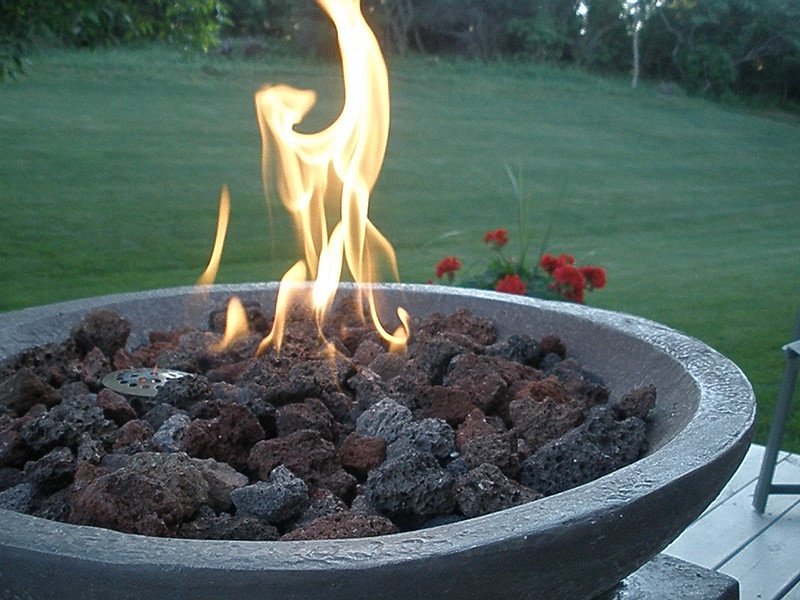
I like approved lava rock where the patio already features stone, timber-look furniture or warm neutral colors. Dark rock can disappear beneath the flame, allowing the fire to take center stage. In daylight it can also look more organic than highly reflective glass. This makes lava rock a strong option for landscape-oriented designs where I don’t want the fire feature to resemble a decorative centerpiece on a dining table.
The key word is approved. I would use only the size and quantity specified by the fire pit manufacturer. Lava rock sold for another application may not be appropriate, and changing piece size can change how media sits around the burner. I would avoid burying the burner or blocking control openings and vents. Some manufacturers provide diagrams showing exactly how to cover a burner while leaving ignition components unobstructed.
Maintenance is another reason I like this style. Approved lava rock usually needs periodic inspection for breakage, debris and material breakdown. I would let everything cool completely, then clean or replace media according to the manual rather than washing or reinstalling damp material without guidance. If rocks fracture or deteriorate, I treat them as replacement items, not as material that can be topped off indefinitely.



3. Ceramic logs: the wood-fire appearance, with an important restriction
Ceramic gas logs can create an appealing traditional appearance on appliances specifically designed for them. I understand why people want the look: many patio owners like the visual character of a small wood fire without collecting wood or sweeping ash. But ceramic logs are not universal decorative accessories for every propane fire table or bowl.
A log set can redirect flame, interfere with the burner and change heat exposure. The position of each piece can be part of the tested product design. If the manufacturer offers an exact compatible ceramic log arrangement, I would follow the approved diagram and part number. If the unit was designed for lava rock only, I would not add a freestanding gas log set just because its dimensions appear to fit.
I would also be skeptical of “DIY faux logs” marketed as decoration without clear appliance compatibility. Natural wood, painted wood, plastic props and ordinary ceramic ornaments should never be placed on or inside the burning area. When I want a woodsy theme without a suitable log set, I add wood-toned furniture or a rustic table outside the fire pit’s specified heat and clearance envelope instead.
4. Decorative ceramic stones and pebbles
Smooth ceramic stones can create a soft, contemporary look that works especially well with round bowls or white, sand-colored and pale gray outdoor furniture. The visual advantage is shape: rounded pieces contrast with a hard-edged burner tray and emphasize the flame’s movement. I would use them only where the fire pit explicitly permits that specific ceramic media and arrangement.


Do not confuse approved ceramic fire media with river rocks, landscaping pebbles, aquarium stones or gravel. Natural stones may contain or retain moisture and can crack or eject fragments when heated. The possibility of thermal fracture is a serious reason not to improvise. Even a product described as “decorative stone” may be inappropriate for a gas burner unless its use is documented for the model.
For the same reason, I would not substitute seashells, sea glass, marbles, broken tile or home-garden ornaments. A stylish arrangement in a photograph does not establish combustion compatibility. I want the fire feature to look deliberate without putting guests next to a material that was never designed for direct flame exposure.
5. Glass wind guards: sleek lines, but only compatible designs
A glass wind guard can create a polished, framed look around a fire table burner. It may help shield the flame from some wind in models designed for that accessory, but I would not promise that it will stop flickering or make the appliance safe under unsuitable weather or overhead conditions. I treat it as part of a manufacturer-approved system, not an interchangeable shield.
I check the required glass specification, dimensions, edge spacing, mounting hardware and the appliance’s instructions about airflow. Installing an aftermarket barrier that interferes with combustion, ventilation or heat dissipation is not worth the risk. Some installations require specific supports and a designated gap between shield and burner; others prohibit added barriers altogether.
My decorating preference is clear glass with minimal visible hardware on modern metal tables. On rustic fire bowls, I usually leave the approved design alone because a tall glass rectangle can visually overwhelm the softer shape. Any wind protection must be compatible with the fire feature—not simply attractive.
6. Decorative lids and protective covers
A properly designed lid can make a fire table more versatile, converting the appearance back to ordinary outdoor furniture once everything is off and fully cool. It is one of the best cosmetic additions for a patio that must look tidy during daylight hours. Some fire tables come with a matching metal lid; others require an optional part. I would choose the manufacturer’s own lid rather than constructing one from sheet metal or timber.
A weather cover solves a different problem: it helps protect the unit when stored according to the manual. I prefer a cover with a clean fit and minimal loose fabric, but no cover belongs over a lit or hot unit. I also never use an improvised cover to hide the propane cylinder or enclose a hose. The product’s ventilation and fuel-cylinder requirements still apply when it is not in use.
If I were deciding between decorative accessories, I would buy approved functional items first. A good lid, a suitable cover and replacement-approved burner media generally offer more practical value than an extra bag of colored glass that might not even fit the manufacturer’s specifications.
7. Outdoor furniture: the most important decoration may be outside the fire pit
A fire feature becomes much more inviting when chairs relate to it naturally. I like a circular conversation group for a round bowl and a sofa-plus-two-chairs arrangement for a rectangular fire table. The arrangement should invite people to face one another instead of forcing everyone to stare directly at the fire. Still, I do not set furniture distances by a decorating formula. Required combustible clearances and access routes come first.
I would choose cushions and outdoor textiles for comfort but keep them entirely outside the manufacturer’s prescribed clearance areas. Cushions, synthetic wicker, umbrellas, hanging fabrics and other combustibles can create risks near high heat. For compact patios, a small fire pit with fewer appropriately placed seats may look better—and work better—than a larger feature surrounded by crowded furniture.
My three layout approaches
- Conversation circle: a compatible round bowl forms the visual center; chairs sit beyond all mandated clearances and leave a usable exit path.
- Outdoor lounge: a rectangular fire table aligns with a sofa, while side chairs complete the arrangement without obstructing controls or cylinder access.
- Garden focal point: a heavier decorative feature sits in a compliant open-air area with intentional pathways and seating well beyond required heat zones.
If the outdoor setting is rented or subject to condominium rules, I would read the fire pit guide for renters before purchasing decorative furniture or a fire unit. Written permission, approved location and cylinder storage can be more important than any styling decision.
8. Pavers, gravel borders and landscape beds around the fire feature
I often prefer a restrained ground treatment because the flame already supplies the moving visual element. A simple pattern of suitable pavers, a neutral patio finish or a defined landscape edge can make a portable fire pit appear integrated into the yard. However, the surface must be one the manufacturer permits. A material that looks like concrete or stone is not automatically suitable beneath a hot appliance.
I would never put loose stones into the burner to echo a nearby gravel border. Ground landscaping and fire-rated burner media are different things. Similarly, I would not install combustible edging, mulch or decorative grass directly under or near the unit in violation of clearance requirements. My style advice applies only after the installation layout has met the manufacturer and local requirements.
For a budget-friendly refresh, I might first rearrange existing patio pieces and choose a cohesive ground color rather than replacing burner media. The visual payoff can be substantial without touching combustion components.
9. Planters and outdoor greenery
Plants can soften a metal fire table and connect it to the garden. I favor structured potted greenery outside the clearance area rather than trailing vines close to the rim. Dry foliage, planters made from combustible materials and overhanging branches all need careful consideration. I never place a planter on the fire-table edge while it is operating unless the manufacturer specifically permits the placement, which should not be assumed.
A tall planter can anchor one side of the conversation area, while lower plants farther away can keep the flame visually prominent. I would choose plants for mature size, not just how they look when purchased. A shrub that is safely away from the fire feature today may grow into the required clearance area next season. I would check and maintain those distances over time.
10. Subtle outdoor lighting to complement the flame
A fire pit already produces a warm focal glow, so I do not want competing brightness. I prefer indirect, low-level landscape illumination or approved outdoor lighting aimed at pathways and seating rather than a glaring light directly over the flame. It can help guests navigate safely without diminishing the fire feature’s atmosphere.
I pay equal attention to wires and electrical equipment. Outdoor-rated fixtures, cables and connections must be located and installed according to their instructions, away from heat and walking routes. I never drape string lights or electrical cords over the fire feature or assume a pergola is acceptable because the lights look attractive in a photograph. The appliance’s overhead and installation restrictions still control the setup.
11. Color combinations that work without overcrowding the design
I use a simple palette method: choose one dominant neutral for the fire pit body, one coordinating material or color for patio furniture, and one restrained accent repeated in cushions, planters or permitted fire media. Limiting the palette can make a modest fire pit look more intentional than buying many unrelated accessories.
| Style direction | Fire pit appearance | Surrounding colors | Permitted decorative-media style |
|---|---|---|---|
| Modern charcoal | Black or graphite metal | Cream, pale gray, warm timber | Clear or charcoal glass only if approved |
| Natural rustic | Earth-tone shell or dark metal | Sand, olive, warm brown | Manufacturer-approved lava rock |
| Coastal | Light frame or stone-look finish | White, beige, muted blue | Approved clear or aqua glass |
| Minimalist | Plain round feature | Gray, black, off-white | Single muted media tone |
| Traditional courtyard | Bronze or deep brown body | Brick, terracotta, textured neutral fabrics | Approved lava rock or model-specific ceramic logs |
| Contemporary resort | Pale composite finish | Taupe, black metal, green plants | Approved reflective-style glass |
These combinations are original editorial style suggestions; they are not product test results or guaranteed design trends. I would choose the permitted burner material first and then build the rest of the palette around it. Trying to force the flame area to match a cushion color can lead to unnecessary—and potentially unsafe—media substitutions.
12. Decorative-media comparison: cost, appearance and maintenance
Because buyers often ask me which media offers the best value, I compare decorative performance with a second variable: whether the product is approved. If compatibility is absent, the price, color and maintenance score do not matter. The budget ranges below are approximate planning allowances for small-to-moderate decorative media purchases, not live retailer quotations, and quantity varies by burner.
| Item | Illustrative budget | Visual character | Maintenance consideration | Eligibility |
|---|---|---|---|---|
| Approved lava rock media | $15–$45 | Natural, matte, understated | Inspect for breakage or dust | Exact appliance approval required |
| Approved fire glass | $25–$90 | Reflective, modern, colorful | Check for dust, damage and installation quantity | Exact appliance approval required |
| Approved ceramic log arrangement | $50–$200+ | Traditional log-fire look | Check positioning and breakage | Only designated compatible appliances |
| Approved ceramic stone arrangement | $30–$120+ | Smooth, minimal, sculptural | Inspect chips and correct placement | Only designated compatible appliances |
| Compatible glass wind guard | $60–$220+ | Architectural frame | Clean glass and inspect mounts | Manufacturer-listed accessories only |
| Matching cover or lid | $20–$120+ | Finished appearance in storage | Clean, dry and inspect fit | Approved model and cooled shutdown use |
These prices are deliberately broad and do not imply a specific thickness, amount, size or brand. I do not recommend purchasing decorative media by cubic volume from a generic landscaping supplier. Follow the manufacturer’s exact quantity, weight or installation diagram, and contact the appliance manufacturer if details are missing.
13. Worked example: designing a $300 patio refresh
Suppose I already own a certified propane fire table with manufacturer-approved lava rock and a safe, open-air installation. I have $300 for improving how the patio looks. Instead of automatically buying expensive fire glass, I would first ask whether the existing media is still serviceable and whether changing it is permitted. If I like the current flame, I may gain more visual improvement by coordinating outdoor pieces outside the required clearances.
| Illustrative purchase | Example allowance | Reason for including |
|---|---|---|
| Manufacturer-approved replacement cover | $45 | Tidier appearance and protection during proper storage |
| Two suitable outdoor cushion covers | $50 | Adds a consistent accent color, placed outside clearances |
| Two weather-suitable planters | $70 | Balances the seating area away from heat |
| Approved pathway lighting | $65 | Improves evening navigation and atmosphere |
| Outdoor side table | $60 | Provides a useful surface away from the hot burner |
| Total illustrated spending | $290 | Leaves $10 of the $300 allowance |
Here is my original design principle: spend first on what the fire pit makes visible, not necessarily what touches the flame. The fire illuminates the nearby furniture, plants and textures. A coordinated $290 surrounding-area refresh may change the whole atmosphere more than $100 of decorative glass placed inside the burner. That is a design judgment, not a measured consumer experiment; use it as a budget decision framework.
If you are shopping for a fire pit from scratch, I would separate the purchase from the decorating allowance. My propane fire pit price guide and retailer comparison help establish the appliance budget before you allocate money to accessories.
14. A compatibility-first scorecard for decorative choices
I use a two-stage process I call the “permission then preference” test. Stage one is binary: the exact product documentation either permits the accessory or does not. If I cannot establish approval, the option fails and I do not score it for beauty. Stage two compares permitted options by design, upkeep, usefulness and price.
| Question | Pass condition | If the answer is no or unknown |
|---|---|---|
| Is this item approved for the exact appliance? | Documented manufacturer compatibility | Do not install in burner or attach to appliance |
| Is the installation arrangement permitted? | All vents, pilot components and passages remain as required | Keep existing setup |
| Does it preserve required clearance? | No new combustible or obstruction within restricted area | Move or omit accessory |
| Will it work with the patio palette? | Repeats one or two colors/materials intentionally | Choose a simpler finish |
| Can I maintain it correctly? | Cleaning and replacement instructions are clear | Prefer lower-maintenance alternative |
| Does the total delivered cost fit? | Includes required accessories and shipping | Rebalance budget toward essentials |
This process is particularly useful when a decorative product is marketed as “universal.” Many accessories are visually universal but technically specific. A wind guard, log arrangement or glass media kit should be assessed by the documentation for the appliance, not by whether it physically fits in the opening.
15. How much decorative media do I need?
I would not give you a universal pounds-per-square-foot rule for a propane burner. Different glass sizes, rock densities, pan depths and burner configurations require different amounts. More importantly, the permitted depth and distribution can be necessary for safe combustion. Some gas fire-pit manufacturers illustrate only a shallow layer of glass over their burner, while other burner styles require a different arrangement. Their guidance cannot be generalized across brands.
For a purely geometric planning illustration—not an instruction to fill any burner—consider an empty rectangular area 24 inches by 8 inches. A layer 0.5 inch deep occupies 96 cubic inches, or roughly 0.056 cubic feet. Double the depth and the material volume doubles. This arithmetic helps explain why an innocent-looking extra layer can materially change the volume of media around the burner. It does not tell you the correct safe installation depth, which must come from the manual.
| Illustrative rectangle | Depth used in math only | Geometric volume | Safe media quantity? |
|---|---|---|---|
| 24 × 8 inches | 0.25 inch | 48 cu in / 0.028 cu ft | Not established |
| 24 × 8 inches | 0.50 inch | 96 cu in / 0.056 cu ft | Not established |
| 24 × 8 inches | 1.00 inch | 192 cu in / 0.111 cu ft | Not established |
Notice the last column. I would not turn geometry into a buying recommendation without the manufacturer’s instructions. If an approved accessory requires a certain weight of media, use that weight; if the instructions call for exact placement, follow the diagram rather than pouring in the entire bag.
16. Decorations I would never put in the burner
Some attractive decorations are poor candidates for a gas fire feature. The problem may be moisture retention, thermal fracture, melting, unwanted fumes, altered gas flow or interference with ignition. I avoid the following inside any burner pan unless the manufacturer specifically supplies and approves a given item as part of its tested design.
- River rocks and ordinary landscaping pebbles: they may retain moisture and fracture when heated.
- Aquarium gravel, craft glass and decorative marbles: they are not equivalent to approved fire glass.
- Ordinary ceramic ornaments and painted stones: their materials and coatings may not tolerate direct flame.
- Seashells, driftwood and natural wood: a decorative gas burner should not be treated like a wood-burning pit.
- Plastic foliage, candles and fabric accents: these are not burner media and can ignite, melt or contaminate combustion.
- Unapproved screens or homemade burner covers: they can obstruct airflow, ignition or required venting.
- Extra media piled over ignition areas: even an approved material can create problems if installed incorrectly.
The same caution applies to decorations outside the pan: I would keep flammable planters, umbrellas, furniture fabric and other objects completely outside the product’s clearance requirements. Do not assume a material is safe just because it is described as outdoor-rated. My complete fire pit safety guide explains the broader risks and inspection steps.
17. Seasonal styling without disturbing the fire system
I think seasonal refreshes are best achieved by changing the surrounding space. In spring I might use pale cushion covers and green planters. In summer, I favor restrained lighting and comfortable seating. In autumn, warm-colored textiles can create a cozy mood—but never within required heat clearances. In winter, I focus on proper storage and weather protection instead of adding decorations to the flame area.
I would avoid tying artificial foliage, ribbons or holiday lights directly to the fire pit, even when it is off, because those items can be forgotten when the burner is lit later. A small seasonal arrangement on a separate, suitably positioned side table is easier to manage. Keeping decorative objects independent of the combustion appliance also reduces the risk of someone accidentally leaving an accessory in an unsafe position.
18. Choosing the best elements for your fire pit type
| Fire pit type | My first visual choice | Supporting decoration | What I would avoid |
|---|---|---|---|
| Portable metal bowl | Existing approved dark lava rock | Simple outdoor seating, pathway illumination | Loose stones, homemade flame shields |
| Compact square table | Approved single-color fire glass if permitted | Coordinated outdoor cushions, proper lid | Unapproved glass and crowded tabletops |
| Rectangular lounge table | Approved original burner media | Low furniture profile and matching side tables | Blocking access or crowding chairs |
| Heavy decorative stone-look bowl | Approved neutral media | Planters and restrained paving | Extra weight on lip or burner |
| Traditional gas-log-style feature | Specified ceramic log set | Rustic seating and muted lighting | Repositioning logs or adding real wood |
If you have not settled on the form of the appliance yet, see propane fire pit tables versus bowls. The shape of the fire feature often determines the best overall visual design more than the color of the decorative media.
19. Maintenance checklist for a beautiful and reliable fire pit
A design remains attractive only if I can care for it. I would keep the maintenance routine consistent with the manufacturer’s manual and never clean, move or rearrange burner components while the unit is hot. I avoid aggressive scrubbing or chemical products near the burner unless specifically approved.
- Before lighting: look for loose debris, blocked ventilation, visible damage or displaced media; if uncertain, do not operate.
- After complete cooling: remove outdoor dirt using approved cleaning methods and make sure any media is completely dry before reinstallation where permitted.
- Periodically: check the body finish, accessories, wind-guard mounts and cover for damage.
- At the season change: follow the approved storage and weather-protection routine; handle the propane cylinder according to the appliance instructions and local rules.
- After abnormal flame behavior: stop operation and seek manufacturer or qualified service guidance rather than adding or removing media to experiment with flame shape.
The decorative elements should never make it harder to inspect the fire pit. I want to be able to locate controls and shutoff arrangements, access any required service openings and see whether the unit is operating abnormally. Beautiful design and good maintenance should support each other.
20. Frequently asked questions
What is the best material to put in a propane fire pit?
There is no universal best. I would use only the exact decorative media that the appliance manufacturer lists as compatible. Approved lava rock can give a natural look, while approved fire glass offers reflective color. Some specialty features support ceramic components. Never substitute generic landscape materials.
Is fire glass better than lava rock?
For visual sparkle and color choices, I often prefer fire glass. For an understated natural look and simpler styling, I often prefer lava rock. The better practical choice is whichever material the specific propane appliance safely permits, in the specified amount and placement.
Can I mix fire glass and lava rock?
Only if the specific manufacturer documents that combined media arrangement. Even when both materials are individually approved, mixing them may change distribution and depth. I would not infer that compatibility with each material separately authorizes a mixed installation.
Can I put river rocks around my propane burner?
Not inside or on the burner as a substitute for approved media. Natural stones may retain moisture and fracture with heat. Landscape rock may be appropriate in areas away from the appliance if the surface and clearance rules permit it; the decorative burner pan is a separate issue.
Can I add ceramic logs to any propane fire pit?
No. A ceramic log arrangement should be supplied or explicitly approved for the exact appliance. Improper log placement can disturb combustion, ignition or flame patterns. If your unit is designed for glass or lava rock only, I would keep that original configuration.
Do decorative elements change propane consumption?
A compliant media change generally does not change the burner’s nominal rated BTU input by itself. Actual operation can still be affected by incorrect installation, and excessive or misplaced media can introduce serious combustion problems. I would never use decorative media to try to reduce fuel usage. For legitimate planning calculations, see hourly and monthly propane fire pit operating costs.
How do I make an inexpensive propane fire pit look expensive?
I would begin with a coherent color palette, a neat approved cover, suitable furniture arrangement, clean surfaces and subdued lighting outside required clearances. Those improvements create a more deliberate setting without touching the burner or gas system.
Can I decorate a propane fire pit for the holidays?
I would decorate the surrounding patio rather than attach ribbons, greenery, string lights or ornaments directly to the appliance. Keep decorations outside required clearances and maintain clear access to controls, exits and fuel equipment.
Final recommendation: design around the fire, not inside it
If I were styling a propane fire pit today, I would start by keeping its original, properly installed media. I would consider changing that media only after confirming exact manufacturer approval. Next, I would pick a restrained body-and-furniture color scheme, then add lighting, planters, cushions or side tables beyond the required clearances. This creates a coherent outdoor room without altering the appliance’s combustion system.
My favorite design principle is to make the flame the only moving centerpiece. The more visually organized the surrounding patio becomes, the less I need to add to the burner itself. The practical next step is to review what to look for when buying a propane fire pit, compare tables and bowls, then confirm fire pit safety requirements before choosing accessories. That sequence helps you build a setting that looks attractive and remains suitable for the actual appliance.

Mike is an experienced propane technician with over 15 years of professional experience in the field. He has dedicated his career to helping customers with their propane needs, from installation to maintenance and repair. Together with Jeremy, he co-founded this website to provide useful information and guidance to customers seeking reliable propane services.