Updated November 5, 2026. This guide is for the U.S. market. Prices are snapshots of retailer listings checked for this article, and can vary with location, stock, seller, color, promotions and taxes. I do not treat a crossed-out reference price as proof that the product was recently sold at that amount.
If you are searching for the best places to buy propane fire pits, you probably have two questions: Where can I get a good deal, and how do I know that deal is actually good? I would answer both before buying. A low sticker price is attractive, but a missing hose, expensive shipping, unfamiliar marketplace seller, or inconvenient return policy can erase the savings. I also want you to see beyond the first purchase: propane usage and a suitable cylinder add to the real expense.
Quick-reference: where to buy propane fire pits
I would use this as a shopping map, not as a permanent ranking. The lowest price changes too often for any one retailer to deserve that crown year-round. For context, see my broader guide to how much a propane fire pit costs before choosing the type.
Real retailer price examples I checked
These are selected U.S. online listings observed during research, rather than a claim that all products in a store fall in the same price band. The snapshot is useful because it shows just how widely a 50,000 BTU product can be priced.
Prices checked November 5, 2026; taxes, shipping and location-specific adjustments excluded. These are retailer listing examples, not endorsements or verified transaction prices. I deliberately leave external merchant links out of this article. Compare exact model numbers and dimensions when checking the stores because product names can be similar.
1. Walmart: my first stop for a budget comparison
I would start at Walmart if the goal were a basic propane fire pit under $250. Its wide assortment makes it easy to see portable bowls beside 28-inch and 43-inch tables. During my price check, a Homall portable bowl was displayed at $94.99 and a 28-inch Philergo table at $176.99. Those prices tell me what an entry-level product can look like, but they do not establish its longevity.
My filter would be seller credibility before advertised savings. A product sold through a marketplace may have a different support and return process from one sold directly by the retailer. I would inspect recent negative reviews for ignition problems, chipped finishes, missing hardware and damaged shipping cartons. Reviews about assembly instructions are especially helpful because a fire table can look fantastic in a photograph and still arrive as an hour-long puzzle.


A $179 table is attractive if it includes a lid, burner media, regulator and protective cover. If those items are absent, the apparent bargain becomes less impressive. I also check whether a 20-pound cylinder fits inside the frame or has to sit outside with the supplied hose.
2. Target: useful for compact designs and promotional prices
Target is worth checking when I want something a little more decorative without automatically moving into luxury pricing. I found a 17-inch Threshold column-style unit listed at $120, a Costway 58,000 BTU portable model at $125.99 and a 32-inch Costway fire table at $199.99. The listing pages also presented much higher reference prices on some items.
That last detail is where I slow down. I do not measure value by the size of a percentage-off label alone. A claimed 60% discount does not make a $240 table better than a comparable $200 table from a different store. I compare the final price, burner design, materials, warranty and whether the cover is included. I would also make sure the listing identifies the actual manufacturer and not only a marketplace storefront.
Target can be especially useful for side-by-side dimensions: a short round column may fit a compact seating plan, while a 42-inch rectangular table may require much more open floor space. If you are renting, check the rules and practical risks for renters before treating a compact unit as balcony-safe.
3. Home Depot: a strong comparison for in-person support
For homeowners who prefer a familiar hardware-store purchase, I would check Home Depot against the lowest online offers. Its assortment runs from basic steel tables to heavier composite or stone-look installations. I found a 28-inch iron model listed at $229.08, a 48-inch dual-height 50,000 BTU model at $488, and a more decorative round MGO unit with tank-cover table at $836.60.



Those listings illustrate why a phrase like “50,000 BTU fire pit” is not a sufficient product description. Two units with the same maximum burner rating can have radically different sizes, finishes, covers, tank-storage arrangements and weights. One may cost more because of its body and accessories, not because it burns hotter.
I would review the exact seller and written return terms. For large furniture-like products, return shipping and restocking conditions can matter more than a $20 discount. A local store is helpful for discussing collection and inspection, but not every online-only product is physically stocked at the nearest branch.
4. Lowe’s: compare the same specifications, not just the brands
Lowe’s belongs in my shortlist because hardware chains are useful places to compare practical specifications and seasonal outdoor assortments. I would search by dimensions, fuel type and BTU input, then compare whether a model is a complete fire table or only a burner kit. I would also ask whether the unit can be picked up locally and whether the product is supplied by a third-party seller.
I have not assigned Lowe’s a single current “lowest price” because an equivalent, matched listing was not verified in this check. Instead, I would use Walmart and Target listings as budget anchors and see whether Lowe’s offers a comparable item with better returns, pickup convenience or warranty terms. In a physical store, I can inspect welds, lid fit, coating and overall proportions more accurately than in a product thumbnail.


5. Wayfair: the place I would compare style and size
Wayfair is particularly useful when the fire pit is supposed to look like part of an outdoor living room. I would compare rectangular coffee-table shapes, faux-stone bowls, wicker-look surrounds and matching tank-cover tables. The important question is not whether an item has a premium-looking photograph; it is what material sits beneath the finish.
A lightweight concrete-look shell, for example, is not the same thing as thick poured concrete. I would check the actual weight, frame construction, burner material, assembly requirements and cleaning instructions. On large items, return freight can be substantial, so I would read the product-specific policy before ordering.
If a discount appears unusually deep, I would record the exact SKU and compare equivalent models elsewhere. Price comparison fails when you accidentally compare a 28-inch steel unit against a 42-inch composite table with a glass wind guard.
6. Costco and Sam’s Club: look for bundle value
Warehouse clubs can make sense if you already have a membership and want a complete outdoor setup. I would look for seasonal packages including a table, lid, burner media, protective cover or coordinated furniture. But I would not assume the clubs always stock propane fire pits, or that one will have the lowest price when it does.
A bundle is valuable only if I would have bought the extras anyway. A matching tank-cover side table might save me an additional purchase; decorative cushions that do not suit my patio are not meaningful savings. I also check whether a heavy order is curbside-only and how damaged pieces are handled. Local club inventory can differ considerably from the website.
7. Specialty stores, manufacturer sites and local showrooms
I would move beyond general retailers if I wanted a specific burner configuration, a custom stone-look installation, a distinctive finish or longer-term parts support. Specialty patio dealers can sometimes explain replacement ignition components, corrosion-resistant burners, approved glass media and installation details better than a generic listing.
Local showrooms also let me assess practical details: is the flame area proportionate to the table, is there adequate space for cups when the burner is on, and does the edge feel sturdy? These questions matter if the fire pit is going to stay outside for years. I would not pay a luxury premium for appearance alone; I would ask exactly what support, materials and components justify it.
Before deciding which retailer offers the best value, I recommend comparing the full range of designs, materials, installation requirements and ownership expenses in my Propane Fire Pit Buying Guide: Prices, Types & Features. It provides a broader product-selection framework beyond store prices.
Propane fire pit types: technical comparison
These are comparison ranges, not universal product standards. “BTU” on a listing generally means a heat input rate in BTU per hour; it is not a guarantee of how warm every chair will feel. Wind, seating distance and flame adjustment change comfort. I also would not assume a propane fire pit can be converted to natural gas unless the exact manufacturer explicitly supports an approved conversion.
The comparison metric I use: ready-to-light cost
Here is a shopping calculation that I find more useful than retail markdown percentages: Ready-to-light cost = fire pit + unavoidable shipping + required accessories + cylinder purchase + initial fuel + sales tax. Do not double-count a cylinder that arrives filled or accessories included in the box. Because taxes vary, I keep them separate in the example below.
These are deliberately illustrative scenarios, not quotes. In this example, A is cheaper even after a missing $20 accessory; B costs $130 more before tax. If B has a demonstrably longer-lasting frame, better warranty and a design you value, that extra cost could still be reasonable. The model helps you make the tradeoff deliberately rather than chasing a sale banner.
My second metric: how much does the flame cost to run?
A fire pit can be cheap to buy but expensive to operate at full flame. For a reproducible estimate, I use approximately 91,500 BTU per U.S. gallon of propane, a completely filled standard 20-pound cylinder containing roughly 4.7 gallons, and a sample refill price of $4 per gallon. Real filling volume, regulator behavior, ambient conditions and average burner setting affect actual runtime.
Gallons/hour = burner BTU/hour ÷ 91,500. Hourly fuel expense = gallons/hour × propane price/gallon. Estimated hours = usable gallons ÷ gallons/hour. All results below assume uninterrupted operation at the stated input and are rounded.
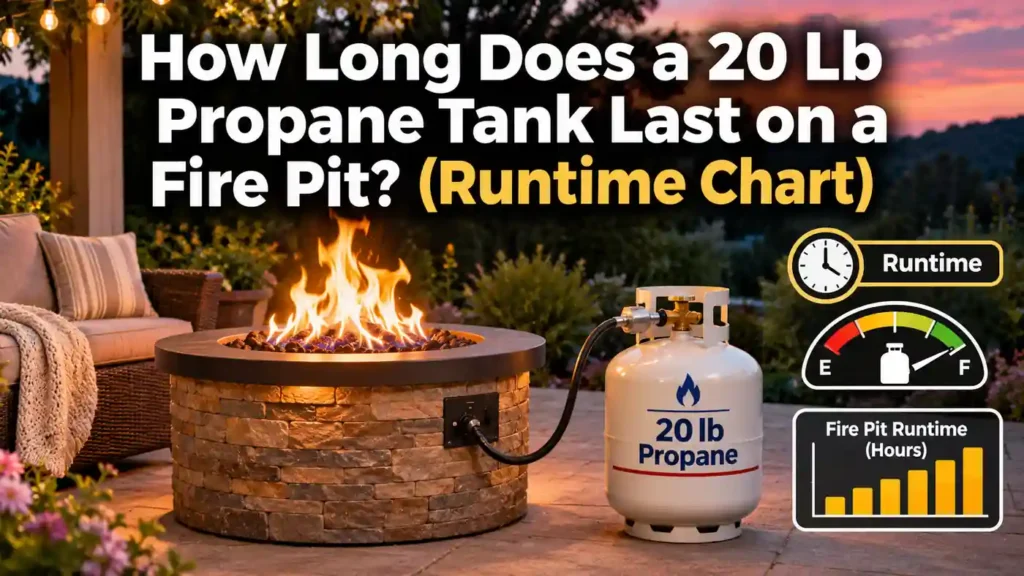
For a deeper calculation with more usage patterns, see my hourly and monthly propane fire pit fuel-cost guide and the 20-pound cylinder runtime chart. If a listing promises an exact number of hours without explaining flame setting, consider it a marketing estimate rather than a guaranteed result.
Interactive propane fire pit runtime and fuel cost estimator
Choose a rated burner input, an estimated average flame percentage, your refill price and the amount of propane you expect to have. The calculator uses the same transparent arithmetic as my tables. It is an estimate, not a substitute for the appliance manual or a cylinder-supply assessment.
Estimated runtime: 11.5 hours | Operating cost: $1.64/hour
Assumes gas consumption scales directly with the selected percentage. Actual low-setting consumption is product-specific. Outdoor use only and follow manufacturer requirements.
A worked example: portable bowl versus a larger fire table
Suppose I am choosing between a $125 portable 58,000 BTU bowl and a $240 rectangular 60,000 BTU table. The price difference is $115 before tax or extras. At full input, the bowl consumes about 0.634 gallons hourly, while the table consumes 0.656. At $4 per gallon, that is about $2.54 versus $2.62 per hour—a difference of only $0.09 per hour after rounding.
That surprises some shoppers: the larger-looking table is not necessarily dramatically more expensive to fuel when the burner ratings are close. The real decision is whether the table gives me a more useful surface, better tank storage and enough clearance in my seating area. If the smaller bowl is used at a lower setting, its actual fuel consumption could be substantially less. I would compare settings, not just rated maximums.
How I decide whether a discount is real
The advertised markdown is only the first screen. I use a four-step method that I call my same-SKU test. First I copy the full model number. Second I compare at least two sellers carrying the exact model and finish. Third I add shipping, required extras and return costs. Fourth I check whether the model has a clear warranty and replacement-part path. That is a practical evaluation framework, not a claim that I personally tested every listed item.
When are propane fire pits usually cheaper?
I tend to look at clearance when a retailer is changing outdoor assortments. Depending on region, that can occur late summer, fall or after a major sales event. November promotions and winter inventory changes may bring interesting offers, but there is no universal cheapest month. A warm-weather market may retain patio demand all year, while a colder region may clear its seasonal stock sooner.
I would track a short list of exact products for two or three weeks rather than assuming a holiday promotion is automatically best. Record the seller, full product title, sticker price and delivery total. That takes only a few minutes and protects against misleading comparisons when the retailer swaps a bundle or a different finish into the listing.
Eight checks before I buy a propane fire pit
- Confirm outdoor-only approval. A propane fire pit is not a substitute for indoor heating, and a roofed patio, tent, balcony or enclosure may be prohibited by the appliance instructions.
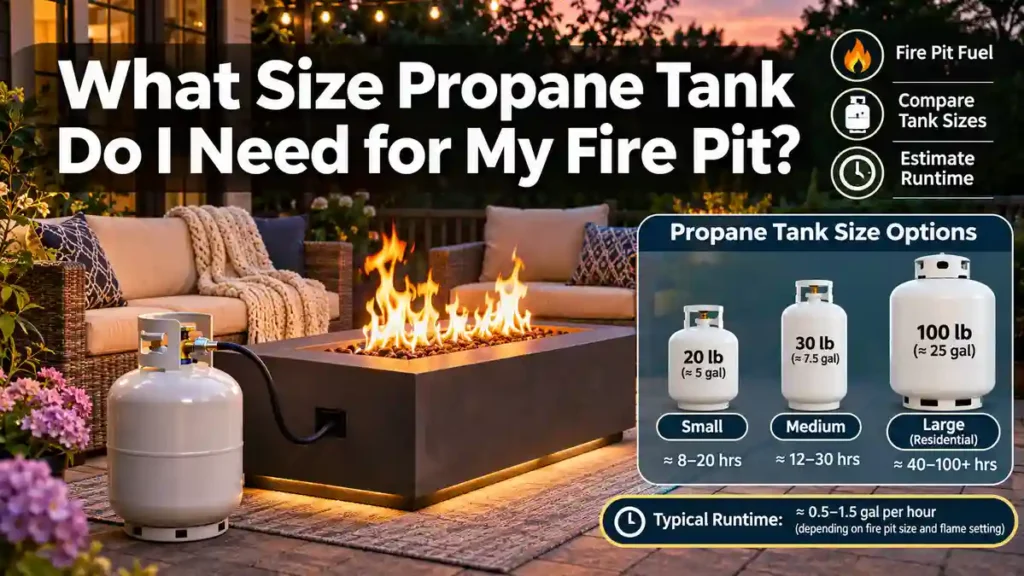
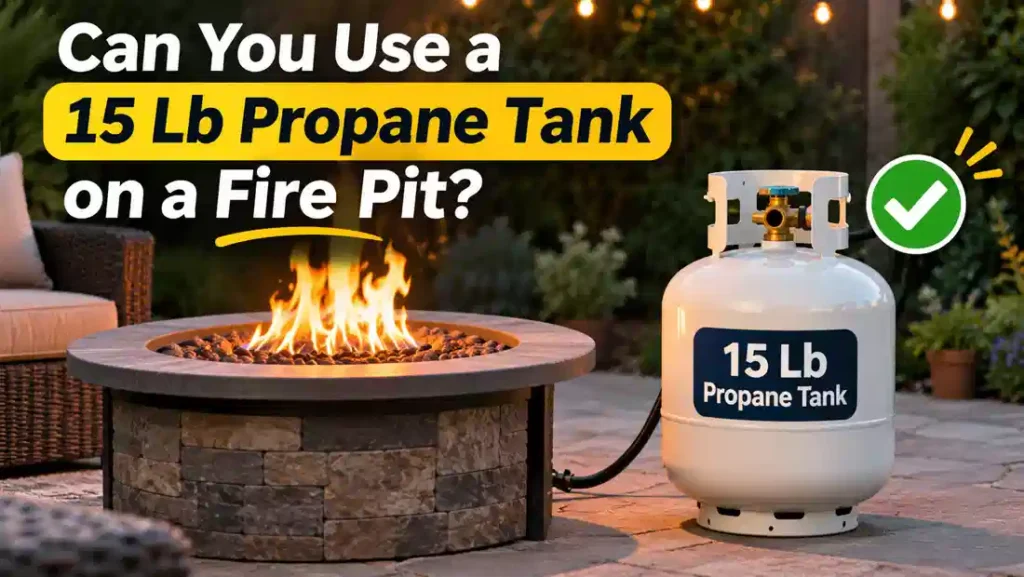
- Read the cylinder requirement. Many models use a standard upright 20-pound cylinder, but not every model permits the same tank size or location. See my propane fire pit tank-sizing guide.
- Check fuel-system completeness. Verify that the correct regulator, hose and connections are included and approved for that exact appliance. Never improvise fittings.
- Inspect the burner and ignition. Stainless components may improve durability, but material labels alone do not prove service life.
- Measure clearances. Read the specific minimum distances from structures, railings, overhead surfaces and combustibles. Do not use a generic clearance figure instead of the manual.
- Check certification and documentation. Look for a legitimately listed or certified product where required, with clear identification, installation instructions and warnings.
- Check assembly, mass and handling. If you need to move it after every use, a heavy 50-inch composite table may be inconvenient.
- Confirm parts, returns and warranty. The availability of approved burner, ignition and lid components matters more to me than a minor price advantage.
Read my propane fire pit safety guide before your first use. Never perform a flame test for leaks; if gas is smelled, shut off the supply only if safe, move away and follow emergency instructions. Only use a model where the location and use comply with the manufacturer and local rules.
A buying decision guide by budget
The budget bands are planning ranges rather than a guarantee that an item with a certain feature will fit them. If your funds are limited, a well-built $200 unit and money left over for fuel can be a smarter decision than a $400 product purchased purely because its claimed original price was $800.
Hidden costs buyers overlook
Apart from the initial fire pit price, I set aside money for the cylinder and fuel, replacement protective cover, permitted burner media, delivery, assembly and eventual upkeep. Some covers protect from rain but cannot withstand being left on a hot appliance. A gas fire table also needs a dry, well-ventilated location appropriate for its manual; weather resistance is not the same as indestructibility.
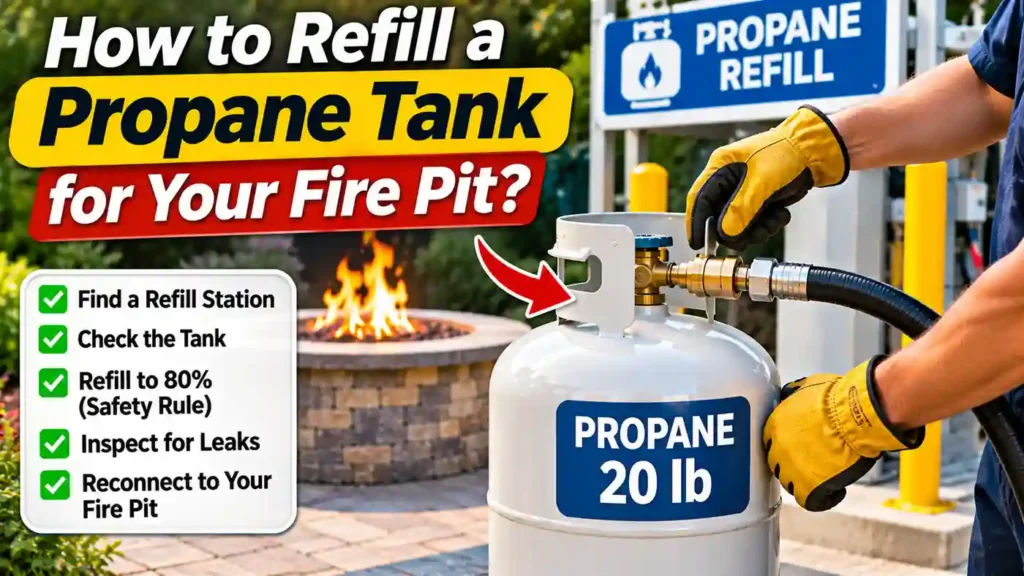
These amounts are illustrative planning assumptions, except the fuel line computed from the stated inputs. They are not quotations from a specific retailer. Check where and how to refill a fire pit propane cylinder if you need to compare refill and exchange economics.
My original approach: compare cost per useful evening
I like to translate the purchase into an evening-by-evening budget. Suppose one table costs $180 and another costs $300. If you expect 60 two-hour evenings over three seasons, the equipment portion works out to $3 per evening for the $180 table and $5 per evening for the $300 table—before fuel, maintenance or financing. If each outing uses a 50,000 BTU burner at 70% of maximum, estimated fuel cost is about $3.06 for two hours at $4 per gallon.
I call this a useful-evening test. It avoids overreacting to a one-time discount while acknowledging that a better-built product may justify a higher price. It also reveals a counterintuitive point: for someone who rarely uses the fire pit, purchase price matters more per outing; for a frequent user, fuel cost and operating habits become increasingly significant.
How to avoid an expensive mistake with a small patio
Before shopping, I would sketch the outdoor area and reserve space for seating, walking paths, burner clearances and the approved cylinder position. Fire tables with broad flat edges are convenient for gatherings, but the tabletop may not be appropriate for drinks or objects close to the hot burner. Follow the specific heat and placement instructions. A 42-inch table may look compact on a product page, yet occupy much more living space once chairs and required clearances are considered.
Where space is particularly tight, see the smallest propane tank and fire pit sizing considerations. Do not assume a smaller cylinder or burner automatically makes a fire pit suitable for an apartment balcony. Building policies and the manufacturer’s restrictions are separate issues.
My best-buy picks by buyer situation
Frequently asked questions
Where is the cheapest place to buy a propane fire pit?
There is no consistently cheapest retailer. In the listings checked here, Walmart had a portable example under $100 and several steel tables under $200, while Target showed competitive bowls and tables. I would compare the same item at Walmart, Target and the major hardware chains, then calculate total delivered cost.
Is a $150 propane fire pit worth buying?
It can be. I would buy a lower-priced model if it is correctly certified where needed, includes approved fuel components, has clear instructions and offers workable returns. I would not overlook corrosion resistance, proper clearances or replacement parts merely to stay under $150.
Should I buy a propane fire pit online or in a store?
Online shopping gives me more specifications and price comparisons. In-store shopping makes dimensions, finish and packaging easier to assess. For a heavy unit, local pickup might reduce shipping damage or simplify returns, but I always verify stock and the exact seller first.
Does higher BTU mean a better fire pit?
No. A higher maximum burner input means higher potential gas consumption and heat output, but comfort also depends on wind, layout, seating distance and design. A high-output model can burn through a cylinder sooner when run near its rating.
Do fire pits usually come with a propane tank?
Do not assume so. Most listings should be checked for cylinder inclusion, required cylinder size, regulator, hose and approved tank placement. The cylinder and fuel are often separate expenses.
Can I leave a propane fire pit outdoors all year?
That depends on manufacturer instructions, climate and materials. Weather-resistant models still require maintenance, correct storage and a suitable cover. Follow the maker’s procedure for cylinder storage; never store propane cylinders indoors or in enclosed spaces.
What is the best time of year to find a deal?
End-of-season clearance and major retail promotions are worth monitoring, but timing differs by region and stock levels. I would track a specific model’s final price rather than assume a published seasonal discount is always its best offer.
Final verdict: where I would buy
If I were buying a propane fire pit today, I would start with Walmart and Target to establish the budget price range, compare Home Depot and Lowe’s for product support and pickup, then review Wayfair or a local specialty showroom if finish and furniture styling were important. I would consider warehouse clubs for bundled value, not simply because a large percentage discount appears on the page.
My final check is simple: Does the exact model suit my space, does it include the approved components, is the seller trustworthy, and what will it cost to use? If the answers are clear, I can make a confident choice without relying on a dramatic sale label. For the next step, compare propane tank sizing, 20-pound tank runtime, hourly fuel costs and safe placement and use before lighting the fire.

Mike is an experienced propane technician with over 15 years of professional experience in the field. He has dedicated his career to helping customers with their propane needs, from installation to maintenance and repair. Together with Jeremy, he co-founded this website to provide useful information and guidance to customers seeking reliable propane services.