Quick Answer
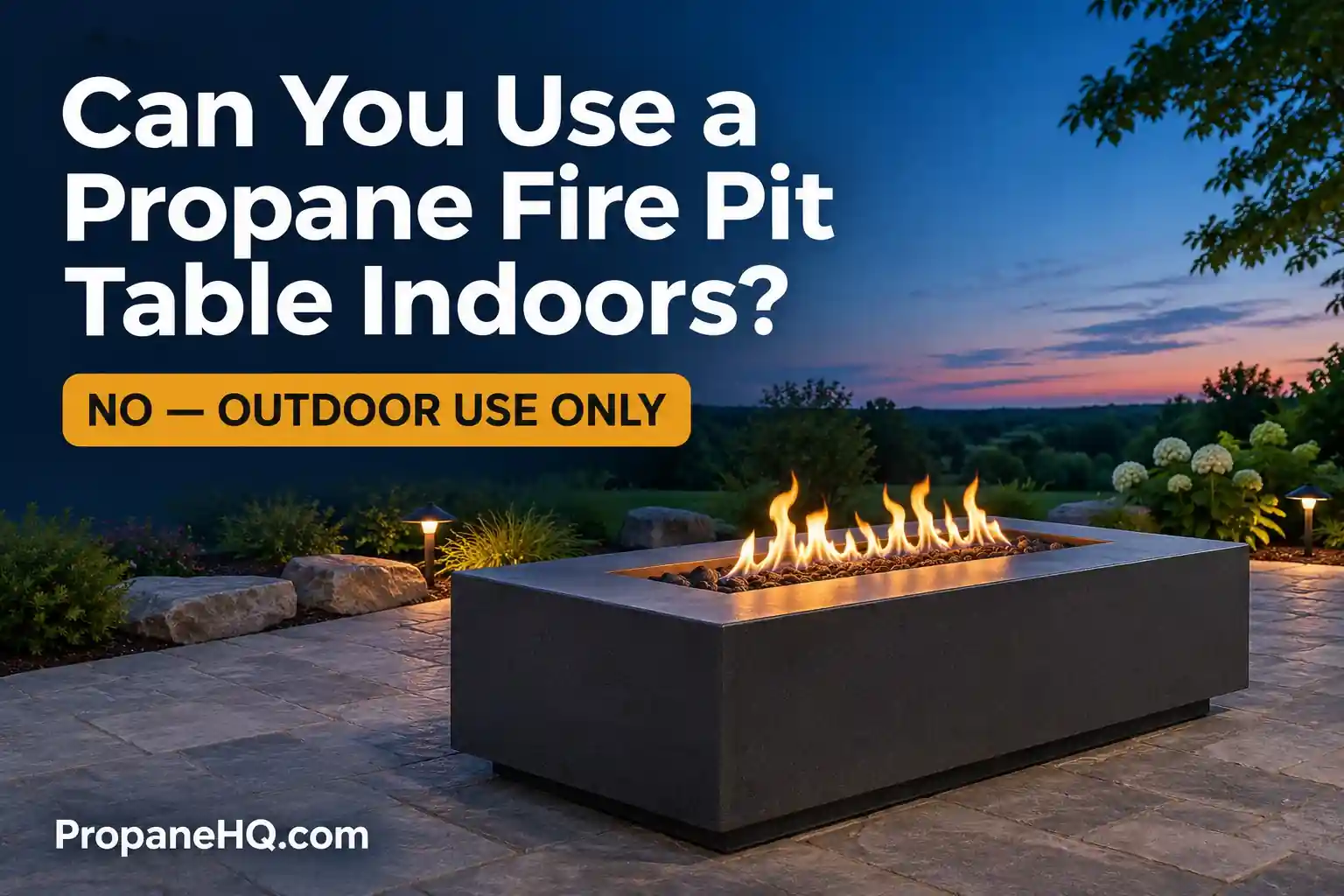
No. You must not operate an outdoor propane fire pit table indoors, including in a living room, garage, enclosed porch, tent, or sunroom. Opening windows, running fans, using a smaller flame, or installing a carbon monoxide alarm does not make an outdoor-only appliance suitable for indoor use. It can create carbon monoxide, fire, burn, and gas-leak hazards.
I would use a fire pit table only in an outdoor location allowed by its exact installation instructions and applicable rules. For indoor warmth or a flame effect, choose equipment specifically designed and approved for that indoor purpose. If the table is already burning indoors and you suspect exposure or a leak, get everyone outside and call emergency services from a safe location.
A propane fire table can resemble a coffee table, especially when the burner has a matching lid. That appearance can make it tempting to bring the flame into a family room when the weather turns cold. But its furniture shape does not change the type of appliance you own.
My approach is to separate three different questions: where you may operate it, where you may store the cooled appliance, and where the propane cylinder belongs. Confusing those questions is how a winter storage instruction can turn into an unsafe assumption about indoor use.
This guide includes original outdoor fuel-budget examples and a runtime calculator. Those tools help you plan permitted patio use; they cannot estimate a safe indoor exposure time. I do not claim personal testing of these products or that the calculations are unavailable anywhere else.
Where Can You Use a Propane Fire Pit Table?
I begin with the rating plate and manual, not the sales photograph. An outdoor decorative gas appliance remains an outdoor appliance even when its flame is small or the surrounding room is large. A covered outdoor installation also needs its own assessment; “outside” alone does not settle every clearance requirement.
| Proposed location | My answer | What determines the next step |
|---|---|---|
| Living room, kitchen, bedroom, or basement | Do not operate an outdoor fire table here. | Choose equipment specifically approved for the indoor application. |
| Garage with its door open | Do not use it here. | An open door does not convert a garage into an approved location. |
| Enclosed sunroom or porch | Do not operate it indoors. | Windows and screens are not proof of a compliant installation. |
| Tent or enclosed event canopy | Do not use an outdoor fire table inside. | Use the event’s permitted equipment and arrangements. |
| Screened porch or partially enclosed patio | Do not assume permission. | The exact manual and site requirements must expressly allow the configuration. |
| Covered open-air patio | Only if expressly permitted and compliant. | Verify overhead and side clearances, openness, materials, and local rules. |
| Open outdoor patio | Potentially suitable. | Still meet the manual’s placement, surface, and clearance requirements. |
My preference is to resolve the location before selecting the table. Otherwise, you might buy a large piece of furniture that has nowhere appropriate to operate. The propane fire pit buying guide helps you compare formats after that first decision.


Why an Outdoor Propane Fire Table Is Unsafe Indoors
The danger is not limited to visible smoke. Combustion products can accumulate in an enclosed space, nearby materials can ignite, and escaping fuel can create a separate hazard. A fire that looks calm can still be inappropriate for its surroundings.
Carbon monoxide cannot be judged by smell
Carbon monoxide, or CO, can result from incomplete combustion of propane. It is colorless and odorless. The odor added to propane helps warn of some fuel leaks; it does not tell you whether carbon monoxide is present. A lack of propane smell is therefore not evidence of clean indoor air.
CPSC identifies headache, dizziness, nausea, fatigue, and shortness of breath among possible symptoms of CO poisoning. If exposure is suspected, leave for fresh air and seek emergency help immediately. Do not wait for an alarm or try to confirm the diagnosis yourself.
The flame and hot surfaces create additional hazards
Curtains, upholstery, paper, and other indoor materials may be much closer to the burner than the appliance allows. Heat can also affect surfaces above and beside the flame. I would not treat a protective mat or a glass wind guard as permission to ignore the listed installation conditions.
Escaping propane is a different problem from combustion exhaust
Unburned propane can escape from a damaged or leaking system. It is heavier than air and may accumulate in low areas, although airflow affects its movement. This is one reason cylinder storage and enclosure ventilation matter. A CO alarm does not generally detect a propane leak unless it is specifically a combination device designed for both.

| Issue | What it involves | What does not prove safety |
|---|---|---|
| Carbon monoxide | Poisonous gas associated with incomplete combustion | No smell, little smoke, or a quiet alarm. |
| Fuel leak | Unburned propane escaping from the system | A CO alarm alone. |
| Fire and burns | Flames and hot components near people or materials | A smaller flame or decorative glass guard. |
| Unsuitable installation | An appliance used outside its approved conditions | A seller’s photograph or a generic certification logo. |
Do Open Windows, Fans, or a Range Hood Make It Safe?
No. I would not use any of those as a workaround for an outdoor-only fire pit table. They do not establish that the appliance has an approved indoor installation. A kitchen exhaust hood is not a substitute for the venting system and installation instructions of a purpose-built indoor gas appliance.
I would also reject advice based on room size or a short burn. A larger room does not change the appliance listing, and a timer cannot verify combustion quality or prevent a leak. There is no manufacturer-approved indoor runtime for equipment whose instructions prohibit indoor operation.
This is why I have deliberately excluded room-volume calculations, air-change targets, and “safe minutes” from the calculator below. Such numbers could give false confidence without establishing that the appliance is suitable for indoor use. The useful calculation here is your fuel budget for a compliant outdoor location.
Does a Carbon Monoxide Alarm Make Indoor Use Acceptable?
No. A CO alarm is an important protective device, not permission to operate an outdoor appliance indoors. Follow the alarm manufacturer’s installation, testing, and replacement instructions. CPSC recommends alarms on every level of the home and outside sleeping areas, with battery backup where applicable.


My practical distinction is simple: prevention means choosing and using the correct appliance; an alarm provides an additional warning if something goes wrong. I would not deliberately create a prohibited situation and rely on a detector to decide when to stop.
If an alarm sounds, move outside and call emergency services. Do not stay to search for the source or silence the alarm and continue using the equipment. Return only when responders say it is safe. People with symptoms should receive prompt medical assessment.
Technical Comparison: Appearance Does Not Establish Indoor Approval
The two named outdoor products below illustrate how substantial burner input can be hidden inside ordinary-looking patio furniture or a compact bowl. Their specifications are manufacturer-published examples. The other categories describe equipment types, not a recommendation for an unspecified model.
| Equipment | Technical example | Fuel / design | Indoor-use conclusion |
|---|---|---|---|
| Outland Granville Series 403 table | 50,000 BTU/hr; 44 × 32 × 24 in.; 96 lb with rocks | Propane decorative fire table; specified 20-lb cylinder | Outdoor equipment; furniture styling does not authorize indoor operation. |
| Outland Premium 870 bowl | 58,000 BTU/hr; 19 × 19 × 11 in.; 25 lb with rocks | Portable propane fire bowl; specified 20-lb cylinder | Portability does not make it an indoor appliance. |
| Purpose-built indoor direct-vent gas fireplace | Input and clearances depend on the exact model | Designed with a specified combustion-air and exhaust arrangement | Requires its approved installation and professional assessment. |
| Indoor-rated electric fireplace | Wattage and circuit needs depend on the model | Electric heat and/or a simulated flame effect | Use according to indoor listing and electrical instructions. |
I would never transfer an approval from one category to another. A company can sell both indoor fireplaces and outdoor fire tables without making those products interchangeable. If you are comparing outdoor furniture styles, see fire pits versus fire tables.
What About a Covered Patio, Pergola, or Screened Porch?
These locations require more care than a simple indoor-versus-outdoor label suggests. Roofs, walls, screens, curtains, and nearby openings can change the installation conditions. An open-sided structure may still be prohibited by a particular manual, while another product may have explicit conditions for certain covered installations.
I would collect the exact model’s manual and describe the proposed structure to a qualified installer or the manufacturer. Ask about the overhead construction, side openings, combustible materials, and nearby doors or windows. Do not borrow clearance numbers from a different brand or an unrelated outdoor heater.
The Outdoor Plus fire-pit manual, for example, prohibits enclosed locations and warns against placement near openings that can lead into a home. Its product-specific instructions illustrate why I would check the manual before assuming a covered area is acceptable. They are not a universal clearance chart for every fire pit.
- Identify the exact model and fuel configuration.
- Read its covered-location and enclosure restrictions.
- Verify the required surface and clearances.
- Keep exits, controls, and required vents accessible.
- Confirm applicable property rules and local requirements.
- If the installation cannot be confirmed as permitted, choose another location.
If you rent, review fire pit considerations for renters before buying. Permission from a landlord does not replace the manufacturer’s conditions, and a suitable appliance does not override a property prohibition.
Can I Use It Indoors During a Power Outage?
No. An outage does not change the outdoor-only restriction. I would not bring a patio fire table into the home for emergency heat, cooking, or light. The attraction is understandable when the house becomes cold, but the appliance still lacks an approved indoor installation.
Plan an indoor heating or relocation option before severe weather arrives. If you choose heating equipment, it must be designed for the intended indoor setting and used exactly as directed. Do not assume that any propane appliance can take the place of a properly installed household heater.
I would also separate appearance from resilience. An electric flame-effect appliance may be appropriate indoors but will not operate without a suitable electricity supply. A gas fireplace may have model-specific electrical dependencies. Ask those questions before purchasing emergency equipment rather than discovering them during an outage.
Can I Store the Fire Pit Table Indoors When It Is Off?
Storage and operation are different questions. Some manufacturers allow a fully cooled appliance to be stored indoors after its fuel supply has been disconnected as instructed. That does not authorize lighting it indoors, and it does not mean the portable propane cylinder may come inside with the table.
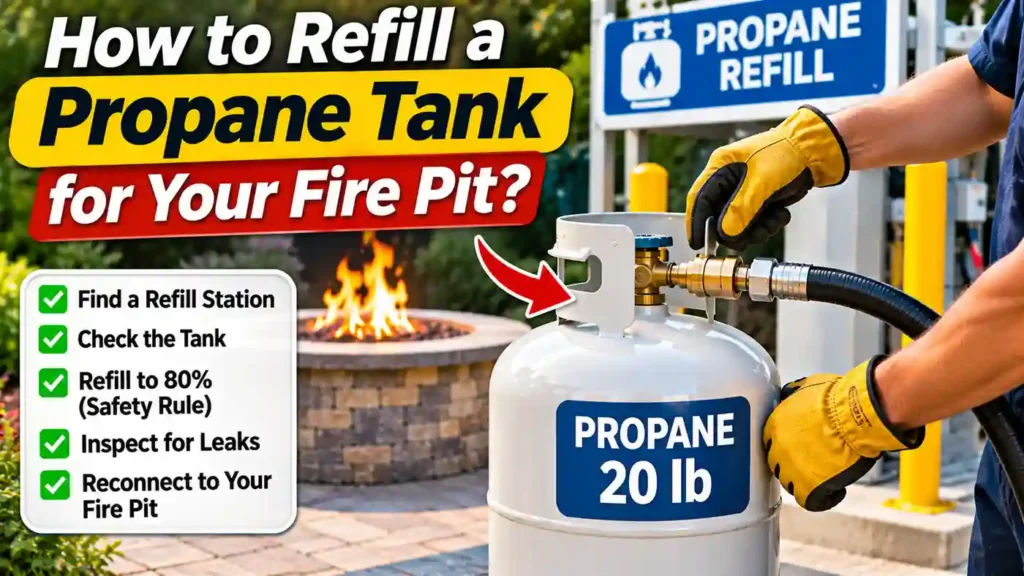
Follow the exact storage procedure in your manual. PERC guidance calls for portable propane cylinders to be kept outdoors rather than in enclosed basements, garages, sheds, or tents. A cylinder that seems empty can still contain propane. Do not treat “empty” as permission for indoor storage.
My storage checklist would separate the furniture, burner, and fuel cylinder. Confirm what can be moved, what must remain outside, and whether the appliance has cooled completely. Do not move a burning table or carry a leaking cylinder through the home to solve a storage problem.
| Situation | What I would do |
|---|---|
| Table operating outdoors in a compliant location | Follow the normal lighting, supervision, and shutdown instructions. |
| Table fully cooled and disconnected | Check whether its manual permits indoor appliance storage. |
| Portable cylinder still connected | Do not bring the fueled assembly indoors. |
| Disconnected cylinder, including an apparently empty one | Store outdoors as required, away from prohibited locations. |
| Suspected leak or damaged gas equipment | Keep away and obtain professional guidance; do not transport a leaking cylinder. |
Outdoor-Only BTU Consumption and Tank Runtime
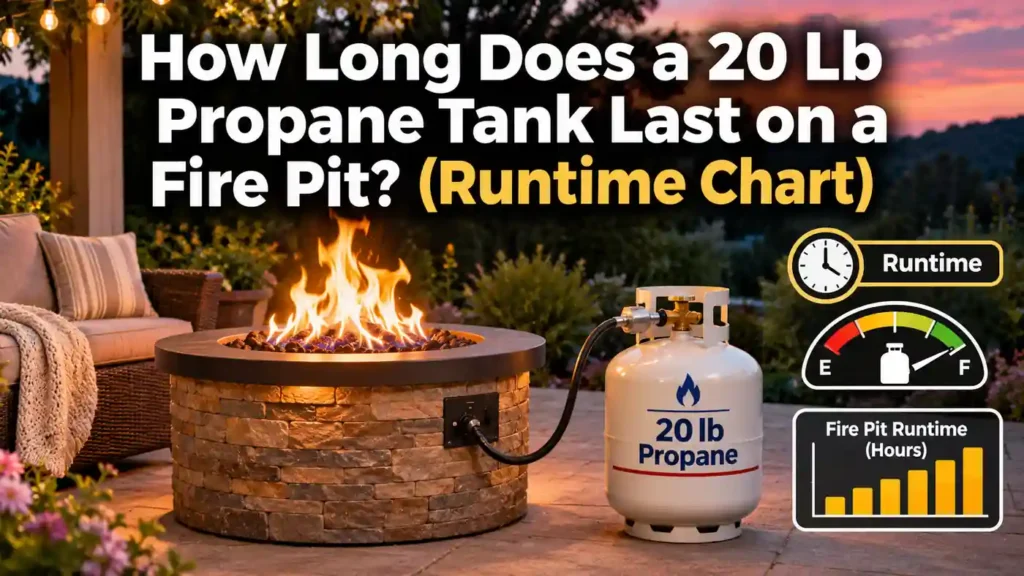
Once you have confirmed a permitted outdoor location, fuel estimates help plan ordinary use. I use approximately 91,500 BTU per US gallon of propane. Dividing rated input by that energy content estimates liquid fuel consumption at a constant full-input setting.
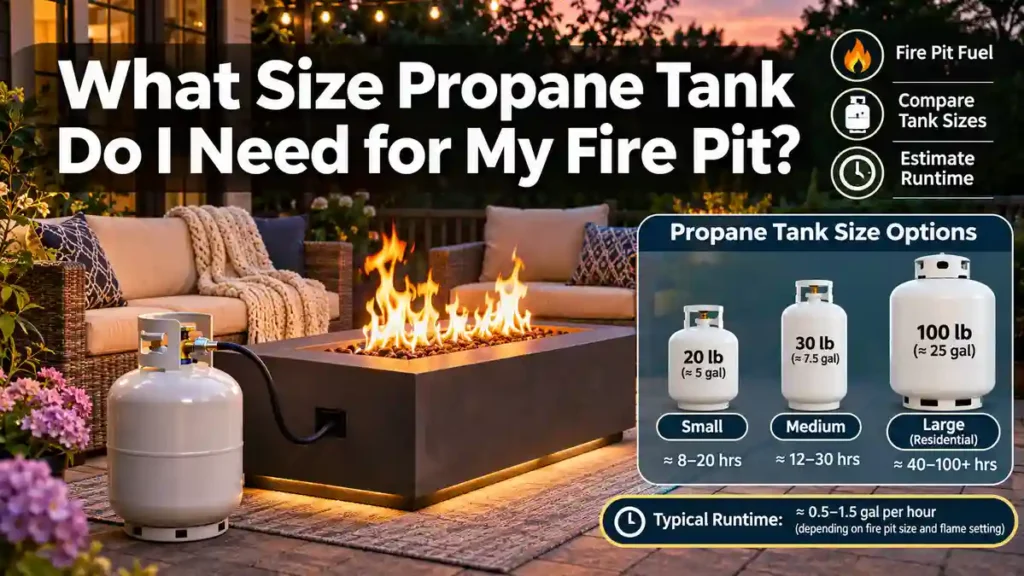
For a nominal full propane fill, I use approximately four-and-seven-tenths gallons in the runtime table. This represents the stated fuel contents, not total cylinder volume or steel-container weight. Do not subtract another fill allowance from that fuel quantity.
| Rated input | Gallons/hour | Ideal hours from 4.70 gal | Gallons for 3 outdoor hours |
|---|---|---|---|
| 30,000 BTU/hr | 0.328 | 14.3 | 0.98 |
| 40,000 BTU/hr | 0.437 | 10.8 | 1.31 |
| 50,000 BTU/hr | 0.546 | 8.6 | 1.64 |
| 58,000 BTU/hr | 0.634 | 7.4 | 1.90 |
| 60,000 BTU/hr | 0.656 | 7.2 | 1.97 |
| 100,000 BTU/hr | 1.093 | 4.3 | 3.28 |
These are energy estimates, not approval to use a particular cylinder with every burner. Actual operation depends on remaining fuel, flame setting, temperature, vaporization capacity, and the manufacturer’s approved supply arrangement. A larger burner may require a different supply even when the arithmetic appears straightforward.
I would use the full rating as a conservative fuel-budget starting point rather than assume a halfway knob position means half consumption. If your cylinder is partly used, enter the fuel actually available in the calculator. None of these numbers changes the indoor prohibition.
Outdoor Fuel Cost Scenarios
The following prices are illustrative assumptions, not current local quotes. Use your actual effective fuel price and account separately for taxes, exchange charges, delivery minimums, or other applicable costs. The calculation concerns fuel only, not equipment purchase or installation.
| Input | At $3/gallon | At $4/gallon | At $5/gallon |
|---|---|---|---|
| 30,000 BTU/hr | $0.98 | $1.31 | $1.64 |
| 40,000 BTU/hr | $1.31 | $1.75 | $2.19 |
| 50,000 BTU/hr | $1.64 | $2.19 | $2.73 |
| 58,000 BTU/hr | $1.90 | $2.54 | $3.17 |
| 60,000 BTU/hr | $1.97 | $2.62 | $3.28 |
| 100,000 BTU/hr | $3.28 | $4.37 | $5.46 |
I include this comparison because readers sometimes consider indoor use when they believe the table would be an economical heater. Fuel cost cannot establish suitability. A low estimated hourly expense still belongs to an outdoor decorative appliance used outdoors. For purchase planning, see propane fire pit costs.
Worked Example: Budgeting Permitted Patio Evenings
Here is an original example using an assumed schedule and fuel price. I calculate with unrounded values and round only the displayed results. The example deliberately concerns an outdoor patio that already meets the appliance’s requirements.
| Assumption or result | Value |
|---|---|
| Burner input | 50,000 BTU/hour |
| Evening length | 2 hours |
| Evenings per month | 8 |
| Monthly burn time | 16 hours |
| Propane price assumption | $4/gallon |
| Monthly fuel | 50,000 ÷ 91,500 × 16 = 8.74 gallons |
| Cost per evening | $4.37 |
| Monthly fuel cost | $34.97 |
| Equivalent nominal 20-lb fills | 8.74 ÷ 4.70 = 1.86 fills |
The fill-equivalent result describes fuel volume, not your exact number of refill trips. Starting contents and leftover fuel affect the practical schedule. My perspective is that budgeting the patio use accurately is more useful than trying to justify an unsafe secondary use inside the house.
Interactive Outdoor Runtime and Cost Estimator
This calculator estimates outdoor fuel consumption only. It does not calculate carbon monoxide exposure, room ventilation, safe indoor operating time, or whether your installation complies with the manual. Confirm suitability before using it to plan an evening.
No indoor use: These results are fuel estimates, not safety limits.
Use the tables and formulas when JavaScript is unavailable.
- Gallons per hour: BTU/hour ÷ 91,500.
- Ideal outdoor runtime: available gallons × 91,500 ÷ BTU/hour.
- Evening cost: gallons/hour × fuel price × outdoor operating hours.
- Monthly cost: evening cost × evenings per month.
What I Would Choose for Indoor Ambiance or Heat Instead
If your objective is a flame appearance, I would start by comparing indoor-rated electric flame-effect products. If your objective is meaningful household heat, I would evaluate equipment designed for that job, its installation needs, and the operating conditions. Those choices deserve a separate assessment from patio furniture.
For a real indoor gas flame, consult a qualified professional about a listed indoor fireplace suitable for your home. Fuel supply, venting, clearances, controls, and local requirements all matter. Do not adapt a fire table, add an improvised exhaust duct, or assume a different regulator turns it into an indoor fireplace.
I would ask the seller for the exact installation manual before ordering. Look for an explicit indoor application rather than relying on phrases such as clean-burning, smokeless, or certified. A safety certification applies to specified conditions, not every location in which the product physically fits.
My Decision Guide Before You Light Anything
| Your situation | My decision | Next action |
|---|---|---|
| You want to light an outdoor fire table in the house | Do not use it indoors. | Select an indoor-rated alternative. |
| You have an open garage door or several windows | Still do not operate it indoors. | Choose a permitted outdoor location. |
| You want a covered patio installation | Permission must be verified. | Check the exact manual and have the site assessed. |
| You want winter storage for the table | Storage may be allowed after cooling and disconnection. | Follow the model’s instructions; keep portable cylinders outdoors. |
| You need heat during a power outage | Do not substitute an outdoor fire table. | Use an appropriate emergency plan and approved equipment. |
| A CO alarm sounds or exposure is suspected | Leave immediately. | Call emergency services from outside and await clearance. |
| Outdoor location and equipment requirements are satisfied | Proceed according to the manual. | Supervise use and follow shutdown instructions. |
For the outdoor purchase itself, my fire pit buying checklist helps you compare documentation, service access, and features. I would put a clearly permitted location ahead of styling or a discount.
Frequently Asked Questions
Can I use a propane fire table indoors for just a few minutes?
No. A short duration does not make an outdoor-only appliance approved for indoor use. There is no safe indoor runtime supplied by the outdoor fuel calculator, and you should not experiment with one.
Is a tabletop model safer indoors because it is smaller?
Size does not establish approval. Check the exact fuel and product type: outdoor propane, indoor electric, and other flame-effect products are different categories. An outdoor-only propane model stays outdoors even if it fits on a small table.
Can I put an outdoor fire table inside an existing fireplace?
No. An existing fireplace opening does not authorize installing an unrelated outdoor appliance inside it. Use a listed fireplace system or insert appropriate to that installation and have a qualified professional evaluate the project.
Does using natural gas instead of propane solve the problem?
No. Changing the fuel does not change an outdoor-only appliance into an indoor-approved one. Any fuel conversion also requires the manufacturer’s approved arrangement for that exact model.
What if I already used it inside and nobody felt ill?
Do not repeat the use. An uneventful experience does not establish safety. If anyone has symptoms, an alarm activates, or a leak is suspected, leave and obtain emergency assistance. Ask a qualified professional about any equipment or installation concerns before further operation.
My recommendation is to keep the decision straightforward: outdoor propane fire pit tables belong in compliant outdoor locations. Choose a different, properly approved appliance for the room inside your house. For your next patio question, explore the Propane Fire Pits guides.

Mike is an experienced propane technician with over 15 years of professional experience in the field. He has dedicated his career to helping customers with their propane needs, from installation to maintenance and repair. Together with Jeremy, he co-founded this website to provide useful information and guidance to customers seeking reliable propane services.