Quick Answer:
A propane fire pit needs regular visual checks, gentle cleaning, clear ventilation, properly arranged fire media, and periodic professional inspection. Before every use, I look for leaves, insect debris, standing water, damaged hoses, unstable supports, or anything blocking the burner. Once the fire pit is completely cool and the gas is shut off, I clean only the surfaces that its manufacturer identifies as owner-serviceable.
At the beginning of the season, I recommend a more thorough inspection. I would arrange professional service at least annually when appropriate or as frequently as the manual requires. A qualified gas technician should handle gas leaks, pressure testing, damaged gas components, regulator replacement, burner faults, and complex ignition repairs. Never enlarge burner holes, modify an orifice, or bypass a safety device.
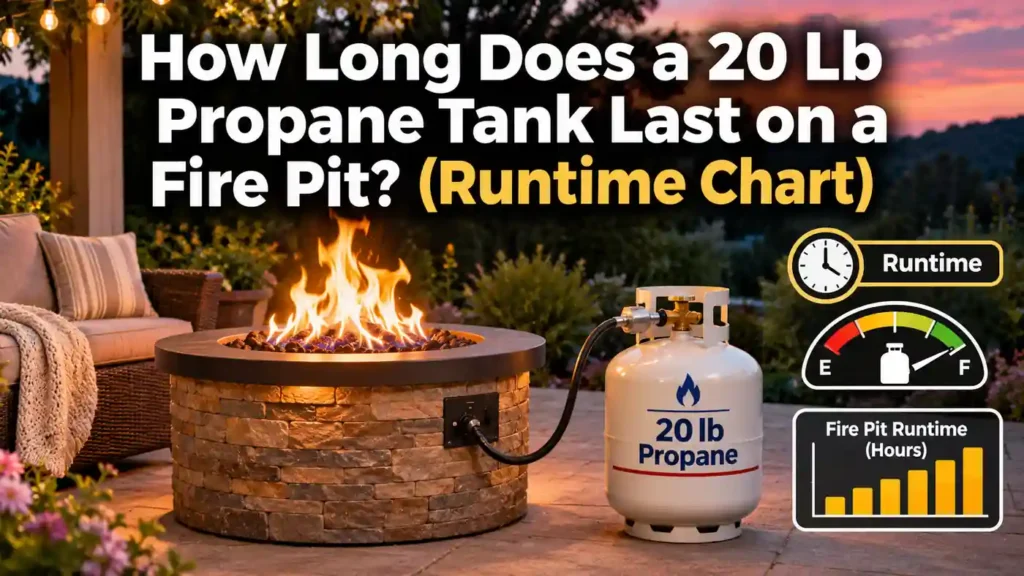
For fuel planning, a 50,000 BTU/hour propane fire pit consumes approximately 0.55 gallon per hour at full input. With roughly 4.7 gallons in a full 20-pound cylinder, theoretical runtime is around 8.6 hours. Actual runtime may be shorter.
When I think about propane fire pit maintenance, I do not start with a cleaning spray or a replacement regulator. I start with three questions: Is it safe to operate? Are the burner and ventilation areas in the condition the manufacturer intended? And did the fire pit actually develop a fault, or am I noticing an ordinary change in weather, fuel level, or flame settings?
Those questions help you avoid unnecessary repairs while taking genuine hazards seriously. Some maintenance takes only a short visual inspection. Other work requires shutting the unit down and calling a qualified professional. In this guide, I will explain how to recognize the difference, keep a usable maintenance log, estimate propane consumption, and budget for reliable outdoor use.
Propane Fire Pit Maintenance Schedule: What Should You Check?
I separate routine care into before-use, after-use, seasonal, and professional service tasks. An owner who glances at the burner every evening may spot leaf buildup long before it becomes an issue. An owner who documents an abnormal shutdown can describe a problem more accurately when requesting service. The intervals below are sensible planning examples rather than a substitute for the manufacturer’s instructions.
| Interval | Owner-level check | When to call a professional |
|---|---|---|
| Before each use | Look for debris, water, blocked vents, hose damage, unstable supports, and unsafe surroundings. | Any suspected gas leak, damaged gas component, or abnormal condition. |
| After each use, once cold | Shut off gas as instructed, remove accessible debris, and cover only when appropriate. | Unusual soot, unexpected shutdown, or erratic flames. |
| Monthly during use | Check finish, media condition, accessible hose, cabinet vents, and drainage. | Persistent corrosion, ignition faults, or deterioration. |
| At start of season | Perform an in-depth visual inspection, clean permitted areas, review manual. | Manufacturer-recommended gas and ignition system inspection. |
| At least annually | Review maintenance history, cover, storage plan, and any recurring symptoms. | Qualified servicing of gas and safety controls when required or appropriate. |
| After storms, impact, or storage | Check for obvious water, damage, dislodged media, and debris. | Evaluation if gas or ignition components were affected. |
I prefer to record the actual condition rather than mark every inspection “good.” A note such as “small amount of water drained from pan; no visible hose damage” is more useful later. If the same issue appears repeatedly, a technician has a starting point. The long-term perspective in How Long Do Propane Fire Pits Last? can help you decide when regular maintenance is no longer enough.


Technical Details: Maintenance Needs of Different Propane Fire Pits
It helps to identify the type of appliance you own before planning upkeep. A compact tabletop burner, portable fire bowl, and large electronic-ignition feature can share the same fuel but use different valves, controls, enclosures, and supply requirements. I use the ranges below for comparison only. They are illustrative product categories, not universal rated specifications.
| Type | Illustrative BTU input | Typical LP fuel arrangement | Main maintenance focus |
|---|---|---|---|
| Small tabletop fire feature | 10,000–20,000 BTU/hr | Approved small canister or specified hose. | Finish, flame area, compatible connector. |
| Portable round fire bowl | 30,000–60,000 BTU/hr | Often approved 20-pound cylinder. | Hose protection, burner pan, feet, heat shield. |
| Outdoor propane fire table | 40,000–65,000 BTU/hr | Approved ventilated cabinet or remote supply. | Cabinet vents, pan drainage, access door, media. |
| Linear decorative fire feature | 60,000–150,000 BTU/hr | May require larger cylinders or fixed LP supply. | Multiple burner sections, media depth, supply capacity. |
| Large electronic-ignition feature | 100,000–250,000+ BTU/hr | Engineered tank, regulator, and pipe system. | Ignition sensors, control box, wiring, safety system. |
Higher BTU output changes more than your fuel bill. A small cylinder may have enough liquid propane in it on paper yet fail to vaporize gas quickly enough for a high-output burner under cold or low-fuel conditions. The supply must be designed for the actual fire pit. Do not substitute a higher-pressure regulator to solve a weak flame. If you are shopping for easier ownership, my Propane Fire Pit Buying Guide discusses practical features and layouts worth comparing.
How to Clean a Propane Fire Pit Safely
To me, good cleaning is careful and unhurried. I would never start while the appliance or fire media is still warm. Turn off the unit and gas supply according to the manual, allow all parts to cool completely, and check which components are intended for routine owner maintenance. Some fire pits provide easy access to a shallow pan. Others have enclosed burner assemblies that should only be serviced by trained personnel.
1. Prepare the area and look for damage
Remove combustible material from the surrounding patio and check for obvious damage before touching anything. Do you see an abraded hose, bent connector, heavy corrosion, or an unstable cylinder? If so, stop rather than continuing with cosmetic cleaning. A maintenance routine must never hide a damaged gas component.
2. Wipe exterior surfaces with compatible materials
Painted steel, stainless steel, stone-look composite, glass, and concrete-style fire tables do not necessarily tolerate the same cleaners. I would follow the manual and use a soft cloth or brush with a mild approved product. Harsh abrasives can strip coatings, and certain acids can damage stone-like finishes. Dry the surface when finished, especially around joints and hardware.

3. Remove accessible leaves and insect debris
Outdoor pits collect dust, seeds, leaves, twigs, and occasional insect nests. With everything cold, remove loose material from areas the manual permits you to access. Pay attention to ventilation and drainage paths. Do not insert pins, wire brushes, drills, or sharp objects into burner ports. Changing the shape of an opening can change how the appliance burns.
4. Inspect and arrange fire media
Fire glass, lava rock, and ceramic pieces do more than decorate the flame. Their placement can affect the way air and flames move near the burner. Check for chipped pieces, accumulated dirt, soot deposits, excess moisture, and media that has shifted over an igniter. Clean or reposition only if the instructions expressly permit it, and keep the correct quantity and depth. Never pile extra media over an ignition sensor to improve appearance.
5. Allow wet parts to dry fully
Moisture matters. If washing is an approved procedure for a specific media type, follow the drying instructions before restoring it to the appliance. I would not heat damp decorative stone just to speed up drying. Some unsuitable or moisture-filled rocks can crack or break when subjected to high heat.
Once cleaning is complete, I check that no cloth, packaging, tool, or loose debris remains in the enclosure. The next use should follow the normal lighting instructions, not an improvised restart process.


For a more detailed discussion of approved fire media, see Best Decorative Elements for Propane Fire Pits. My rule is to preserve the original burner arrangement rather than trying to make the table look fuller with unapproved material.
What Should I Check on the Tank, Hose, and Regulator?
Before you light a propane fire pit, the visible supply components deserve attention. I look for an upright cylinder in its approved location, an intact hose routed away from sharp edges and heat, and accessible fittings without signs of impact, corrosion, or damage. I do not disconnect fittings just to inspect their threads, and I do not replace a regulator because another model looks similar.
Physical fit does not prove compatibility. A hose or regulator must meet the exact fuel, pressure, flow and connector requirements of the appliance. If I am uncertain, I ask the manufacturer or a qualified gas technician to identify the approved replacement part.
| What you notice | Possible concern | What I would do |
|---|---|---|
| Leaves blocking enclosure openings | Reduced ventilation or drainage. | Remove accessible debris only when cool. |
| Hose has cracks, abrasions, or melted area | Loss of gas-line integrity. | Stop using the pit and arrange approved replacement. |
| Heavy rust on a burner component | Possible structural deterioration. | Request professional inspection. |
| Gas odor or suspected hissing | Possible escaping propane. | Leave area, avoid ignition sources, seek emergency help. |
| Flame suddenly much smaller | Fuel level, temperature, restriction, controls, or other issue. | Stop and follow allowed checks; seek service if unexplained. |
| Cylinder is unstable or in unapproved enclosure | Tipping, heat, ventilation, or storage hazard. | Do not operate until the approved placement is restored. |
Only perform a leak-check procedure if it is prescribed in your owner’s manual and you can follow it exactly. Do not search for leaks with an open flame. Plumbing work, pressure testing, regulator adjustment, and repairs belong to qualified personnel. For additional information, see How to Check if Your Propane Fire Pit Has the Right Gas Pressure.
Why Are the Flames Lower, Uneven, or Producing Soot?
I treat changes in flame appearance as clues rather than diagnoses. A windy evening, a cylinder nearing empty, cold weather, displaced fire glass, or a genuine gas-system fault can produce similar visible symptoms. Decorative flames are often intentionally yellow, so color alone does not indicate a problem. What matters is whether the flame matches the normal appearance described for that specific model.
If a unit repeatedly shuts down, overheats surrounding surfaces, produces unexpected heavy soot, or smells of gas, I would discontinue use. I would not keep relighting a faulty burner or bypass a safety control to force it to operate.
| Symptom | Possible explanations | Safe next step |
|---|---|---|
| Low flame after long operating period | Low cylinder level, cold temperature, or insufficient vapor delivery. | Check allowed fuel information; seek service if it recurs. |
| Black soot forming on the media | Combustion, airflow, or incorrect media arrangement. | Stop use, consult manual, arrange qualified service. |
| Push-button igniter keeps failing | Battery, moisture, ignition component, or supply issue. | Use permitted battery checks only; request service if unresolved. |
| One part of the burner burns unevenly | Debris, shifted media, or distribution issue. | Inspect owner-accessible areas only when cool. |
| Fire pit shuts off by itself | Safety control, fuel supply, or ignition problem. | Do not bypass controls; have it evaluated. |
| Gas smell, suspected leak, or hissing | Escaping gas. | Leave the area, avoid switches/flames, call for emergency assistance. |
My favorite maintenance habit is writing down exactly what happened: how long it had been running, weather conditions, approximate cylinder level, and whether the flame changed suddenly or gradually. Those details are more valuable to a service technician than guessing which component is bad. A correct diagnosis avoids replacing good parts.
Does Fire Glass or Lava Rock Need Regular Replacement?
There is no universal replacement interval for every type of fire media. I would inspect it for cracking, contamination, soot, loss of its intended form, or any condition mentioned in the product instructions. Approved media may last for years, but dirty or damaged pieces should be cleaned or replaced in accordance with the manufacturer’s guidance.
Remember that a propane fire pit does not create wood ash, yet its pan can still accumulate windblown dust, leaves, pollen, insects, and bits of degraded nearby material. A clean-looking flame does not guarantee that drain channels beneath the media remain open.
I also avoid river pebbles, construction gravel, and decorative stones that were never intended for heat exposure. Some can retain moisture and fracture when heated. The manufacturer’s specified media depth is another non-negotiable: too much material can obstruct combustion openings or ignition equipment.
Electronic Ignition and Push-Button Igniters: What Is Different?
Simple match-lit fire bowls have fewer electronic parts than an automatic ignition table with flame-sensing controls. That does not make the simpler design maintenance-free; it just changes what you need to check. With a battery-powered igniter, the manual may allow battery replacement and cleaning of an accessible compartment. If there is corrosion, water damage, or a wiring fault, I would stop and request appropriate service.
For a fully automatic system, follow the manufacturer’s weather protection and shutdown instructions. Sensors, valves, and electronic modules should be evaluated as part of qualified service. I would never hold a gas valve open by hand, bridge electrical contacts to defeat flame sensing, or remove a safety device because the unit will not stay lit.
If you are buying a new unit, consider how easily it can be inspected and how readily its manufacturer supplies approved replacement components. A little extra planning now can save confusion when the fire pit is older.
Rain, Winter, and Long-Term Storage
The outdoor environment shapes the right maintenance schedule. A pit beneath trees faces falling leaves and pollen. A coastal fire table may suffer faster surface corrosion. A model exposed to heavy rain may accumulate water even when its burner is protected. I would treat these factors as reasons to inspect more often, not as permission to invent new cleaning or heating methods.
- Before rainy weather: Check that drainage and ventilation openings are unobstructed. Use only a cover approved for your fire pit, and never cover hot media.
- After storms: Look for standing water, displaced media, fallen branches, obvious corrosion, or damaged connections before attempting normal operation.
- Before freezing temperatures: Follow model-specific winterization instructions. Never warm a regulator or cylinder with a torch or improvised heater.
- During extended storage: Shut the gas supply off as the manual instructs. Keep portable propane cylinders only in approved outdoor storage areas, never in your home, garage, or enclosed room.
- Before returning to service: Recheck the manual, inspect visible components, and arrange professional attention if the system has been damaged, moved, or disconnected.
When I use a cover, I pay attention to ventilation and moisture control. An attractive cover does not replace proper drainage, and a poorly chosen cover may trap moisture rather than solve the problem.
What Can I Do Myself, and When Do I Need a Gas Technician?
Here is the line I use: routine cosmetic and visible upkeep can often be done by the owner within the manual, whereas changes to fuel delivery, combustion, ignition, or automatic shutoff require qualified expertise. The distinction matters more than the number of tools you own.
| Task | Owner-level? | Professional service? | Condition |
|---|---|---|---|
| Wipe cool exterior surfaces | Yes | Usually no | Use manual-approved cleaning materials. |
| Look at accessible hose for visible damage | Visual inspection only | Yes when damaged | Do not substitute an unknown hose. |
| Clean permitted drain opening | When allowed | If obstruction is internal | Do not dismantle burner assembly. |
| Reposition approved media | When manual permits | If damage or restricted assembly | Restore original fill depth and layout. |
| Measure or adjust operating gas pressure | No | Yes | Requires suitable instruments and procedure. |
| Repair a leaking regulator, hose, or fitting | No | Yes | Do not operate until repaired. |
| Service flame sensor, valve, or complex ignition | Limited checks only | Yes | Never defeat safety protections. |
| Change burner orifice or convert fuel type | No | Yes | Only manufacturer-approved conversion. |
If the instructions use technical service terms without explaining them in an owner section, I would not interpret that as an invitation to experiment. Ask the manufacturer for clarification or contact an appropriately qualified gas professional.
BTU Consumption Table: How Much Propane Does a Fire Pit Use?
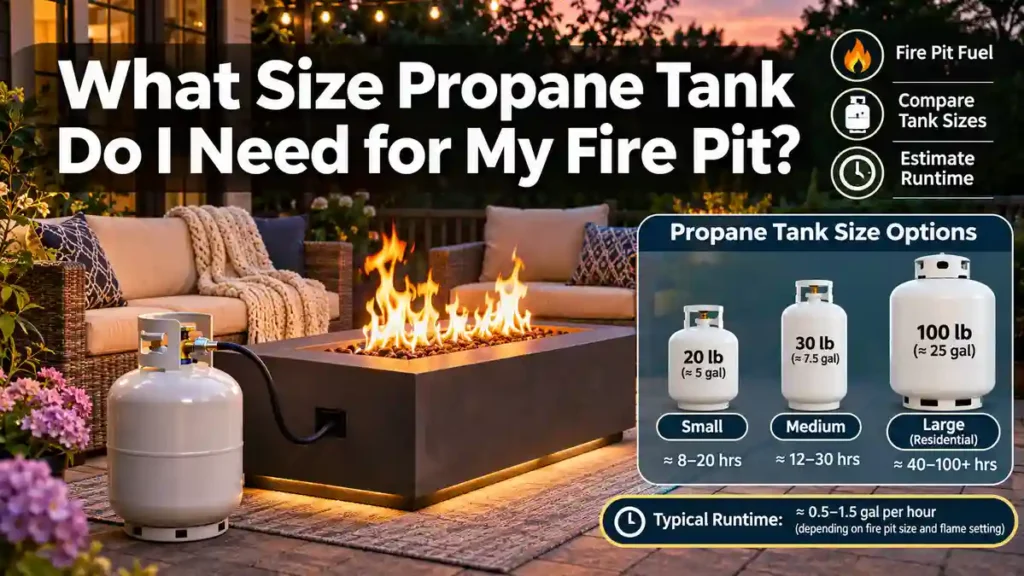
A correctly maintained fire pit still burns fuel according to its heat-input rating. I start with approximately 91,500 BTU of fuel energy per gallon of propane. A nominal 20-pound fill contains about 4.7 gallons. Those figures let me estimate usage, but they do not measure pressure or prove that an appliance is functioning correctly.
Gallons per hour = rated BTU/hour ÷ 91,500
Theoretical runtime = available liquid gallons ÷ gallons per hour
Fuel cost = gallons consumed × price per gallon
| Input rating | Consumption | 20 lb: 4.7 gal | 15 lb fuel load: 3.5 gal |
|---|---|---|---|
| 20,000 BTU/hr | 0.219 gal/hr | 21.50 hours | 16.01 hours |
| 30,000 BTU/hr | 0.328 gal/hr | 14.34 hours | 10.68 hours |
| 40,000 BTU/hr | 0.437 gal/hr | 10.75 hours | 8.01 hours |
| 50,000 BTU/hr | 0.546 gal/hr | 8.60 hours | 6.41 hours |
| 60,000 BTU/hr | 0.656 gal/hr | 7.17 hours | 5.34 hours |
| 75,000 BTU/hr | 0.820 gal/hr | 5.73 hours | 4.27 hours |
| 100,000 BTU/hr | 1.093 gal/hr | 4.30 hours | 3.20 hours |
| 150,000 BTU/hr | 1.639 gal/hr | 2.87 hours | 2.14 hours |
These values are estimates at full rated input, not guaranteed burn times. The actual cylinder fill, ambient temperature, remaining propane level, burner demand, and vaporization capacity can affect operation. The tank, regulator, and hoses must all meet the manufacturer’s supply requirements. The 20-pound propane fire pit runtime chart explains further why practical cylinder life differs from simple arithmetic.
Worked Example: How I Connect Fuel Costs with Maintenance Records
Suppose I own a 50,000 BTU/hour fire table and operate it at its full rated input. Dividing 50,000 by 91,500 gives approximately 0.546 gallon per hour. A three-hour gathering uses roughly 1.64 gallons. At an illustrative price of $4.00 per gallon, the fuel expense is about $6.56.
If I host four three-hour gatherings in a month, total monthly burn time is 12 hours. Multiplying 12 by 0.546 gives around 6.56 gallons; multiplying by $4 gives approximately $26.23 in fuel expense. A single 4.7-gallon cylinder will not last the entire month at that usage pattern.
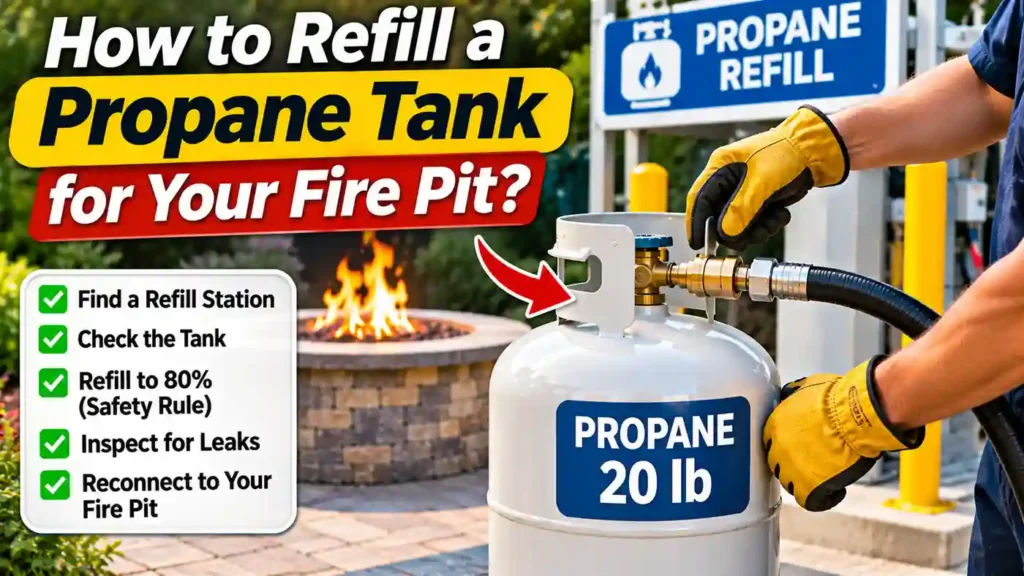
Now imagine that I refill more often than expected. I would review how much propane was actually sold, because some exchanges provide a 15-pound fill rather than 20 pounds. I would also check whether my usage estimate included all hours. I would not assume that a higher-than-expected fuel bill proves a leak. If there is gas odor or other evidence of a leak, however, I would treat it as an emergency regardless of the cost estimate.
For me, the useful habit is combining consumption calculations with a log of actual use and unusual symptoms. That gives service professionals context without pretending that a fuel chart can substitute for a safety inspection.
Interactive Propane Fire Pit Runtime and Fuel Cost Calculator
Use this interactive estimator to enter your own fire pit’s BTU rating, the amount of propane available, and the fuel price you pay. I included a planning load factor, but it does not correspond to a particular control-knob position. Unless you know the manufacturer’s verified low-input rating, I would use 100% for conservative full-output planning.
Fuel use: 0.546 gal/hr · Hourly fuel cost: $2.19 · Monthly fuel: 6.56 gal · Monthly cost: $26.23
This is a mathematical estimate, not a test of gas pressure, combustion, or cylinder vaporization performance. If WordPress strips JavaScript, the formulas and tables above remain available.
Fuel Cost Scenarios: Hourly and Monthly Budgets
Propane prices differ by region, supplier, taxes, and refill-versus-exchange method. Here I compare $3, $4, and $5 per gallon as illustrative planning scenarios, not as verified current retail prices. All calculations use the unrounded energy figure and round only the displayed amounts.
| Rated input | Gallons/hr | $3/gal | $4/gal | $5/gal |
|---|---|---|---|---|
| 30,000 BTU/hr | 0.328 | $0.98 | $1.31 | $1.64 |
| 40,000 BTU/hr | 0.437 | $1.31 | $1.75 | $2.19 |
| 50,000 BTU/hr | 0.546 | $1.64 | $2.19 | $2.73 |
| 60,000 BTU/hr | 0.656 | $1.97 | $2.62 | $3.28 |
| 75,000 BTU/hr | 0.820 | $2.46 | $3.28 | $4.10 |
| 100,000 BTU/hr | 1.093 | $3.28 | $4.37 | $5.46 |
| Rated input | 8 hours/month | 16 hours/month | 30 hours/month |
|---|---|---|---|
| 30,000 BTU/hr | $10.49 | $20.98 | $39.34 |
| 40,000 BTU/hr | $13.99 | $27.98 | $52.46 |
| 50,000 BTU/hr | $17.49 | $34.97 | $65.57 |
| 60,000 BTU/hr | $20.98 | $41.97 | $78.69 |
| 75,000 BTU/hr | $26.23 | $52.46 | $98.36 |
Those amounts cover fuel, not inspection, approved parts, transport, taxes, or maintenance supplies. I keep fuel costs separate from the service budget so I know which expense changed. For a longer discussion of operating expenses, visit How Much Does It Cost to Run a Propane Fire Pit?
What Does Propane Fire Pit Maintenance Cost Per Year?
I would not promise that every owner should pay the same amount annually. A straightforward portable fire bowl may require very little cosmetic care, while a large permanently installed electronic feature might need specialized attention. The following is an example of how to build a budget, not actual contractor pricing.
| Budget item | Basic-care year | Moderate-service year | Repair year |
|---|---|---|---|
| Cleaning consumables and cover allowance | $20 | $40 | $60 |
| Inspection or professional service | $100 | $175 | $250 |
| Approved batteries, media, and parts allowance | $10 | $50 | $175 |
| Illustrative total | $130 | $265 | $485 |
Real costs can be lower or much higher. A technician may find the system in excellent condition and need no parts; a failed control valve or electronic module could be more expensive than the example. I would obtain a written quote and never postpone a necessary safety repair simply to remain under an arbitrary budget.
My Maintenance Decision Guide: Clean, Monitor, Service, or Replace?
I use this simple decision approach because the correct response depends on the seriousness of what you find. A dirty exterior is not an emergency. A suspected gas leak is. Several conditions can exist at the same time, so choose the most cautious applicable action.
| Observation | Decision | Next step |
|---|---|---|
| Exterior dust with no other concern | Clean | Use approved method after complete cool-down. |
| Leaves at owner-accessible vent or pan | Clean | Remove debris safely; confirm airflow and drainage. |
| Media shifted, manual permits adjustment | Restore layout | Follow the documented arrangement and fill depth. |
| Unexplained low flame or repeated ignition fault | Service | Stop use; have the cause evaluated if not resolved by permitted checks. |
| Cracked hose, rusted burner, damaged regulator | Do not operate | Request qualified inspection and approved repair. |
| Gas odor, suspected leak, hissing | Emergency response | Leave area, avoid ignition sources, contact emergency help. |
| Severe deterioration and costly repeated failures | Compare replacement | Obtain service quote and compare a listed new unit. |
A cost-saving approach is only useful when it does not compromise safety. If I have repeated repair bills or poor parts support, I compare the repair quote against a factory-built replacement. The article What Are the Downsides of Using a Propane Fire Pit? reviews longer-term ownership tradeoffs.
Keep a Short Maintenance Log
One original planning method I recommend is pairing a condition log with approximate hours of operation. It is not a leak detector or a substitute for a professional inspection. It simply makes your own observations more consistent, and it helps you explain a recurring symptom without guessing.
| Date | Condition observed | Usage note | Action taken |
|---|---|---|---|
| April 6 | Pan clear, vents open, media intact | Two hours of normal use. | Routine inspection. |
| April 20 | Leaves near accessible enclosure vent | Did not operate before cleaning. | Removed debris after cool-down. |
| May 4 | Flame smaller than usual | One hour; cylinder level unknown. | Stopped and reviewed owner-level checks. |
| May 5 | Low-flame behavior repeated | No further operating test. | Requested qualified inspection. |
Write down the actual fuel amount purchased, not just “one tank,” because cylinder exchange fills vary. If you are using your log to plan refills, see How Long Will a Propane Fire Pit Burn on a Full Tank?. I find that a tiny record made regularly is more valuable than a detailed spreadsheet no one updates.
Seven Maintenance Mistakes I Would Avoid
- Cleaning a warm fire pit. Heat remains in burner parts and decorative media long after the flame disappears. Let everything cool completely.
- Using a wire or drill bit in burner openings. A damaged port can change approved gas flow and flame characteristics.
- Adding unapproved river rocks. Unrated rocks may retain moisture and fracture under heat.
- Blocking ventilation or drainage. A tidy cabinet is not necessarily a safely ventilated one.
- Storing cylinders indoors. Follow approved outdoor storage requirements, not convenience.
- Replacing regulators based only on flame height. Many different issues can cause a small flame, and improper pressure changes can be hazardous.
- Ignoring or defeating ignition safety devices. Repeated shutdown may be a sign that the equipment needs attention, not that a safety switch should be removed.
I would also reassess the fire pit if a patio renovation changes the surrounding clearances, drainage, enclosure vents, or gas-line routing. The original installation may have been safe before a new wall, cabinet, or outdoor kitchen was added.
Frequently Asked Questions
How often should I clean a propane fire pit?
I remove visible loose debris whenever needed after cool-down, visually inspect before each use, and perform a more thorough cleaning at the beginning of the season. The manual, weather exposure and amount of use determine the exact interval.
Should my fire pit be professionally serviced every year?
An annual professional inspection is a sensible baseline for many gas fire features, subject to the manufacturer’s maintenance requirements and local rules. Some models or conditions require more frequent service. Gas-supply, valve, and ignition-system work belongs with qualified personnel.
Can I wash fire glass or lava rocks?
Only if the manufacturer permits washing the specific media installed. Follow the cleaning and drying instructions. Replace broken or contaminated pieces as instructed rather than assuming all decorative media can be treated the same way.
What if my propane fire pit gets rained on?
Let the equipment cool, keep it turned off, and inspect for standing water, blocked drainage, shifted media, or visible damage. Follow the manual before attempting to light it. If ignition or gas components are affected, request professional service.
Can I clean the burner holes myself?
Do not insert sharp objects, drill ports, or dismantle fuel-metering components. Some manufacturers permit limited superficial debris cleaning on a cold unit. For internal blockage or corrosion, I would call a qualified technician.
Is a yellow flame always a problem?
No. Many decorative fire pits are designed to display yellow flames. Heavy new soot, abnormal noises, unstable flames, or a major change from the normal pattern still deserves attention. Compare with the manufacturer’s operating guidance.
How long will a 20-pound tank last on my fire pit?
At 50,000 BTU/hour, 4.7 gallons gives approximately 8.6 theoretical hours at full input. Actual results vary with fill quantity, input setting, weather and the cylinder’s ability to vaporize propane fast enough.
Should I disconnect the cylinder after every use?
Follow the appliance’s specific shutdown, disconnection and storage instructions. Always shut off the fire pit and cylinder valve as directed. Do not disconnect fittings unnecessarily or store portable propane cylinders in enclosed rooms.
What is the clearest sign I should stop using the fire pit?
A suspected gas leak—odor, hissing, or other evidence—calls for immediately stopping use and moving away. Avoid ignition sources or operating electrical switches, and contact your gas supplier or emergency services from a safe location. Damaged gas components and unexplained repeated failures also mean the pit needs attention before further use.
Final Thoughts: A Simple Routine Protects Your Fire Pit
My practical advice is to make maintenance predictable: a quick visual check before lighting, careful debris removal after cool-down, seasonal cleaning, and qualified service for gas, burner, and safety-control problems. Consistency is more helpful than an enormous checklist you follow once and forget.
I also like keeping a short fuel and condition log. Together with the calculator, it helps you plan gatherings and explain how the fire pit has behaved over time. But fuel calculations are planning tools, not evidence that an appliance is leak-free or safe. If something looks wrong, use the manual and call a qualified professional rather than experimenting with gas components.
Read next: Are Propane Fire Pits Safe? for a broader safety guide, or How Long Do Propane Fire Pits Last? for service life and replacement considerations.

Mike is an experienced propane technician with over 15 years of professional experience in the field. He has dedicated his career to helping customers with their propane needs, from installation to maintenance and repair. Together with Jeremy, he co-founded this website to provide useful information and guidance to customers seeking reliable propane services.