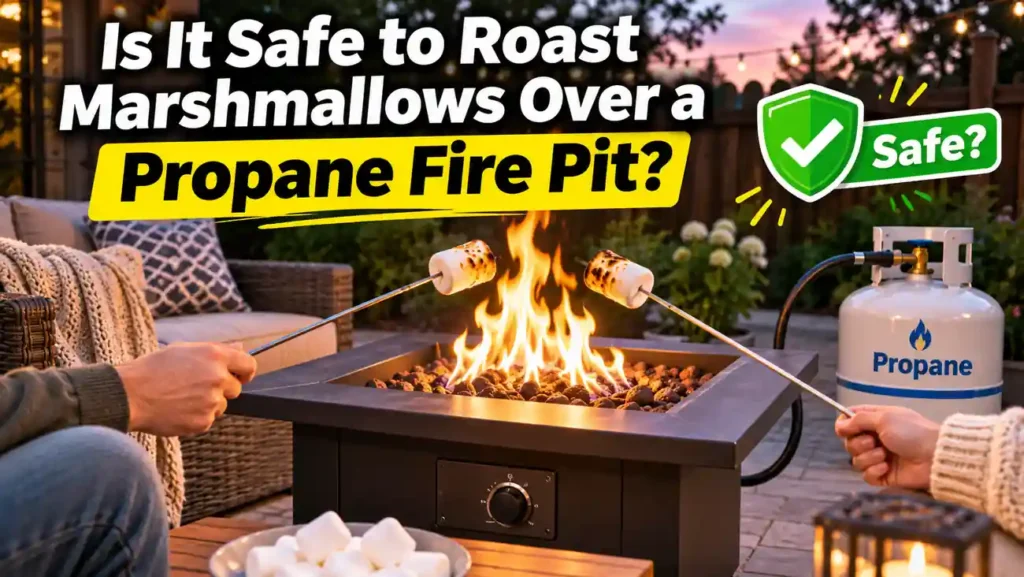
Quick Answer
Roasting marshmallows over a propane flame is not automatically unsafe because of the fuel, but you should do it only if your exact propane fire pit is expressly approved by its manufacturer for food roasting. Many propane fire bowls and fire tables are decorative heating appliances, not cooking appliances. If the manual says “decorative use only,” prohibits cooking, or never authorizes food preparation, I would not roast marshmallows over it. Use a food-rated propane camp stove, grill or other approved roasting appliance instead.
My practical rule is to check three things before getting out the marshmallows: the appliance’s permitted use, the condition and location of its flame system, and the people managing the activity. A clean flame cannot compensate for an unapproved burner, dripping sugar, improper media, or an unattended child.
There is something appealing about making s’mores around an outdoor fire pit without hauling logs or tending smoky coals. I understand why a propane fire table seems ideal: it starts quickly, the flame is adjustable, and there is less smoke blowing into everyone’s faces. But I would never treat a decorative propane fire pit as a grill simply because both burn propane.
In this guide, I’ll explain where the real risks come from, why model-specific approval matters, how food residue can affect a burner, how I would organize a family roasting session if the appliance is approved for it, and when I would switch to another cooking method. I’ll also show a fuel-use calculation and give you a decision checklist you can use before a gathering.
In This Guide
Can You Roast Marshmallows Over a Propane Flame?
Propane is routinely used in cooking appliances, including outdoor grills and gas ranges. Under good combustion conditions, its principal combustion products are carbon dioxide and water vapor. That explains why a properly operating propane cooking appliance can heat food without giving it the smoke flavor of a wood fire.
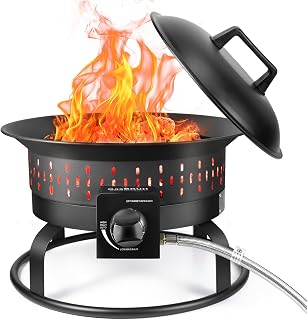
However, the word propane describes the fuel, not the design or intended use of every device that burns it. A fire table may have a decorative flame spread across lava rock or fire glass, and its burner may not be intended for food drippings, utensils, or people leaning close to the fire. It might meet standards for an outdoor decorative gas appliance rather than an appliance designed and evaluated for cooking.
I separate the question into two parts: “Is propane an ordinary cooking fuel?” Yes, in a correctly designed cooking appliance. “Is this particular fire pit approved for cooking?” That answer must come from the exact owner’s manual or manufacturer. The second answer determines what I would do.


Why a clean flame is not enough
Some articles say that propane burns cleanly, so roasting marshmallows over any propane fire pit must be safe. I think that conclusion skips the most important question. It says nothing about whether the decorative rocks are approved for contact with food, whether sticky drips can obstruct burner ports, whether flames remain stable during cooking, or whether guests can safely reach the roasting area.
A blue flame also does not prove that a decorative appliance is food-safe, nor does a yellow flame automatically prove the opposite. Flame color depends on burner design, combustion, and other conditions. If the flame changes unusually, the manual and a qualified service professional—not a guess based on color—should guide the response.
How Do I Know Whether My Propane Fire Pit Allows Roasting?
I would start with the model number, not with advice for a vaguely similar fire bowl. Look for the model label, then read the installation and operating instructions. Search the manual for “cooking,” “food,” “roasting,” “decorative,” “not for cooking,” and any restrictions on accessories or media.
Some manufacturers explicitly advise against cooking over their fire pits. For example, published manufacturer answers for certain Bond models say the products were not rated for food preparation and warn that food drippings could block burner openings. Other products may be designed specifically for cooking. These positions cannot be transferred from one model to another.
Important Safety Note: A certification mark or outdoor-use label is not, by itself, approval for preparing food. Before roasting marshmallows over a propane fire pit, confirm that the manufacturer expressly permits food roasting for your exact appliance model and configuration. If cooking is prohibited or approval cannot be verified, use a separate food-rated cooking appliance.

If you have a permanent gas fire feature connected to a larger tank or gas line, the same principle applies. A professional installation may address gas-system requirements, but it does not transform a decorative appliance into an approved cooking station. For related setup issues, see our ‘+link(‘How to Set Up a Propane Fire Pit in Your Backyard’)+’ and ‘+link(‘Are Propane Fire Pits Safe? Complete Safety Guide’)+’.
Propane Fire Pit Marshmallow Safety Risks at a Glance
I consider five categories of risk before a gathering: the appliance’s authorization, burner contamination, accidental burns, operating environment, and food-handling habits. Most problems become easier to prevent when you separate them rather than asking one vague question about whether the fire is “safe.”
Important Safety Reminder: A marshmallow roasting session should never override the propane fire pit manufacturer’s original requirements for outdoor placement, combustible clearances, supervision, or shutdown procedures. Only roast food over appliances expressly approved for that purpose. Always supervise children and pets, keep combustible materials away from the flame, and allow the appliance to cool completely before cleaning or storing it.
Sticky marshmallow drips are not a minor detail
Marshmallows contain sugar and can soften rapidly near a hot flame. When they fall, the residue may land on decorative media or a burner opening. A decorative fire pit does not necessarily have a removable, food-safe catch pan or a cleaning system designed for grease and sugar.


That is why I would not tell you simply to put a homemade wire mesh over the burner. An improvised tray or screen can change airflow, heat distribution, or approved clearances. Unless the manufacturer expressly supplies or authorizes it, I would avoid it. If sugary food falls into the appliance, stop using it, allow it to cool, and follow its cleaning instructions. If burner ports are affected or performance changes, contact qualified service rather than poking holes with makeshift tools.
Why ventilation still matters outdoors
Although propane can burn cleanly in a correctly operating appliance, combustion can produce carbon monoxide, especially when conditions are poor. Carbon monoxide cannot be reliably detected by smell. An outdoor-only fire pit must stay outdoors in an area permitted by its manual. Enclosed patios, garages, tents and poorly ventilated structures can be dangerous even when a door or window is open.
I would also keep an approved fire pit away from doorways, windows and air intakes according to the exact manufacturer instructions and applicable local rules. For a closer look at placement, read ‘+link(‘How Much Space Do You Need Around a Propane Fire Pit?’)+’ and ‘+link(‘Can You Use a Propane Fire Pit Table Indoors?’)+’.
How I Would Organize a Marshmallow-Roasting Session on an Approved Appliance
Here is a planning method I recommend rather than a claim that I personally tested a particular fire pit. It applies only if the manufacturer expressly permits the roasting activity. The goal is to remove predictable mistakes before the first marshmallow goes near the flame.
1. Confirm the exact equipment setup
Read the manual. Confirm fuel type, regulator, cylinder size, placement, permitted media, accessory requirements and any cooking instructions. Do not swap a propane cylinder, convert fuels or add a cooking grate because another product uses the same connection. I would perform any required outdoor leak check before lighting, using the procedure given by the manufacturer and never using a flame to look for leaks.
2. Prepare the area before guests arrive
I would put chairs and bags outside the appliance’s specified clearance zone, check overhead branches or fabric structures, and clear walking paths. Wind matters: a blowing flame can threaten nearby materials and make an otherwise calm gathering unpredictable. If wind or weather is outside the manual’s permitted conditions, I would postpone the fire-pit portion of the evening.
3. Set a single roasting position
Rather than letting guests circle the fire, I prefer one managed position where an adult can supervise the activity and avoid crowding. I would keep waiting guests and children farther back. This is a planning practice, not a substitute for the manufacturer’s clearance distances. The precise safe reach and utensil length depend on appliance size and instructions.
4. Use suitable food-contact utensils
Choose clean, food-safe skewers or roasting implements recommended for the equipment. Avoid short improvised sticks that force your hand over the flame, and be mindful that metal parts can heat up. If using reusable utensils, wash them before and after the gathering. Never lay a hot skewer on a chair, tabletop finish or where children can grab it.
5. Roast slowly and supervise closely
Where roasting is expressly approved, use the maker’s instructions for flame level, position and food distance. I would rotate the marshmallow steadily rather than deliberately setting it on fire. A marshmallow that flares up can drop burning sugar or alarm a child holding the stick. If food ignites, move it away from people and manage it safely; do not wave it around, and do not bring a flaming skewer indoors.
6. Keep the cooking area free of toppings
For s’mores, I would build an assembly station away from the burner. Crackers, chocolate, plates, wrappers and napkins are easier to handle on a separate table. It also reduces the temptation to reach over hot fire media. I would not allow anyone to drop chocolate, butter, oil, syrups or food scraps into a decorative fire feature.
7. Shut down and allow complete cooling
When the last marshmallow is done, follow the appliance’s shutdown sequence, including the cylinder valve where required. Continue keeping people away from the hot rim, fire glass and stones after the flame goes out. Surfaces can remain hot well after shutdown, and visible absence of flame is not evidence that a surface is cool enough to touch.
How Much Propane Does a Three-Hour S’mores Night Use?
Even when the activity uses an approved outdoor appliance, fuel planning can help. I use approximately 91,500 BTU per gallon of propane for an illustrative calculation. Actual consumption depends on the appliance’s input rating and the amount of time it operates at each setting.
Suppose an approved propane appliance has a rated input of 30,000 BTU per hour. At full input, I estimate consumption by dividing 30,000 by 91,500. That equals about 0.328 gallons per hour. Over a three-hour gathering, the calculation is approximately 0.984 gallons. At a hypothetical $3.50 per gallon, the fuel-only cost is about $3.44.
That is a planning scenario, not evidence that a decorative 30,000 BTU fire pit is approved for roasting food. Burner input affects fuel use; it does not establish food-safety approval, clearances or compatibility with a particular propane tank.
Calculation Note: These estimates use approximately 91,500 BTU per gallon of propane and an illustrative fuel price of $3.50 per gallon. Calculations assume the appliance operates at its full rated burner input throughout the entire three-hour period. Actual fuel consumption and costs may vary with burner settings, propane prices, and operating conditions. These fuel consumption figures do not imply that a propane fire pit is approved for preparing food. Always confirm that the manufacturer expressly permits marshmallow roasting or food preparation before use.
What if the flame is turned down?
Some users assume a control knob at halfway means exactly half the propane consumption. I would not make that assumption. Knob position and input rate are not necessarily proportional. If your manufacturer gives an actual low-fire BTU input, you can use that number. Otherwise, a nominal reduction is only a rough scenario, not a measurement.
For instance, if an approved appliance truly averages 15,000 BTU per hour rather than 30,000, its estimated fuel use becomes roughly 0.164 gallons per hour. Three hours would consume about 0.492 gallons, costing about $1.72 at $3.50 per gallon. That calculation is mathematically straightforward, but it does not tell you what your particular knob setting achieves.
If you want more detail on cylinders and session length, continue to ‘+link(‘How Long Does a 20 Lb Propane Tank Last on a Fire Pit?’)+’ or ‘+link(‘How Much Does It Cost to Run a Propane Fire Pit?’)+’. I would treat those as planning tools, not permission to use an unsuitable cylinder or cook on an unsuitable fire pit.
Worked Example: A Family Backyard S’mores Night
Imagine a household with four adults and three children planning to make s’mores after dinner. The backyard contains a 50,000 BTU decorative propane fire table with lava rock. The adults have clean long roasting forks and plenty of marshmallows. Should they begin?
My first step is not measuring the forks. I would read the model’s manual. Suppose it states that the fire table is intended for decorative use and must not be used to prepare food. In that case, I would stop the cooking plan immediately. The proper choice is to use the fire table only for permitted ambiance and roast the marshmallows separately on a food-approved appliance in another safe location.
Now imagine instead they have a purpose-built outdoor propane roasting unit whose instructions expressly permit marshmallows. I would verify stable placement, approved fuel system, ventilation, clearances and supervised access. I would set up one roasting area, put chocolate and graham crackers on a separate table and assign an adult to operate the unit. These details make the activity orderly and reduce accidental contact with hot equipment.
Important Safety Note: This comparison is illustrative and does not represent a product test or certification. Decorative propane fire tables are not automatically approved for cooking or marshmallow roasting. Always consult the exact manufacturer’s manual to determine whether food preparation is permitted. If roasting is prohibited or approval cannot be verified, use a separate food-rated cooking appliance.
This example captures the central point: the right decision may mean not using your fire pit for roasting at all. It also helps a reader avoid buying accessories or modifying burners to solve a problem that is really about the intended purpose of the appliance.
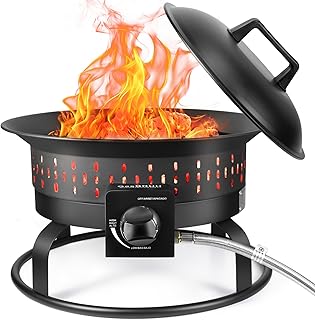

Can You Roast Marshmallows Over Fire Glass or Lava Rock?
The material surrounding a propane burner is often called decorative media. It might be lava rock, ceramic pieces or specially manufactured fire glass. Each has different handling and maintenance instructions. I would never assume that a food item may be held over the media just because the rocks or glass withstand high temperatures.
Some makers approve only the media supplied with the appliance. Adding stones from a garden, painted material, unapproved glass or an improvised protective plate can create new hazards. Wet or unsuitable media may crack or pop when heated. In a cooking context, dripped sugar can further complicate cleaning and block a burner.
If a marshmallow lands on media in an approved roasting appliance, I would shut it down safely and wait until it is completely cool before inspecting the residue. Follow the exact cleaning procedure. Do not pour water onto hot media, grab hot pieces or scrape burner openings with metal tools. If the residue affects burner operation, arrange appropriate service before relighting.
If the appliance is decorative and prohibits cooking, I would not treat the choice of lava rock versus fire glass as a way to make roasting acceptable. The manufacturer’s use restrictions come first.
What About Propane Taste, Soot and the Smell of Gas?
Readers sometimes worry that a propane flame will automatically make food taste like gas. Propane is an established cooking fuel, so that concern alone is not a reason to reject an approved propane cooking appliance. But a fire pit producing unusual soot, flames or odors should not be used for food preparation—or continued operation—until the issue is resolved.
Gas suppliers add an odorant so leaks can be detected. If you smell a strong or persistent gas odor, hear hissing, or suspect a leak, do not light the appliance. Move people away, avoid flames and electrical switching near the suspected leak, and contact emergency services or your gas supplier from a safe location. Close a valve only if it is safe to do so.
I would also avoid suggesting that someone “test roast” a marshmallow to investigate smoke or discoloration. Food is not a diagnostic tool for gas appliances. Let approved maintenance guidance or a qualified professional address irregular combustion. Our related guide, ‘+link(‘Propane Fire Pit Odor: Is That Normal?’)+’, explores common odor concerns in more detail.
My Three-Permission Decision Guide
Here is the framework I would use to decide quickly. It is an original decision-making framework for this article, not a certification method or a substitute for manufacturer instructions.
Permission one: the appliance. Does the exact manufacturer explicitly allow food roasting in the installed configuration? If not, stop the cooking plan.
Permission two: the place. Is the outdoor location approved, ventilated, stable and clear of combustibles as required? If not, relocate or postpone.
Permission three: the activity. Are safe utensils, adult supervision, weather conditions, shutdown procedures and cleanup plans in place? If not, address the missing steps first.
I consider all three permissions necessary. Passing only two is not enough. A fully prepared family cannot make a prohibited decorative fire table into a cooking appliance, and an approved roasting unit is still unsafe when installed in a forbidden enclosed space.
Important Safety Reminder: Do not interpret “proceed cautiously” as permission to exceed or disregard any manufacturer instruction. Marshmallow roasting should take place only when the specific propane appliance is approved for food preparation and all operating, clearance, ventilation, and supervision requirements are satisfied. If you suspect a gas leak, move people away, avoid ignition sources and electrical switching near the leak, and contact emergency services or your propane supplier from a safe location.
Pre-Roasting Checklist
⚠ Important Safety Warning: A suspected propane leak takes priority over every cooking plan. Do not ignite or operate the appliance. Move people away, avoid ignition sources, and contact emergency services or your propane supplier from a safe location. Do not resume use until the hazard is resolved.


Frequently Asked Questions
Is a propane fire pit safe for making s’mores?
Only if the specific appliance expressly permits food roasting and is used as instructed. Propane itself is a common cooking fuel, but many decorative fire pits are not rated or intended for preparing food.
Can I roast marshmallows over a propane fire table?
Do not assume you can. Check the manufacturer’s manual. If it says the unit is decorative or prohibits cooking, use a separate appliance approved for roasting instead.
Does propane leave a chemical taste on marshmallows?
Properly operating propane cooking equipment is routinely used to prepare food. A persistent gas smell, unusual soot or irregular flame should prompt you to stop and investigate safely rather than consume food exposed to questionable combustion conditions.
Can melted marshmallows damage a fire pit?
They can create sticky residue on media or burner components, and some manufacturers warn that food drips may obstruct burner openings. Follow cleaning instructions and do not operate a burner with suspected blockage.
Is it safe to use a propane fire pit indoors for roasting?
No. Do not use an outdoor-only propane fire pit indoors, in garages, enclosed tents or other prohibited spaces. Carbon monoxide can accumulate when combustion appliances are used without appropriate ventilation.
Can I add a cooking grate to a decorative fire pit?
Only if the exact manufacturer expressly approves that accessory and cooking use. An improvised grate can alter the appliance’s intended configuration and does not establish food-safety approval.
Is a wood fire pit better for marshmallows?
Some wood-burning setups are designed for cooking, but they have their own smoke, ember, burn and local fire-restriction issues. Choose a unit intended for cooking, regardless of fuel type.
What if my manufacturer will not confirm that roasting is allowed?
I would treat that as a no for food preparation. Use an approved propane grill, roasting appliance or other cooking device rather than guessing.


Final Verdict: Check Approval Before Roasting
When someone asks me, “Is it safe to roast marshmallows over a propane fire pit?” I would not answer with an unconditional yes. The fuel can be suitable for cooking, but an attractive outdoor flame is not necessarily a food-preparation appliance. The exact manufacturer instructions decide whether roasting is permitted.
My preference is straightforward: if s’mores are a regular part of your family gatherings, buy equipment that explicitly supports roasting. If you already own a decorative fire table, let it do what it was designed to do—create warmth and atmosphere—and make your marshmallows on a separate approved device. That keeps the evening enjoyable without betting on an untested setup.

Mike is an experienced propane technician with over 15 years of professional experience in the field. He has dedicated his career to helping customers with their propane needs, from installation to maintenance and repair. Together with Jeremy, he co-founded this website to provide useful information and guidance to customers seeking reliable propane services.