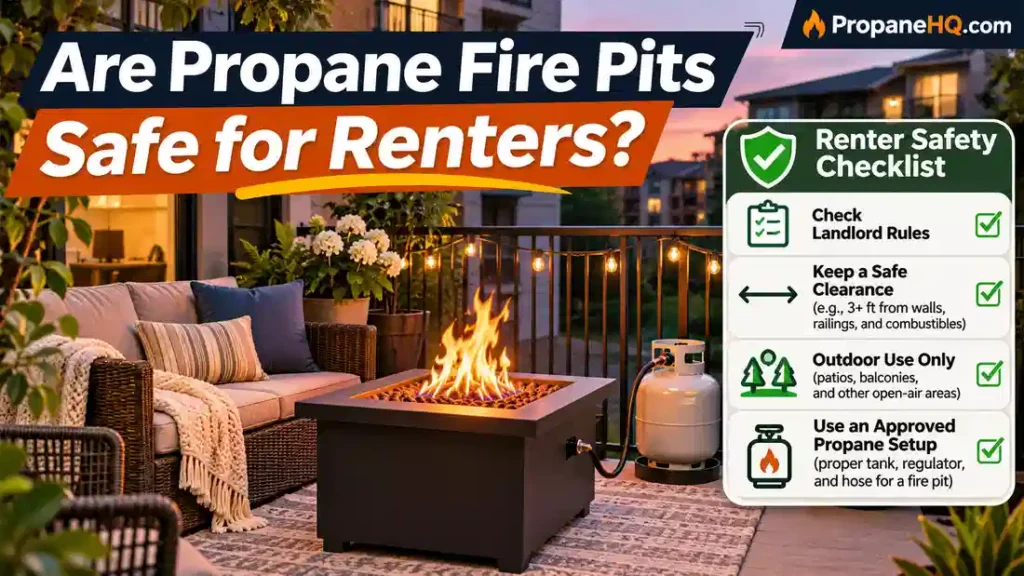
Quick Answer
Propane fire pits can be safe for renters only when the local fire rules, your lease or property policies, and the exact fire pit manufacturer’s instructions all permit the intended use—and your location meets every safety requirement. A ground-level private patio might be acceptable with written approval. An apartment balcony, covered walkway, shared courtyard, or roof deck may prohibit propane flames or cylinders entirely, even when a fire pit is portable.
My rule is simple: permission first, placement second, equipment inspection third, lighting last. If any of those checks fail, I would not light the fire pit. A small cylinder, a compact burner, or a landlord’s informal verbal assurance does not automatically make the setup legal or safe.
A portable propane fire pit sounds attractive when you rent. You can bring it to a new home, avoid a permanent masonry installation, and enjoy a controlled flame without piles of firewood. Yet renting creates safety questions that homeowners may not face: who controls the property, who insures it, where a cylinder may be stored, and whether an evacuation route runs past your patio.
In this guide, I’ll explain how I would evaluate a renter’s setup step by step. You’ll find technical comparisons, an apartment-specific decision matrix, fuel consumption estimates, and an interactive calculator. I use hypothetical examples rather than pretending I’ve inspected your building. Your local fire authority, lease and appliance manual ultimately control the decision.
In This Guide
Are Propane Fire Pits Allowed in Rental Properties?
There isn’t one nationwide yes-or-no answer. A U.S. tenant might encounter state-adopted fire codes, city ordinances, local fire-department interpretations, apartment community policies, HOA rules and lease restrictions. The same fire pit may be acceptable in an open yard but unacceptable on a second-floor balcony.
I would check four separate layers. First, ask the fire department or other authority having jurisdiction which rules apply to outdoor decorative propane fire features at your type of building. Rules for cooking grills can provide clues, but don’t assume a decorative fire pit is exempt. Some restrictions expressly cover heating and similar open-flame devices.
Second, examine the lease, community handbook, fire-safety addendum and HOA rules where applicable. Third, read the exact fire pit manual—not just its online listing. Fourth, evaluate whether the permitted space really meets the required clearances, ventilation, stable-surface and cylinder-location conditions.


Important Safety Reminder: I recommend verifying all four approval layers before using a propane fire pit at a rental property. Written landlord permission does not override local fire regulations, manufacturer restrictions, or unsafe installation conditions. If even one requirement cannot be satisfied, do not operate the fire pit until the issue has been resolved.
The distinction matters because permission at one layer cannot overrule a prohibition at another. A manager cannot authorize a fire-code violation. Equally, compliance with code does not force a landlord to permit an open flame on private property.
Ask the landlord in writing
I’d send a concise message that identifies the specific model, BTU rating, fuel-cylinder capacity, exact proposed location, surface type, and whether there is a roof or balcony above. Ask where you may operate and store both the appliance and cylinder. Don’t ask only, “Are fire pits okay?” That phrase invites an answer too vague to be useful.
Keep a copy of the reply with your lease documents. If management says no, I wouldn’t secretly use the pit or switch to a one-pound cylinder to evade the policy. Instead, I’d consider a non-flame outdoor lighting feature or an expressly permitted alternative.
Apartment Balconies, Patios, Courtyards and Rooftops
Balconies are the most common point of confusion. They can have combustible decking, overhead balconies, narrow exits, siding, furniture cushions and neighboring windows. They may also fall under explicit multifamily-building bans on flame-producing equipment or propane cylinders.



For example, some fire authorities applying versions of NFPA 1 prohibit gas-fired grills and similar devices on balconies, beneath overhangs or within a prescribed distance of buildings. Other jurisdictions use different adopted codes or specific exceptions. I would never present one distance or cylinder limit as permission everywhere.
Important Safety Reminder: A propane fire pit is not automatically safe or permitted simply because it is portable or located outdoors. Before using one at a rental property, verify local fire regulations, written landlord or management permission, manufacturer instructions, and physical site conditions. Never operate an outdoor-only propane fire pit inside a garage, enclosed porch, apartment, or other enclosed space. If any requirement cannot be met, choose another approved location or do not use the appliance.
Can I put a propane fire pit under a pergola?
I would treat a pergola, awning, balcony above, shade sail or patio roof as an overhead structure, not as an automatic weather shield. Some manuals require a specified minimum overhead distance; others prohibit overhead combustible construction altogether. Even where an illustrated dimension appears generous, that doesn’t override a model’s prohibition.
Also look beyond the flame itself. Wind can bend flames toward fabric; heat can accumulate under a roof; and propane combustion in a poorly ventilated enclosure can produce dangerous carbon monoxide exposure. Outdoor-only appliances must never be moved inside an apartment, garage or enclosed tent.


What about wooden or composite decks?
Don’t assume that fire-resistant appearance means noncombustible construction. Composite boards, plastic furniture, outdoor rugs and vinyl siding may be combustible. Some fire pits expressly disallow combustible decks, whereas others require an approved protective base and specific clearances. The manual and local rules—not a generic protective mat advertisement—must settle this question.
For a deeper placement check, see our Propane Fire Pit on a Deck guide and fire pit clearance guide within the Propane Fire Pits topic area.
Propane Cylinder, Hose, Regulator and Leak Safety for Renters
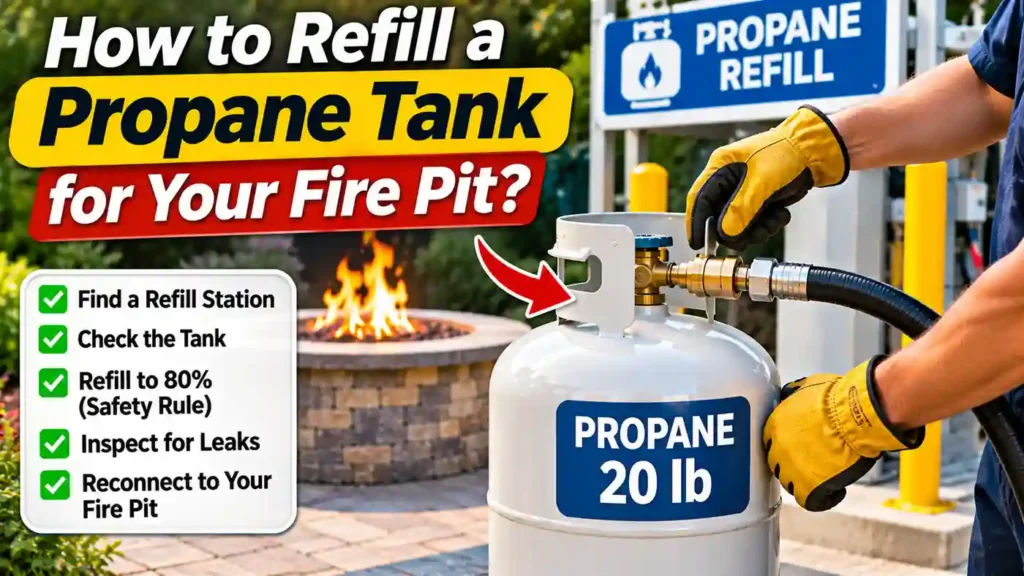
A renter should know not only how to ignite a fire pit, but also how to shut it off and where the cylinder may legally be kept afterward. I would not leave a propane cylinder in an apartment kitchen, bedroom, closet, hallway, stairwell or attached garage. Rules for storage and transit through multifamily buildings can be strict, including for partly used or apparently empty cylinders.
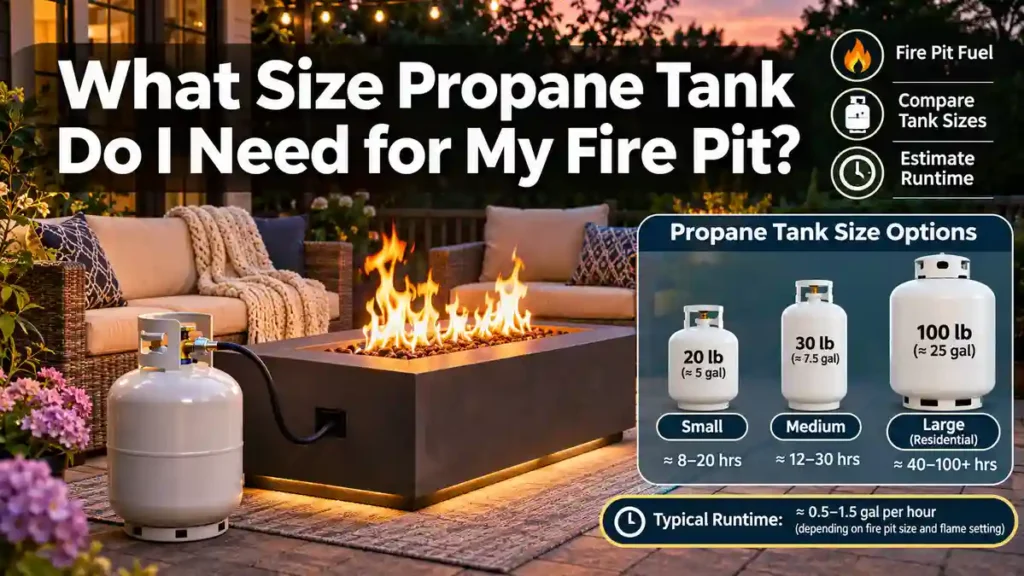
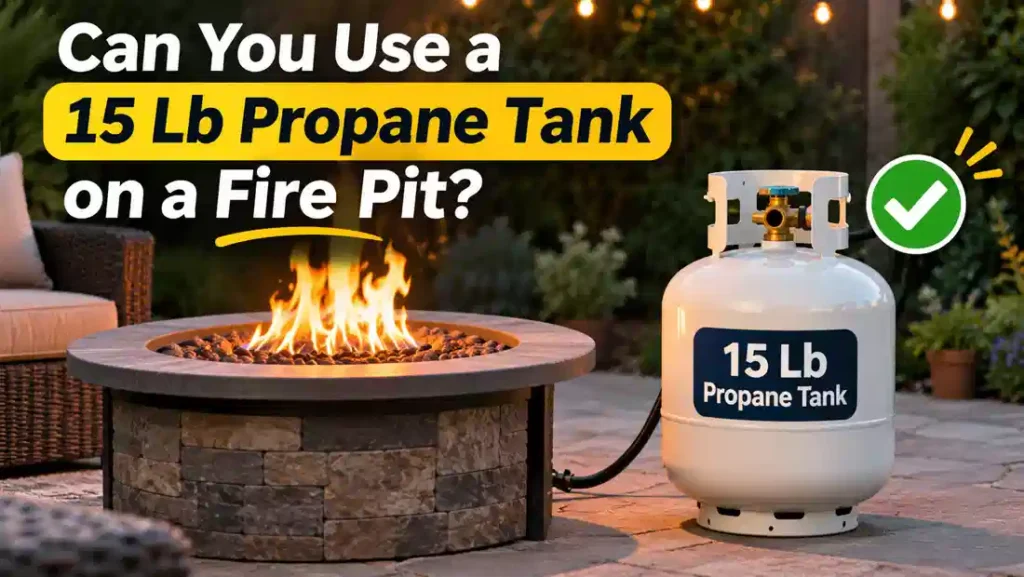
A 20-pound cylinder is common for standard fire bowls, but smaller does not necessarily mean safer or permitted. An appliance must specifically approve the cylinder, connection and fuel supply. A hose adapter won’t change the burner demand or make a prohibited setup acceptable.
⚠ If You Suspect a Gas Leak: Do not ignite or operate the appliance. Move everyone away, avoid smoking, flames, sparks and operating electrical switches near the leak, and contact emergency services or the propane supplier from a safe location. Close the cylinder valve only if you can do so safely. Do not return or resume use until the hazard is resolved.
For routine leak checks, use only the manufacturer’s stated outdoor procedure—typically an approved leak-detection solution on designated connections. Never test with a lighter or match. If you cannot confidently perform the inspection, have a qualified service professional handle it.
Where should a renter store the tank?
In an approved, well-ventilated outdoor position, upright, protected from physical damage and away from ignition and heat sources—subject to the building’s specific rules. Don’t guess that a tiny storage locker or covered balcony cabinet is acceptable. Ask the landlord or fire authority about approved storage arrangements, including transit through common areas.
If there is nowhere legal and safe to store a cylinder, that may end the purchasing decision. It’s better to discover this before spending money than to own a fire pit you cannot use.
How Much Space and Supervision Does a Renter Need?
I would measure from the appliance to the closest combustible object in every direction, including overhead. The correct numbers come from the exact manual and local rules. A 48-inch side distance or 72-inch overhead distance may appear in some manuals, but neither is a universal safety standard or authorization.
Rented patios also change quickly: a neighbor moves a cushion, guests pull chairs closer, or a balcony above acquires a fabric shade. That is why I would treat clearance as a before-every-use check, not a once-and-for-all measurement.
Keep children and pets out of the hot zone. Assign one sober, responsible adult to manage ignition, attendance and shutdown. Never leave the flame unattended, even when the unit has an automatic shutoff. Ensure nobody has to walk between the fire pit and the nearest door or escape route.
Do Renters Need Insurance for Propane Fire Pits?
Renters insurance may cover certain personal-property losses or liability claims, but policy wording, exclusions and facts matter. Don’t assume that owning liability coverage makes a prohibited fire pit permissible. A fire caused while violating a lease or code may create complicated disputes; coverage decisions are policy-specific.
I would review the declarations, exclusions and liability section, and ask the insurer directly whether an outdoor propane fire pit at the rental location is covered. Also ask whether management requires additional coverage or restricts appliances in common areas. Keep written responses when possible.
Remember that a landlord’s building policy generally protects the landlord’s insurable interests, not automatically your belongings or liability. A documented permission process is valuable, but it cannot replace safe operation.
Propane Fire Pit BTU Consumption and Fuel-Cost Scenarios
Once use is permitted, I would estimate operating cost before buying. Here’s the calculation method: divide the burner’s BTU-per-hour input by approximately 91,500 BTU per gallon. Multiply by your expected hours and the price per gallon. This is a fuel-energy estimate, not a promise of exact measured flow.
Calculation Note: These estimates use approximately 91,500 BTU per gallon of propane and an illustrative price of $3.50 per gallon. Calculations use unrounded intermediate values and assume the appliance operates at its full rated burner input for three continuous hours. Actual propane consumption and costs depend on the appliance, burner settings, operating conditions, and fuel purchase terms. A low-BTU burner does not automatically authorize propane fire pit use in an apartment, balcony, or other rental property. Always verify local fire regulations, property policies, and the manufacturer’s instructions before operating a propane fire pit.
What could a renter spend each month?
Imagine a permitted fire pit running two hours each Friday, four Fridays a month: that’s eight burner-hours. The table below uses $3.50 per gallon and assumes full-rated input throughout; actual modulated burners may use less, but don’t treat dial position as a precisely linear flow adjustment.
Calculation Note: These estimates assume a propane price of $3.50 per gallon, an energy content of approximately 91,500 BTU per gallon, and continuous operation at the burner’s full rated input. The 8-hour scenario represents approximately two hours of use per week over four weeks, while the 24-hour scenario represents six hours per week over four weeks. Fuel consumption and costs are calculated using unrounded intermediate values. Actual expenses depend on propane prices, burner settings, operating conditions, and refill or exchange charges. Important: These calculations estimate fuel expenses only. They do not establish whether propane fire pit use is permitted at a rental property, apartment, balcony, or shared outdoor space.
Retail cylinder exchanges or one-pound disposable bottles typically don’t match the economics of bulk gallon pricing. Also budget for buying the appliance, a compatible cylinder, approved protective accessories, and any insurance or property-specific requirements. In my view, the highest hidden cost for renters is often not fuel—it is buying equipment before confirming permission.
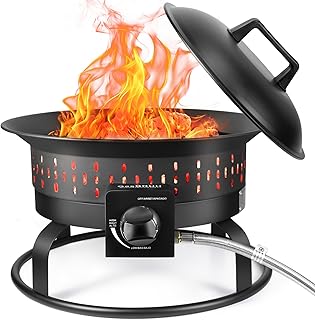

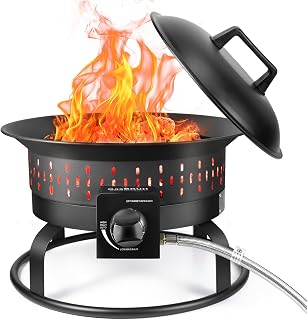
Interactive Propane Fire Pit Runtime and Cost Calculator
Use this estimator to plan an approved session. Enter the pounds of propane actually in the cylinder, not the container’s total metal weight. It cannot determine whether the cylinder is legal at your property or can sustain the specified vapor demand.
Propane Fire Pit Runtime & Cost Calculator
I created this calculator to help you estimate how long your propane cylinder could power a fire pit and how much fuel your gathering may cost. Adjust the settings below to calculate your own estimates.
Estimates use approximately 21,600 BTU per pound and 91,500 BTU per gallon of propane.
The firing-rate percentage approximates fuel use; actual knob position may not be proportional to burner input.
The usable-fuel percentage is a planning buffer, not the cylinder’s 80% filling rule.
This calculator cannot establish cylinder compatibility, propane vaporization capacity, or permission to operate a propane fire pit at a rental property, apartment, balcony, or shared outdoor space. Always verify applicable fire regulations, property rules, and manufacturer instructions.
Worked Example: A Renter’s 12-by-14-Foot Patio
Consider a hypothetical renter with a 12-by-14-foot, ground-floor patio and a 40,000 BTU/h fire bowl. Management has not yet issued written permission. There’s an awning overhead, a wood fence nearby, and a frequently used rear door.
My first conclusion would be do not light it yet. The renter must verify fire-code permission, lease rules, overhead allowances and the exact manufacturer’s clearances. Even if the fuel estimate looks favorable, that doesn’t solve the location problem.
Important Safety Note: This is a hypothetical rental-property assessment, not approval for a particular installation. I recommend verifying written landlord permission, local fire regulations, manufacturer-specific clearance requirements, and unobstructed emergency exits before operating a propane fire pit. A fabric awning or insufficient clearance may make the proposed location unsuitable. The fuel-cost example assumes continuous operation at full rated input, approximately 91,500 BTU per gallon of propane, and an illustrative price of $3.50 per gallon. Fuel calculations do not establish whether the installation is safe or permitted.
Suppose the renter moves the pit to an open approved section of a larger yard, obtains written consent, meets the appliance manual and local codes, and performs the required checks. The project may become practical. The key is that the location changed—not merely the tank size or the number of minutes of use.
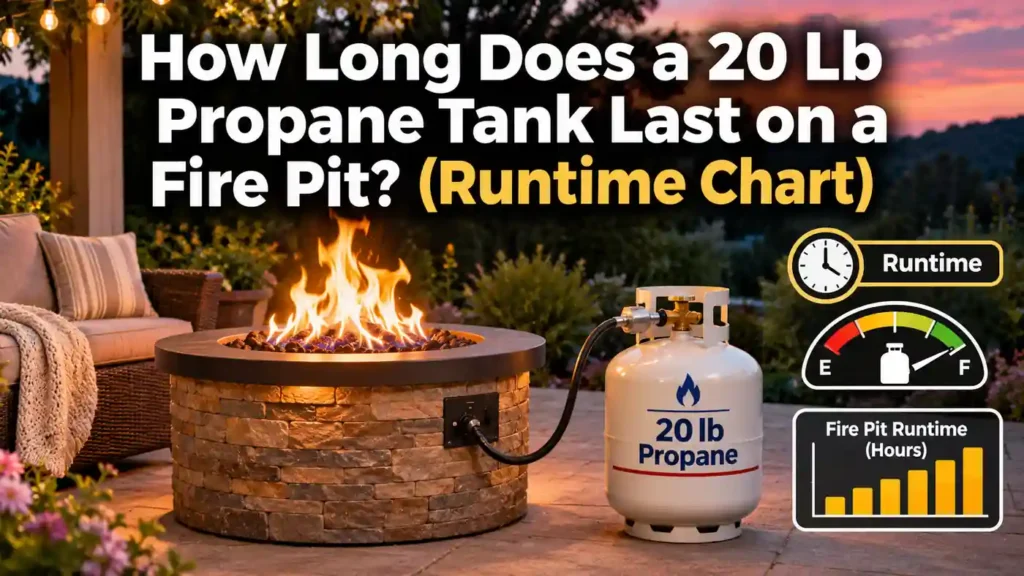
The 40,000 BTU/h appliance consumes about 0.437 gallon per hour at full input. For a three-hour evening, that’s 1.31 gallons. A nominally full 20-pound cylinder contains about 4.7 gallons; using an 85% planning factor gives about 4.0 gallons for estimates, or roughly 9.2 hours of theoretical full-input operation. These energy calculations do not guarantee pressure stability or safe operation.


My Renter’s Decision Guide
Important Safety Reminder: I recommend confirming all four approval layers before using a propane fire pit at a rental property: local fire regulations, landlord or property management permission, manufacturer instructions, and physical site safety. If you detect a suspected propane leak, do not operate the appliance. Move people away, avoid ignition sources and electrical switching near the leak, and contact emergency services or your propane supplier from a safe location. Written landlord permission does not override applicable fire codes or manufacturer restrictions.
My 12-point pre-light checklist
- Local fire rules explicitly allow the proposed appliance and location.
- The lease or management policy permits propane flames and cylinders.
- Any required written permission is documented.
- The exact fire pit manual allows the surface and outdoor setup.
- Required side and overhead clearances are satisfied.
- Every exit and shared walkway remains unobstructed.
- The cylinder is approved, upright, in good condition and correctly located.
- The regulator, hose, valve and fittings are manufacturer-approved.
- Required outdoor leak checks have been completed successfully.
- There is no odor, suspicious sound, visible damage or erratic flame.
- Children, pets and guests can be kept at safe distances under supervision.
- The operator knows shutdown, cooling and emergency procedures.
If even one required condition fails, I wouldn’t proceed. A checklist isn’t a substitute for the manufacturer manual, fire-code requirements or a qualified professional.
What If Your Landlord Says No?
I’d respect the restriction and ask whether a non-combustion alternative is acceptable. Options may include battery-powered flame-effect lights, LED lanterns, or an electric outdoor heater specifically approved for the area and electrical outlet. Electric heaters also need their own clearance and electrical safety checks; they are not automatically acceptable on balconies.
You might also use a properly designated community fire feature maintained by management, or gather at a permitted public venue. I wouldn’t bring a propane pit to a shared lawn without permission, nor assume that changing from 20 pounds of propane to one pound bypasses a general open-flame ban.
Moving Out: Cleaning, Storage and Your Security Deposit
Portability is useful only if you handle the equipment responsibly. I would shut the unit down, close the valve as directed, allow full cooling, clean approved surfaces, and inspect for scorch marks or fuel-system damage. Never pack an attached cylinder into a moving box or vehicle passenger compartment without following applicable transport requirements.
Before moving day, document the patio condition with photographs, especially around the fire pit’s previous placement. Follow property rules about removing personal equipment and storing the cylinder. If the fire pit has left damage, address it rather than concealing it. A small rental-friendly product is still capable of producing expensive heat damage.
How I Would Choose a Fire Pit as a Renter
Only after the permission questions are settled would I shop. I’d favor a listed, portable model with clear instructions, a stable footprint, manufacturer-approved hose and regulator, and readily available replacement parts. I’d compare its actual BTU input to my use pattern, rather than buying the highest-output model on the shelf.
I’d also ask a practical question most buying lists miss: where does the entire system live on the other 29 days of the month? If the approved outdoor storage area is too small, exposed to tampering, or prohibited by management, the appealing evening atmosphere may not justify the purchase.
For related buying decisions, explore our propane fire pit buying checklist, tank sizing guide, and running-cost guide. These are internal PropaneHQ search links to related articles; replace them with verified direct permalinks when available.


Frequently Asked Questions
Can a renter use a propane fire pit on an apartment balcony?
Not automatically, and often not at all. Many jurisdictions or buildings restrict open flames and propane storage on multifamily balconies. Verify the specific current fire code, building policy, manual and physical clearances before considering use.
Does a landlord’s permission make it legal?
No. Written permission is valuable, but it cannot override an applicable fire code or unsafe appliance installation. Every approval layer needs to pass independently.
Is a one-pound propane cylinder allowed on every balcony?
No. Some regulations distinguish small camping cylinders from larger ones, but an exception for a particular cooking device or storage situation is not blanket permission for a decorative propane fire pit.
Can I store a 20-pound propane cylinder inside my apartment?
Do not assume so. Indoor and multifamily propane-cylinder storage can be prohibited or strictly limited. Follow applicable rules and seek an approved outdoor storage arrangement rather than using a closet, hallway or garage.
Is a propane fire pit safer than a wood-burning pit for renters?
Propane can reduce flying embers and eliminate firewood handling, but it still creates an open flame, hot surfaces and gas-system risks. Many lease and code restrictions apply to both. Better convenience does not equal automatic approval.
Can I put a propane fire pit on an outdoor rug?
Only if the exact appliance instructions permit that surface and the required clearances and protective setup are met. Many rugs are combustible; I would choose a stable, manufacturer-approved base instead.
What if I smell propane while the fire pit is off?
Treat a possible leak seriously. Do not relight or operate the unit. Move away, avoid nearby ignition sources and call the appropriate emergency service or gas supplier from a safe place. Resume use only after the hazard has been resolved.
Will renters insurance cover a propane fire pit accident?
It depends on your policy and circumstances. Ask your insurer about personal liability, excluded activities and fire losses; do not assume coverage authorizes code- or lease-prohibited use.
How many hours does a 20-pound tank last at 40,000 BTU/h?
An energy-only calculation gives about 10.8 hours using 432,000 BTU divided by 40,000 BTU/h. With an 85% usable-fuel planning factor, the estimate is about 9.2 hours. Actual runtime and sustained fuel delivery vary.
Can I leave the propane fire pit outside after an evening?
The fire pit itself may be stored outdoors as the manufacturer permits, after complete cooling. The propane cylinder has separate requirements; don’t leave it in a prohibited balcony, doorway, enclosure or storage locker.
Final Thoughts: Safety Begins Before You Buy
When I’m evaluating a propane fire pit for a renter, I don’t begin with flame height or style. I begin with four questions: Is it legally permitted here? Does the property owner approve? Does the manual approve the setup? Can the equipment operate and be stored safely without compromising neighbors or escape routes?
If every answer is documented and favorable, a portable propane fire pit can be a reasonable outdoor amenity. If any answer is no or unknown, the safe decision is to wait, relocate, or choose another form of ambiance. For broader information, read Are Propane Fire Pits Safe? Complete Safety Guide and more articles in the Propane Fire Pits category.

Mike is an experienced propane technician with over 15 years of professional experience in the field. He has dedicated his career to helping customers with their propane needs, from installation to maintenance and repair. Together with Jeremy, he co-founded this website to provide useful information and guidance to customers seeking reliable propane services.