

Installing a propane tank in Texas requires compliance with state safety regulations, equipment placement standards, and applicable local requirements.
Whether you’re installing a 250-gallon tank for household appliances or a 1,000-gallon container for a rural property, I’ll explain the rules you need to understand before purchasing equipment or scheduling installation.
Quick Answer
Essential requirements for Texas homeowners


| Item | Quick answer |
|---|---|
| State regulatory authority | Railroad Commission of Texas |
| Typical 500-gallon tank setback | 10 feet from buildings and applicable property lines |
| Large installation plan approval | 10,000+ gallons aggregate water capacity |
| Underground corrosion protection | Required for applicable buried steel containers |
State safety codes: Texas adopts NFPA 58 (2017 edition) and NFPA 54 (2018 edition), subject to state-specific modifications.
Residential permits: An ordinary single-family residential installation generally does not require the commercial LPG filing process. Other applicable approvals may still be necessary.
Tank color: Applicable above-ground ASME containers must have a suitable heat-reflective finish.
Excavation: Contact Texas 811 at least two working days before digging.


Professional installation: Use an appropriately licensed propane company and qualified technicians to ensure compliance.
Requirements vary according to tank capacity, installation type, occupancy, and site conditions. Confirm your proposed installation with the appropriate authorities.
1. Who Regulates Residential Propane Installations?
The Railroad Commission of Texas (RRC), through its Alternative Fuels Safety department, is responsible for regulating the safe storage, transportation, distribution, and use of liquefied petroleum gas.
Despite its name, the commission’s responsibilities extend well beyond railroads. It plays a central role in regulating the propane industry throughout Texas.
Applicable state laws and safety standards
| Regulation | What it governs |
|---|---|
| Texas Natural Resources Code, Chapter 113 | State LPG industry regulation |
| 16 TAC Chapter 9 | Texas LP-Gas Safety Rules |
| 16 TAC §9.101 | Stationary installation filings |
| 16 TAC §9.113 | Installation and maintenance |
| 16 TAC §9.116 | Container corrosion protection |
| 16 TAC §9.134 | Connecting containers to piping |
| 16 TAC §9.140 | System protection |
| 16 TAC §9.141 | Uniform safety requirements |
| 16 TAC §9.142 | Container placement and storage |
| NFPA 58, 2017 edition | LPG storage and handling |
| NFPA 54, 2018 edition | Fuel gas systems |
The Railroad Commission’s published current rule compilation identifies December 8, 2025, as the effective date of its compiled Chapter 9 rules.



One important distinction is that the latest nationally published NFPA standard is not automatically the edition legally adopted by Texas.
I recommend asking your installer which code provisions apply to your specific project.
2. Do You Need a Permit to Install a Residential Tank?
Many homeowners assume that every permanently installed propane tank requires a state-issued installation permit.
Texas distinguishes between ordinary residential systems, commercial facilities, and larger storage installations.


Under §9.101 of the Texas LP-Gas Safety Rules, the standard commercial completion reporting process applies to commercial installations below 10,000 gallons of aggregate water capacity.
Larger installations reaching 10,000 gallons or more require advance plan approval.
State filing requirements by installation type
| Installation | RRC filing consideration |
|---|---|
| Single 120-gallon residential tank | Generally outside commercial filing requirement |
| Single 250-gallon residential tank | Generally outside commercial filing requirement |
| Single 500-gallon residential tank | Generally outside commercial filing requirement |
| Single 1,000-gallon residential tank | Generally outside commercial filing requirement |
| Commercial facility below 10,000 gallons | LPG Form 501 completion report |
| Installation of 10,000 gallons or more | Advance plan approval using LPG Form 500 |
| Large commercial storage facility | Additional documentation and applicable inspections |
Not needing a commercial LPG installation filing does not mean your residential system is exempt from safety regulations.
All applicable equipment placement, installation, piping, testing, and maintenance requirements remain important.
Local building permits, floodplain development approvals, and other construction-related requirements may also need to be considered.
3. Railroad Commission Installation Forms and Fees
If your property includes a commercial propane installation, agricultural business, or large storage facility, additional paperwork may apply.
State LPG installation filing fees
| Application or report | Published fee |
|---|---|
| LPG Form 500 initial plan application | $50 |
| LPG Form 500 resubmission | $30 |
| LPG Form 501 completion report | $10 per container or rack |
These fees apply to covered installations, not automatically to ordinary residential tanks. Confirm current resubmission charges directly with the RRC because published materials differ on the Form 501 resubmission fee.
Commercial installations below the applicable 10,000-gallon threshold generally require the licensed installer to submit the completion report within 30 calendar days after installation.
For larger installations, the approval process must be completed before construction begins.
If you operate a ranch or farm business from your residential property, explain the intended use of the propane system to your installer.
A container serving a family residence may have different filing requirements from one supplying commercial grain drying or fuel dispensing equipment.
4. Can Texas Cities Impose Their Own Propane Restrictions?
One of the most important aspects of Texas propane law is state regulatory preemption.
Under Texas Natural Resources Code §113.054, the Railroad Commission’s LPG rules take precedence over local regulations governing the propane industry.
A political subdivision seeking to establish more restrictive LPG safety standards may petition the commission’s executive director and must demonstrate that the proposed requirements improve public safety.
This is particularly important if you live in a city with its own fire prevention and construction ordinances.
However, you should not interpret state preemption as permission to disregard every municipal approval.
Building construction, floodplain development, electrical installations, zoning, and other associated work may involve separate requirements.
Example: Installing a tank in Austin
The City of Austin publishes an outdoor LPG installation request process.
Its guidance distinguishes noncommercial single-family residential installations from commercial installations requiring permits.
Although the city identifies a permit exemption for noncommercial single-family residential use, it still requests information concerning equipment location and surrounding exposures before installation.
Which authority should you contact?
| Installation concern | Appropriate authority |
|---|---|
| LPG equipment safety | Railroad Commission of Texas |
| Propane company licensing | RRC Alternative Fuels Safety |
| State LPG installation filings | Railroad Commission of Texas |
| Associated building construction | Municipal building department |
| Standby generator electrical work | Applicable electrical authority |
| Floodplain development | Local floodplain administrator |
| Underground utility identification | Texas 811 |
| Private deed restrictions | Property association or legal adviser |
If you receive conflicting information from a local inspector and your propane supplier, request clarification from the Railroad Commission before proceeding.
5. Propane Installer Licensing Requirements
Texas regulates businesses and individuals performing professional LPG installation, repair, servicing, and distribution activities.
Under Texas Natural Resources Code §113.081, regulated propane activities generally require appropriate licensing, subject to statutory and regulatory exceptions.
The RRC also administers exemptions and registration procedures for certain qualified plumbing and air-conditioning contractors.
Before hiring an installer, I recommend verifying the following:
- Appropriate Railroad Commission company licensing.
- Technician qualifications for residential LPG installation.
- Required liability insurance.
- Experience installing your selected tank type.
- Responsibility for permits and regulatory documentation.
- Availability of ongoing maintenance and emergency services.
A general contractor’s license should not automatically be considered sufficient authorization for specialized propane work.
A qualified company should be able to explain which credentials authorize it to perform your proposed installation.
6. Can You Install Your Own Tank?
Texas regulations contain limited provisions concerning homeowner-installed residential gas piping.
For example, §9.134 addresses circumstances under which a licensee may connect a propane container to piping installed by an individual at that individual’s single-family residence.
However, this provision should not be interpreted as unrestricted permission to install, connect, fill, or commission an entire propane system yourself.
Permanent residential systems involve pressurized flammable gas, specialized equipment, pressure regulation, appliance compatibility, and mandatory safety standards.
I strongly recommend using a qualified propane professional for the complete installation.
An improperly installed system can create substantial safety risks and may prevent a supplier from agreeing to deliver fuel.
7. Minimum Setback Distances From Buildings and Property Lines
Tank placement is one of the most important aspects of residential propane installation.
The required separation generally depends on the container’s rated water capacity and whether it is installed above or below ground.
Residential propane tank setback chart
General NFPA 58 placement requirements
| Tank capacity | Above ground | Underground | Between tanks |
|---|---|---|---|
| Under 125 gallons | Conditional* | 10 ft | None |
| 125–250 gallons | 10 ft | 10 ft | None |
| 251–500 gallons | 10 ft | 10 ft | 3 ft |
| 501–1,200 gallons | 25 ft** | 10 ft | 3 ft |
| 1,201–2,000 gallons | 25 ft | 10 ft | 3 ft |
General planning distances from important buildings and adjoining property lines that can be built upon. Additional clearances and Texas-specific conditions apply.
* Certain containers smaller than 125 gallons may qualify for installation alongside buildings when applicable requirements concerning openings, ignition sources, relief valves, and filling connections are satisfied.
** A single above-ground container of up to 1,200 gallons may qualify for a reduction to 10 feet when it is at least 25 feet from other containers exceeding 125 gallons and satisfies all applicable conditions.
Texas LP-Gas Safety Rule §9.142 incorporates the relevant NFPA placement requirements, together with additional state provisions.
Example of a 500-gallon installation layout
Conceptual 500-gallon above-ground installation. Not to scale or intended as an approved construction plan.
I recommend allowing additional space wherever possible instead of designing your entire installation around the minimum legal separation.
Future home extensions, garages, workshops, and outdoor kitchens could affect an otherwise compliant installation.
8. Distance From Windows, Doors and Ignition Sources
Building and property line setbacks are only part of the placement requirements.
Your installer must also consider pressure relief valves, filling connections, air intakes, electrical equipment, and potential ignition sources.
The required separation depends partly on whether the equipment is an ASME storage container, an exchanged cylinder, or a container filled at the customer’s property.
Additional clearance considerations
| Nearby feature | Installation consideration |
|---|---|
| Windows and doors | Applicable separation from gas discharge points |
| Crawlspace openings | Prevent potential vapor accumulation |
| Air-conditioning equipment | Evaluate ignition sources |
| Standby generators | Maintain equipment-specific clearances |
| Mechanical air intakes | Prevent propane entry into buildings |
| Outdoor electrical equipment | Evaluate ignition potential |
| Overhead power lines | Applicable electrical clearances |
| Basement openings | Avoid potential gas accumulation |
Propane vapor is heavier than air. Following a leak, it can travel toward lower areas and collect in poorly ventilated spaces.
For a more detailed explanation, read my guide on how close a propane tank can be to household appliances.
9. Above-Ground Installation Requirements
Above-ground containers are popular throughout rural Texas because they are relatively economical and accessible for maintenance.
A professionally installed system requires an appropriate location, stable supports, suitable protective measures, approved equipment, and safe delivery access.
Above-ground installation considerations
| Requirement | Purpose |
|---|---|
| Suitable tank supports | Prevent unstable equipment placement |
| Approved pressure vessel | Ensure suitability for propane storage |
| Heat-reflective coating | Reduce solar heat absorption |
| Required setbacks | Reduce exposure to surrounding hazards |
| Vehicle impact protection | Prevent accidental equipment damage |
| Accessible valves | Allow inspection and servicing |
| Approved regulators | Maintain appropriate appliance supply pressure |
| Professional safety testing | Verify system integrity |
Texas LP-Gas Safety Rule §9.113 requires covered equipment to be installed and maintained in accordance with applicable rules and manufacturer instructions.
I would avoid placing an above-ground tank in an area frequently used by vehicles, farm equipment, or landscaping machinery.
Even a relatively minor collision could damage valves or connected piping.
10. Can You Paint or Cover Your Tank?
Texas has specific requirements governing propane container paint colors and overhead coverings.
These rules are particularly relevant because of the state’s intense summer heat.
Permitted and prohibited tank finishes
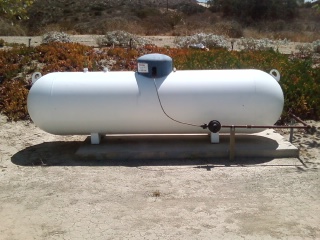
Under §9.141, applicable ASME containers must have a heat-reflective finish.
| Paint color | General suitability |
|---|---|
| White | Permitted |
| Aluminum or silver | Permitted |
| Light blue | Generally permitted |
| Light green | Generally permitted |
| Other light reflective finishes | Subject to suitability |
| Black | Prohibited heat-absorbing color |
| Navy blue | Prohibited heat-absorbing color |
The RRC may require manufacturer information to establish whether a disputed coating is sufficiently heat-reflective.
Can you build a roof over a propane tank?
Texas LP-Gas Safety Rule §9.141(f) prohibits overhead canopies or coverings over stationary ASME containers with capacities of 125 gallons or more.
Therefore, constructing a decorative roof over a typical 250- or 500-gallon tank is not an acceptable way to protect it from direct sunlight.
If appearance is important, discuss a compliant landscaping arrangement or underground installation with your supplier.
Do not obstruct equipment ventilation, required clearances, valves, or maintenance access.
11. Underground Installation Requirements
Underground tanks are often preferred in landscaped residential developments, custom homes, and properties where visible equipment is undesirable.
However, a buried container requires specialized equipment and additional corrosion protection.
Texas-specific corrosion protection requirements
Under §9.116, applicable underground, partially underground, and mounded steel containers and steel piping systems installed on or after March 1, 2014, require corrosion protection.
The regulation also requires servicing licensees to monitor applicable cathodic protection systems, document the results, and retain testing records.
Underground installation considerations
| Requirement | Purpose |
|---|---|
| Approved underground container | Ensures suitability for burial |
| Protective exterior coating | Reduces corrosion exposure |
| Cathodic protection | Protects steel against underground corrosion |
| Appropriate excavation | Accommodates safe equipment placement |
| Flotation protection | Reduces movement in saturated soil |
| Accessible service dome | Allows valve and gauge access |
| Corrosion protection testing | Confirms ongoing protection |
| Required setbacks | Maintains separation from surrounding hazards |
Only containers specifically designed and approved for underground installation should be buried.
For additional information, read my guide on the cost of installing a buried propane tank.
12. How Much Does a Compliant Residential Installation Cost?
Although this guide focuses primarily on regulations, understanding installation expenses can help you prepare an appropriate budget.
Estimated installation costs by capacity
| Tank capacity | Above ground | Underground |
|---|---|---|
| 120 gallons | $1,500–$2,800 | $3,000–$4,500 |
| 250 gallons | $2,400–$4,000 | $3,500–$6,000 |
| 320 gallons | $2,800–$4,500 | $4,000–$6,500 |
| 500 gallons | $3,500–$5,500 | $5,000–$8,500 |
| 1,000 gallons | $5,500–$8,500 | $7,500–$12,000+ |
Illustrative planning budgets for purchased equipment and installation. These are not surveyed Texas contractor averages. Initial fuel delivery, appliances, taxes and unusual site work are excluded.
A property in the Texas Hill Country may involve more expensive excavation than a level property in North Texas.
Coastal properties may require additional flood protection, while suburban properties may involve more complicated equipment placement.
You can find additional equipment pricing information in my guide on how much a 500-gallon propane tank costs.
Worked example: Complete installation budget
Sample 500-gallon above-ground installation
| Expense | Estimated cost |
|---|---|
| Tank purchase | $2,900.00 |
| Transportation and placement | $350.00 |
| Approved supports | $200.00 |
| Gas piping and trenching | $650.00 |
| Regulators and fittings | $250.00 |
| Applicable permit allowance | $150.00 |
| Installation subtotal | $4,500.00 |
| Initial delivery of 400 gallons at $3.209 | $1,283.60 |
| Estimated project total | $5,783.60 |
Hypothetical installation expenses using the EIA Texas residential propane price for November 16, 2026.
I recommend maintaining an additional 10% to 15% contingency allowance for unexpected site work.
13. Residential Tank Capacity and Filling Limits
Choosing the correct tank capacity requires understanding the difference between rated water capacity and usable propane storage.
A conventional residential tank is generally filled to approximately 80% of its rated capacity, leaving space for liquid expansion.
Approximate usable propane capacity
Calculated using the conventional 80% fill guideline. Professional filling requirements depend on applicable equipment and temperature conditions.
According to the EIA, Texas’s average residential propane price was $3.209 per gallon for the week of November 16, 2026.
Estimated fuel costs
| Tank capacity | Approximate 80% fill | Fuel cost |
|---|---|---|
| 120 gallons | 96 gal | $308.06 |
| 250 gallons | 200 gal | $641.80 |
| 320 gallons | 256 gal | $821.50 |
| 500 gallons | 400 gal | $1,283.60 |
| 1,000 gallons | 800 gal | $2,567.20 |
These calculations exclude taxes and additional service charges.
14. Gas Piping, Regulators and Pressure Testing
A safe propane installation involves much more than selecting a compliant location for the storage container.
The equipment connecting the tank to your appliances must also satisfy applicable safety standards.
Your installer should evaluate the combined fuel demand, piping specifications, regulator capacity, operating pressures, and appliance requirements.
For example, a household using propane for cooking may require a considerably different gas system from one operating a pool heater, furnace, water heater, and standby generator simultaneously.
Gas system safety considerations
| Component | Safety consideration |
|---|---|
| Tank valves | Approved equipment and proper operation |
| Pressure regulators | Suitable capacity and pressure ratings |
| Underground piping | Approved materials and physical protection |
| Building connections | Applicable installation standards |
| Appliance connections | Manufacturer requirements |
| Shutoff valves | Appropriate accessibility |
| Pressure testing | Verification of system integrity |
| Leak checks | Safe commissioning and service restoration |
Never modify a regulator or gas piping system to increase appliance performance.
If your appliances experience inadequate fuel flow, contact your propane supplier for professional assessment.
15. Buying, Leasing and Consumer Protection Laws
Texas has specific consumer protection provisions concerning propane container sales and leasing.
Chapter 2002 of the Texas Business and Commerce Code addresses purchase options, supply agreements, and certain circumstances involving refills by nonowners.
Written notice of ownership options
Under §2002.002, businesses selling or leasing LPG containers must provide prospective customers with written information about the purchase or use options they offer.
These may include outright purchase, leasing, or lease-purchase arrangements.
Section 2002.003 also establishes a related disclosure requirement for applicable supply contracts.
Buying versus leasing
| Consideration | Buying | Leasing |
|---|---|---|
| Initial investment | Higher | Generally lower |
| Equipment ownership | Homeowner | Supplier |
| Supplier flexibility | Greater | Usually restricted |
| Annual rental charges | None | Possible |
| Maintenance responsibility | Homeowner | Subject to contract |
| Resale value | Possible | Not applicable |
Read my guide on propane tank leasing costs and the advantages of renting before signing a long-term supply agreement.
16. Can Another Company Refill Your Leased Tank?
Texas has an important statutory emergency provision that distinguishes it from many other states.
Under Texas Business and Commerce Code §2002.004, a nonowner may fill or refill an LPG container when the occupant requests the service and signs a written statement establishing that an emergency exists and the container owner is unavailable to provide the refill.
This provision does not create unrestricted permission to purchase propane from competing suppliers whenever you wish.
Normal versus emergency refill situations
| Situation | Recommended action |
|---|---|
| You own your tank | Compare qualified suppliers |
| You lease your tank | Follow the supply agreement |
| Another supplier offers cheaper fuel | Review ownership and contractual restrictions |
| Existing supplier is temporarily unavailable | Contact the supplier and evaluate available options |
| Genuine emergency with unavailable owner | Ask a qualified supplier about §2002.004 |
I recommend retaining a copy of your equipment ownership documents and supply agreement.
These records can help resolve disputes concerning equipment ownership and fuel delivery authorization.
17. Extreme Heat and Summer Safety
Texas experiences prolonged periods of high summer temperatures.
As propane temperature increases, the liquid expands and the pressure inside the container rises.
Approved propane equipment is designed to accommodate ordinary temperature-related pressure changes when properly installed, maintained, and filled.
Nevertheless, homeowners should avoid creating additional heat exposure.
Summer safety considerations
| Hazard | Recommended precaution |
|---|---|
| Direct solar heating | Maintain an approved reflective coating |
| Overfilled container | Use qualified propane filling services |
| Heat-absorbing paint | Avoid prohibited dark finishes |
| Nearby outdoor fires | Maintain applicable clearances |
| Dry vegetation | Remove combustible debris |
| Damaged equipment | Arrange professional inspection |
Never deliberately vent propane to reduce tank pressure.
If you suspect that a container is overfilled, damaged, or experiencing abnormal pressure-related conditions, move away from the equipment and contact your supplier.
18. Hurricane, Flood and Wildfire Protection
Texas’s size and geography expose propane installations to several different environmental hazards.
Coastal communities face hurricanes and storm surge, while western regions and the Texas Panhandle may experience grassfires, wildfires, and severe winter storms.
| Texas region | Major installation concern |
|---|---|
| Gulf Coast | Hurricanes, storm surge and corrosion |
| Central Texas | Rocky excavation and flash flooding |
| Texas Hill Country | Sloping terrain and wildfire exposure |
| North Texas | Severe thunderstorms and tornadoes |
| Texas Panhandle | Extreme cold, wind and grassfires |
| West Texas | Heat, remote deliveries and wildfire |
| East Texas | Flooding, falling trees and severe storms |
Flood-prone installations
Both above-ground and underground propane tanks can be displaced by flooding.
Have your installer evaluate appropriate anchoring, flood elevation, drainage, and protection against flotation.
Contact the local floodplain administrator when your proposed installation involves regulated flood hazard areas.
Wildfire-prone installations
Keep the surrounding area free of excessive vegetation, firewood, and combustible debris.
Do not delay evacuation to protect propane equipment.
Following a wildfire, flood, or damaging storm, arrange professional inspection before restoring service.
19. Installing a Tank for a Standby Generator
Many Texas homeowners install propane-powered generators to prepare for severe weather and electrical outages.
However, the generator’s fuel consumption must be considered alongside existing household propane appliances.
Estimated generator operating time
| Generator consumption | Daily fuel consumption | 500-gallon tank* | 1,000-gallon tank* |
|---|---|---|---|
| 1 gallon/hour | 24 gal | 250 hours | 500 hours |
| 1.5 gallons/hour | 36 gal | 167 hours | 333 hours |
| 2 gallons/hour | 48 gal | 125 hours | 250 hours |
| 3 gallons/hour | 72 gal | 83 hours | 167 hours |
| 4 gallons/hour | 96 gal | 63 hours | 125 hours |
Assumes continuous operation using available fuel between 80% and 30% tank levels. Other appliances are excluded.
Suppose your generator consumes two gallons per hour during a three-day outage.
It would consume approximately 144 gallons of propane, costing $462.10 at the November 2026 EIA Texas fuel benchmark.
The installer must evaluate whether your system can support simultaneous appliance operation and adequate vaporization capacity.
For additional calculations, read my guide on how often you need to refill a propane generator.
20. Buying Used Propane Tanks
Used equipment can reduce installation expenses, but purchasing an unsuitable pressure vessel can create expensive problems.
I recommend arranging a professional inspection before completing a private purchase.
Used tank inspection considerations
| Inspection item | Why it matters |
|---|---|
| Manufacturer’s data plate | Establishes equipment specifications |
| Serial number | Identifies the container |
| Ownership documentation | Confirms legal ownership |
| Exterior condition | Reveals potential corrosion |
| Valve condition | Affects operational safety |
| Previous installation history | Helps establish suitability |
| Underground corrosion records | Documents applicable protection |
| Professional inspection | Identifies potential safety defects |
Permanent ASME containers generally follow different inspection requirements from portable DOT cylinders.
A residential container does not automatically require replacement simply because it is old. Its construction, condition, suitability, and applicable regulations are more important.
For portable cylinders, read my guide on who recertifies propane tanks.
21. Professional Installation Process
The following stages explain what homeowners should expect when arranging a permanent installation.
- Property assessment: Your installer evaluates fuel requirements, property boundaries, installation locations, and environmental hazards.
- Equipment selection: An appropriate container is selected based on storage and appliance demand.
- Regulatory verification: Applicable state requirements, municipal approvals, and property restrictions are identified.
- Underground utility identification: The responsible excavator contacts Texas 811 and arranges private utility locating where necessary.
- Site preparation: Approved supports, excavation, drainage, and protective measures are prepared.
- Professional installation: Qualified personnel position the container and install associated equipment.
- Safety testing: Required pressure tests, leak checks, and applicable inspections are completed.
- Initial fuel delivery: Following the required approvals and safety checks, the system is placed into service.
Texas 811 advises homeowners and contractors to submit utility location requests at least two working days before digging, excluding weekends and holidays.
Privately owned gas lines, electrical cables, water pipes, and septic systems may require separate locating services.
22. Common Installation Violations and Mistakes
Understanding common mistakes can help you avoid purchasing equipment that cannot legally or safely be placed into service.
| Mistake | Potential consequence |
|---|---|
| Insufficient building setbacks | Required relocation |
| Incorrect property line separation | Regulatory noncompliance |
| Painting a container black | Violation of heat-reflective coating requirements |
| Constructing a roof over a 500-gallon tank | Prohibited overhead covering |
| Missing underground corrosion protection | Equipment cannot be filled where the requirement applies |
| Unauthorized propane system modifications | Safety hazards and service interruption |
| Unstable tank supports | Equipment movement and piping damage |
| Missing equipment documentation | Difficulty establishing compliance |
| Ignoring flood exposure | Tank displacement |
| Using unqualified installation personnel | Unsafe installation |
One mistake I would particularly emphasize is installing the container before confirming the proposed location.
Relocating a permanent tank can involve equipment handling, gas piping modifications, professional testing, and additional expenses.
A pre-installation site assessment is considerably more economical than correcting an unsuitable installation afterward.
23. Homeowner Installation Compliance Checklist
Before purchasing equipment or scheduling installation, use the following checklist to identify important compliance considerations.
- ☐ Confirm the intended residential or commercial use.
- ☐ Calculate anticipated household propane consumption.
- ☐ Select an appropriate storage capacity.
- ☐ Verify RRC company licensing and technician qualifications.
- ☐ Compare at least three installation quotations.
- ☐ Confirm applicable state filing requirements.
- ☐ Check associated municipal approvals.
- ☐ Verify building and property line setbacks.
- ☐ Evaluate ignition sources and building openings.
- ☐ Confirm that tank supports are appropriate.
- ☐ Select a compliant heat-reflective finish.
- ☐ Avoid prohibited overhead coverings.
- ☐ Verify underground corrosion protection requirements.
- ☐ Evaluate flood, hurricane and wildfire exposure.
- ☐ Arrange Texas 811 utility notification.
- ☐ Complete required pressure tests and leak checks.
- ☐ Obtain equipment ownership and installation records.
- ☐ Establish a maintenance and fuel delivery schedule.
Completing these preparations can help prevent installation delays, unnecessary expenses, and future compliance problems.
24. Frequently Asked Questions
Do I need a permit to install a 500-gallon propane tank in Texas?
An ordinary single-family residential installation generally falls outside the RRC’s commercial installation filing process. However, associated municipal approvals and applicable state safety requirements must still be considered.
How far must a 500-gallon tank be from my house?
A typical 500-gallon residential container generally requires at least 10 feet of separation from important buildings and applicable adjoining property lines. Additional clearances may apply.
How far must a 1,000-gallon tank be from a building?
The general above-ground requirement is 25 feet, although qualifying single-container installations may be eligible for a reduction to 10 feet.
Can I install a propane tank next to my house?
Certain containers smaller than 125 gallons may qualify for installation alongside buildings. Equipment-specific requirements concerning openings, ignition sources, relief valves, and filling connections must be satisfied.
Can I paint my propane tank black?
No. Texas requires applicable ASME containers to have heat-reflective finishes. Black and other dark heat-absorbing colors are prohibited under §9.141.
Can I build a shed over my propane tank?
Texas prohibits overhead coverings over stationary ASME propane containers with capacities of 125 gallons or more.
Can I bury a propane tank in my backyard?
Yes, provided the equipment is specifically approved for underground installation and complies with applicable placement, corrosion protection, and safety requirements.
Do underground tanks require cathodic protection?
Texas requires appropriate corrosion protection for covered underground, partially underground, and mounded steel installations dating from March 1, 2014, onward.
Can another company refill my leased propane tank during an emergency?
Texas Business and Commerce Code §2002.004 establishes a limited emergency provision requiring a written request documenting the emergency and the container owner’s unavailability.
Who investigates unsafe propane installations?
The Railroad Commission’s Alternative Fuels Safety department accepts complaints concerning unsafe or noncompliant LPG installations.
What should I do if I smell propane?
Immediately leave the affected area. Avoid flames, electrical switches, and phone use near the suspected leak.
Contact 911 and your propane supplier from a safe location. Do not return until emergency responders or qualified personnel confirm that it is safe.
Conclusion
Installing a propane storage system in Texas requires an understanding of Railroad Commission regulations, equipment placement standards, licensing requirements, and applicable local approvals.
For many households, a 500-gallon above-ground container provides a practical balance between fuel storage, installation expense, and maintenance accessibility.
However, proper placement is just as important as selecting the correct capacity.
Pay particular attention to Texas’s heat-reflective paint requirements, prohibition on certain overhead coverings, underground corrosion protection rules, and consumer protection laws.
My recommendation is to arrange a professional property assessment before purchasing equipment and obtain written confirmation of the applicable installation requirements.
A properly installed and maintained propane system can provide dependable energy for your household for many years.

Mike is an experienced propane technician with over 15 years of professional experience in the field. He has dedicated his career to helping customers with their propane needs, from installation to maintenance and repair. Together with Jeremy, he co-founded this website to provide useful information and guidance to customers seeking reliable propane services.