TL;DR: Does Butane Brand or Quality Matter?
Yes. Fuel composition, purity, refill nozzle, container construction and appliance approval can matter more than price. For torch lighters, choose clean fuel approved by the manufacturer. For camping stoves, choose the exact approved cartridge. For refrigerators and industrial equipment, use the specified technical-grade product, never ordinary lighter fuel.
Detailed Brand, Fuel and Compatibility Guide
How I Choose Between Butane Brands
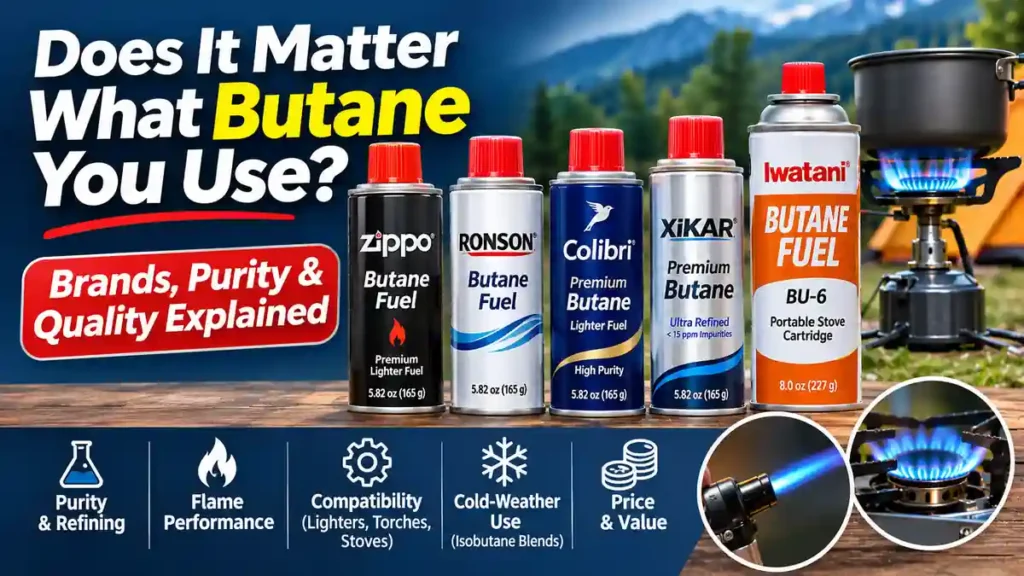
I start with the device, not the can. A refillable pocket lighter, multi-jet cigar torch, tabletop culinary torch and camping stove can have very different connections and fuel requirements. For lighter refills, Zippo, Ronson, Colibri, Xikar, Vector and Newport are names consumers may encounter. S.T. Dupont owners should identify the specific refill system for their model. These brands are not interchangeable by default. I check the manufacturer’s fuel guidance, the nozzle fit, the net fuel quantity and the authenticity of the seller. I also distinguish a refill brand from a fuel specification: a familiar logo cannot make an incompatible cartridge safe. I do not select fuel by its advertising claim alone.
What Butane Specifications Actually Tell You
Normal butane, or n-butane, has the molecular formula C4H10, a molar mass of approximately 58.12 grams per mole and a normal boiling point near minus 0.5 degrees Celsius. Isobutane has the same formula and molecular mass but a different structure; its boiling point is around minus 11.7 degrees Celsius. These values help explain why fuel delivery can change in cold weather. At a given temperature, isobutane has a higher vapor pressure than normal butane. A mixture containing propane may have still different pressure characteristics. I would never use those physical differences as permission to substitute fuel in equipment that specifies a particular cartridge or refill. The product instructions remain the deciding factor.


Why Fuel Cleanliness Matters in Small Burners
A precision lighter has tiny fuel passages and may rely on stable gas delivery through a small valve. Residues or contaminants can contribute to unreliable performance, particularly when passages are narrow. But poor ignition does not always mean dirty fuel. The spark system, ambient temperature, flame adjustment and condition of the lighter also matter. I distinguish three questions when evaluating a can: Is the chemical mixture approved? Is the product sufficiently clean for the device? Does the nozzle or adapter fit? A can can pass one test and fail another. Premium marketing may address cleanliness without proving that the fuel is suitable for every burner.
A Practical Comparison of 5X, 7X and 11X Labels
Five-times, seven-times and eleven-times refined are marketing descriptions rather than a universally standardized laboratory grading system. Different producers can use different purification methods and starting materials. Without comparable analytical data, I cannot conclude that an eleven-times-refined product has fewer residues than every five-times-refined competitor. I would rather have a clear manufacturer recommendation and authentic packaging than rely solely on the number printed on the can. For a basic compatible lighter, a reputable standard refill can be sufficient. For an expensive multi-jet torch, the maker’s recommended premium fuel may be the safer choice for performance and warranty considerations.
What Makes a Refill Nozzle Compatible?
The refill tip should meet the lighter’s valve squarely and form the intended connection without excessive pressure or leakage. Some fuel cans have one fixed tip; others come with adapters. A nozzle that looks similar is not necessarily correct. I do not trim a tip, widen a valve, fabricate an adapter or transfer fuel from an unrelated camping canister. If gas escapes continuously during filling, I stop, avoid ignition sources and consult the lighter’s instructions. Compatibility is about both the fuel inside the can and the mechanical connection at the valve. A low price is not worth damaging the refill system.
Cold Weather and Butane Performance
Butane relies on sufficient vapor pressure to feed a burner. When the lighter or can becomes cold, vapor pressure decreases, and the flame may weaken or fail to light. This is especially noticeable with normal butane near its atmospheric boiling point. A warmer environment can restore ordinary operation, but I never recommend heating a lighter or refill can with a flame, stove, hot water or other improvised heat source. I also would not switch to a higher-pressure camping blend simply to overcome cold weather unless the appliance manufacturer specifically approves it. A persistent problem at room temperature warrants proper troubleshooting rather than repeated filling.


How to Compare the Real Cost of Butane
I compare the net mass of fuel rather than the apparent size of the aerosol can. For illustration, a 100-gram can costing six dollars has a nominal fuel price of six cents per gram; a 200-gram can costing ten dollars has a nominal price of five cents per gram. These are hypothetical examples, not current store prices. The usable value also depends on transfer losses, nozzle fit and whether the lighter accepts the product. A cheaper refill that leaks around the valve can waste fuel and introduce risk. For premium lighters, the cost of a recommended refill may be small compared with repair or replacement costs.
Why Camping Canisters Need Separate Consideration
Camping fuel cartridges may be sold as butane, isobutane or mixed gas, and they often use different connectors from lighter refill cans. Some blends contain propane. Their vapor-pressure behavior and intended appliances can differ from lighter fuel. I never assume that a cartridge intended for a stove or lantern can be transferred into a pocket lighter. Likewise, a lighter-refill can is not a substitute for an appliance cartridge merely because both contain hydrocarbons. Read the stove or torch model’s specified fuel standard, cartridge connection and operating instructions. Improvised adapters and transfers can create leakage and fire hazards.
Safety Checks Before Buying or Refilling
I inspect the container for damage, confirm that the label is legible and read its storage and handling warnings. Butane is extremely flammable; released vapor can collect in low spaces because it is heavier than air. I avoid ignition sources and work only in suitable ventilation. I keep refill cans away from direct sunlight and excessive heat, and never leave them in a hot vehicle. If a lighter leaks or smells strongly of gas, I do not test the flame. I stop using it and follow the manufacturer’s safety guidance. I also keep pressurized fuel out of children’s reach and follow local rules for disposal.
My Seven-Point Butane Buying Checklist
Before choosing a brand, I ask seven questions. First, what exact appliance model am I using? Second, what fuel composition does its manufacturer approve? Third, does the refill nozzle or cartridge connection match? Fourth, is the can authentic and undamaged? Fifth, is the product clean enough for the intended burner? Sixth, are the storage instructions appropriate for where I live? Seventh, what is the cost per usable gram? If the first three questions are unanswered, I do not proceed on the strength of a purity claim or discount. This method helps me make a consistent decision without pretending that one brand is always best.
| Fuel or product | Technical distinction | Buying consideration |
|---|---|---|
| n-Butane | Boiling point about −0.5°C | Use only where approved |
| Isobutane | Boiling point about −11.7°C | Different vapor pressure |
| Zippo / Ronson | Lighter refill brands | Check exact insert and valve |
| Colibri / Xikar | Premium lighter refills | Follow model recommendations |
| S.T. Dupont | Model-specific refills | Verify refill system |
| Vector / Newport | Other refill brands | Verify composition and nozzle |
Is All Butane the Same?
No. Normal butane and isobutane share the formula C₄H₁₀ but have different structures and boiling points. Commercial products can contain varying mixtures of hydrocarbons. A fuel labeled butane may be unsuitable for another appliance because of its container, valve, pressure or composition. Always check the equipment manual.

Does Butane Purity Matter?
For related guidance, see my article on how to determine butane quality.
Purity matters particularly in narrow fuel passages of precision torch lighters. Contaminants and nonvolatile residues may cause deposits or clogging. However, not all impurities have the same effect, and lighter malfunctions may also result from temperature, valve damage or incorrect filling. A published contaminant specification is more useful than an unverified claim of exceptional purity.
What Does Five-Times Refined Mean?
For related guidance, see my article on 5X versus 11X refined butane.
Some lighter fuels advertise three, five or more refining stages. Those counts do not constitute a universal purity standard. I would compare measured impurity levels, nonvolatile residue specifications and manufacturer compatibility rather than treating the biggest refining number as the best fuel.


Zippo Butane Fuel
Zippo markets butane refill fuel for compatible butane lighter inserts, utility lighters and torches. Its butane fuel is different from traditional liquid lighter fluid. I would start with Zippo’s recommended fuel when using a Zippo butane appliance and check the precise model instructions.
Ronson Butane Fuel
Ronson is an established lighter fuel brand. Certain Zippo guidance recognizes Ronson fuel for particular butane torch products. That does not mean every Ronson can is suitable for every appliance; check the specific product and refill connection.
Colibri Premium Butane
Colibri recommends its premium butane for compatible Colibri lighters and warns that contamination or unsuitable fuel pressure can affect lighter mechanisms. This makes manufacturer-approved fuel an especially sensible choice for an expensive precision lighter.
Xikar Premium Butane
For related guidance, see my article on top butane brands.
Xikar publishes a claim of fewer than 15 parts per million impurities for its Premium Butane Fuel. That is more concrete than an unspecified refining count, but it is a manufacturer claim rather than an independent comparison proving Xikar outperforms all alternatives.
Iwatani Butane Cartridges
Iwatani BU-6 is a 227-gram butane cartridge for compatible portable appliances, not a conventional lighter-refill can. Iwatani specifies its own fuel for its butane appliances. Correct cartridge geometry, valve connection and appliance approval are essential.
| Brand | Main use | Important consideration |
|---|---|---|
| Zippo | Lighter and torch refills | Check Zippo model guidance |
| Ronson | Lighter fuel | Check refill tip and approval |
| Colibri | Premium lighter fuel | Colibri recommends its own fuel |
| Xikar | Premium jet-lighter fuel | Publishes fewer than 15 ppm impurity claim |
| Iwatani BU-6 | Portable stove cartridge | 227 g; appliance-specific cartridge |
Is Expensive Butane Better?
Not necessarily. Premium fuel may reflect tighter controls, packaging or brand positioning. For sensitive torch lighters, paying for documented cleanliness and manufacturer approval can be worthwhile. For tabletop stoves, the correct approved cartridge matters more than premium lighter-fuel marketing. Compare price per gram or equivalent volume, not only can price.
Different Grades of Butane
Commercial fuel butane, lighter-refill butane, camping cartridges, refrigerant-grade R-600a, laboratory-grade butane and petrochemical feedstock have different intended specifications. Premium is a marketing term unless backed by measurements. Refrigerant-grade fuel is not interchangeable with lighter fuel, and ordinary lighter fuel must never be used to service refrigeration systems.
Does Brand Affect Flame Temperature?
For related guidance, see my article on butane versus propane flame heat.
A higher price does not guarantee a hotter flame. Burner design, fuel-air mixing, ambient temperature, fuel composition and pressure all influence performance. Idealized butane-air adiabatic flame temperature is around 1,970°C, but actual torch and lighter flame temperatures differ. A weak flame is not proof of inferior fuel.
Can Fuel Quality Affect Lighter Lifespan?
Unsuitable or contaminated fuel may contribute to clogging in small passages. Nevertheless, lighter lifespan also depends on valves, seals, ignition components and use. There is no reliable universal percentage by which premium fuel extends life. If a lighter leaks, hisses unexpectedly or behaves abnormally, stop using it and follow the manufacturer’s safety instructions.
Does Butane Type Matter for Camping?
For related guidance, see my article on whether butane becomes too cold to light.
Absolutely. Pure n-butane boils near 31.1°F (−0.5°C), isobutane near 10.9°F (−11.7°C), and propane near −43.7°F (−42.1°C). Vapor pressure drops in cold conditions, so pure n-butane can struggle near freezing. Some approved isobutane-propane blends perform better, but a fuel blend’s behavior changes as it is consumed. Never heat a cartridge with a flame.
| Fuel | Boiling point | Implication |
|---|---|---|
| n-Butane | 31.1°F | Weak vaporization near freezing |
| Isobutane | 10.9°F | Better cold performance |
| Propane | −43.7°F | Generally better for cold-weather fuel supply |
Does Brand Affect Stove Runtime?
For related guidance, see my article on 220g butane cartridge runtime.
Runtime depends mainly on usable fuel mass and consumption. A 220-gram cartridge consumed at 150 grams per hour has a theoretical runtime of 1.47 hours, approximately 88 minutes. Real results vary with temperature, burner setting and fuel composition. Compare fuel mass and the stove’s grams-per-hour rating before assuming one brand lasts longer.
| Fuel mass | 100 g/h | 150 g/h | 200 g/h |
|---|---|---|---|
| 100 g | 60 min | 40 min | 30 min |
| 220 g | 132 min | 88 min | 66 min |
| 227 g | 136 min | 91 min | 68 min |
| 250 g | 150 min | 100 min | 75 min |
| 450 g | 270 min | 180 min | 135 min |
What Butane Should You Use for a Culinary Torch?
Use the manufacturer’s specified fuel and refill connection. Some torches have refill valves, while others attach directly to cartridges. Clean fuel may help small passages, but a can marked food grade does not by itself establish compatibility or safety. Never improvise adapters or modify valves.
Can You Mix Butane Brands?
For related guidance, see my article on the risks of mixing butane with other fuels.
Do not deliberately mix fuels or transfer fuel between containers unless the equipment manufacturer specifically permits it. Two products labeled butane may differ in composition and pressure. Never refill a nonrefillable camping cartridge or substitute propane in a butane-only appliance.
How to Recognize Quality Butane
Look for a reputable manufacturer, clear fuel composition or impurity specifications, intact packaging, appropriate hazard labels, correct nozzle or cartridge, and written appliance compatibility. Manufacturer approval is essential, not merely another optional quality feature.
Is Premium Butane Worth It?
For a costly jet-flame lighter, I would choose the fuel recommended by its maker. For a simple compatible refillable lighter, a reputable lower-priced fuel may be adequate. For camping, prioritize approved cartridge design and appropriate temperature performance. For refrigeration or laboratory work, follow the exact required technical specification.
Common Buying Mistakes
Do not assume all butane cans are interchangeable, rely solely on refining-stage counts, expect premium fuel to burn hotter, force a mismatched stove cartridge, substitute lighter fuel for refrigerant, refill disposable cartridges, or store pressurized cans in excessive heat.
Frequently Asked Questions
Does it matter which brand I use?
Yes when the manufacturer specifies one; otherwise compare compatibility and measurable quality.
Is Zippo better than Ronson?
Neither is universally superior. Follow your lighter’s instructions.
Is Xikar good for torch lighters?
It publishes a low-impurity specification, but suitability still depends on the lighter.
Can cheap butane damage a lighter?
Contaminated or unsuitable fuel can cause problems, but price alone does not establish contamination.
Can I use lighter butane in a stove?
Not unless the stove manufacturer explicitly approves that fuel and delivery system.
Does butane expire?
The fuel does not spoil like food, but containers, valves and seals can deteriorate.
Final Verdict
Yes, what butane you use matters—but the brand name alone is not the deciding factor. I would rank appliance compatibility first, fuel composition and cleanliness second, brand reputation third, and price fourth. This helps avoid unnecessary spending while protecting equipment and reducing safety risks.
For an overview of everyday applications, read What Are the Main Uses of Butane?.

Mike is an experienced propane technician with over 15 years of professional experience in the field. He has dedicated his career to helping customers with their propane needs, from installation to maintenance and repair. Together with Jeremy, he co-founded this website to provide useful information and guidance to customers seeking reliable propane services.