Is Butane Safe for Camping? My Verdict
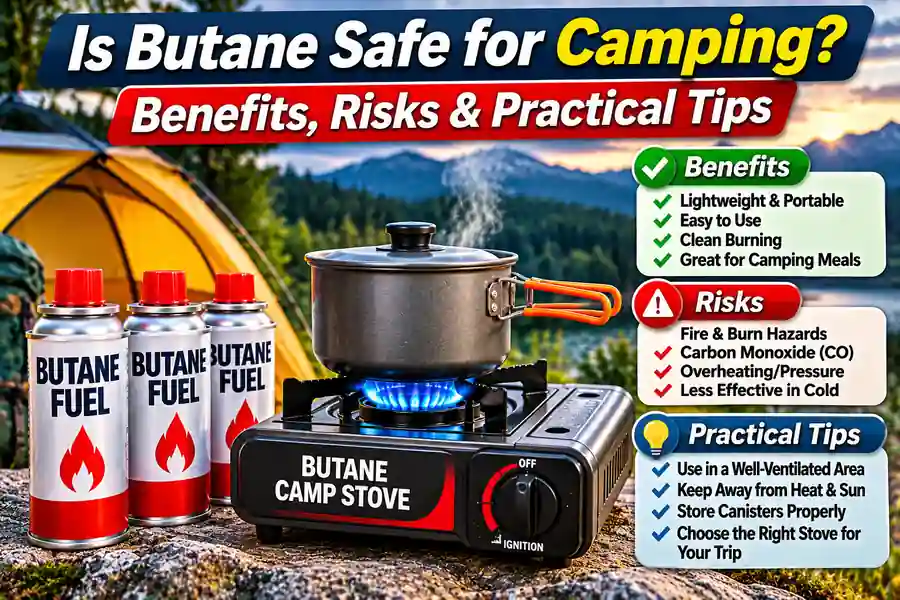
Yes, but only within the limits of the equipment. I consider butane suitable for many outdoor camping meals because properly designed portable stoves are compact, easy to light and relatively simple to operate. Yet I never equate a small fuel canister with a harmless product. It is a pressurized container of flammable gas, and a cooking burner is an open ignition source.
If you are planning your first camping trip, I would start by choosing the camping environment and the cooking task, not by buying the cheapest set of cartridges. Are you cooking at an established campsite, hiking with a small pack, or stopping at an RV site? Will you be camping in warm weather or close to freezing? Do local fire restrictions allow a gas stove at all?
These details change what safe and useful equipment looks like. A flat tabletop cassette stove may be ideal for a level picnic table in mild weather, while a compact threaded-canister burner might make more sense for backpacking. Both have restrictions, and neither belongs inside an ordinary camping tent.


Benefits of Butane as a Camping Fuel
1. Easy packing and straightforward use
One advantage I appreciate is portability. A compatible cassette stove and a few factory-filled cartridges form a compact outdoor cooking setup without a hose leading to a large cylinder. Many portable models have an integrated igniter and adjustable burner. These are conveniences, not safety guarantees; I still read the manual and test the system before leaving home.
2. Good heat control for ordinary meals
For heating soup, scrambling eggs in an appropriate pan or boiling water, an adjustable butane burner may be easier to manage than a traditional wood campfire. You can often turn the flame down when cooking is complete, which reduces unnecessary fuel consumption. Actual simmer performance varies by model, and wind can make some burners inefficient.
3. Clean-looking combustion
A properly adjusted butane burner often produces little visible soot. That makes cookware easier to maintain than some smoky campfire setups. But I would never describe the exhaust as harmless: combustion emits carbon dioxide and can produce dangerous carbon monoxide when conditions are poor. Flame color is not a reliable indoor-air safety indicator.
4. Convenient canister replacement
Factory-filled cartridges simplify fuel changes when the stove and cartridge are designed for each other. The tradeoff is packaging and limited supply. I would check whether the exact cartridge is sold near the destination before relying on it for every meal. A standard-looking canister can still have the wrong valve, fuel mix or dimensions.


5. Useful where campfire cooking is unsuitable
When local rules specifically permit portable gas stoves, they can offer a controllable cooking alternative to wood fires. However, a fire ban can restrict gas appliances too. I check the current local rule rather than assume a gas burner is automatically exempt, and I bring no-cook food for days when flame use is prohibited.
| Potential benefit | Why campers value it | What I would verify |
|---|---|---|
| Portability | Compact fuel and cooking equipment | Total packed mass and stove stability |
| Ignition convenience | Many models have built-in igniters | Manual and igniter condition |
| Adjustable heat | More control than a fixed flame | Low-flame stability |
| Low visible soot | Cleaner-looking pots | Ventilation and exhaust safety |
| Replaceable cartridge | Straightforward fuel supply | Exact fuel compatibility and availability |
| Quick shutdown | Flame can normally be switched off | Reliable controls and cooling instructions |
The Main Risks of Camping With Butane
Carbon monoxide: the danger you cannot smell
Carbon monoxide is odorless and colorless. A stove that appears to work normally can still create dangerous exposure if operated in a tent, camper, vehicle, enclosed cooking shelter or other poorly ventilated location. The U.S. Consumer Product Safety Commission warns that camping heaters, lanterns and stoves can poison people in these spaces. I would never sleep with a butane burner or lantern operating nearby in an enclosed area.
Headache, dizziness, nausea, weakness or confusion may resemble fatigue or an ordinary illness. If these symptoms appear around fuel-burning equipment, stop exposure, move into fresh air and seek urgent medical care. I regard a carbon monoxide alarm as a useful supplemental protection where appropriate, not a license to use outdoor equipment indoors.
Cartridge overheating and flash fires
Health Canada specifically warns about portable butane stoves that hold a disposable cartridge inside the body of the cooker. Incorrect grate orientation, oversized pans and nearby heat sources can cause excessive heating of the cartridge. If pressure builds and gas escapes, it can ignite suddenly and cause a flash fire.
I keep the cooking grate correctly oriented, with supports in the position specified by the manual. I do not use a wide griddle stretching over the fuel compartment, put two burners together under one pan, or operate another heater beside the cartridge. Even if a stove advertises pressure protection, that feature does not excuse unsafe cookware.

Leaks and mismatched cartridges
A hiss, damaged valve, unusual gas odor or visibly damaged cartridge is reason to stop. I do not force canisters into place, attach aftermarket transfer hardware or assume that all products labeled ‘butane’ are interchangeable. I would remove equipment from service and follow the maker’s instructions if a connection appears compromised.
Fire, burns and unstable cookware
A lightweight stove can tip if its base is uneven or its pot is too wide. I prefer a secure, level, fire-resistant surface where children and pets cannot brush against the equipment. I do not leave a lit burner unattended or place it beneath combustible tarps and low branches. A pot handle that extends into a walkway can be as dangerous as the flame itself.
| Hazard | Typical trigger | Safer prevention |
|---|---|---|
| Carbon monoxide | Combustion in enclosed or poorly ventilated places | Use outdoor-rated stoves outdoors only |
| Flash fire | Overheated internal cartridge or reflected heat | Follow pot limits, grate orientation and clearances |
| Gas leak | Incorrect fit, damaged valve or old seals | Use matching fuel; stop when leaking |
| Burns | Hot pot, burner or nearby objects | Maintain clear cooking zone |
| Tipping | Unstable ground or oversized pot | Level surface and approved cookware |
| Cold-weather failure | Low cartridge vapor pressure | Use an approved cold-weather system or no-cook plan |
Can I Use a Butane Stove Inside a Tent?
No. I would not use an outdoor-rated butane camping stove inside a tent under any circumstances. Opening the tent door is not enough to make combustion exhaust safe, and the flame can ignite tent fabric, sleeping equipment or stored fuel. The same principle applies to ordinary vehicle cabins, enclosed awnings, garages and campers.
A tent vestibule is particularly tempting during rain because the cook stays relatively dry. I would still avoid it: sheltered fabric geometry, confined air and wind can channel hot exhaust and fire in unpredictable ways. If weather prevents safe outdoor cooking, I switch to food that requires no heat instead of moving the burner into the tent.


For context about combustion equipment at a larger scale, our guide Can You Run a Propane Generator Indoors? addresses carbon monoxide risks with generators. Its equipment-clearance rules are not instructions for butane stoves, but the core message about indoor exhaust hazards is similar.
Which Butane Canister Is Best for Camping?
The first answer is the cartridge your stove manufacturer explicitly approves. The second is the one suited to your expected weather and usage within that approved system. Standard n-butane and isobutane are different molecular forms of C4H10, and outdoor fuel canisters may also contain propane. They differ in vapor pressure, which affects how the burner performs when the canister cools.
| Fuel or cartridge | Common application | Temperature consideration | Buying caution |
|---|---|---|---|
| Normal butane cassette, around 220 g | Compatible tabletop camping stove | Can become weak near freezing | Use only approved cassette system |
| Threaded isobutane blend, 110 g or 230 g | Matching backpacking stove | Typically better in cold than pure n-butane | Thread and mix must match manual |
| Propane/isobutane blend | Manufacturer-approved backpacking burners | Higher vapor pressure can help in cool weather | Not approved for every butane-only appliance |
| Refill aerosol for torch or lighter | Refillable designated tool | Depends on device design | Not a substitute for stove cartridge |
| Manufacturer-specific cartridge | Dedicated camping appliance | Depends on specified formulation | Never force an alternative |
The physical appearance of a connector is not enough to establish compatibility. I never recommend refilling a nonrefillable cassette cartridge or threaded canister with an adapter. Pressurizing and refilling containers not designed for that process can cause leaks, overfilling or rupture.
Why Butane Performs Poorly in Cold Weather
Normal butane boils at roughly 31°F (−0.5°C) at sea level, while isobutane boils near 11°F (−11.7°C). Propane’s boiling point is around −44°F (−42°C). These are physical reference points, not guaranteed stove operating temperatures. During use, fuel evaporation cools the cartridge, so actual flame performance can deteriorate even when the surrounding air is somewhat warmer.
MSR explains that an 80% isobutane/20% propane blend can maintain pressure more effectively than pure normal butane in cooler conditions. I would not assume that means any isobutane-propane cartridge is safe in any cassette stove. Fuel pressure, valve design and manufacturer approval remain decisive.
| Approximate outdoor temperature | Ordinary n-butane consideration | My planning approach |
|---|---|---|
| 60°F / 16°C | Usually adequate vaporization in compatible equipment | Check wind and normal safe operation |
| 45°F / 7°C | Cooling can reduce high-output performance | Use realistic fuel allowance |
| 32°F / 0°C | Vapor supply can become inadequate | Bring an alternative approved system |
| 20°F / −7°C | Poor normal-butane performance likely | Do not rely on basic cassette stove alone |
| 10°F / −12°C | Very limited normal-butane vapor pressure | Use a specifically rated alternative |
I never warm a gas canister with a torch, stove flame, heater or hot-water improvisation to restore pressure. That could overheat a pressurized vessel. If weather defeats the fuel system, I choose food that can be eaten cold or use another manufacturer-approved cooking arrangement. For separate propane equipment, my propane generator winterization guide discusses planning for colder conditions.
How Long Does a Butane Canister Last When Camping?
I use a simple equation: nominal runtime in hours equals fuel mass in grams divided by actual fuel consumption in grams per hour. This is a planning estimate, not a universal performance guarantee. At a hypothetical burn rate of 100 g/hour, a 220 g cartridge holds 2.2 hours of fuel. At 150 g/hour, it has about 1.47 hours of nominal fuel.
| Fuel amount | At 60 g/h | At 100 g/h | At 150 g/h | At 200 g/h |
|---|---|---|---|---|
| 110 g | 1.83 h | 1.10 h | 0.73 h | 0.55 h |
| 220 g | 3.67 h | 2.20 h | 1.47 h | 1.10 h |
| 230 g | 3.83 h | 2.30 h | 1.53 h | 1.15 h |
| 450 g | 7.50 h | 4.50 h | 3.00 h | 2.25 h |
These figures omit cartridge cooling, the gas remaining when operation weakens and changes in burn rate during simmering. They also do not imply that a 450 g cartridge fits a 220 g cassette stove. Each row should be applied only to a stove approved for that cartridge. For larger-scale fuel calculations, How Often Do You Need to Refill a Propane Generator? uses the same consumption-based thinking.
How Much Butane Should I Bring for a Weekend Camping Trip?
I would plan cooking minutes for each meal, rather than merely count the people traveling. Suppose two campers cook breakfast for 15 minutes and dinner for 25 minutes each day over a two-day trip. That is 80 total burner minutes, or 1.33 hours. At an illustrative 100 g/hour, total consumption is around 133 g. Theoretically one compatible 220 g cartridge contains enough, assuming the stove performs as expected.
I would still carry an appropriate reserve within safe storage limits, or pack ready-to-eat food that works without any flame. Weather, wind, altitude, a larger pot or a stove malfunction can invalidate the simple calculation. I like to record real fuel consumption after each trip so the next estimate is based on something stronger than generic advertising.
| Camping plan | Total burner time | Assumed rate | Theoretical fuel consumed |
|---|---|---|---|
| Two meals, 15 min each | 30 min | 100 g/h | 50 g |
| Two days, 40 min/day | 80 min | 100 g/h | 133 g |
| Three days, 45 min/day | 135 min | 100 g/h | 225 g |
| Three days, 60 min/day | 180 min | 150 g/h | 450 g |
| Four days, 30 min/day | 120 min | 120 g/h | 240 g |
A 225 g estimate is slightly more than one 220 g cartridge, so I would not pretend it fits comfortably inside a single can. Round up to whole compatible containers and include an actual reserve plan. Do not attempt to combine leftovers by transferring fuel between disposable cartridges.
How Much Does Camping With Butane Cost?
Canister prices vary considerably by brand, size, region and fuel blend. I compare the price per net gram of compatible fuel and the cost per meal using observed burn time. A small lightweight threaded canister can cost more per gram than a common cassette cartridge, but that does not mean it is a safe substitute in the same stove.
| Illustrative purchase | Example price | Net mass | Calculated price per 100 g |
|---|---|---|---|
| Single cassette cartridge | $3.50 | 220 g | $1.59 |
| Four cassette cartridges | $12.00 | 880 g | $1.36 |
| Small threaded cartridge | $7.00 | 110 g | $6.36 |
| Medium threaded cartridge | $12.00 | 230 g | $5.22 |
All prices are hypothetical calculation examples, not current verified retailer offers. In practice, fuel availability and approved compatibility come before unit price. I would not buy an unsuitable fuel blend solely to save money.
How to Set Up a Butane Stove Safely at a Campsite
Before lighting: inspect the site
I first confirm that the campground allows gas-stove cooking. Then I look for a level, stable, noncombustible work surface outside and away from tents, tarps, doors, vents, dry vegetation and flammable supplies. I consider both flame clearance and possible wind gusts. If a safe outdoor location is unavailable, I do not light the stove.
Inspect the equipment and match the fuel
I check the manufacturer’s model and fuel designation, cartridge condition, stove body, controls and obvious damage. The cartridge should engage as directed without force. A bent fitting, corrosion or gas odor is a reason to stop and consult the manual or qualified support.
Position cookware correctly
I ensure the supports are oriented properly and the pot size falls within manufacturer limits. For cassette stoves, cookware must not extend over the fuel compartment and reflect excess heat toward the canister. I do not use two cassette stoves under one shared griddle or place the cooking device beside another heat source.
Light and operate as instructed
I use the manufacturer’s ignition method, keep clear of the flame and supervise continuously. If ignition fails, I turn the stove off and follow its waiting and troubleshooting directions. I do not repeatedly spark a burner when unburned gas may be accumulating.
Shut down and cool before packing
When cooking is done, I turn the burner off, keep people clear and allow it to cool completely. I remove the cartridge for storage when instructed by the manufacturer, and I do not put a hot stove in a fabric carrying case. A cooled stove is still something I inspect for damage before the next use.
Wind, Rain and Fire Restrictions: What Changes?
Wind has two effects: it can waste heat around the pot and push flame into parts of the stove that were not intended to be heated. I would only use a windscreen when its manufacturer expressly approves the arrangement. Homemade sheet-metal barriers around a cassette stove can trap heat near the cartridge, which is the opposite of what I want.
Rain is not a reason to bring outdoor cooking into a tent. If a site has a properly designed outdoor cooking area that meets the stove’s clearance rules, that may be suitable, but I would never assume any roof or enclosed shelter is safe. Lightning, high winds, flooding and wildfire smoke may justify skipping the burner entirely.
Campfire bans deserve separate attention. Some jurisdictions permit certain gas stoves during specified restrictions, while others ban all open flames. I would read the exact rules for the campsite on that day. Good camping preparation includes food you can eat without heating when restrictions change unexpectedly.
Safe Canister Storage and Transport
I keep pressurized fuel out of direct sun, hot vehicles and proximity to campfires, heaters and electrical ignition sources. I follow temperature limits, package instructions and local transport rules. The car trunk is not automatically an appropriate long-term storage location, particularly in summer heat.
I also separate fuel from sharp tools and protect the canister from crushing during transport. A cartridge that appears empty can still contain flammable vapor; I would never puncture or burn it. Local waste-handling requirements determine whether it can enter a particular recycling stream.
The broader principles of fuel storage and equipment handling also appear in our guide to transporting and storing propane generators safely. That article concerns different hardware, so always follow your butane cartridge’s own label.
Butane vs. Propane for Camping
Butane’s advantages often include compact cassette-style packaging and convenient warm-weather cooking. Propane has much better cold-weather vapor pressure, but it generally requires a system designed for the different fuel and pressure. Some camping stoves are expressly dual-fuel; many are not. A regulator or adapter offered online does not establish safe compatibility.
| Factor | Butane system | Propane system |
|---|---|---|
| Typical use case | Warm-weather cassette cooking | Approved colder-weather camping or larger burners |
| Atmospheric boiling point | About 31°F for n-butane | About −44°F |
| Cold-weather vapor pressure | Limited near freezing | Typically higher |
| Fuel packaging | Cassette and other approved canisters | Approved cylinders or specified cartridges |
| Main decision | Fuel fit, safe pot size and mild temperatures | Approved appliance, regulator and connection |
If camping with an RV, I would also distinguish a cooking stove from a generator that supplies electrical power. My propane generator sizing guide for RVs explains that separate electrical task. Never operate a generator inside an RV or enclosed structure.
My Camp Cooking Risk Scorecard
I use a simple check-before-you-light routine when planning a campsite kitchen. It is my own editorial checklist, not an official certification or substitute for a manufacturer inspection. If any critical condition fails—especially outdoor location, equipment integrity or approved fuel—I stop regardless of the score.
| Pre-cooking condition | Score if satisfied |
|---|---|
| Outdoor location and clearances approved | 1 |
| Local fire restrictions checked | 1 |
| Stove and cartridge are compatible | 1 |
| No damaged valves or signs of leakage | 1 |
| Pot fits grate without covering cartridge | 1 |
| Stable, level surface | 1 |
| No unapproved windscreen or adjacent heat | 1 |
| Safe distance from tents, people and dry material | 1 |
| Adult supervision throughout cooking | 1 |
| No-cook backup meal available | 1 |
I aim for ten out of ten, but the score is not permission to proceed when even one dangerous condition exists. I do not turn a failed carbon-monoxide or leakage check into a pass by compensating with other points. The value of the scorecard is that it prompts consistent questions before someone strikes a flame.
Is Butane Safe for Family Camping With Children or Pets?
I would keep children and pets outside the cooking zone, not merely tell them to be careful. A low stove on the ground can be particularly easy for a child or dog to bump. I prefer a secure outdoor cooking station where pot handles do not face walking routes and fuel cartridges are never left as toys or loose objects.
Adults should manage lighting, fuel changes and hot cookware. I keep a suitable first-aid kit available and know the route to the nearest medical facility. A hot stove can cause burns even after the flame is off, so I allow sufficient cooling time before anyone handles or packs it.
What if You Smell Gas or the Stove Stops Working?
If I detect a continuing hiss or gas smell, I stop operating the burner, avoid flames and electrical sparks, move people away from the area and follow the equipment maker’s emergency instructions. I do not keep testing the igniter to see whether the leak will burn away. If a serious release or fire occurs, I contact emergency services rather than attempting a pressurized-container repair.
Weak flame output may come from a nearly empty cartridge, low temperature, incorrect fitting or a blocked burner. I do not modify jets or heat the canister to restore pressure. I allow the system to cool and use the troubleshooting steps supplied with the exact model.
Our article Propane Generator Leaks: How to Detect and Prevent Them outlines related leak-awareness concepts, but it should not be used as a technical service manual for a small camping stove.
Frequently Asked Questions
Is it safe to cook with butane at a campsite?
Yes, with compatible, sound equipment in a permitted outdoor cooking area and full compliance with the stove manufacturer’s directions. The risks rise sharply with improper cartridge placement, oversized cookware, poor ventilation or unattended operation.
Can I use butane in a tent with the door open?
No. Outdoor-rated camping stoves do not belong inside tents, even with openings. Carbon monoxide and fire hazards remain.
Is butane safe for winter camping?
Ordinary normal butane may perform poorly near freezing. Choose a stove and fuel mix explicitly approved for the expected weather, or carry a no-cook alternative. Never improvise heating a canister.
How long will 220 g of butane last?
At 100 g/hour, approximately 2.2 hours of theoretical burner time; at 150 g/hour, about 1.47 hours. Actual operating time depends on burner settings, temperature, cartridge design and remaining usable fuel.
Is it safe to refill an empty camping canister?
Do not refill a cartridge labeled nonrefillable. A self-sealing valve does not make the container certified for repeated filling, and improvised transfers can cause overfilling and leaks.
Can butane fumes make me sick?
Combustion gases can contain carbon monoxide, and unburned gas can displace oxygen in poorly ventilated spaces. If anyone becomes dizzy, nauseated or confused, stop exposure, get fresh air and seek medical evaluation.
Can I use a big frying pan on a cassette stove?
Only if the pan stays within the manufacturer-approved dimensions and does not overhang or heat the cartridge compartment. Oversized cookware has been associated with dangerous cartridge overheating and flash fires.
What is the best fuel for camping?
There is no single universal best. Normal butane may suit mild-weather cooking on a matching stove, while certified isobutane blends or propane systems may be more useful in cold conditions. Compatibility and safe use come before price.
Final Verdict: How I Would Camp Safely With Butane
I would use butane for camping when the stove is appropriate to the trip, fuel is easy to obtain, outdoor cooking is permitted and the weather suits the appliance. The most attractive benefits are compact equipment, controllable heat and convenient meals. The most important risks are carbon monoxide, flame and burn hazards, cartridge overheating, leakage and reduced cold-weather pressure.
My practical rule is to buy the correct cartridge, choose cookware that fits, test the stove at home outdoors before traveling, store fuel carefully and bring a backup meal that requires no flame. If the conditions are not safe, I do not cook with the stove. That is how I turn a useful camping convenience into a responsible piece of outdoor equipment.

Mike is an experienced propane technician with over 15 years of professional experience in the field. He has dedicated his career to helping customers with their propane needs, from installation to maintenance and repair. Together with Jeremy, he co-founded this website to provide useful information and guidance to customers seeking reliable propane services.