What Can You Power With Butane?
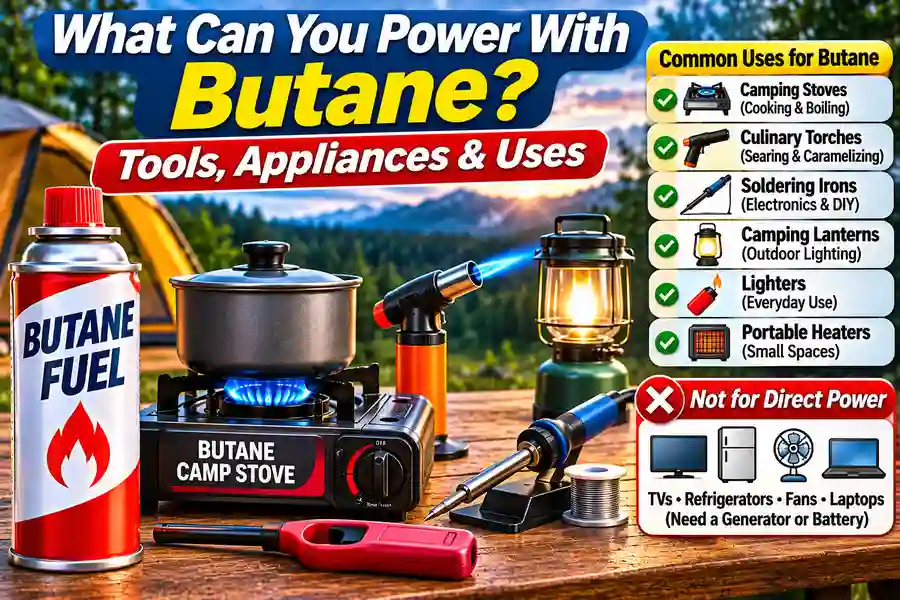
When someone asks me what butane can power, I first distinguish a fuel that burns to generate heat from a fuel system that actually generates electricity. Butane is extremely useful as a compact heat source in the right appliance. It can light a cigarette, brown food, boil water at an approved outdoor stove or warm the soldering tip of a cordless iron. But an ordinary can of butane cannot charge a phone or keep a refrigerator operating.
This distinction is more than a technical detail. It shapes what you should buy for camping, household preparedness, workshop jobs and travel. If your main goal is cooking without mains electricity, a compatible butane stove may help. If your goal is charging devices or running an electric pump, you need a different system built to supply electricity.
I prefer to choose the end task before choosing the fuel. How much heat do you need? Does the tool use a direct flame, hot metal tip or hot air? Can it safely operate in the intended environment? Can you buy the correct cartridge? Those answers matter more than whether a retailer labels a fuel ‘premium’ or ‘universal.’


Butane-Powered Tools and Appliances: Quick Reference Chart
| Device or appliance | What butane actually powers | Typical fuel arrangement | Important limitation |
|---|---|---|---|
| Refillable lighter | Small ignition flame | Approved butane refill aerosol | Valve and fuel must match |
| Culinary torch | Concentrated flame for food finishing | Integrated refillable reservoir | Do not refill near heat or flame |
| Camping cassette stove | Cooking burner | Matching single-use cassette cartridge | Outdoor-only when rated for outdoor use |
| Backpacking burner | Compact camp-cooking flame | Approved threaded gas blend cartridge | Connector and mixture are model-specific |
| Butane soldering iron | Catalytic heating element and tip | Refillable internal reservoir | Not a direct replacement for every electric iron |
| Jewelry microtorch | Small precision flame | Manufacturer-approved butane | Not sufficient for all metal thicknesses |
| Hot-air craft tool | Warm air for approved tasks | Integrated butane-fueled heater | Heat can damage plastic and electronics |
| Portable specialty heater | Combustion heat in a certified appliance | Specific fuel container | Never use a camping burner as a room heater |
| Gas-powered hair styling tool | Heated styling surface in some specialty products | Proprietary or approved cartridge | Check model certification and operating environment |
| Household refrigerator | Not directly powered by a simple butane can | Requires electrical or dedicated engineered system | Do not improvise fuel conversions |
| Phone or laptop | Not directly | Requires electricity | Use battery or rated generator/power supply |
The table describes categories, not an assurance that every device in each category accepts every kind of butane. I always check the exact model’s instructions. Even two similar-looking portable burners can use different cartridge connectors and fuel blends.
How Butane Powers Equipment
Most consumer butane products store the fuel as a liquefied gas under pressure. When a compatible appliance opens its control valve, vaporized fuel moves toward the burner and mixes with air. Ignition releases chemical energy as heat. The appliance then directs that heat into a flame, metal tip, cookware or another specially designed heat exchanger.
Some devices use an open flame directly. Others burn gas internally to heat a metal or ceramic element. A cordless soldering iron, for example, may deliver the heat to its tip without holding a visible flame against the circuit board. A hot-air tool may use combustion to heat air that then reaches the workpiece.
This gives butane a clear strength: heat can be delivered without an electrical cord. Its limitation is equally clear. Heat output is not the same as regulated household electrical output. A device must contain a separately engineered generator and electrical controls to convert fuel into electricity. Ordinary butane torches and camping burners do not have those components.


Technical Specifications: The Properties That Matter
I focus on a few measurable properties rather than vague claims about fuel being ‘powerful.’ Normal butane is C4H10, with an atmospheric boiling point near 31°F (−0.5°C). Isobutane has the same chemical formula but a different structure and a boiling point near 11°F (−11.7°C). That affects vapor delivery in cool weather but does not authorize substitution between devices.
| Technical property | Approximate reference value | Practical meaning |
|---|---|---|
| Normal butane chemical formula | C4H10 | Combustible hydrocarbon fuel |
| Molecular mass | 58.12 g/mol | Useful for engineering calculations |
| Normal butane boiling point | 31°F / −0.5°C | Cold-weather vapor delivery can fall |
| Isobutane boiling point | 11°F / −11.7°C | Some compatible blends perform better in cooler conditions |
| Lower heating value | About 45–46 MJ/kg | Amount of fuel chemical energy |
| Energy in 100 g butane | About 4.6 MJ | Before burner efficiency losses |
| Energy in 220 g butane | About 10.1 MJ | Before burner efficiency losses |
| Direct CO2 from complete combustion | About 3.03 kg/kg of butane | Burning fuel creates carbon emissions |
These are rounded reference figures and calculations for approximately pure butane. Commercial canisters may contain a mixture of normal butane, isobutane and propane. The fuel’s exact composition affects both operating pressure and equipment suitability, so I do not use the reference table as a replacement for the manufacturer’s specification.
1. Butane Lighters: The Most Familiar Application
The ordinary refillable butane lighter is probably the easiest example of a butane-powered product. Fuel vapor passes through a small burner and is ignited by a spark or other ignition mechanism. The device is inexpensive to operate in many cases because each lighting event consumes little fuel.
I would look for a purpose-built refillable lighter, a reliable valve, a stable flame and a matching lighter-grade refill aerosol. A manufacturer may recommend refined low-residue fuel because tiny valves and jets can be sensitive to deposits. However, ‘ultra-pure’ marketing is not a substitute for compatible fuel or proper nozzle fit.
I also distinguish refillable lighters from disposable ones. A lighter that is not designed for refilling should not be modified to accept gas. Even when a valve-like feature is visible, that is not permission to force fuel into it.

Traditional flame versus jet-flame lighter
A traditional soft-flame lighter and a wind-resistant jet-flame lighter can both use approved butane, but they direct heat differently. A focused jet flame can deliver more concentrated heat at the point of use. It may also use fuel faster, depending on settings and design. I would not assume one model’s refill method or runtime applies to another.
2. Butane Camping Stoves and Portable Cooking Burners
Butane camping stoves are useful when you have a permitted, safe outdoor cooking location. The burner supplies heat directly to cookware and can prepare food without an electrical outlet. Many tabletop units use a specific cassette-style cartridge, commonly around 220 g, while backpacking stoves may use threaded canisters containing different approved gas blends.
The fuel system matters as much as the burner. I do not treat a lighter refill aerosol as a substitute for a cassette stove cartridge, or assume that a threaded isobutane blend can be connected to any butane burner. An adapter advertised online does not automatically make a combination approved.
There is a particularly important safety boundary: outdoor-rated camping stoves must never be used inside houses, garages, tents, vehicles or campers. Carbon monoxide can accumulate without a noticeable smell. Health Canada also warns that oversized cookware and incorrect grate positioning can reflect heat toward a cassette stove’s cartridge, creating a flash-fire hazard.


For a blackout, I would keep no-cook food ready in case the weather makes outdoor stove use unsafe. A fuel burner is useful only when the operating environment meets the equipment instructions.
3. Culinary Butane Torches: Small Flame, Precise Heat
A culinary torch uses a concentrated flame for tasks such as browning a dessert topping or finishing a dish. I like the precision of a small torch for finishing rather than attempting to use it as an entire cooking system. It is not an efficient substitute for a proper burner when you need to cook a pot of food.
Many culinary models have an internal refillable reservoir that accepts the specified lighter-grade butane aerosol. Others may have dedicated cartridge systems. I would check the valve design, ignition control, safety lock and handling instructions before choosing a fuel.
When using a torch around food, I focus on the torch’s designated culinary application and safe operation. A fuel sold as ‘premium’ does not automatically guarantee food-contact suitability of the entire appliance. I keep loose packaging, alcohol, oils and other flammable materials away from the open flame and let the torch cool before refilling.
4. Cordless Butane Soldering Irons
A gas soldering iron is one of the most useful butane tools for maintenance away from a power outlet. Butane burns within a small heater and raises the temperature of a metal soldering tip. Some multi-function tools also offer approved hot-air and open-flame attachments.
For wiring repairs, the main advantage is portability. I can bring a compact soldering tool to an approved outdoor work area or an appropriate field-maintenance location instead of running an extension cord. But I would not choose a gas tool automatically for delicate printed circuit boards: a temperature-controlled electric station often offers more consistent thermal control and suitable electrical-safety features.
The tip, not just the gas, determines how effectively the solder joint heats. A small pointed tip may struggle with a broad ground pad, even when the fuel burns normally. I would inspect the tip condition, approved gas setting and tool performance before changing to an unapproved fuel.
For field electronics where electricity is available through a backup source, our guide to inverter propane generators for sensitive electronics addresses an entirely different way to power conventional electrical tools.
5. Jewelry and Precision Microtorches
Butane microtorches can support some small jewelry and craft projects that require localized heating. Their appeal is the ability to direct a small flame onto a suitable heat-resistant workpiece. For very small assemblies, that can be practical; for large or heat-conductive metal pieces, a tiny torch may not supply enough heat across the joint.
I prefer to compare actual heat delivery, flame shape and continuous operating capability before buying. A published flame-temperature figure is not the same as the amount of energy reaching the workpiece. A broad metal mass may draw heat away faster than a miniature burner can provide it.
Appropriate eye protection, fire-resistant supports and ventilation are essential. I never use an open flame near solvent vapors, aerosol cans or temperature-sensitive materials. If a task demands more heat, I would buy properly rated equipment instead of forcing propane or another incompatible gas into a butane-only torch.
6. Butane-Powered Hot-Air and Craft Tools
Certain portable multi-purpose gas tools offer hot-air attachments. These can be useful for manufacturer-approved heat-shrink tubing, controlled warming and other small tasks. But hot air is not harmless: it can melt insulation, deform plastic, discolor finishes and damage nearby parts.
I would judge this category by the tool’s heating range, compatible attachments, ignition stability and the manufacturer’s list of approved applications. One device may be designed for soldering and heat shrinking, while another is intended only for flame work. The shared fuel name does not establish interchangeable accessories.
For intermittent tasks, a refillable gas tool can be convenient. For repeated work on sensitive electronics, a proper temperature-controlled electric hot-air station may deliver better repeatability. The best choice depends on the material and work environment, not on the marketing term ‘cordless.’
7. Specialized Butane Heaters and Other Appliances
Some specialty heating products are engineered to use butane cartridges or refillable gas reservoirs. Historically, certain portable hair styling appliances and niche equipment have used fuel cartridges to produce controlled heat. Their existence does not mean any cartridge can run any heater or styling tool.
I would be extremely cautious about portable space-heating claims. A butane camping stove is never an acceptable replacement for a properly certified room heater. Combustion appliances can produce carbon monoxide, consume oxygen and introduce fire hazards. Only use a heating device for the location and purpose expressly approved by its manufacturer and the applicable rules.
For specialized products, proprietary fuel systems may be part of the safety design. I would reject a conversion based only on a connector’s appearance or a seller’s assurance that two gas products are ‘basically the same.’
What Can Butane Not Power Directly?
This question deserves a separate section because searches about butane-powered equipment often mix heat appliances with electrical devices. Butane cannot directly run a phone, laptop, television, refrigerator, ordinary LED lamp, water pump or household air conditioner. Those products need electricity supplied at a specified voltage and power level.
A conventional butane stove produces heat, not regulated AC or USB output. Even if chemical energy exists in the fuel, there is no safe shortcut from a camping canister to an electrical socket. Power generation requires a dedicated machine with appropriate electrical conversion, controls, protection and emissions management.
| Device | Can an ordinary butane burner power it directly? | Practical alternative |
|---|---|---|
| Smartphone | No | Charged power bank or approved USB supply |
| Laptop | No | Suitable power station and charger |
| Refrigerator | No | Rated electrical backup sized for compressor |
| Television | No | Battery/inverter system or suitable generator |
| LED light | Not as an electrical light | Battery or rechargeable lantern |
| Water pump | No | Appropriate electrical backup |
| Cooking pot | Yes, via an approved stove | Use appropriate outdoor cooking stove |
| Small soldering tip | Yes, in a purpose-built butane iron | Compatible gas soldering tool |
| Room heating | Not with an outdoor camping stove | Certified heater or safe heated shelter |
If your objective is household backup electricity, read Can a Portable Propane Generator Power Your Home During an Outage?. I would not mistake the fuel energy inside a small butane can for available household electrical energy.
How Much Energy Is Stored in Butane?
For an approximate technical comparison, I use a lower heating value of 46 megajoules per kilogram. One megajoule equals about 0.2778 kilowatt-hours of energy, so one kilogram of butane contains approximately 12.8 kWh of chemical energy. That sounds impressive, but it is not 12.8 kWh of usable electricity. An appliance only delivers a portion of the chemical energy as useful work.
A stove transfers only part of the combustion energy into the pot; the rest is lost to surrounding air and cookware. A soldering iron directs heat into a tip, and some energy escapes through the body and exhaust. These efficiency losses are why I avoid promising a specific number of meals from a canister solely from its energy content.
| Net butane mass | Chemical energy at 46 MJ/kg | Equivalent chemical kWh | Approximate direct CO2 if burned |
|---|---|---|---|
| 30 g | 1.38 MJ | 0.38 kWh | 0.091 kg |
| 60 g | 2.76 MJ | 0.77 kWh | 0.182 kg |
| 100 g | 4.60 MJ | 1.28 kWh | 0.303 kg |
| 220 g | 10.12 MJ | 2.81 kWh | 0.667 kg |
| 230 g | 10.58 MJ | 2.94 kWh | 0.697 kg |
| 450 g | 20.70 MJ | 5.75 kWh | 1.364 kg |
| 1 kg | 46.0 MJ | 12.78 kWh | 3.03 kg |
These numbers are rounded engineering examples based on pure butane assumptions. Product composition, heating-value convention and manufacturer data may differ. The final column is direct combustion CO2 only; it does not include fuel production or container disposal.
How Long Can Butane Power Different Tools?
I calculate theoretical runtime by dividing the usable fuel mass in grams by a tool’s average consumption in grams per hour. That is a better starting point than assuming a certain number of hours from the can size alone. The same 100 g can could support many short torch uses or a much shorter high-output cooking session.
For an example, assume a small gas tool consumes 10 g/hour. A 30 g internal tank would nominally last three hours at that rate. A stove consuming 120 g/hour would use a 220 g cartridge in about 1.83 hours. Neither figure is a guarantee; actual consumption varies by heat setting, ignition, duty cycle, ambient temperature and unusable remainder.
| Fuel quantity | At 10 g/h | At 30 g/h | At 60 g/h | At 120 g/h |
|---|---|---|---|---|
| 20 g | 2.00 h | 0.67 h | 0.33 h | 0.17 h |
| 30 g | 3.00 h | 1.00 h | 0.50 h | 0.25 h |
| 60 g | 6.00 h | 2.00 h | 1.00 h | 0.50 h |
| 100 g | 10.00 h | 3.33 h | 1.67 h | 0.83 h |
| 220 g | 22.00 h | 7.33 h | 3.67 h | 1.83 h |
These are theoretical mass-division results, not claims that a 220 g cassette cartridge fits a 10 g/hour soldering tool. Devices have different reservoirs and connectors. For equipment that actually generates electricity, the same logic of fuel-rate budgeting appears in our propane generator refill and runtime guide.
How Much Does It Cost to Power Tools With Butane?
Cost depends on the compatible fuel, quantity, retailer and device usage. A refill aerosol for a lighter or soldering iron can cost considerably more per gram than a stove cartridge. That does not make the stove cartridge a cheaper alternative for the lighter: it may be entirely incompatible, and attempting to transfer fuel would be unsafe.
I compare price per net gram only after confirming the complete fuel system. If two approved fuels fit the same device, I also compare brand reliability, residue claims supported by the manufacturer and the actual cost of successful refills.
| Illustrative compatible fuel purchase | Assumed price | Fuel mass | Price per 100 g |
|---|---|---|---|
| Small refined refill aerosol | $6.00 | 60 g | $10.00 |
| Medium refined refill aerosol | $8.00 | 100 g | $8.00 |
| Cassette cartridge | $3.50 | 220 g | $1.59 |
| Threaded backpacking fuel | $12.00 | 230 g | $5.22 |
All prices are hypothetical examples to demonstrate unit-cost calculations, not verified live retail listings. A cheap product is not a bargain if it is an unapproved fuel or would require modifying the equipment.
Which Type of Butane Should You Buy?
There is no one-size-fits-all answer. Normal butane and isobutane have different vapor-pressure properties, and some camping products deliberately contain propane blends. Many refillable lighters and microtorches specify refined butane, while portable stoves specify a matching factory-filled cartridge. I always defer to the exact model manual.
| Application | What I would seek | What I would avoid |
|---|---|---|
| Refillable lighter | Manufacturer-approved lighter-grade butane | Camping cartridges and forced adapters |
| Culinary torch | Approved refill and correct fill nozzle | Unlabeled mystery gas |
| Cordless soldering iron | Low-residue, manufacturer-approved refill | Unapproved mixed-fuel substitute |
| Cassette stove | Specified factory-filled bayonet cartridge | Refilling disposable cartridge |
| Backpacking stove | Specified threaded cartridge and blend | Wrong thread or improvised conversion |
| Specialist heater | Exactly approved cartridge and environment | Using camp stove as room heater |
Buying fuel in the wrong package can defeat an otherwise sensible purchasing decision. A cartridge with the same nominal fuel weight may have a different valve and mixture. I would not trust a listing that advertises universal compatibility without model-level documentation.
Cold Weather: When Butane-Powered Tools Stop Performing
Normal butane boils near 31°F (−0.5°C) at atmospheric pressure, and its ability to supply vapor can decline near freezing. Fuel evaporation also cools the container during use, potentially reducing output even when the weather is a little warmer. Isobutane and certain certified blends can perform differently, but only an approved combination is acceptable.
For a cold-weather camping trip, I would identify the lowest expected temperature before choosing a stove. I would never heat a cartridge with a flame, heater or improvised hot-water treatment to increase pressure. Instead, select equipment rated for the conditions or prepare a no-flame alternative.
| Ambient temperature, approximate | Normal butane consideration | My practical decision |
|---|---|---|
| 60°F / 16°C | Generally favorable vapor delivery | Check normal compatibility and wind |
| 40°F / 4°C | Cooling may affect output | Allow for reduced performance |
| 32°F / 0°C | Vapor supply may be poor | Have approved alternative |
| 20°F / −7°C | Often unreliable for ordinary butane | Do not depend on normal-butane system alone |
| 10°F / −12°C | Severe vapor limitation likely | Use correctly rated alternative equipment |
Those temperature bands are contextual guidance, not exact operating specifications. For related cold-weather thinking on larger propane-powered equipment, see propane generator sizing for RVs, where load and fuel planning become part of a separate electrical system.
How Safe Are Butane-Powered Appliances?
Safety depends on appliance certification, operating location, fuel compatibility, maintenance and user behavior. Butane is highly flammable and may release gas if a valve or seal is damaged. Combustion appliances can produce carbon monoxide under poor conditions. The fact that a small torch is portable does not make it appropriate to use in a tight room or near combustible materials.
For camping and cassette stoves, I follow the manufacturer’s outdoor-use and cookware requirements. Health Canada warns against indoor or confined-space operation and identifies oversized pans, improper grate placement and nearby heat sources as ways to overheat canisters. The CDC likewise warns never to use portable gas camping stoves indoors.
I also treat fuel leaks as an immediate operational issue rather than an inconvenience. A continuous hiss, gas odor or damaged valve means I stop use, keep ignition sources away and follow manufacturer emergency guidance. If necessary, I contact emergency services. Our propane generator leak prevention article discusses related principles for a much larger system.
Can You Use Butane During a Power Outage?
Yes, for certain heating and cooking tasks using approved outdoor appliances. A portable butane stove may allow you to make a simple meal when household power is unavailable. A small torch or soldering iron can still perform an appropriate task without a wall outlet. But these tools cannot keep refrigerated food cold or recharge communication devices.
My emergency plan combines shelf-stable meals, charged power banks, battery lighting, safe drinking water and optional outdoor cooking. I would never use an outdoor-rated camp stove indoors because it is raining or windy. If the outdoor location is unsafe, I skip the flame and use food that needs no heating.
If you also need to run refrigerators or household electrical loads, consider the separate requirements described in our guide to portable propane generators for home outages. An electrical backup is a fundamentally different purchase from a camping stove.
What I Would Check Before Buying a Butane-Powered Device
I use a short decision framework that begins with the task and ends with realistic fuel availability. This is an editorial checklist, not an official technical certification. If a critical safety or compatibility condition fails, I would not buy the product merely because other features look attractive.
| Buying question | What a satisfactory answer looks like | Why it matters |
|---|---|---|
| Does it do the job? | Heat output and accessories suit intended task | Avoids buying wrong equipment |
| Is it certified or appropriately approved? | Verifiable model-level documentation | Safety and legal suitability |
| Which fuel does it accept? | Exact fuel specification in manual | Prevents unsafe substitutions |
| How does the fuel connect? | Specified valve or cartridge interface | Helps prevent leaks |
| Where can it operate? | Approved environment and clearance requirements | Carbon monoxide and fire safety |
| How long will it run? | Model-specific or measured consumption | Fuel planning |
| Can fuel be bought locally? | Reliable approved suppliers | Useful in emergencies |
| How is it stored and disposed? | Manufacturer and local rules are clear | Reduces pressure-vessel hazards |
I would pay attention to parts and serviceability too. A replaceable soldering tip, good torch ignition or sturdy stove grate may have more long-term value than an expensive fuel with inflated purity claims. A device that cannot be used reliably is not a good investment no matter how little its fuel costs.
My Application-Based Recommendations
For household cooking
If your application is routine cooking, choose a properly approved household cooking system. I would not recommend relying on an outdoor-rated cassette stove as a permanent indoor kitchen appliance. For occasional outdoor meals, a stable certified cassette stove with the correct cartridge can be convenient. Always follow ventilation and clearance restrictions.
For camping
I prioritize portability, stove stability, local fuel availability and weather performance. A small backpacking burner may suit a solo traveler, while a cassette stove may better support ordinary pans at an outdoor campsite. I bring no-cook food because fire bans and weather can make even a good burner unusable.
For workshop repairs
A refillable butane soldering iron or microtorch can help when a suitable electrical outlet is unavailable. I would select a good tip, stable stand and manufacturer-approved fuel before paying extra for marketing claims about refining passes. If precise electronics work is frequent, I would consider a controlled electric tool.
For home backup electricity
I would not buy butane cooking cartridges to run household electronics. Instead, I would evaluate appliance wattage, required runtime, electrical safety and an appropriate battery or generator. Our portable propane generators for job sites article illustrates why work requirements and the fuel system should be evaluated together rather than treated as interchangeable.
Common Mistakes That Waste Money or Create Risk
Mistake 1: Assuming all butane is interchangeable
A label reading ‘butane’ does not make a refill aerosol compatible with a cassette stove or a threaded canister. Each appliance has its own approved fuel type and connector. I never force a fit.
Mistake 2: Refilling a disposable stove cartridge
A standard single-use cartridge is not a refillable pressure vessel. Do not top it up with an aftermarket adapter, especially not with a different LPG mixture. Replace it with the matching factory-filled cartridge.
Mistake 3: Buying solely by flame temperature
For soldering, jewelry or cooking, useful heat transfer matters more than a headline maximum flame temperature. A burner that produces a hot flame but cannot transfer enough heat to the workpiece may still be unsuitable.
Mistake 4: Using a camping stove as indoor heat
An outdoor camping stove is not a room heater. Indoor combustion and carbon monoxide can be fatal. If an emergency prevents safe outdoor cooking, I use a no-cook plan instead.
Mistake 5: Ignoring actual fuel use
I always distinguish tank mass, consumption rate and operating setting. A stove at maximum flame will not necessarily last as long as the same stove at simmer. Marketing claims must be checked against model specifications.
Frequently Asked Questions
Can butane power a generator?
Ordinary butane refill cans are not designed to fuel typical propane or gasoline generators. A specially engineered butane-fueled generator would require its own manufacturer-approved fuel system, but you should never convert a conventional generator using improvised adapters. For most consumers, the answer is that a butane canister is not a generator fuel supply.
Can butane power a refrigerator?
Not directly from an ordinary camping canister or torch refill. Refrigeration needs electrical power or a specifically engineered absorption refrigeration system with approved fuel. Never improvise a gas connection.
What household appliances run on butane?
Certain approved portable cooking equipment, lighters, torches, specialized heating products and gas-fueled small tools can use butane. Ordinary household televisions, lights, washers and refrigerators do not run directly on butane.
Can a butane torch replace an electric soldering iron?
A proper butane soldering iron can perform many compatible field jobs. A bare open-flame torch is not equivalent to a temperature-controlled soldering tip, particularly for delicate electronics.
How long does a 220 g butane cartridge last?
At an illustrative 120 g/hour consumption rate, approximately 1.83 hours of nominal burner time. Actual runtime depends on the stove, heat setting, weather and available fuel.
Does butane work in cold weather?
Normal butane may lose useful vapor pressure near freezing. Choose only a manufacturer-approved alternative system for cold conditions; do not heat the canister to force fuel out.
Is butane safer than propane?
Both are highly flammable and can create carbon monoxide when burned improperly. Different fuel systems have different pressures, uses and safety controls. The safest choice is properly rated equipment used under its approved instructions.
Can any butane refill any lighter or torch?
No. The fuel formulation and nozzle must be compatible with the device’s specification and valve. Premium or refined fuel labels do not guarantee a universal fit.
Final Verdict: Butane Powers Heat, Not Ordinary Household Electricity
If I need a portable flame or compact heating tool, butane can be a very practical fuel. Refillable lighters, torches, soldering irons and approved portable stoves are all examples of equipment built to use it. The common theme is controlled combustion delivering heat directly to the job.
If I need a refrigerator, phone, pump, television or household lighting, I choose a real electrical system instead. I would never mistake the kilowatt-hours of chemical energy in a canister for available electrical output. The best decision begins with the device’s actual power requirement, approved fuel system and operating environment.
My advice is simple: match the tool to the task, the fuel to the exact model, and the usage location to the manufacturer’s safety rules. Then budget the fuel you will really consume. That approach produces more useful results than chasing one fuel advertised as powering everything.

Mike is an experienced propane technician with over 15 years of professional experience in the field. He has dedicated his career to helping customers with their propane needs, from installation to maintenance and repair. Together with Jeremy, he co-founded this website to provide useful information and guidance to customers seeking reliable propane services.