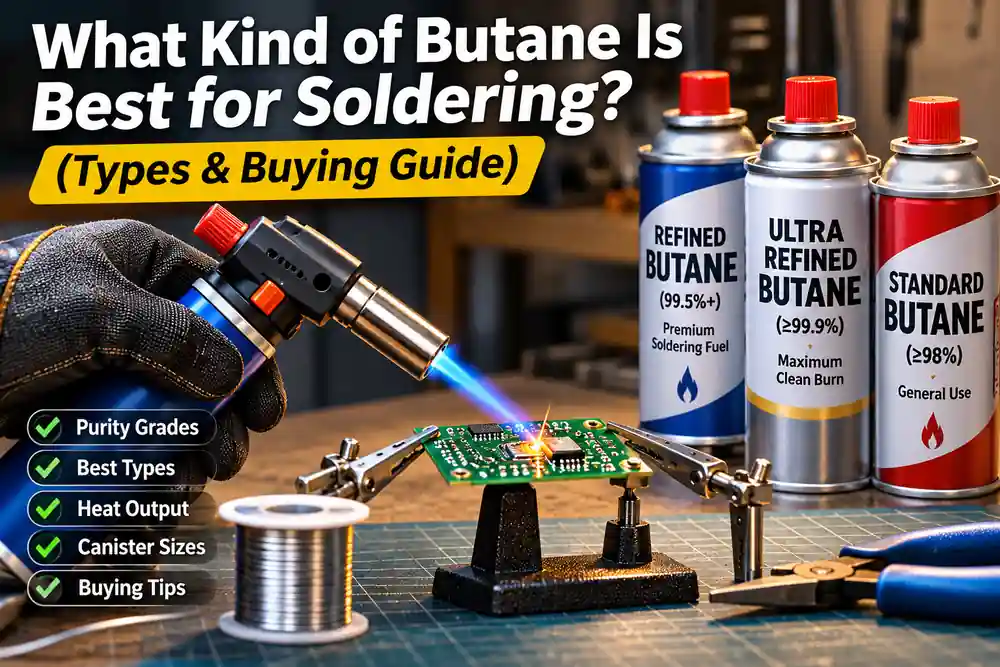
What Kind of Butane Is Best for Soldering?
I would choose refined butane sold for refillable soldering irons or precision torches, from a supplier that identifies the contents, provides usable instructions and supplies a nozzle that seals properly against the filling valve. The tool manual comes first. Some butane-powered soldering tools specify refined lighter-grade butane, while other burners use purpose-built fuel cartridges. Those systems are not interchangeable merely because both say butane.
This distinction matters because fuel does not directly touch the solder joint in a catalytic soldering iron. Gas burns inside the heater, transfers energy to a metal tip and exits through vents. In a conventional flame torch, by contrast, the flame supplies heat directly to the work. The ideal fuel and tool combination depends on whether you are repairing circuit boards, joining wire, shrinking tubing, making jewelry or soldering plumbing connections.
In my buying framework, I start with the device’s specified fuel and connector, then evaluate how controllable the heat is and finally consider refill price. I do not start with an exaggerated claim about the number of refinery passes. Good performance means reliable ignition, steady operation, little residue and an appropriate heat profile for the actual work.


Quick Comparison: Butane Fuel Types for Soldering
| Fuel type | Typical use | Advantages | Limitations / buying advice |
|---|---|---|---|
| Refined lighter-grade butane | Refillable gas soldering irons, precision microtorches | Widely available; commonly accepted by small refillable tools | Confirm the manual and valve fit; select low-residue fuel |
| Premium low-residue butane | Frequent-use precision irons and small torches | May reduce deposits in narrow internal passages | Look for manufacturer claims or data, not a vague purity multiple |
| General-purpose butane refill aerosol | Lighters and some compatible torch tools | Often economical and readily available | Quality, nozzle design and impurities vary |
| Butane/isobutane/propane camping blend | Camping stoves designed for threaded or bayonet cartridges | Can improve stove operation under certain conditions | Not appropriate for a refillable soldering iron unless explicitly approved |
| Proprietary butane cartridge | Appliances built for a matching cartridge | Simple fit when specified by manufacturer | Do not pierce, adapt or force a different canister |
| Propane or MAP-Pro-type fuel | Compatible heavy-duty soldering torches and plumbing applications | Greater heat delivery in appropriately designed tools | Never substitute into a butane-only refill valve |
The labels in this table describe product categories, not universal grades. Two brands may use similar base fuel but have different packaging, additives, nozzle kits and quality controls. If a manufacturer requires a particular cartridge, that requirement outranks every general-purpose buying recommendation.
Refined Butane, Premium Butane and the Meaning of Purity
When shoppers ask whether refined butane is worth paying for, they are often trying to avoid a clogged soldering iron or inconsistent flame. That is sensible. But purity is not the same as heat output. For otherwise identical fuel composition and operating conditions, a higher marketing grade does not magically increase the energy delivered to a solder joint.
Low nonvolatile residue is a more meaningful feature. Nonvolatile contaminants can remain in a valve, jet or catalytic assembly after the volatile gas evaporates. Weller describes its butane refill as low in contaminants that can clog burner valves. That is the kind of manufacturer-backed product detail I prefer to a bare claim of ‘ultra-pure’ without context.
Does 5X, 7X or 11X refined mean better soldering?
Not necessarily. Those labels may refer to a manufacturer’s claimed refining process, but there is no single universally comparable consumer standard that guarantees one brand’s 11X is cleaner than another brand’s 5X. I would rather see a credible supplier, a suitable safety data sheet, specific fuel compatibility and consistent performance than purchase based on the biggest number printed on the aerosol can.


If a soldering iron runs well on a midpriced approved fuel, there is little reason to assume a more expensive can will improve a joint. If it repeatedly sputters or clogs, however, investigate fuel quality, the refill procedure, nozzle damage and the tool’s maintenance condition before deciding that fuel alone is responsible.
Normal butane versus isobutane
Normal butane and isobutane are related hydrocarbons with different boiling points. Normal butane boils at approximately 31°F (−0.5°C), while isobutane boils near 11°F (−11.7°C) at standard atmospheric pressure. That matters for vapor delivery in cold conditions, but it does not authorize you to use a different gas mixture in a soldering iron. A manufacturer may approve a specific blend or may require refined butane.
| Property | n-Butane | Isobutane | Practical meaning |
|---|---|---|---|
| Chemical formula | C4H10 | C4H10 | Same molecular formula; different structure |
| Approximate atmospheric boiling point | 31°F / −0.5°C | 11°F / −11.7°C | Isobutane vaporizes better at lower ambient temperatures |
| Approximate lower heating value | 45–46 MJ/kg | 45–46 MJ/kg | Similar energy per unit mass |
| Typical application relevance | Refillable irons where specified | Approved blends and fuel systems | Only use what the tool maker permits |
These are approximate reference properties, not equipment-specific operating limits. Even a gas that vaporizes well in the cold may not keep a small refillable soldering iron operating correctly when its valve, catalyst or ignition system is outside the manufacturer’s specified temperature range.
The Tool Matters More Than the Can
I separate cordless soldering equipment into three groups. The first is a catalytic soldering iron, where combustion heats a solid tip. The second is a microtorch, where a visible flame heats the target. The third is a multi-function tool with interchangeable soldering, hot-air and flame heads. A single butane can may fuel several of these devices, but the working temperatures and application risks are very different.
| Tool or heat mode | Illustrative operating temperature | Best suited to | Key caution |
|---|---|---|---|
| Small catalytic soldering tip | Roughly 250–550°C depending on model | Wires, terminals and selected electronics | Set the tip for the joint; avoid overheating pads |
| Hot-air attachment | Up to roughly 625–680°C on cited models | Heat shrink, carefully controlled heating | Can dislodge adjacent components |
| Butane microtorch open flame | Up to roughly 1,200–1,300°C on cited models | Metalwork and robust assemblies | Direct flame can destroy circuit boards |
| Electric temperature-controlled iron | Commonly set around 300–380°C for many electronics tasks | Bench electronics repair | Actual setting depends on alloy, thermal mass and flux |
| Larger compatible fuel torch | Model-dependent; high heat delivery | Heavier plumbing joints | Different fuel system and safety requirements |
These temperature values describe manufacturer equipment ranges or common setpoints; they are not recommendations to apply those temperatures directly to every workpiece. For example, a Dremel VersaTip lists up to 550°C at its tip, 680°C in hot-air mode and 1,200°C as an open flame. A Weller Portasol model lists tip temperatures up to 580°C. Neither fact means delicate circuitry should be exposed to those maximum temperatures.



What Temperature Do You Actually Need to Melt Solder?
I would not buy fuel based on a torch’s maximum advertised flame temperature alone. Solder melts at a much lower temperature than an open-flame butane torch produces. What matters is delivering enough heat to the joint, quickly and predictably, without overheating nearby materials. Contact area, tip condition, alloy, wire size and thermal mass can all change the appropriate setting.
| Solder alloy or material | Approximate melting behavior | Typical consideration |
|---|---|---|
| 63/37 tin-lead solder | Eutectic melt at about 183°C / 361°F | Used in some legacy and specialist electronics |
| 60/40 tin-lead solder | Melting range about 183–190°C / 361–374°F | Lead exposure and handling controls required |
| SAC305 lead-free solder | Melting range about 217–220°C / 423–428°F | Common lead-free electronics alloy |
| Common lead-free tin-copper solder | Often about 227°C / 441°F, alloy-dependent | Requires suitable tip heating and flux |
| Silver-bearing solder | Varies widely by formulation | Check product specification; not all silver solders are alike |
Lead-containing solders raise hygiene and waste-handling issues, especially when heated. Use appropriate ventilation, avoid eating or drinking at the bench, wash hands after handling and follow applicable rules. Flux smoke can also be irritating or harmful; keeping your face away from fumes and using effective local extraction is important regardless of whether your tool burns butane or uses electricity.
Best Butane for Electronics and Circuit Board Repair
For occasional electronics work away from an outlet, I prefer a quality catalytic butane iron with replaceable, appropriately sized tips and precise gas control. Fuel should be the refined butane named or permitted in the instruction manual. I would not aim a raw flame at a printed circuit board, an integrated circuit package or an insulated wire simply because the flame is small.
A fine point can seem like the obvious choice for every small component, but it may transfer heat poorly to a larger ground pad. A properly sized chisel tip often delivers heat more effectively. I look for replaceable tips, a stable stand, easy ignition, a gas-level window where available and enough heat control to avoid lingering on the joint. A clean, tinned tip is essential.


For sensitive components and repeat work, I would generally favor a temperature-controlled electric station because repeatability, grounding/ESD provisions and controlled heat delivery often matter more than portability. A cordless butane iron earns its place when you’re troubleshooting in a vehicle, working outdoors where permitted or making isolated repairs in the field. If reliable off-grid electricity is available, see our related guide to inverter propane generators for sensitive electronics; it addresses a different power-source decision.
Best Butane for Wire Splices, Automotive Wiring and Heat Shrink
A portable catalytic butane iron is useful for wire splices when you need mobility. I would choose a tool with sufficient thermal capacity for the wire gauge and a nozzle-free soldering tip, rather than trying to melt solder with a visible flame next to plastic loom, hoses or electrical insulation. For heat-shrink tubing, an approved hot-air or reflector attachment often gives better results than a concentrated flame.
The practical test is whether the tool can heat both conductors and the connector, not just melt solder directly on the tip. Cold or incomplete joints are more likely when the workpiece never reaches the alloy’s flow temperature. Clean the surfaces, use the correct flux and solder, support the connection mechanically and let the joint cool without movement.
Vehicles have flammable materials, fuel systems and batteries nearby. Disconnect or isolate power according to the equipment procedure, keep the heat away from fuel vapors and make sure a butane tool is permitted for the work area. I would not use an open flame near an automotive fuel system. For more on managing fuel equipment around work sites, the portable propane generators for job sites article covers a related but distinct operational context.
Is Butane Good for Jewelry Soldering?
Small butane microtorches can work well for certain hobby jewelry tasks, such as heating light silver pieces or small assemblies within the torch’s available heat capacity. But jewelry soldering differs from electronics soldering. The joining alloys, fluxes, metal thickness, thermal conductivity and required working temperatures can be dramatically different. Larger pieces may dissipate heat too quickly for a tiny torch.
I would inspect the torch’s flame stability, nozzle geometry and duty cycle before deciding on the fuel. Refined, approved butane is a practical default for a refillable jewelry microtorch, but only when the torch manufacturer specifies it. Make sure the work is supported on a fire-resistant surface, with eye protection and ventilation appropriate to the process. Never use a torch near stones, coatings or assembled items that cannot tolerate heat.
Can I Use Butane for Copper Pipe Soldering?
Sometimes, for very small low-mass jobs when the torch is rated for that application. For larger copper pipe joints, a compatible propane or MAP-Pro-type torch is usually more practical because the burner can transfer heat to a larger area more effectively. A flame with a high theoretical temperature may still fail to bring a large joint evenly to soldering temperature if total heat delivery is insufficient.
I would not attach a propane cylinder to a butane-only soldering iron, nor use camping adapters to improvise a connection. If you need higher heat, buy a burner approved for the different fuel instead. Our propane versus gasoline generator efficiency guide illustrates why energy per fuel unit and useful output must be treated as separate measurements, although generator efficiency should not be used to predict soldering-torch performance.
Fuel Can Sizes: How Much Butane Should You Buy?
A refill can’s net fuel mass and its volume are both useful labels, but they cannot be interchanged without assumptions about density and packaging. For soldering tools, I prefer comparing grams of fuel rather than aerosol can height. A 60 g refill and a 200 g refill can differ in cost per gram, but the larger one is not the better deal if you use the tool twice a year and cannot store the extra fuel safely.
| Illustrative refill size | Approximate net fuel mass | At 7 g/hour theoretical use | At 12 g/hour theoretical use |
|---|---|---|---|
| Small refill | 60 g | 8.6 hours total fuel input | 5.0 hours total fuel input |
| Medium refill | 100 g | 14.3 hours total fuel input | 8.3 hours total fuel input |
| Large refill | 200 g | 28.6 hours total fuel input | 16.7 hours total fuel input |
| Extra-large refill | 300 g | 42.9 hours total fuel input | 25.0 hours total fuel input |
The table shows only a fuel-mass divided by consumption-rate calculation, not the runtime of a single soldering-iron tank. It ignores gas remaining in the can, transfer losses, interruptions, ignition and temperature adjustments. Real runtime depends on the tool. The fuel must first be transferred into the much smaller internal reservoir according to the manufacturer’s directions.
A useful per-refill calculation
Suppose your iron carries 7 g and uses approximately 7 g per hour at a particular setting. The simplified estimate is 7 ÷ 7 = 1 hour. At 12 g per hour, the same 7 g would last roughly 35 minutes. Those are planning calculations, not guaranteed performance. Manufacturer specifications can vary substantially by setting; Dremel’s VersaTip literature describes approximately 45 to 90 minutes per fill for its cited model.
For infrequent hobby use, buying one reasonably sized premium refill may be more sensible than buying a bulk case. For a small service business, calculate how many full refills you consume per month and whether any fuel is wasted through mismatched nozzles. My rule is to price the fuel that successfully reaches the tool, not just the number of ounces printed on the can.
How Much Does Butane for Soldering Cost?
Prices vary by market, brand, container size and retailer, so I would compare current local listings rather than rely on a permanent dollar figure. Weller’s 110 mL/60 g refill has been listed by the manufacturer at a U.S. suggested retail price of $6.91, which works out to approximately $0.115 per gram before taxes, shipping or retailer differences. That is an example, not a universal going rate.
| Illustrative offer | Fuel mass | Example price | Calculated cost per gram |
|---|---|---|---|
| Small specialty refill | 60 g | $6.91 | $0.115/g |
| Mid-size refill | 100 g | $8.00 | $0.080/g |
| Large refill | 200 g | $12.00 | $0.060/g |
| Bulk-size refill | 300 g | $18.00 | $0.060/g |
Only the Weller example reflects a sourced manufacturer suggested price; the other rows are hypothetical arithmetic examples for comparing offers. Prices in your area will differ. If a bargain refill comes with no reliable labeling, a poor-fitting nozzle or uncertain authenticity, I would skip it even when the arithmetic looks attractive.
Buying Checklist: The Seven Details I Verify
1. The tool manual explicitly allows the fuel
This is a hard requirement. Search for the exact model and approved fuel description before buying. ‘Butane-powered’ may refer to a refillable tank or to a specific replaceable cartridge system. The instruction manual resolves the difference.
2. The filling stem fits the valve without force
Aerosol cans may include several plastic adapters, but more adapters do not mean universal compatibility. Look for the appropriate fit, a sealed fill connection and clear instructions. Never modify a valve, puncture a cartridge or force a nozzle into a mismatched fitting.
3. The fuel has a trustworthy identity
I look for the product manufacturer, combustible-gas hazard labels, net quantity, batch or traceability information when available and an accessible safety data sheet. I treat unsupported claims such as ‘zero impurities’ with skepticism. No consumer aerosol should be assumed harmless because it is described as purified.
4. Deposits and inconsistent operation are addressed
Low-residue fuel is attractive in a tiny valve system. However, sputtering can also arise from a low fill level, cold conditions, incorrect refill technique or a worn igniter. Do not immediately assume an expensive fuel solves a mechanical fault.
5. The can is sensible for your workload
For weekend hobby work, one moderate can may be enough for many sessions. For field technicians, consistency and easy transport can matter more than bulk discounts. Avoid leaving pressurized fuel in a hot vehicle; follow the canister’s storage-temperature limit and local hazardous-material rules.
6. The torch can actually do the job
Check tip availability, ignition reliability, gas adjustment, flame stability, stand quality and heat delivery. If the tool struggles on heavier wire or copper, use an appropriately rated tool rather than keep raising flame output without understanding its limits.
7. You can store and dispose of the fuel safely
I prefer a practical quantity that can be kept in a cool, ventilated place away from heat, sparks, children and ignition sources. Follow the product label and local waste guidance. An empty-looking aerosol may still contain residual flammable vapor, so never puncture or burn it.
How to Refill a Butane Soldering Iron Safely
I always begin with the exact manufacturer procedure because fill orientation, timing and nozzle fit can differ among models. The general approach below is a safety-oriented checklist, not a substitute for the operating manual.
| Step | What to check | Why it matters |
|---|---|---|
| Before filling | Switch off, let cool, and move to a well-ventilated area without ignition sources | Avoid ignition and burns |
| Inspect | Check the fill valve and container for damage, leaks or corrosion | Do not refill damaged equipment |
| Select fuel | Use manufacturer-approved refined butane and correct nozzle | Avoid fuel incompatibility and leaking connections |
| Fill | Follow the tool’s specified direction, orientation and duration | Reduce overfilling and improper transfer |
| After filling | Stop if gas leaks; allow any released gas to disperse before ignition | Avoid igniting escaping vapor |
| Before work | Confirm stable operation at the lowest effective setting | Minimize unnecessary heat and fuel use |
Weller’s refill instructions for certain compatible products describe a low flame adjustment and several brief fill presses, but I would not copy those timings to an unrelated iron. Dremel likewise warns against overfilling its refillable tools. If you smell gas or hear continued hissing, do not ignite the tool. Move away from potential ignition sources, follow the manufacturer’s leak-response directions and seek qualified help if the leak does not stop.
Why a Butane Soldering Iron Sputters, Clogs or Fails to Ignite
Poor performance is frustrating because the fuel often gets blamed first. I troubleshoot by separating three questions: Is fuel arriving? Is the ignition system functioning? Is the heating tip transferring energy? Those questions help avoid throwing away a functioning tool or buying unnecessarily expensive refill cans.
| Symptom | Possible explanation | Safer next action |
|---|---|---|
| No ignition | Empty tank, faulty igniter, blocked flow, low ambient temperature | Switch off; consult troubleshooting instructions |
| Weak tip heat | Low gas setting, damaged tip, clogged catalyst, large joint mass | Check approved setting and tip condition |
| Flame fluctuates | Low tank pressure, cold fuel, blocked jet, valve issue | Stop and inspect per manual; do not force controls |
| Gas smell or continuous hiss | Leaking valve or connection | Do not ignite; isolate from ignition sources |
| Blackening or deposits | Combustion conditions, contaminated surfaces or incorrect operation | Inspect and clean only as manufacturer permits |
| Very short runtime | High gas setting, incomplete fill or small internal tank | Compare against model-specific specification |
Never poke wires into a burner jet, drill out an orifice, dismantle a pressurized tank or heat a canister to increase pressure. Those actions can damage designed flow controls. If the unit leaks or repeatedly malfunctions, remove it from service and consult the manufacturer or a qualified technician.
Ventilation, Indoor Work and Fire Safety
Soldering fumes are not the only concern. Burning butane consumes oxygen and can generate carbon monoxide under inadequate combustion conditions. Flame exhaust, heated flux and nearby combustible materials introduce additional hazards. I would work in a location permitted by the equipment manufacturer, with effective fresh-air ventilation and local fume capture where needed. Never rely on a small room’s air volume alone as a safety system.
Keep a heat-resistant stand on a stable bench, clear paper and solvents away, check for flammable vapors and avoid working in confined spaces. Allow tips to cool before changing accessories or packing the tool. For a broader discussion of combustion-related hazards, see Can You Run a Propane Generator Indoors?—the generator article is not a substitute for the butane tool’s own operating instructions.
A little portable torch can still start a major fire. I do not refill near a flame, running heater, electrical spark or smoking area. I also keep the soldering tool away from aerosol sprays and solvent containers. If I notice a gas odor, I stop, avoid switching electrical devices in the affected area and follow the manufacturer’s emergency guidance. For related fuel-leak principles, our propane generator leak prevention guide covers larger equipment.
My Buying Method: Three Work Scenarios
Scenario A: Hobbyist replacing one broken wire
My choice would be a small refillable catalytic butane iron and one can of compatible refined fuel, provided I cannot conveniently use an electric iron. I would spend more attention on a good tip, stand, flux and strain relief than on upgrading from a trusted midrange fuel to a premium marketing grade.
Scenario B: Mobile technician repairing several connectors daily
I would prioritize a robust ignition system, replaceable tips, consistent fuel delivery and predictable refill access. I would calculate cost per gram but also track interrupted jobs, wasted refill gas and tip replacement expenses. A backup tool may save more money than a slightly cheaper can.
Scenario C: Jewelry hobbyist heating small metal pieces
I would pick the microtorch’s flame shape and continuous-run capability first, verify that the maker approves the chosen refined butane, and check whether the workpiece is small enough to heat evenly. If the piece is too massive, the answer is not ‘purer fuel’; it is an appropriately rated torch and process.
What I Would Not Buy
I would avoid unbranded mystery aerosols, pressurized fuel with damaged or illegible labeling, adapters that require force and cans with unsupported claims about maximum flame temperature. I would also avoid using any propane, mixed camping fuel or improvised refill setup in a butane-only tool. Saving a few dollars on fuel is not worth damaging a valve or creating a leak.
Another mistake is buying too much. If you solder once every few months, a giant refill stockpile gives you no meaningful performance improvement and increases the amount of flammable material you must safely store. The relevant principles of fuel transport and storage are explored in How to Transport and Store a Propane Generator Safely, although the storage rules for small butane aerosols must be taken from their own labels.
Frequently Asked Questions
Is premium butane better for soldering?
It can be preferable when it has documented low residue and reliable manufacturing, especially in small precision valves. A higher price or ’11X refined’ label alone does not prove better soldering results. Compatibility and tool condition remain more important.
Can I use lighter refill butane in a soldering iron?
Often yes, when the soldering iron manual specifically permits refined lighter-grade butane. Verify the nozzle fit and fuel requirements first. Do not assume every lighter refill or gas blend is interchangeable.
Can I use butane camping stove canisters to fill an iron?
Not unless the tool manufacturer explicitly approves the fuel and connection method. Camping cartridges can have different valves, pressures and fuel blends. Do not improvise a transfer adapter.
Does purified butane make a torch hotter?
Not in the straightforward way advertisements imply. Torch temperature and heat transfer depend on combustion, airflow, tool design and flame control. Purity can matter for reliable flow and reduced residue, but it is not an automatic temperature upgrade.
What size refill can should I buy?
Choose according to how often you work, safe storage conditions and the tool’s actual consumption. For occasional use, a moderate 60–100 g refill can be practical; a daily user might benefit from a larger can if the fuel is approved and storage is appropriate.
Is butane better than an electric soldering iron?
Butane wins on mobility without needing wall power. A good electric temperature-controlled station usually wins for repeatable precision electronics work. For thick metal and plumbing, choose a correctly rated heating tool rather than assuming either format is ideal.
Can I use a butane flame directly on a circuit board?
I would not. A direct flame can overheat or burn laminates, plastic connectors, coatings and adjacent components. Use a suitable soldering tip, a controlled hot-air system or other manufacturer-approved process instead.
Final Verdict: The Best Butane for Soldering
For a typical refillable gas soldering iron or microtorch, my recommendation is straightforward: buy reputable refined, low-residue butane that the manufacturer approves, in a practical can size with a correctly fitting refill nozzle. Avoid making the decision solely from a 5X, 7X or 11X label. When you need better results, inspect the tool, tip, heat transfer and workflow before assuming the gas needs an upgrade.
For delicate electronics, I put controlled tip temperature and clean technique ahead of flame temperature. For wire repairs, I prioritize sufficient heat transfer and safe surroundings. For jewelry and heavier joints, I choose a burner built to deliver the needed heat. That is the buying approach I believe gives you more reliable work, less wasted fuel and fewer safety problems.

Mike is an experienced propane technician with over 15 years of professional experience in the field. He has dedicated his career to helping customers with their propane needs, from installation to maintenance and repair. Together with Jeremy, he co-founded this website to provide useful information and guidance to customers seeking reliable propane services.