
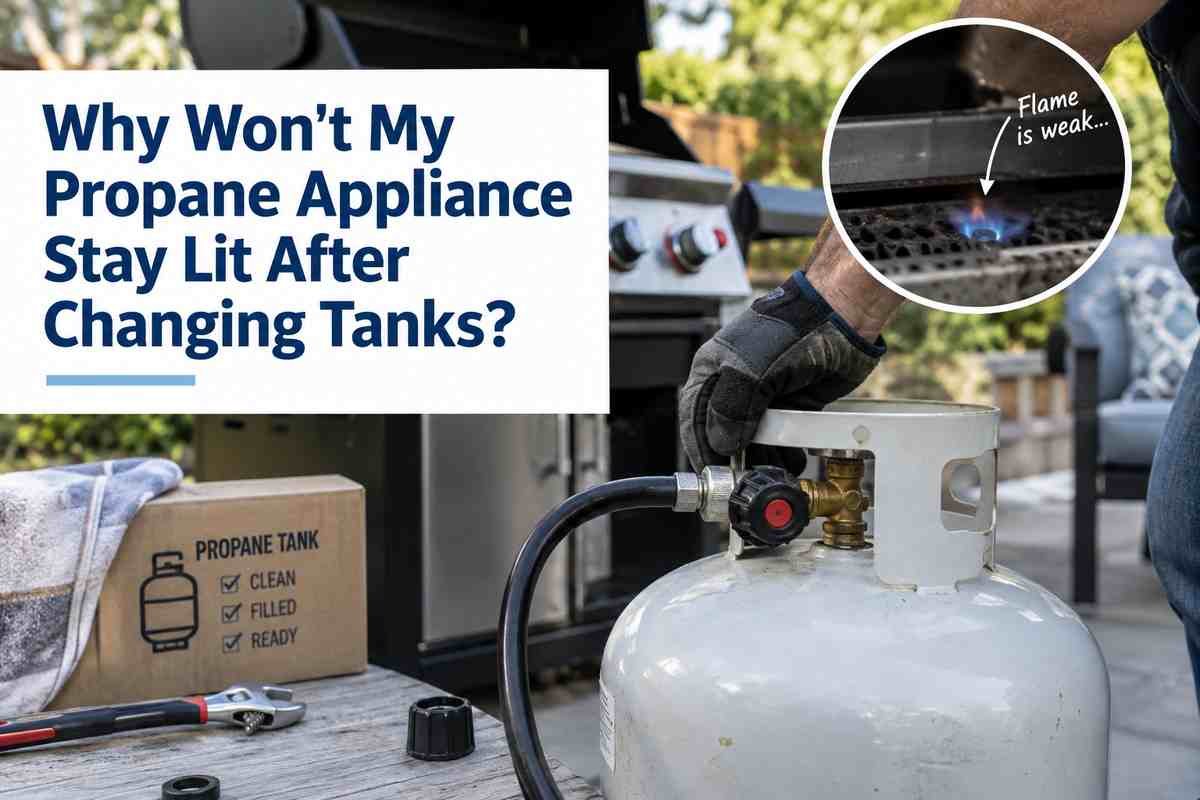
Quick Answer: If your propane appliance will not stay lit after changing tanks, I would first suspect restricted gas flow at the new cylinder connection. On many portable propane systems, opening the tank valve too quickly can activate an excess-flow safety device and leave only a small amount of gas reaching the burner. A loose or poorly seated connector, a problem with the replacement cylinder, air introduced during the change, low inlet pressure, or an appliance flame-safety control can cause similar symptoms. If you smell propane or hear sustained hissing, stop trying to relight the appliance and treat it as a possible leak.
The timing gives you an important clue. If the appliance worked normally with the old cylinder and started acting up immediately after the tank change, I would check the tank, connection, and flow-safety features before assuming the appliance suddenly failed. A burner that lights weakly and dies is different from a pilot that burns normally but goes out the moment you release the control knob, and those two symptoms can point to different causes.
Other Causes
The most common post-change problem on portable propane equipment is reduced gas flow. Many grill, heater, and hose/regulator assemblies use an excess-flow feature designed to restrict propane if gas rushes through the connection abnormally fast. That feature is meant to help limit flow after a major leak or hose failure, but some systems can also restrict flow if the tank valve is opened too quickly.
Weber, for example, tells users that an activated excess-flow safety device can cause a burner to have a very small flame or fail to operate normally, and its reset procedure calls for closing the tank and burner controls, waiting, and then reopening the cylinder valve slowly. Mr. Heater likewise instructs users of several portable propane heaters to open a newly connected or refilled cylinder valve slowly to avoid activating excess-flow protection.
| What You Notice | Likely Cause | What I Would Check First |
|---|---|---|
| Tiny flame that quickly goes out | Excess-flow restriction or low gas flow | Tank-opening procedure and connector |
| No flame after tank change | Connector not engaged, cylinder problem, or no gas flow | Tank connection and correct cylinder |
| Pilot lights but dies when knob is released | Thermocouple/flame-safety issue or weak pilot | Manufacturer lighting procedure; service if repeated |
| Works with one tank but not another | Replacement-cylinder valve or connection issue | Have the suspect cylinder checked by the supplier |
| Propane smell or sustained hissing | Possible leak | Stop use; move away and follow leak-safety steps |
1. The Excess-Flow Device May Have Restricted the Gas
This is the first thing I would consider when a grill, portable heater, or similar cylinder-fed appliance suddenly develops a tiny flame after a tank change. The device is often in the cylinder connector, hose assembly, or related fitting rather than inside the regulator itself.
When the new cylinder is opened, the empty hose and regulator have to fill with propane. If the valve is snapped open, that initial surge can be large enough for some excess-flow devices to react as though there were a downstream break. The device may not shut flow off completely; instead, it can reduce it to a trickle. That is why the appliance may light but refuse to stay lit.
This is closely related to the issue I cover in why a propane system can seem to “trip” when the tank valve opens.


What I would do
For a portable appliance, follow the reset procedure in that appliance’s manual. A common manufacturer procedure is to turn the appliance controls OFF, close the cylinder valve, wait several minutes, confirm the connection is properly seated, and then reopen the tank valve slowly before lighting the appliance normally.
I would not keep repeating the reset if it trips again immediately. A damaged hose, loose fitting, or real leak can also cause abnormally high flow, and a safety device should never be bypassed just to restore a stronger flame.
2. The New Tank Connection May Not Be Fully Seated
A propane cylinder connection has to do more than simply feel tight. Type 1/QCC, POL, and other propane fittings have specific sealing surfaces and safety features. If the connector is cross-threaded, not fully engaged, contaminated, or damaged, the system may not get normal gas flow—or it may leak.
Make sure the appliance controls are off, the cylinder is upright and stable, and the connector looks undamaged. Do not force a stubborn connector or add tape unless the manufacturer specifically calls for it.
If the connection will not seat normally, I would stop there and replace the approved hose/regulator assembly or have the equipment inspected rather than improvising a fix.
3. The Replacement Cylinder Itself Can Be the Problem
If the appliance works normally with another compatible cylinder, that is a strong clue that the replacement tank or its valve deserves attention. A cylinder can be full and still have a valve or sealing problem. A newly manufactured cylinder also has to be properly prepared and filled by the propane supplier.
Coleman notes that a new propane tank that was not properly purged before its first fill can contain air, which can cause very low or no flame until the issue is corrected. That is a supplier/filling issue—not something I would recommend fixing by manually venting propane through the appliance.
If one cylinder consistently causes trouble and another known-good cylinder works normally, return the suspect tank to the propane retailer or filling station. Do not attempt to repair the cylinder valve yourself.
4. Air May Be in the Hose or Appliance Gas Path
Disconnecting a cylinder can introduce air into the short section of hose or manifold between the tank and the burner. Some portable appliances account for this in their normal lighting procedure, which may require holding a control in a specific position for a set amount of time before the pilot establishes.
What I would not do is manually open a fitting or valve just to “bleed” air out. The Propane Education & Research Council (PERC) specifically warns users not to let air out of a gas line because that releases gas. For household propane systems, persistent pilot-light trouble or a system that has run out of gas is a job for a qualified professional.
If your appliance uses a pilot, follow the exact manufacturer’s lighting instructions. If the pilot is difficult to light or repeatedly goes out, PERC recommends contacting a qualified professional instead of continuing to troubleshoot it yourself.
5. The Pilot Flame May Be Too Weak to Hold the Safety Valve Open
On appliances with a thermocouple or similar flame-safety device, the pilot flame has to heat the sensor properly. If the pilot is weak because gas flow is restricted, the safety control may close as soon as you release the lighting knob. The result looks like “it lights, then immediately dies.”
If the pilot remains strong but still will not stay lit, see my guide on whether a propane regulator can cause a pilot light to keep going out. Appliance-specific components such as a thermocouple, oxygen-depletion sensor, tip switch, or control valve may need professional diagnosis.
6. The Regulator or Hose May Be Restricted or Damaged
A tank change sometimes gets blamed for a problem that was already developing. Regulators and hoses can fail, become contaminated, kink, or develop internal restrictions. If the appliance behaves the same way with several known-good cylinders and the correct startup procedure, I would start looking beyond the tank.
A failing regulator can cause low outlet pressure, unstable flames, repeated shutdowns, or poor performance under load. A kinked hose can create the same low-flow symptom without any regulator failure at all.
If you need a broader checklist, read how to tell whether a propane regulator is working properly. For systems that repeatedly lose gas after startup, also see why a propane regulator keeps shutting off.
7. Cold Weather Can Expose a Marginal Propane Supply
If you changed cylinders during cold weather, the new tank may be connected correctly but still struggle to supply a high-BTU appliance. Liquid propane has to absorb heat from its surroundings to vaporize. As outdoor temperature drops, a cylinder’s vaporization capacity drops too.
A small cylinder can therefore be “full” yet still be too small to vaporize propane fast enough for the appliance under severe cold conditions. If the problem is temperature-dependent, see why propane regulators and supply systems can freeze up.
How I Would Troubleshoot It Safely
If this were my portable propane appliance, I would troubleshoot it in this order:
- Stop immediately if I smell propane. I would not attempt another ignition.
- Confirm the appliance controls are OFF. Starting with an open burner valve can increase the initial gas surge.
- Inspect the tank connection and hose visually. I would look for obvious damage, kinks, a connector that is not seated correctly, or a cylinder sitting in the wrong position.
- Use the manufacturer’s reset and lighting procedure. If the manual says to reset excess-flow protection, I would follow that sequence exactly and reopen the cylinder valve slowly.
- Compare behavior with another known-good compatible cylinder if the manufacturer permits it. That can help separate a cylinder issue from an appliance issue.
- Stop if the problem repeats. At that point I would have the regulator, hose, and appliance checked rather than defeating safety devices or repeatedly cycling the valve.
| If This Happens | Most Useful Clue | Next Step |
|---|---|---|
| Worked before tank change; tiny flame afterward | Strongly suggests supply/connection issue | Follow approved excess-flow reset procedure |
| Only one replacement tank causes the problem | Points toward cylinder valve/fill issue | Return cylinder to supplier |
| Several tanks behave the same way | Points beyond the cylinder | Inspect regulator, hose, pressure, appliance controls |
| Pilot is strong but dies when control is released | Possible flame-safety component issue | Follow appliance manual; seek qualified service if repeated |
| Odor or hissing appears | Possible active leak | Stop use and follow propane leak procedures |
What to Do If You Smell Propane After Changing the Tank
Do not keep trying to light the appliance. PERC advises treating propane odor as an emergency warning. Extinguish flames and smoking materials, avoid switches and other potential ignition sources, leave the area if necessary, shut off the propane supply only if it can be done safely, and contact the propane supplier or emergency services from a safe location.
If the odor seems to be concentrated around the regulator or connection, read why a propane regulator area may smell like gas. If gas is actually discharging from the vent, see what it means when propane comes out of a regulator vent.
When I Would Stop DIY Troubleshooting
I would stop and call a qualified propane professional when the appliance will not stay lit after the approved reset procedure, the pilot repeatedly goes out, several known-good cylinders behave the same way, the regulator is damaged or venting, or there is any unexplained propane odor.
For fixed household propane systems, the threshold for professional service is even lower. PERC says a qualified professional should handle system service, appliance connector work, persistent pilot-light problems, and situations where the gas supply has been shut off or run out.
Frequently Asked Questions
Why does my propane grill have a tiny flame after I changed the tank?
An activated excess-flow device is one of the most common causes. The tank may have been opened too quickly, causing the safety feature to restrict gas. Follow the grill manufacturer’s reset procedure and reopen the cylinder valve slowly.
Why does my propane heater light and then go out with a new tank?
Low gas flow, air in the appliance gas path, a weak pilot, or a flame-safety device can all cause this. Mr. Heater specifically notes excess-flow activation after installing or refilling a tank as one possible cause on several models. Follow the exact model’s lighting instructions.
Should I bleed the propane line after changing tanks?
No, I would not manually vent or bleed a propane gas line. PERC warns that intentionally letting air out of the line also releases gas. Use the appliance’s approved lighting sequence or have a qualified professional handle the problem.
Can a brand-new propane tank be the problem?
Yes. A cylinder can have a valve, sealing, filling, or first-fill preparation problem even when it contains propane. If another compatible cylinder works normally, return the suspect cylinder to the supplier.
Does the regulator need to be replaced?
Not necessarily. If the problem appeared only after the tank change and disappears after the proper connection/reset procedure, the regulator may be fine. Repeated low-flow problems with multiple known-good cylinders justify regulator and hose inspection.
Why will the pilot light but not stay on?
The flame-safety sensor may not be getting enough heat, or the pilot may be too weak because gas flow is restricted. Follow the manufacturer’s lighting instructions. If the pilot repeatedly goes out, stop troubleshooting and have the appliance serviced.
Bottom Line
If my propane appliance stopped staying lit immediately after a tank change, I would start with the new cylinder connection and gas-flow safety features—not the appliance itself. A slowly reopened cylinder and the manufacturer’s approved reset procedure often separate a simple excess-flow restriction from a real equipment problem. But if the appliance still will not stay lit, or if there is any propane odor, I would stop cycling the system and have it checked rather than bypassing a safety device.
Sources used for safety and technical verification: Propane Education & Research Council safety guidance, Weber excess-flow/bypass guidance, and Mr. Heater portable propane troubleshooting guidance.

Mike is an experienced propane technician with over 15 years of professional experience in the field. He has dedicated his career to helping customers with their propane needs, from installation to maintenance and repair. Together with Jeremy, he co-founded this website to provide useful information and guidance to customers seeking reliable propane services.


