
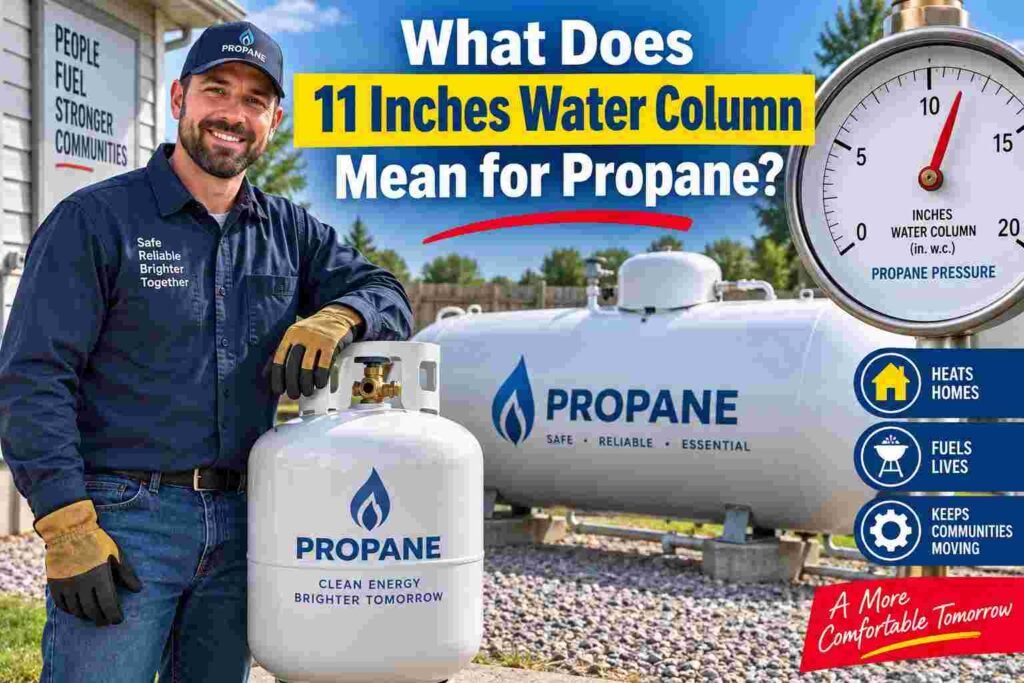
11 inches water column (11″ w.c.) is a low propane delivery pressure equal to about 0.397 psi, 2.74 kPa, or 27.4 mbar. In a typical propane vapor system, this is the pressure you often see on the low-pressure side after the second-stage or integral two-stage regulator. It is not the pressure inside the propane tank. The tank may be holding propane vapor at well over 100 psi depending on temperature, while the regulator reduces that pressure to a level the downstream piping and appliances can use safely.
When I see “11 inches water column” on a propane regulator, appliance data plate, service manual, or manometer, I read it as a pressure specification—not a fuel quantity and not a measurement of how full the tank is. If you are trying to diagnose weak flames, appliances that shut down, regulator problems, or pressure drop when several appliances run at once, understanding this number is one of the most useful starting points.
11 Inches Water Column Propane Pressure: Technical Details
| Measurement | Approximate Equivalent | What It Means |
|---|---|---|
| 11 in. w.c. | 0.397 psi | Very low gas pressure compared with tank pressure |
| 11 in. w.c. | 2.74 kPa | Metric pressure equivalent |
| 11 in. w.c. | 27.4 mbar | Common European-style pressure unit equivalent |
| 1 psi | 27.68 in. w.c. | Shows why inches w.c. is better for small pressure differences |
The conversion values above are based on the conventional inch-of-water definition published by the National Institute of Standards and Technology (NIST). NIST lists one inch of water as 249.0889 pascals and one psi as about 27.68 inches of water.
What Does “Inches Water Column” Actually Mean?
I like to explain water column pressure by picturing an old-fashioned U-tube manometer. The tube contains water. When gas pressure is applied to one side, the pressure pushes the water level down on that side and up on the other. The difference in the height of the water columns tells you the pressure.
If the pressure can support a difference corresponding to 11 inches of water, we call that 11 inches water column, usually written as 11″ w.c., 11 in. w.c., or 11 inH2O.
That is a small amount of pressure. In fact, it is less than half of one psi. This is exactly why technicians commonly use a manometer rather than an ordinary high-pressure gauge when checking the low-pressure side of a propane system. A gauge designed for hundreds of psi would not give you the same useful resolution around 11 inches w.c.
Why Is 11 Inches Water Column Common for Propane?
Propane is stored as a liquid under pressure. Above the liquid is propane vapor, and that vapor pressure changes with temperature. Appliances, however, do not normally receive full tank pressure. The system uses one or more regulators to reduce the pressure in stages.


Marshall Excelsior describes typical two-stage regulation in which the first stage reduces container pressure to roughly 10–15 psig and the second stage reduces it to about 11 inches water column. RegO similarly describes second-stage regulation that takes first-stage pressure down to approximately 11 inches w.c. for low-pressure distribution.
Here is the basic idea:
| Part of System | Typical Pressure Mentioned in Manufacturer Guidance | Purpose |
|---|---|---|
| Propane container | Varies greatly with temperature | Stores liquid propane and vapor |
| First-stage regulator outlet | Often around 10 psig | Reduces high container pressure for distribution to the second stage |
| Second-stage regulator outlet | About 11 in. w.c. (about 0.4 psi) | Supplies low-pressure propane to downstream piping and appliances |
| Appliance manifold | Must match appliance manufacturer specification | Controls pressure at the burner system |
That last row matters. I would not assume that every propane appliance must have exactly 11 inches w.c. at its burner manifold. Some appliance gas valves and appliance regulators are designed for a lower manifold pressure. RegO specifically warns technicians that appliance regulators may be preset by the manufacturer for a flow pressure lower than 11 inches water column.
11 Inches Water Column Is Not Propane Tank Pressure
This is probably the most common point of confusion. If you put a pressure gauge on a propane tank, you can see pressure that is dozens or even hundreds of psi. If you measure the low-pressure side after the final system regulator, you may see only around 11 inches water column.
Both measurements can be correct because they are taken at different points in the system.
RegO publishes approximate propane vapor pressures at different temperatures. These numbers show just how different container pressure is from the 11-inch low-pressure delivery side:
| Propane Temperature | Approximate Container Vapor Pressure |
|---|---|
| 0°F (-18°C) | 28 psig |
| 40°F (4°C) | 72 psig |
| 70°F (21°C) | 127 psig |
| 100°F (38°C) | 196 psig |
Compare 127 psig in a container at about 70°F with roughly 0.397 psi at 11 inches water column after low-pressure regulation. The regulator is doing a tremendous amount of pressure reduction.
Safety note: Never connect a low-pressure manometer directly to propane container pressure. A water-column manometer used for appliance or downstream regulator testing is not a substitute for equipment rated for high-pressure propane service. If you are not trained to work on LP-gas regulators and piping, I recommend having a qualified propane or gas technician perform the pressure test.
Where Should I See 11 Inches Water Column?
When I am thinking about an 11-inch reading, I first ask: Where was the pressure measured? The same system can have very different pressures at the tank, between regulators, at the building entrance, at an appliance inlet, and at the burner manifold.
For a conventional two-stage residential propane system, approximately 11 inches w.c. is commonly associated with the outlet of the second-stage regulator. RegO’s service guidance says a regulator flow-pressure check should read 11 inches water column at the appliance with approximately half the total appliance load operating, followed by a check with all appliances operating to make sure the pressure is maintained.
If you want a more detailed explanation of the test itself, I have a separate guide on how to check propane regulator pressure.
Flow Pressure, Lock-Up Pressure, and Regulator Droop Are Different
One reason propane pressure troubleshooting gets confusing is that a single number does not tell the whole story. A regulator can look acceptable when no gas is flowing and still fail to maintain pressure when several burners are running.
| Pressure Term | When It Is Measured | What I Learn From It |
|---|---|---|
| Flow pressure | While propane is being consumed | Whether the regulator and piping maintain adequate pressure under load |
| Lock-up pressure | When downstream gas flow stops | How high downstream pressure rises as the regulator closes |
| Droop | As gas demand increases | How much outlet pressure falls as the regulator delivers more flow |
If a system reads close to 11 inches w.c. with one small appliance running but drops sharply when a furnace, water heater, range, or generator starts, I would not automatically blame the appliance. The issue could be regulator capacity, pipe sizing, a restriction, freezing, a partially closed valve, a damaged line, or another supply problem.
I cover that situation in more detail in why propane pressure drops when another appliance turns on.
How Do You Measure 11 Inches Water Column?
The usual tool is a manometer. Digital manometers are common today, but the basic principle is the same: measure a small pressure difference accurately.
A qualified technician normally connects the manometer to an approved pressure test point, verifies the test setup, operates the system under the required load condition, and compares the reading with the regulator and appliance manufacturer specifications. The technician may then check behavior as additional appliances are turned on.
PERC’s propane training materials specifically include water manometers with a range suitable for low-pressure propane demonstrations, along with separate higher-pressure gauges. That distinction is important because the pressure before and after regulation can differ enormously.
What If I Measure Less Than 11 Inches Water Column?
A reading below 11 inches w.c. is not automatically proof that the regulator is bad. First, I would confirm the correct test location and the required pressure for that particular appliance or system.
If the specification calls for roughly 11 inches w.c. at the test point and the pressure is low, especially under load, possible causes can include an undersized regulator, undersized piping, excessive piping length, a restriction, regulator icing, low vaporization capacity in cold weather, a valve that is not fully open, or a regulator that is not performing correctly.
Symptoms may include weak flames, burners that struggle when another appliance starts, delayed ignition, nuisance shutdowns, or appliances that will not achieve rated input. But those symptoms can also have appliance-specific causes, so pressure testing is only part of the diagnosis.
| Observation | Possible Interpretation | Next Check |
|---|---|---|
| Normal pressure at light load, low pressure at heavy load | Capacity or restriction problem may be present | Regulator capacity, pipe sizing, valves, restrictions, supply |
| Low pressure all the time | Regulator setting, supply, or test-location issue | Verify specification, inlet pressure, regulator condition |
| Pressure changes when another appliance starts | System pressure drop under load | Total BTU demand and piping/regulator sizing |
| Good supply pressure but poor burner operation | Problem may be inside the appliance | Appliance regulator, gas valve, orifice, burner, combustion setup |
If you are already seeing unstable pressure, you may also want to review my guide to propane regulator valve problems.
What If the Pressure Is Higher Than 11 Inches Water Column?
Higher is not automatically better. Gas appliances are designed around specific inlet and manifold pressures. Too much pressure can cause overfiring, poor combustion, abnormal flame behavior, overheating, soot, carbon monoxide risk, or damage depending on the appliance and the severity of the condition.
At the same time, I would not conclude that a reading such as 12 or 13 inches w.c. is unsafe without knowing the exact regulator specification, whether the reading is under flow or lock-up conditions, and what the appliance manufacturer allows. Some regulators have adjustment ranges that include values on either side of 11 inches w.c., and lock-up pressure can be higher than flow pressure.
The correct rule is simple: compare the pressure at the correct test point with the specifications for the installed regulator and appliance. Do not turn the regulator adjustment screw simply because you expected to see 11.
10 Inches vs. 11 Inches Water Column for Propane
People often ask whether 10 and 11 inches water column are basically the same. They are close, but they are not identical. Eleven inches w.c. is about 10 percent higher than 10 inches w.c. when you compare the water-column values directly.
| Pressure | Approx. PSI | Approx. kPa |
|---|---|---|
| 10 in. w.c. | 0.361 psi | 2.49 kPa |
| 11 in. w.c. | 0.397 psi | 2.74 kPa |
| 12 in. w.c. | 0.434 psi | 2.99 kPa |
Whether 10 inches w.c. is acceptable depends on where you measure it, the gas demand at the time, and the equipment specification. That is why I treat 11 inches as a target associated with many low-pressure propane systems—not a universal number that overrides the manufacturer’s instructions.
Does 11 Inches Water Column Tell Me the Regulator Has Enough Capacity?
No. Pressure and capacity are related, but they are not the same thing.
A propane regulator also has a flow capacity, commonly expressed in BTU per hour. If the total connected appliance demand is greater than the regulator can supply, the outlet pressure may sag as load increases. The piping itself also has to be sized for the total load, pipe length, allowable pressure drop, material, and system pressure.
This means you can have a regulator that looks fine with one small burner running but cannot support the entire building when several appliances operate together. When I troubleshoot a low-pressure complaint, I want to know both the measured pressure and the total connected BTU load.
RegO’s service manual includes separate pipe-sizing tables for first-stage and low-pressure systems because available capacity changes with pipe diameter and length. So if your system repeatedly falls below its required pressure during heavy demand, measuring pressure is only the first step; sizing has to be checked too.
Is 11 Inches Water Column the Same for Homes, RVs, and Other Propane Systems?
The same pressure unit is used across many propane applications, and 11 inches w.c. is common in low-pressure propane equipment. For example, RegO lists compact two-stage regulators designed to reduce container pressure to an 11-inch w.c. delivery pressure for applications that include mobile homes and cylinder installations.
But I still would not assume every RV, food truck, generator, heater, range, fireplace, or industrial appliance uses the exact same downstream requirement. The regulator model, application, appliance gas valve, and manufacturer instructions always control.
Can I Adjust a Propane Regulator to Exactly 11 Inches Water Column?
Some propane regulators are adjustable and some are not. Even when a regulator has an adjustment, the correct setting procedure requires the proper test equipment, a known operating load, and the manufacturer’s specified adjustment range.
I do not recommend turning the adjustment screw by feel or by flame appearance. A burner can appear to work while still operating outside its specified input or combustion range. If the pressure is wrong, the technician should also determine why it is wrong instead of only changing the outlet setting.
If the regulator is failing, contaminated, undersized, improperly vented, frozen, damaged, or receiving incorrect inlet pressure, adjustment alone may not solve the problem.
Frequently Asked Questions
Is 11 inches water column high pressure?
No. Eleven inches w.c. is only about 0.397 psi. In propane service, it is generally considered low pressure compared with container pressure or first-stage pressure.
How many PSI is 11 inches water column?
Using the NIST conventional conversion, 11 inches water column is approximately 0.397 psi.
How many kPa is 11 inches water column?
It is approximately 2.74 kPa.
What should propane pressure be at an appliance?
Many low-pressure propane systems deliver around 11 inches w.c. to the appliance inlet, but the exact required inlet and manifold pressure must come from the appliance manufacturer. The burner manifold may be regulated to a different value.
Why does my propane pressure read 11 inches w.c. but the appliance still does not work?
A normal pressure reading at one moment does not rule out a problem. The pressure may fall under load, the appliance regulator or gas valve may be faulty, the burner orifice may be obstructed, ignition components may be failing, or another appliance-side problem may exist. I would compare static, flow, and appliance-specific measurements rather than relying on one reading.
What tool measures inches of water column?
A manometer is the standard tool. Digital manometers are commonly used for gas-service work because they can accurately display small pressure differences.
My Bottom Line
When you see 11 inches water column for propane, think of it as the low-pressure delivery side of the system: roughly 0.397 psi, 2.74 kPa, or 27.4 mbar. A regulator may be taking propane vapor that began at well over 100 psi in the container and reducing it through one or two stages until only a fraction of one psi remains for the downstream system.
I also want you to remember that 11 inches w.c. is not a universal burner pressure for every appliance. The correct pressure depends on the exact test point, whether gas is flowing, regulator design, total system load, piping, and the manufacturer’s specifications. If you are troubleshooting a real propane system, use the right manometer, test under the correct load, and have a qualified gas professional handle regulator adjustment or repair when you are not trained for LP-gas service.
Sources and Technical References

Mike is an experienced propane technician with over 15 years of professional experience in the field. He has dedicated his career to helping customers with their propane needs, from installation to maintenance and repair. Together with Jeremy, he co-founded this website to provide useful information and guidance to customers seeking reliable propane services.


