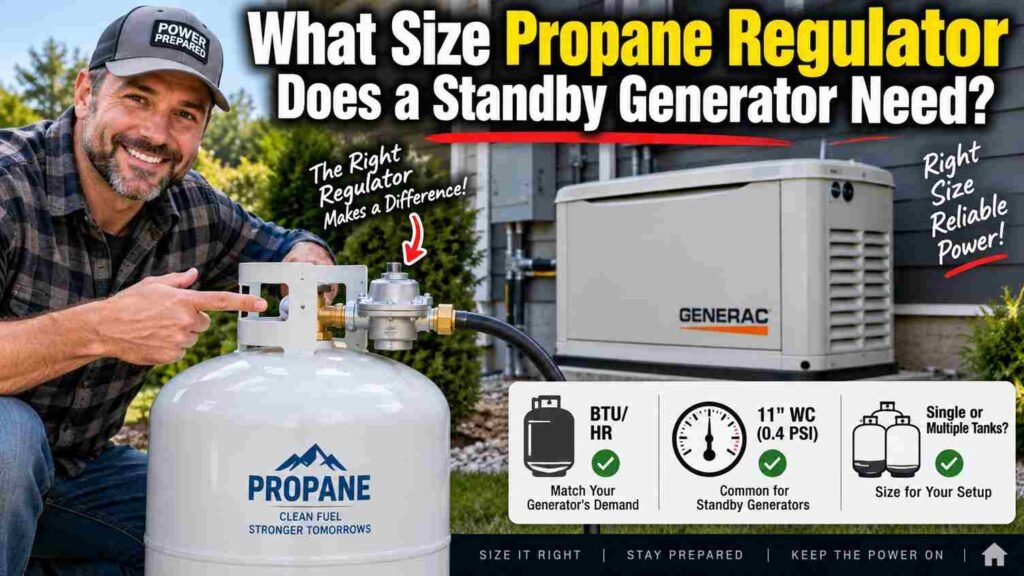
When I size a propane regulator for a standby generator, I do not start with the generator’s electrical kW rating and guess at a regulator. I start with the generator manufacturer’s fuel specifications.
The two numbers I care about most are the required propane inlet pressure and the full-load fuel consumption. Those tell me whether the regulator can both deliver enough gas and hold the correct pressure while the generator is working hard.
This matters because a regulator can look large enough on paper and still cause trouble if it cannot maintain pressure at the actual flow rate. The same is true of the propane piping and the tank itself. A properly sized generator fuel system has to work as a complete system.


In this guide, I’ll explain how I size a propane regulator for a standby generator, how to convert propane consumption into BTU/hr, what regulator capacity I would look for on 14-kW and 16-kW generators, and why pipe size and tank vaporization matter just as much as the regulator.
How I Size a Propane Regulator for a Standby Generator
I use this basic process:
- Find the generator’s required propane inlet-pressure range.
- Find its propane consumption at full load.
- Convert that consumption to BTU/hr if necessary.
- Add any other propane appliances supplied through the same regulator.
- Select the correct regulator type for the system.
- Confirm the regulator’s rated capacity at the actual inlet and outlet pressure.
- Check that the pipe and propane container can deliver the same load.
The most important point is that regulator sizing is a flow-and-pressure calculation. A regulator is not sized simply because the generator says 14 kW, 16 kW, 22 kW, or 26 kW on the enclosure.
What Propane Pressure Does a Standby Generator Need?
The exact pressure depends on the generator manufacturer and model.


For example, Generac specifies 10–12 inches water column of LP gas pressure at the generator fuel inlet for the current 14-kW air-cooled model. Briggs & Stratton specifies 11–14 inches water column for some of its residential LP standby generators.
That difference is why I never assume that every propane generator should be fed at exactly 11″ w.c. I check the nameplate, installation manual, or current manufacturer specification for the exact generator being installed.
| Generator Example | LP Inlet Pressure Requirement | What It Means for the Regulator |
|---|---|---|
| Generac residential air-cooled | 10–12″ w.c. on applicable models | The final regulator and piping must keep pressure in this range under load |
| Briggs & Stratton residential standby | 11–14″ w.c. on applicable models | Do not assume an 11″ setting is automatically correct for every model |
If you want a deeper explanation of low-pressure propane measurements, see What Does 11 Inches Water Column Mean for Propane?.
Why Full-Load Fuel Consumption Is the Number I Use
I size the regulator and fuel piping for the generator’s full-load fuel demand, not half-load consumption and not average daily fuel use.
A standby generator can be lightly loaded most of the time and still need full fuel flow when large electrical loads come on. The fuel system has to be capable of supporting that condition without the propane pressure falling below the manufacturer’s minimum.

Generac specifically notes in its published specifications that the fuel pipe must be sized for full load. That is the same conservative approach I use when evaluating regulator capacity.
How Do I Convert Generator Propane Use to BTU/hr?
If the generator manual gives propane consumption in cubic feet per hour, I can convert it to BTU/hr using the manufacturer’s stated conversion factor.
Generac uses:
For example, if a generator consumes 106 ft³/hr of propane at full load:


That means the regulator and piping must support roughly 265,000 BTU/hr for that generator alone, while maintaining the required inlet pressure.
If other appliances share the same regulator, I add those loads too. My detailed calculation method is explained in How Do I Calculate Total BTU Load for a Propane Regulator?.
What Size Regulator Does a 14-kW Generator Need?
For a 14-kW standby generator, I would first look up the exact manufacturer’s full-load propane consumption.
As a current example, Generac’s 14-kW residential standby generator lists:
| 14-kW Generac Example | Specification |
|---|---|
| LP consumption at 50% load | 63 ft³/hr / 1.76 gal/hr |
| LP consumption at 100% load | 106 ft³/hr / 2.92 gal/hr |
| Approximate full-load heat input | 265,000 BTU/hr using Generac’s 2,500 BTU/ft³ factor |
| Required LP inlet pressure | 10–12″ w.c. |
For a dedicated 14-kW generator with this type of fuel demand, I would look for a regulator with comfortably more than 265,000 BTU/hr of usable capacity at the required pressure.
A 450,000 BTU/hr-class integral two-stage or second-stage regulator can be a reasonable capacity class for this kind of dedicated load, provided its pressure setting and performance curve match the generator requirement and the upstream system is designed correctly.
RegO, for example, publishes compact twin-stage regulators with a 450,000 BTU/hr propane vapor capacity and an 11″ w.c. factory delivery pressure. That gives an example of a regulator class with enough nominal capacity for a 265,000 BTU/hr generator load.
I would not stop there, though. I still check the regulator performance curve, line length, pipe diameter, fittings, tank temperature, and actual dynamic inlet pressure at the generator.
What Size Regulator Does a 16-kW Generator Need?
A 16-kW generator is usually in a similar regulator-capacity range, but I still use the specific model’s published fuel consumption.
One Generac 16-kW residential standby specification lists 109 ft³/hr of propane at full load. Using the manufacturer’s 2,500 BTU/ft³ conversion:
| 16-kW Generator Example | Specification |
|---|---|
| LP consumption at 50% load | 62 ft³/hr in the Generac example |
| LP consumption at full load | 109 ft³/hr |
| Approximate full-load heat input | 272,500 BTU/hr |
| LP inlet pressure | 10–12″ w.c. in this Generac specification |
For this example, I would again consider a 450,000 BTU/hr-class regulator a practical starting point for a dedicated generator because it has significant capacity above the roughly 272,500 BTU/hr full-load demand.
But I do not say that every 16-kW generator needs exactly a 450,000 BTU/hr regulator. Another manufacturer’s 16-kW engine may consume more or less propane, and its required inlet pressure may be different.
That is why the correct answer is: size the regulator from the exact 16-kW generator’s full-load fuel specification, then choose the next appropriate regulator capacity that can maintain the required pressure.
14-kW vs. 16-kW Propane Regulator Sizing
| Generator Size | Example Full-Load LP Use | Approx. BTU/hr | Practical Dedicated-Regulator Planning Class |
|---|---|---|---|
| 14 kW | 106 ft³/hr | 265,000 BTU/hr | Often 450,000 BTU/hr class, subject to pressure/performance verification |
| 16 kW | 109 ft³/hr | 272,500 BTU/hr | Often 450,000 BTU/hr class, subject to pressure/performance verification |
These numbers are manufacturer examples, not universal values. I use them to show the sizing process—not to replace the installation manual for your exact model.
Should I Use a First-Stage and Second-Stage Regulator?
For many permanent standby generator installations, a two-stage propane system is the preferred arrangement.
A first-stage regulator at or near the tank reduces high and variable container pressure to an intermediate pressure, commonly around 10 PSIG. A second-stage regulator near the building or generator then reduces that pressure to the low pressure required by the appliance.
This arrangement helps maintain more stable fuel pressure over longer pipe runs and changing tank conditions.
RegO lists second-stage regulators designed to reduce 5–20 PSIG inlet pressure down to around 11″ w.c. Some compact second-stage models are rated around 450,000 BTU/hr, while larger residential/commercial models are rated around 935,000 BTU/hr.
If the generator shares propane with the house, a larger second-stage regulator may be necessary because the regulator must supply the generator plus the furnace, water heater, range, dryer, fireplace, or any other appliance that may operate at the same time.
When Would I Need a 935,000 BTU/hr Regulator Instead?
A 935,000 BTU/hr-class second-stage regulator may make sense when the generator is part of a larger whole-house propane load.
For example:
| Appliance | Example Input |
|---|---|
| 16-kW standby generator | 272,500 BTU/hr |
| Furnace | 100,000 BTU/hr |
| Tankless water heater | 199,000 BTU/hr |
| Range | 65,000 BTU/hr |
| Dryer | 35,000 BTU/hr |
| Total Connected Load | 671,500 BTU/hr |
A 450,000 BTU/hr regulator would clearly be undersized for that connected load. A higher-capacity second-stage regulator—such as a 935,000 BTU/hr class—would be much more appropriate from a capacity standpoint, assuming its pressure performance also matches the system.
Does Regulator Port Size Tell Me the BTU Capacity?
No. This is a common mistake.
A regulator with a 1/2-inch or 3/4-inch connection is not automatically good for a certain generator size. Port size is only one design feature.
I always use the regulator manufacturer’s actual propane vapor capacity and performance information. Two regulators with the same connection size can have very different capacities, spring ranges, inlet ratings, and outlet-pressure characteristics.
Why Pipe Size Can Make a Correct Regulator Look Too Small
Even if I choose a regulator with plenty of BTU capacity, the generator can still starve for propane if the line is undersized.
Pressure drop increases with flow and pipe length. A long run carrying nearly 300,000 BTU/hr may require significantly larger piping than a short run carrying the same load.
The generator manufacturer’s installation manual normally provides fuel-pipe sizing guidance or refers the installer to applicable gas-code sizing tables.
I size the pipe for full-load generator consumption and the actual length of the run. I also account for fittings and the pressure available at the beginning of the line.
If a generator starts but struggles when electrical load rises, I consider the piping and regulator together. The problem may be pressure loss under flow rather than a defective regulator.
Why Static Pressure Is Not Enough
I do not consider a generator fuel system proven just because the pressure gauge looks correct while the generator is off.
What matters is dynamic pressure while the generator is running under substantial load.
A weak regulator, undersized pipe, restricted fitting, undersized tank, or low inlet pressure may show normal static pressure but fall badly when propane flow increases.
Briggs & Stratton technical guidance, for example, instructs technicians to check generator fuel pressure with a manometer and notes that only a small pressure drop should occur between static and dynamic conditions on the applicable models.
Does the Propane Tank Need to Be Larger for a Standby Generator?
Often, yes.
A regulator cannot supply gas that the tank cannot vaporize. Propane vaporization depends on tank surface area, liquid level, outdoor temperature, and the amount of propane being withdrawn.
A 14-kW or 16-kW generator drawing roughly 265,000–275,000 BTU/hr is a substantial load. If the same tank also supplies the house during cold weather, the total vapor demand can become much higher.
For this reason, I check tank vaporization capacity separately from regulator capacity. If you are planning the container size too, see What Size Propane Tank Do You Need for a Generator?.
Can I Use an Integral Two-Stage Regulator Directly at the Tank?
In some dedicated generator systems, yes—provided the regulator is listed for the application, has adequate capacity, and can deliver the exact pressure the generator requires through the installed piping.
For example, RegO offers integral twin-stage regulators with 450,000 BTU/hr capacity and nominal 11″ w.c. delivery pressure. That capacity can be above the full-load requirement of many 14-kW and 16-kW generators.
But long pipe runs, large shared loads, unusual pressure requirements, or local installation rules may make a separate first-stage and second-stage system more appropriate.
Common Mistakes I Avoid When Sizing a Generator Regulator
Choosing by kW Rating Alone
Two 16-kW generators can have different engines and different propane consumption. I always use the fuel specification.
Using Half-Load Consumption
I size for full-load fuel demand because that is when the fuel system is under the greatest stress.
Ignoring Other Appliances
If the regulator also serves the house, I add every connected propane load rather than sizing for the generator alone.
Assuming 11″ w.c. Is Correct for Every Generator
Some generators require 10–12″ w.c.; others may specify 11–14″ w.c. I use the exact manufacturer’s allowable inlet range.
Ignoring Pipe Length
A large regulator cannot make an undersized line carry enough gas.
Ignoring Tank Vaporization
Cold weather and low tank level can limit propane vapor production even when the regulator and piping appear correctly sized.
Oversizing Without Checking Pressure Performance
I do not choose the biggest regulator I can find and assume it is better. The regulator still needs the correct pressure setting, inlet-pressure range, vent arrangement, connections, and performance characteristics.
Technical Checklist for a Standby Generator Propane Regulator
| Item | What I Verify |
|---|---|
| Generator fuel | LP vapor configuration |
| Full-load consumption | ft³/hr, gal/hr, lb/hr, or BTU/hr from manufacturer data |
| Required inlet pressure | Exact minimum and maximum in. w.c. from generator manual |
| Regulator capacity | Above full connected load at actual pressure conditions |
| Regulator type | Integral two-stage, first-stage + second-stage, or other approved layout |
| Pipe sizing | Capacity at full load and actual developed length |
| Tank vaporization | Adequate at expected minimum temperature and fuel level |
| Dynamic pressure test | Pressure remains within generator limits while running under load |
| Regulator vent | Installed/oriented according to manufacturer instructions and applicable code |
Can I Install the Generator Regulator Myself?
I do not recommend treating standby-generator propane work as a simple DIY regulator swap.
A permanent generator fuel installation involves high fuel flow, regulator selection, piping calculations, venting, leak testing, pressure testing, and verification under load. A mistake can cause fire, explosion, poor generator operation, or carbon-monoxide hazards.
I recommend having a qualified propane technician or licensed gas fitter size and test the fuel system according to the generator manual and applicable local codes. You can read more in Can I Install a Propane Regulator Myself, or Do I Need a Professional?.
Frequently Asked Questions
What BTU regulator do I need for a standby generator?
I use a regulator whose verified propane capacity exceeds the generator’s full-load BTU requirement and any other connected loads. Many 14–16 kW residential examples fall around 265,000–290,000 BTU/hr of propane input, so a 450,000 BTU/hr regulator class is often a practical dedicated-generator starting point. The exact regulator still has to maintain the manufacturer’s required inlet pressure.
Is a 400,000 BTU regulator enough for a 16-kW generator?
It can be, depending on the exact generator, regulator performance data, inlet pressure, piping, and whether the regulator serves other appliances. If the generator needs around 275,000 BTU/hr and the regulator can truly deliver 400,000 BTU/hr at the required pressure conditions, the capacity may be adequate. I would still verify the manufacturer’s performance curve.
Is a 450,000 BTU regulator enough for a 14-kW generator?
For a dedicated 14-kW generator with a full-load input around 265,000 BTU/hr, a 450,000 BTU/hr-class regulator often has enough nominal capacity. I still confirm the correct outlet pressure and dynamic performance before calling it suitable.
Do I need a separate propane regulator for my generator?
Not always. A generator can share a properly sized propane system with household appliances. But a dedicated regulator can simplify capacity and pressure management in some installations. The correct layout depends on the existing system, total load, pipe distances, and local requirements.
Why does my generator run fine with no load but shut down under load?
A fuel-delivery problem is one possibility. As electrical load rises, propane consumption rises. If the regulator, piping, tank vaporization, or upstream pressure cannot keep up, inlet pressure can fall. That should be diagnosed with proper pressure testing rather than by replacing parts at random.
Bottom Line
When I size a propane regulator for a standby generator, I use the generator’s full-load propane consumption and required inlet pressure, not the kW rating by itself.
A current 14-kW Generac example consumes 106 ft³/hr of propane at full load, equal to roughly 265,000 BTU/hr using Generac’s conversion. A published 16-kW Generac example consumes 109 ft³/hr, equal to roughly 272,500 BTU/hr.
For dedicated generators in that range, a 450,000 BTU/hr-class regulator is often a sensible capacity class to evaluate. If the regulator also feeds the home, I add the generator to every other propane appliance and may need a much larger regulator—such as a 935,000 BTU/hr class or higher.
The final selection still has to match the generator’s exact pressure requirement, regulator performance data, pipe capacity, tank vaporization, and installation rules. That is why I recommend confirming the design with a qualified propane professional and testing the generator’s fuel pressure under actual load before considering the installation complete.
Technical References

Mike is an experienced propane technician with over 15 years of professional experience in the field. He has dedicated his career to helping customers with their propane needs, from installation to maintenance and repair. Together with Jeremy, he co-founded this website to provide useful information and guidance to customers seeking reliable propane services.