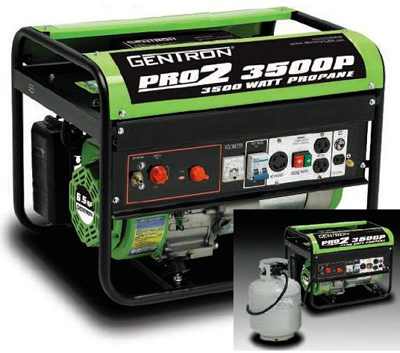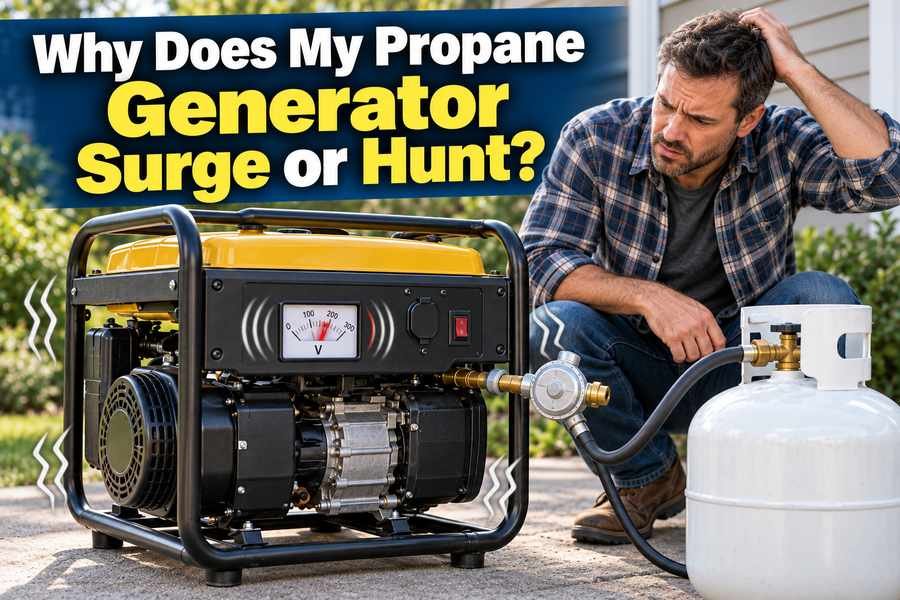
When a propane generator “surges” or “hunts,” the engine does not hold a steady speed. Instead, you hear the RPM rise and fall over and over. The voltage or frequency may also fluctuate, lights can brighten and dim, and connected equipment may sound different as the generator speed changes.
I do not treat hunting as one single problem. The governor may be chasing engine speed because the fuel mixture is unstable, or the fuel mixture may be changing because the regulator, hose, tank, or demand system cannot maintain consistent propane flow. Electrical load changes can also make the governor move aggressively enough that a weak fuel or governor problem becomes obvious.
In this guide, I’ll show you the order I use to diagnose propane-generator surging, how I separate a propane supply problem from a governor problem, what the load pattern can tell you, and when I stop troubleshooting and call a generator or propane technician.


What Does “Hunting” Mean on a Generator?
Generator hunting is a repeated rise-and-fall cycle in engine speed. The governor opens the throttle because RPM falls, the engine speeds up, the governor closes the throttle, the engine slows again, and the cycle repeats.
A small speed change when a heavy load starts is normal. What I consider hunting is a continuing oscillation that does not settle.
| Behavior | Normal or Not? | What It Usually Means |
|---|---|---|
| RPM dips briefly when a large load starts, then stabilizes | Usually normal | Governor responding to load |
| RPM continuously rises and falls at no load | Not normal | Governor instability, lean mixture, fuel restriction, choke issue |
| Surging only when load is added | Not normal if it continues | Fuel capacity, overload, governor droop, unstable demand |
| Surging only on propane, gasoline runs smoothly | Strong clue | Propane supply/regulator/mixer/demand system |
1. Low or Unstable Propane Pressure Is One of My First Checks
If a generator hunts only on propane, I immediately consider unstable fuel pressure.
A propane engine needs a consistent gas supply as the throttle opens and closes. If the pressure drops every time the engine demands more propane, the mixture goes lean, RPM falls, the governor opens the throttle farther, fuel flow catches up, RPM rises, and then the governor closes again. That can create a repeating surge.


The causes can include:
- an undersized propane regulator;
- a regulator that is sticking or worn;
- a kinked or undersized hose;
- a long or undersized gas pipe;
- a partially closed valve;
- a restricted quick-connect fitting;
- low tank pressure;
- poor tank vaporization in cold weather; or
- too many propane appliances running from the same regulator.
This is why I care about dynamic pressure, not just the pressure reading with the generator off.
Static vs. Dynamic Propane Pressure
| Pressure Type | When Measured | Why It Matters |
|---|---|---|
| Static pressure | Little or no gas flowing | May look normal even when the system cannot supply load |
| Dynamic pressure | Generator running | Shows whether the fuel system holds pressure while supplying gas |
| Loaded dynamic pressure | Generator running under electrical load | Best way to expose a regulator, pipe, hose, or vaporization limitation |
I do not adjust propane pressure by ear. I use the generator manufacturer’s pressure specification and a proper manometer. If the system pressure is stable at rest but swings or drops as the generator hunts, I investigate the fuel supply before touching governor adjustments.
2. The Propane Regulator May Be Undersized
A regulator can be perfectly functional and still be too small.
If I have a portable generator, I use the regulator/hose assembly approved for that model. If I have a standby generator, I calculate the full-load generator demand plus every other appliance supplied through the same regulator.

For example:
| Connected Load | Example BTU/hr |
|---|---|
| Standby generator | 270,000 |
| Furnace | 100,000 |
| Water heater | 40,000 |
| Range | 65,000 |
| Total connected load | 475,000 BTU/hr |
A regulator that is comfortable at 300,000 BTU/hr may begin to lose pressure when this system approaches 475,000 BTU/hr. The generator may then hunt because the governor keeps reacting to a lean fuel condition.
If you are sizing a standby system, see What Size Propane Regulator Does a Standby Generator Need?.
3. The Demand Regulator Can Cause Surging
Portable propane and dual-fuel generators commonly use a demand regulator or demand diaphragm. It allows fuel to flow when engine vacuum indicates that the engine is cranking or running.


If the diaphragm sticks, responds slowly, or has contamination or wear, fuel flow may lag behind engine demand. That creates a lean-rich-lean cycle that feels exactly like governor hunting.
I suspect the demand regulator more strongly when:
- the generator hunts only on propane;
- gasoline operation is smooth;
- the hose and cylinder are known good;
- the symptom changes when electrical load changes;
- the engine occasionally smooths out and then resumes hunting; or
- the generator has been stored for a long time.
I do not open or modify a demand regulator unless the manufacturer provides a specific service procedure.
4. A Lean Mixture Can Make the Governor Chase RPM
Champion’s current troubleshooting information explicitly lists a carburetor that is dirty and running lean as a cause of an engine that hunts or falters. On propane, the same basic physics applies: if the air-fuel mixture is too lean, engine torque drops and the governor tries to compensate.
A lean condition on propane can come from:
- low gas pressure;
- restricted LPG passage;
- air leak between mixer and intake;
- damaged intake gasket;
- vacuum leak;
- incorrect high-altitude setup;
- sticking demand regulator; or
- incorrect adjustment on a serviceable LPG mixer/regulator system.
I avoid adjusting mixture screws or regulator settings randomly because those changes can hide the real problem and create unsafe operation.
5. The Choke May Be in the Wrong Position
This is more common than many people expect.
Champion’s troubleshooting table lists incorrect choke position as another cause of hunting or faltering. After the engine starts and warms, the choke should normally be in the RUN position according to the model’s instructions.
If the choke stays partly closed, the engine can run unevenly. If the generator uses a special propane starting sequence and the choke is moved incorrectly, the mixture can also become unstable.
I follow the propane-specific procedure for the exact generator rather than using the same choke routine I use for gasoline.
6. A Governor Problem Can Cause True Speed Hunting
If propane pressure is stable and the engine still cycles up and down, I turn my attention to the governor.
The mechanical governor senses engine speed and changes throttle position to hold approximately the correct RPM as electrical load changes. If the governor linkage is binding, the spring is damaged, the governor is misadjusted, or the internal governor setting has shifted, speed can oscillate.
Champion specifically lists a defective governor as a cause of hunting and faltering. Its service guidance also explains that governor adjustment may be needed after many operating hours, after carburetor removal, or when speed instability develops.
Governor Terms I Use
| Term | Meaning |
|---|---|
| High-speed no-load | Engine speed with little or no electrical load |
| Droop | Normal reduction in RPM/frequency as load increases |
| Hunting | Repeated oscillation around the target speed instead of settling |
| Wide-open throttle stop | Maximum throttle position used in governor setup |
Champion’s governor service material gives a target droop near 240 ± 60 RPM, approximately 4 ± 1 Hz, on applicable conventional-generator models. It also notes that overly tight droop can contribute to no-load hunting. Those numbers are not universal settings for every generator, so I never transfer them blindly to another model.
7. Electrical Load Changes Can Trigger or Expose Hunting
A generator governor is constantly responding to electrical load.
If a refrigerator compressor, pump, air conditioner, or power tool starts, the engine suddenly needs more torque. The governor opens the throttle. A healthy generator should recover and stabilize.
If the fuel system is marginal, the added throttle demand can cause pressure to drop or mixture to lean out. That can turn a small RPM dip into repeated hunting.
I pay attention to whether the generator hunts:
- with no load;
- only with one large appliance connected;
- only when multiple loads cycle;
- after a motor starts; or
- only near maximum generator capacity.
If hunting happens only under heavy load, I reduce the load and see whether the engine stabilizes. Westinghouse and Champion both warn against overloading and instruct users to consider both running watts and starting/surge watts.
Running Watts vs. Starting Watts
| Load Type | What It Means | Effect on Hunting |
|---|---|---|
| Running watts | Continuous power after equipment is operating | Sets normal engine load |
| Starting/surge watts | Short high-power demand when motors start | Can create sudden RPM dip and expose weak governor/fuel response |
8. Cold Weather and Low Tank Level Can Make Propane Flow Unstable
Propane has to vaporize inside the tank before the generator can burn it. Vaporization capacity falls as outdoor temperature falls and as the liquid level drops.
A small portable cylinder that works well in warm weather can struggle when a generator is pulling a high fuel rate in freezing conditions.
I consider vaporization problems when the generator:
- hunts more in cold weather;
- runs better with a fuller tank;
- runs better after the tank warms naturally;
- develops unusual frost on the cylinder or regulator; or
- hunts only under heavier load.
If you also see regulator icing, see Why Does My Propane Regulator Keep Freezing Up?.
9. High Altitude Can Affect Dual-Fuel Generator Stability
Altitude changes engine air density and therefore fuel calibration.
Westinghouse publishes high-altitude guidance for some dual-fuel generators and specifies both a carburetor kit and dual-fuel regulator kit for operation above the stated altitude threshold. On one current WGen dual-fuel manual, power is listed as decreasing about 3.5% for every 1,000 feet of increased elevation, with a high-altitude adjustment required above the model’s specified altitude.
If a generator was moved from near sea level to a high-elevation location and now hunts or runs poorly on propane, I check the manufacturer’s altitude requirements before adjusting anything else.
10. Air Filter, Spark Plug, and General Maintenance Still Matter
Even when propane is the fuel, the engine still needs unrestricted air and strong ignition.
A dirty air filter can change mixture and reduce power. A worn plug can misfire under load. Old or contaminated engine oil can increase drag or trigger protective behavior.
Generac’s portable-generator troubleshooting recommends checking fuel supply, air filter, spark plug, and related basic maintenance when an engine runs rough.
I treat these as normal maintenance checks—not as proof that the propane system is fine.
Why It Hunts on Propane but Runs Smoothly on Gasoline
This is one of the most useful diagnostic clues.
If the same generator runs smoothly on gasoline but hunts on propane, the governor itself may still be reacting normally. It may simply be chasing an unstable propane mixture.
In that situation I prioritize:
- propane cylinder level and vaporization;
- hose and regulator condition;
- fuel selector position;
- demand regulator;
- LPG mixer passage;
- intake/vacuum leaks; and
- propane pressure under load.
For a related propane-only fault, see Why Won’t My Dual-Fuel Generator Start on Propane but Runs on Gasoline?.
Why It Hunts on Both Gasoline and Propane
If hunting occurs on both fuels, I move common components higher on the list:
- governor linkage or spring;
- governor adjustment;
- air leak;
- dirty air filter;
- spark plug or ignition problem;
- mechanical engine issue;
- overload or cycling load; or
- incorrect choke position.
Because both fuels share the same engine and governor, a problem present on both fuels is less likely to be the propane tank or propane regulator alone.
My Safe Troubleshooting Order
I use this sequence because it helps me avoid unnecessary adjustments:
- Disconnect or reduce electrical load and see whether hunting changes.
- Confirm the choke is fully in the correct RUN position.
- Check propane level and use the approved cylinder/tank arrangement.
- Inspect the hose, regulator, and visible fittings for damage or restriction.
- Check whether the symptom changes on gasoline.
- Inspect the air filter and spark plug.
- Check for visible governor-linkage binding with the engine off and cool.
- If propane-only hunting remains, have dynamic fuel pressure and demand-regulator operation tested.
- If hunting occurs on both fuels with stable fuel supply, have the governor inspected and adjusted to the model’s service procedure.
I do not move governor springs, bend linkage, or turn propane regulator adjustments without the exact service data. A bad adjustment can create overspeed, low frequency, poor voltage regulation, or unsafe propane operation.
When Is Surging Dangerous?
I stop using the generator and get service if hunting is severe enough that:
- lights repeatedly brighten and dim;
- frequency-sensitive equipment behaves abnormally;
- the engine backfires;
- I smell propane;
- the regulator or hose is damaged;
- the generator repeatedly trips breakers;
- RPM appears to overspeed; or
- the generator cannot stabilize after loads are removed.
Repeated unstable speed can stress both the engine and the equipment being powered.
Frequently Asked Questions
Why does my propane generator surge with no load?
I first check choke position, propane pressure, demand-regulator operation, intake leaks, and governor stability. Champion specifically identifies governor problems, lean running, and incorrect choke position as causes of hunting or faltering.
Why does my generator surge only under load?
That often points toward insufficient fuel flow, regulator or pipe capacity, overload, or governor droop. The added electrical load raises engine fuel demand and exposes weaknesses that are not obvious at idle or no load.
Can a bad propane regulator cause hunting?
Yes. If the regulator cannot maintain stable pressure as gas flow changes, the engine mixture can alternate lean and rich, causing RPM to rise and fall.
Can a small propane tank cause generator surging?
Yes, especially in cold weather or at high fuel demand. A small or nearly empty cylinder may not vaporize propane fast enough to maintain consistent pressure.
Should I adjust the generator governor myself?
I do not recommend adjusting it without the model-specific service procedure and a way to measure RPM and frequency. Governor settings affect speed, frequency, droop, and overspeed protection.
Does surging mean the carburetor is dirty?
It can, particularly if the generator also hunts on gasoline. But if the generator runs smoothly on gasoline and hunts only on propane, I focus first on the propane supply, regulator, demand diaphragm, mixer, and pressure under load.
Bottom Line
If my propane generator surges or hunts, I think of it as a control problem: the engine is not settling at a steady balance between fuel, air, load, and governor position.
If hunting occurs only on propane, I start with propane pressure and flow, regulator capacity, hose restriction, tank vaporization, the demand regulator, and LPG mixer. If it happens on both fuels, I move governor linkage, choke, air filter, spark plug, intake leaks, and engine condition higher on the list.
I avoid adjusting the propane regulator or governor by ear. The fastest accurate diagnosis usually comes from comparing operation on gasoline versus propane, checking the symptom with and without load, and measuring fuel pressure under actual running conditions.
If the generator cannot stabilize, smells of propane, or shows large voltage/frequency swings, I shut it down and have the fuel system and governor checked by a qualified generator or propane technician.
Technical References

Mike is an experienced propane technician with over 15 years of professional experience in the field. He has dedicated his career to helping customers with their propane needs, from installation to maintenance and repair. Together with Jeremy, he co-founded this website to provide useful information and guidance to customers seeking reliable propane services.