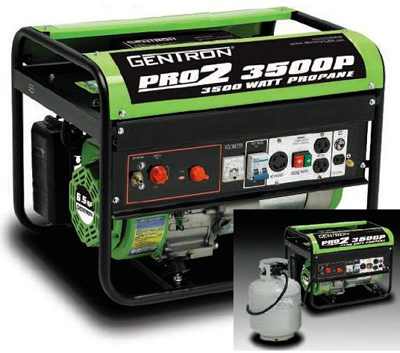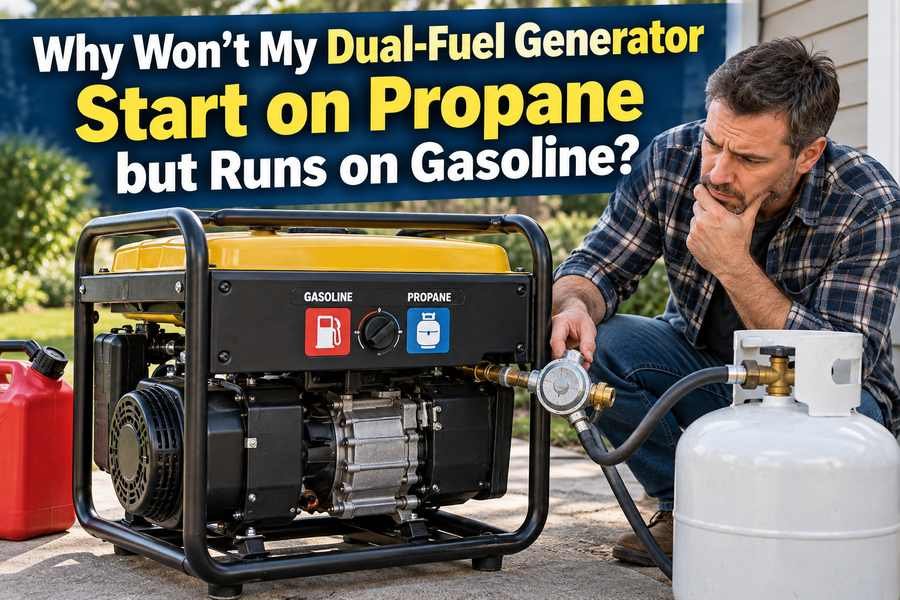
If my dual-fuel generator runs perfectly on gasoline but refuses to start on propane, that immediately narrows the diagnosis. I know the engine can turn over, make compression, and usually produce spark because it runs on gasoline. That makes me look first at everything unique to the propane fuel path.
The good news is that many propane-only starting problems are caused by setup, flow, or starting procedure rather than major engine damage. The bad news is that propane is a pressurized fuel, so I do not loosen fittings, bypass regulators, or improvise hose connections while troubleshooting.
In this guide, I’ll show you the order I use to troubleshoot a dual-fuel generator that runs on gasoline but not propane, what the symptoms tell me, how the propane regulator and demand system work, and when I stop troubleshooting and call for service.


Why Running on Gasoline Is an Important Clue
A dual-fuel generator uses the same basic engine whether it is burning gasoline or propane, but the fuel-delivery paths are different.
Gasoline flows from the tank through a fuel valve and carburetor circuit. Propane comes from the cylinder through a hose/regulator assembly and then through the generator’s propane fuel controls or demand regulator before entering the engine.
If the generator starts and runs normally on gasoline, these parts are less likely to be the main problem:
- basic engine compression;
- starter motor or recoil mechanism;
- most of the ignition system;
- basic valve timing; and
- the engine’s ability to run mechanically.
That does not completely rule out oil-level sensors, spark-plug weakness, controller faults, or cold-start issues. But it makes the propane supply path my first target.


Most Common Causes: Gasoline Works but Propane Does Not
| Likely Cause | Typical Symptom | What I Check |
|---|---|---|
| Propane cylinder empty or too low | Cranks but never fires | Tank level and known-good cylinder |
| Cylinder valve closed / not fully open | No propane reaches engine | Valve position |
| Fuel selector not fully on propane | Cranks with no propane delivery | Selector position per manual |
| Hose/regulator not connected correctly | No fuel or intermittent fuel | Cylinder and generator connections |
| Incorrect choke/prime procedure | Will not catch or only coughs | Exact propane starting procedure |
| Excess-flow device activated | Very weak or no flow after tank valve was opened quickly | Reset procedure in generator/tank instructions |
| Demand regulator / fuel solenoid fault | Gasoline runs normally; propane side remains dead | Professional fuel-system diagnosis |
| Cold weather / poor vaporization | Hard propane starting in low temperatures | Tank size, temperature, fuel level |
1. Check the Propane Cylinder Before Anything Else
I start with the simple question: is there actually enough propane in the cylinder?
A cylinder can feel heavy and still have less usable propane than I expect. If I have another known-good cylinder that matches the generator manufacturer’s requirements, substituting it is a simple way to isolate the fuel source.
Current Champion guidance recommends 20–40 lb propane tanks for its dual-fuel and tri-fuel portable generators. Generac’s current dual-fuel portable troubleshooting guidance says LP operation should use the fuel source specified in the owner’s manual and specifically notes 20 lb cylinders for applicable models.
I do not use a cylinder or tank setup that the generator manufacturer has not approved just because the fitting can be made to connect.
2. Make Sure the Propane Hose and Regulator Are Connected Correctly
Most portable dual-fuel generators use a manufacturer-supplied hose and regulator assembly. That assembly is not just a hose—it is part of the fuel-pressure control system.

Generac’s dual-fuel portable manual tells users to verify that the fuel hose is properly connected to both the LP cylinder and the second-stage regulator. Westinghouse similarly specifies that the LPG hose must be securely connected to the cylinder and generator before propane operation.
I look for:
- a connector that is not fully threaded or seated;
- a quick-connect collar that did not lock;
- a kinked hose;
- visible cuts, abrasion, cracking, or heat damage;
- a regulator that has been dropped or damaged; and
- the wrong hose/regulator assembly for the generator.
I do not add sealant to a connection unless the manual specifically calls for it. Some portable-generator cylinder connections are designed to seal mechanically and the manufacturer specifically warns against using tools or sealants on them.
If you want a deeper explanation of portable-generator regulator requirements, see Propane Regulator for a Portable Dual-Fuel Generator.


3. Verify the Fuel Selector Is Fully Set to Propane
Dual-fuel generators often use a selector dial, lever, or switch that physically or electrically changes which fuel system is active.
If it is sitting between positions, the generator can crank without receiving the correct propane flow.
Westinghouse’s current dual-fuel manuals instruct the user to open the propane cylinder valve and rotate the fuel selector fully to the propane/LPG position. Champion similarly requires the selector to be set to propane operation before starting.
I move the selector exactly as the manual describes rather than assuming the label is only informational.
4. Use the Propane Starting Procedure—Not the Gasoline Procedure
This is one of the biggest reasons I see a generator run on gasoline but refuse to start on propane.
Different generators use different propane-starting procedures. Some require partial choke. Some require full choke for only the first pull. Some use a prime button or relief valve. Others rely on repeated cranking to pull propane through the demand regulator.
For example, a Champion dual-fuel manual specifies a 75% choke position for propane starting on one model, while another Champion model uses a pull-to-prime sequence. A Westinghouse inverter model instructs the user to press its relief valve three times before starting on propane.
| Example Procedure | Manufacturer Example | Why It Matters |
|---|---|---|
| 75% choke for propane start | Champion 3500W dual-fuel example | Full gasoline-style choke may not be the intended LP procedure |
| Pull-to-prime sequence | Some Champion dual-fuel models | Initial pulls help establish propane flow |
| Relief/prime valve pressed 3 times | Westinghouse iGen example | The model uses a specific propane priming step |
That is why I do not give one universal choke position for every dual-fuel generator. I use the exact owner’s manual.
5. Open the Propane Cylinder Valve Correctly
The propane valve has to be open for fuel to flow, but the correct sequence matters.
Many modern cylinder connections include excess-flow protection. If flow suddenly appears abnormally high, the safety mechanism can restrict propane flow.
If the generator will not start after the cylinder valve was opened abruptly, I shut the system down and follow the manufacturer’s reset/start procedure. I do not repeatedly snap the valve open and closed trying to force more fuel through.
When a propane system seems to “trip” after the tank valve is opened, the behavior can be similar to what I explain in Why Does My Propane Regulator Trip When I Open the Tank Valve?.
6. The Propane Regulator or Demand Regulator May Be Sticking
Portable dual-fuel generators commonly use a pressure regulator plus a demand system. The demand regulator is designed to allow propane into the engine only when engine vacuum indicates that the engine is cranking or running.
Champion explains that on its dual-fuel systems, the diaphragm opens because of the vacuum produced while the engine is starting or operating. That safety concept is why the propane line should not simply flow freely when the engine is stopped.
If the diaphragm sticks, the regulator is damaged, or the fuel-control passage is restricted, the gasoline side can work perfectly while the propane side gets little or no fuel.
At that point, I do not disassemble the regulator unless the manufacturer specifically provides a service procedure. Propane regulators contain calibrated and safety-related components.
7. Check Oil Level Even Though It Runs on Gasoline
This sounds contradictory: if low oil were the problem, why would it run on gasoline?
Usually it would not. But oil level can sit right at the shutdown threshold, and moving the generator, changing its angle, or repeatedly cranking it can affect a marginal low-oil sensor condition.
Champion specifically notes in its propane-starting instructions that the generator must be on a flat, level surface and that the low-oil sensor will prevent continued operation when oil falls below the critical level.
I put the generator on level ground, let the oil settle, and check it exactly as the manual specifies.
8. Check the Spark Plug if Propane Will Not Ignite Reliably
Propane and gasoline do not always respond exactly the same way to a marginal ignition system. A spark plug that is fouled, worn, incorrectly gapped, or weak may still let the engine run on one fuel while making cold propane starting difficult.
Generac’s portable-generator troubleshooting guidance specifically includes checking the spark plug and making sure the plug boot is fully seated.
If the generator runs smoothly and strongly on gasoline, I still rank the propane fuel path higher than the spark plug. But once I have ruled out the cylinder, hose, regulator, selector, and starting procedure, the plug is a reasonable maintenance item to inspect.
9. Cold Weather Can Make Propane Starting Harder
Cold conditions affect both the engine and the propane supply.
Generac notes that very cold temperatures can make portable generators difficult to start. Propane also has to vaporize in the cylinder before the engine can use it, and cylinder vaporization capacity drops as temperature falls.
A nearly empty small cylinder in cold weather has less vaporization capability than a fuller or larger approved cylinder at a warmer temperature.
| Cold-Weather Factor | Effect |
|---|---|
| Cold engine oil | Increases cranking resistance |
| Cold battery | Reduces electric-start performance |
| Low cylinder temperature | Reduces propane vaporization rate |
| Low propane level | Further reduces available vaporization surface |
I never heat a propane cylinder with a flame, torch, space heater, or other improvised heat source.
10. Try Starting With All Electrical Loads Disconnected
Manufacturers consistently instruct users to start portable generators with electrical loads disconnected.
Champion’s manual states not to start or stop the generator with electrical devices plugged in or turned on. Generac also tells users to make sure no appliances or extension cords are connected before starting.
Propane usually produces somewhat less generator output than gasoline on the same dual-fuel unit. If a heavy load is already connected during startup, the engine may struggle or stall before it stabilizes.
I unplug the loads, start the generator, let it stabilize, and then add loads within the propane rating shown on the generator.
11. Why It May Start on Propane and Then Die
If the generator does manage to fire on propane but dies after a few seconds, the diagnosis shifts slightly.
I start thinking about:
- weak propane flow;
- regulator or hose restriction;
- cylinder vaporization;
- demand-regulator malfunction;
- low-oil shutdown;
- incorrect choke position after startup; or
- electrical load being applied too quickly.
I covered that symptom in detail in Why Does My Propane Generator Start Then Die?.
A Fast Diagnostic Test: Gasoline vs. Propane Symptoms
| What Happens | What It Suggests |
|---|---|
| Runs perfectly on gasoline, no firing at all on propane | Propane supply, selector, hose/regulator, demand regulator, or starting procedure |
| Starts on propane but dies in seconds | Insufficient propane flow, regulator restriction, low oil, choke issue |
| Runs on propane only with a full cylinder | Vaporization or cylinder-flow limitation |
| Runs on propane warm but not cold | Cold-start procedure, battery/oil, propane vaporization |
| Runs on both fuels but stalls under load on propane | Propane flow/capacity limitation or load exceeds propane output rating |
| Will not run on either fuel | Look beyond propane side: oil shutdown, ignition, compression, controls, starter |
My Troubleshooting Order
When gasoline works but propane does not, this is the order I use:
- Move the generator outdoors to a safe operating location and disconnect all loads.
- Check oil level with the generator level.
- Confirm the propane cylinder has fuel and meets the manufacturer’s requirements.
- Inspect and correctly connect the approved propane hose/regulator.
- Fully select propane/LPG mode.
- Follow the exact propane choke/prime procedure from the manual.
- Confirm the cylinder valve is open according to the manual.
- Try a known-good compatible propane cylinder if available.
- Inspect the spark plug and plug boot if basic propane checks do not solve it.
- If propane still does not reach the engine correctly, have the regulator/demand system professionally tested.
I do not test for propane by cracking open fittings, and I do not remove the regulator from the hose to feed unregulated tank pressure into the generator.
Can I Use a Different Propane Regulator?
I do not substitute a generic barbecue regulator or a random high-pressure regulator just because the fittings look compatible.
A dual-fuel generator’s supplied propane hose/regulator is selected for the engine’s fuel system. Wrong outlet pressure can cause hard starting, poor running, excessive fuel, insufficient fuel, or a safety hazard.
If the original regulator is damaged, I replace it with the manufacturer-specified assembly or a properly approved equivalent that matches the generator’s required pressure and flow.
Could the Carburetor Still Be the Problem?
Yes, but the diagnosis is different from a gasoline-only carburetor problem.
Many dual-fuel generators route propane through a mixer or dual-fuel carburetor assembly. The gasoline circuit can be clean and functional while the LPG passage, demand connection, selector mechanism, or propane side of the mixer is restricted.
If gasoline operation is excellent and every external propane check is correct, an internal LPG fuel-path problem becomes more likely.
When I Stop Troubleshooting
I call a qualified generator technician when:
- I smell propane around the generator or hose connection;
- the regulator appears physically damaged;
- the approved hose/regulator does not pass fuel even with a known-good cylinder;
- the demand regulator or fuel solenoid is suspected;
- the generator has a recurring control or sensor fault;
- the propane mixer/carburetor needs internal service; or
- the unit has been modified from its original fuel configuration.
Propane leaks and regulator faults are not problems I try to solve by trial-and-error adjustment.
Frequently Asked Questions
Why does my generator run on gasoline but not propane?
If gasoline operation is normal, I first suspect the propane supply path: cylinder, valve, selector, hose/regulator, starting procedure, excess-flow restriction, demand regulator, or propane side of the mixer.
Do I need to prime a dual-fuel generator on propane?
Some models do and some do not. Champion has models that use pull-to-prime procedures, while some Westinghouse models have a specific relief/prime step. I follow the exact owner’s manual rather than using a universal procedure.
Should the choke be on when starting on propane?
It depends on the generator. One Champion model specifies 75% choke for propane starting, while other models use different sequences. Too much or too little choke can prevent starting.
Can the propane regulator be bad even if it looks fine?
Yes. A regulator or demand diaphragm can fail internally without obvious exterior damage. If the cylinder and connections are correct but propane does not reach the engine properly, the regulator assembly may need testing or replacement.
Why does my dual-fuel generator have less power on propane?
That is normal for many dual-fuel generators. Manufacturer ratings often show lower running and starting wattage on propane than on gasoline. I use the propane-specific watt rating when deciding what loads to connect.
Can a low propane tank stop the generator from starting?
Yes. A low cylinder can have reduced vaporization ability, particularly in cold weather or on larger generators that demand more fuel.
Bottom Line
If my dual-fuel generator runs on gasoline but will not start on propane, I treat that as a strong clue that the problem is in the propane-specific fuel path or propane starting procedure.
I check the cylinder, valve, hose/regulator connection, fuel selector, choke/prime sequence, oil level, and spark plug in that order. If the generator still refuses propane but continues to run properly on gasoline, I become more suspicious of the demand regulator, LPG mixer passage, fuel solenoid, or regulator assembly.
The most important thing is not to “give it more propane” by bypassing or adjusting safety components. Use the supplied fuel system, follow the model-specific manual, and have the LPG system serviced if the external checks do not solve the problem.
Technical References

Mike is an experienced propane technician with over 15 years of professional experience in the field. He has dedicated his career to helping customers with their propane needs, from installation to maintenance and repair. Together with Jeremy, he co-founded this website to provide useful information and guidance to customers seeking reliable propane services.