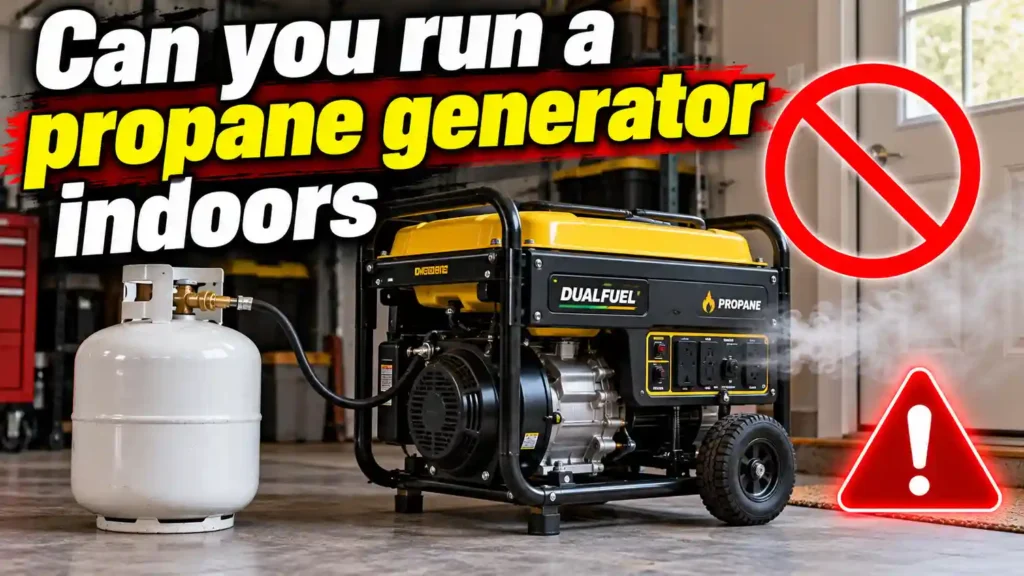
TL;DR — Can you run a propane generator indoors? No. I would never operate a portable propane generator inside a home, garage, basement, shed, RV, workshop, or partly enclosed shelter. Propane burns cleaner than gasoline in some respects, but a propane-powered engine still produces deadly carbon monoxide (CO). Opening a garage door, using a fan, installing an exhaust hose, or relying on a CO shutoff sensor does not make indoor operation safe. For a portable generator, I follow U.S. Consumer Product Safety Commission guidance: operate outdoors at least 20 feet (6.1 m) from the house and other buildings, direct exhaust away from doors, windows, and vents, and increase distance if the site still allows fumes indoors. A professionally engineered generator room for certain commercial equipment is a different, specialized installation—not permission to place a household portable generator indoors.
If you’re asking me, “Can you run a propane generator indoors?”, I want to answer before discussing anything else: no, not if you’re talking about a normal portable propane generator. It doesn’t matter whether the power comes from a 20-pound cylinder, a 100-pound cylinder, or a larger LP supply. The danger comes from the engine exhaust, not just the type of fuel stored outside.
I understand why you might want to put a generator somewhere covered. You may have a storm approaching, limited yard space, a garage with electrical outlets, or a generator you’re trying to protect from theft and rain. But I would never solve a rain or security problem by creating a carbon monoxide exposure problem. Instead, I’ll explain where I would and would not place a generator, what separation distances actually mean, and how to build a safer backup-power plan without turning a room into a hazardous generator enclosure.


Can a Propane Generator Produce Carbon Monoxide?
Yes. An engine running on propane produces exhaust that can contain carbon monoxide, particularly when combustion isn’t complete. CO is invisible and has no smell. That means you cannot use your nose, a lack of smoke, or a clean-looking exhaust pipe to determine whether the air is safe. Gas odor from leaking propane is a separate danger and does not act as a reliable warning for CO.
Carbon monoxide reduces the blood’s ability to carry oxygen. A person exposed to it may experience headache, dizziness, nausea, weakness, confusion, or collapse. Severe exposure can cause unconsciousness or death. During power outages, symptoms are sometimes mistaken for tiredness, stress, or a flu-like illness, which can delay getting help.
In 2026, U.S. public-safety guidance from the Consumer Product Safety Commission (CPSC) and the Centers for Disease Control and Prevention (CDC) remains unambiguous: portable fuel-powered generators belong outdoors, never in living spaces or partly enclosed areas. The same rule applies when the fuel is propane instead of gasoline. I would not make an exception for a low-odor model, an inverter model, a generator with a built-in CO shutdown, or a unit marketed as quiet.
Where Can You Run a Propane Generator? Place-by-Place Safety Chart
I recommend checking both the enclosure around the generator and the routes through which exhaust could enter occupied space. A location that looks “outside” can still trap fumes or push them toward a nearby window.


| Place you might consider | Can I operate a portable propane generator here? | My safety explanation |
|---|---|---|
| Living room, kitchen, hallway, or bedroom | No | Occupied interior space; exhaust can rapidly cause CO poisoning. |
| Attached or detached garage, even with door open | No | A partly open garage is not reliably ventilated; CO may accumulate or travel into a home. |
| Basement, cellar, or crawlspace | No | Enclosed areas are especially dangerous and difficult to escape. |
| Storage shed, tool shed, barn, or workshop | No | Walls and roofs restrict dispersion, even when one side is open. |
| Carport or under-building parking area | No | CPSC warns against carports; an overhead roof and adjoining walls can retain exhaust. |
| Screened porch, covered patio attached to house | No | A screen doesn’t prevent CO, and the location is too close to building openings. |
| Balcony or apartment corridor | No | Too close to occupied spaces and often prohibited by building rules. |
| Under a deck or enclosed pergola | No | Heat, exhaust recirculation, combustible materials, and inadequate clearance. |
| Open yard, driveway, or level gravel surface | Potentially yes | Only if fully outdoors, suitably dry, and sufficiently far from buildings and air intakes. |
| Open-air freestanding canopy | Potentially yes | Only with manufacturer-approved weather protection and no trapped exhaust or clearance conflict. |
| Factory-designed outdoor standby enclosure | Different category | Installed outdoors according to its own tested clearances, manual, permits, and codes. |
| Engineered commercial generator room | Not a portable-generator solution | Specialized generator sets may be designed for dedicated rooms with engineered exhaust, ventilation, and fire protection. |
I would not call a place safe simply because it has no door. Wind direction, nearby walls, patios, soffit vents, window AC units, and even neighboring houses can determine whether exhaust moves into occupied areas. This is why a separation number is a starting point rather than a magic shield.
How Far From the House Should a Propane Generator Be?
For a portable propane generator, the CPSC recommends operating outdoors at least 20 feet from the home and buildings, with the exhaust directed away from doors, windows, and vents. The CDC similarly advises more than 20 feet from windows, doors, and vents. Some safety illustrations, including National Institute of Standards and Technology material, use 25 feet as a more conservative visual example. If I have room, I prefer more distance rather than less, particularly when airflow patterns are unfavorable.
Twenty feet is approximately 6.1 meters; 25 feet is approximately 7.6 meters. I would measure from the generator to the relevant building and openings, not assume the distance based on a few paving stones. The outdoor location must also have sufficient clearance around the machine for cooling, exhaust dispersion, and fire safety according to its manual.
| Placement dimension | Reference value | How I apply it |
|---|---|---|
| Portable generator from home or buildings | At least 20 ft / 6.1 m (CPSC) | A starting minimum; increase if exhaust can be drawn inside. |
| Alternative conservative outdoor illustration | 25 ft / 7.6 m (NIST) | Useful when sufficient yard space is available. |
| Portable generator side and overhead clearance | Model-specific | Some manuals require 5 ft around the unit; I follow the actual manual. |
| Residential standby generator distance from openings | Model- and code-specific | Do not substitute portable-generator 20-ft guidance for a tested standby installation. |
| Certified standby clearance to wall | Sometimes 18 in for specific labeled models | Not a blanket allowance: only where the exact model, certification, manual, and codes permit. |
The distinction in the last two rows is important. A permanently installed standby generator may have a tested outdoor enclosure and a different set of manufacturer-approved clearances. Generac, for example, discusses 5-foot separation from openings and limited reduced wall clearances on particular SwRI-labeled models, but it also warns that CO can still enter buildings even where minimum distances are met. I would never move a regular portable unit closer by borrowing a standby generator’s clearance chart.
Can I Run a Propane Generator in a Garage With the Door Open?
No. This is one of the most tempting and dangerous ideas. A raised garage door does not create a reliable flow path for all engine exhaust. CO can circulate in the garage, build up around a partial wall, or migrate through doors, cracks, or attic connections into a house. Fans and open windows do not guarantee that the concentration stays safe.



I wouldn’t place a generator in the doorway with half of the machine outside, either. The whole operating unit needs a suitable outdoor location with enough separation to prevent exhaust from entering the structure. In an attached garage, the possibility of gas moving into bedrooms or living areas makes the risk especially serious.
If your reason for using the garage is rain, I would solve rain protection outside. If your concern is power connection, I would ask an electrician for an appropriate outdoor inlet and approved transfer equipment, rather than moving the engine next to a garage socket.
Is It Safe to Run a Portable Propane Generator Under a Tent or Canopy?
A purpose-made outdoor generator weather shelter may be appropriate only when the generator manufacturer approves that type of protection and the installation preserves the required clearance, ventilation, exhaust direction, and dry electrical conditions. A generic camping tent, tarp wrapped around the machine, or enclosed plastic shelter is not an acceptable substitute.
I would never drape fabric directly on a running unit or box in the exhaust side to keep out wind-driven rain. The exhaust and engine surfaces can become dangerously hot. Some manufacturers require a specified generator tent or advise not operating during certain weather conditions. I check those instructions before setting up a shelter.


If wind or flooding makes the only available place unsafe, the correct answer may be not to operate the portable generator until conditions permit. I would rather temporarily use battery power for lights and phones than put a running internal-combustion engine in my garage.
Can a Home Standby Propane Generator Be Installed Indoors?
For a typical residential automatic propane standby generator, I would follow the outdoor-installation instructions from the manufacturer and local building authority. These units are generally installed outside on a suitable base and connected by qualified professionals to fuel and electrical systems. Their enclosures are engineered for outdoor operation; the enclosure does not mean that the generator can be installed in a spare room.
A commercial or industrial generator designed for a dedicated indoor equipment room is a separate category. In those projects, engineers address combustion air, engine-cooling airflow, exhaust ducting to the exterior, structural support, fire-rated construction, detection, service access, and code requirements. Such an installation is not achieved by buying a portable propane generator and attaching a flexible exhaust hose.
Cummins power-system design guidance, for example, discusses dedicated generator rooms and specialized ventilation for equipment intended for indoor placement. Those are professionally engineered installations with different product requirements. I would not present them as a DIY exception to the portable generator rule.
For a household system, I explain the equipment-selection side in my whole-home propane generator guide and the fuel-system requirements in standby generator regulator sizing.
What Should I Do If the CO Alarm Sounds While a Generator Is Running?
I would get everyone outside to fresh air immediately, call emergency services, and stay out until responders say it is safe. I would not delay evacuation to save food, unplug appliances, or find the source. I would not send another person back into the building to shut down a generator if it means entering a potentially contaminated area.
Symptoms can include headache, dizziness, nausea, confusion, weakness, chest discomfort, or collapse. People who are asleep may not recognize warning signs. Medical evaluation is important when exposure is suspected, even if someone feels better after moving outside. I would tell responders that a propane generator was operating and explain where it was placed.
| Warning sign or situation | My immediate response | What I avoid |
|---|---|---|
| Carbon monoxide alarm sounds | Evacuate to fresh air and call emergency services | Searching the house for the source before leaving |
| Anyone feels dizzy, nauseated, confused, or faint | Move to fresh air; seek urgent medical attention | Assuming it’s heat or fatigue without checking |
| Someone is unconscious inside | Call responders and report possible CO poisoning | Entering without proper rescue equipment |
| Alarm stops after generator shutdown | Remain outside until authorities clear the building | Treating silence as proof the air is safe |
| Strong propane odor or suspected fuel leak | Move away; avoid switches and ignition sources; call supplier/emergency responders | Disconnecting or repairing gas fittings in a hazardous area |
The goal is to keep people alive, not to diagnose the generator during an emergency. If a problem occurs once, I would not use the same setup again until the location, exhaust path, and equipment have been evaluated.
My Outdoor Generator Placement Check: The Four-D Test
I created a simple homeowner planning framework called the Four-D test: Distance, Direction, Dryness, and Disconnect. It’s an original checklist for organizing a placement decision, not a tested safety certification or substitute for the manufacturer’s instructions. If a location fails any one of the four checks, I choose another place or don’t run the unit.
| Four-D check | Question I ask myself | What passing looks like |
|---|---|---|
| Distance | Is the portable unit at least 20 feet away and farther if needed? | Open outdoor area, away from occupied buildings and openings. |
| Direction | Can exhaust blow toward windows, doors, vents, neighbors, or HVAC intakes? | Exhaust faces away and wind patterns do not send fumes inside. |
| Dryness | Is the generator on firm, dry, level ground with approved protection? | No pooling or runoff; no improvised enclosure or covered exhaust. |
| Disconnect | Can the power be used without backfeeding the utility or exposed wiring? | Proper rated cords or electrician-installed transfer equipment. |
Why do I like this approach? It catches a frequent planning mistake: someone finds a location far enough from the house but overlooks that the exhaust points directly at the neighbor’s open window. Or they place the generator on a safe-looking lawn but run extension cords through standing water. Or they have a perfect outdoor pad but plan to backfeed a dryer receptacle.
The four checks work together. I would also add children, pets, theft prevention, local noise rules, and access for safe shutdown—but none of those secondary considerations justifies moving the machine indoors.
What Are Safe Alternatives When My Yard Is Too Small?
If I can’t place a portable generator far enough from occupied structures and openings, I wouldn’t force an unsafe compromise. I’d consider a battery power station for lighting, phones, internet and limited small appliances, or a professionally designed outdoor standby installation if the property and local rules support one. In a tightly packed townhouse or apartment property, the safest realistic option may be a battery system rather than an engine generator.
An indoor-rated battery power station is different from a propane generator: it has no combustion engine or CO-producing exhaust while discharging. It still requires safe electrical use, appropriate battery charging, and compliance with its manufacturer’s instructions. I would never plug it into home wiring through an improvised backfeed arrangement.
I may also reduce backup loads rather than power the entire house. Running the refrigerator, communications and essential lighting is a different problem from powering electric heating and central air conditioning. My propane generator size guide for houses can help plan the load before I choose equipment.
How Much Clearance Does a Propane Generator Need?
Clearances protect against more than CO. I also need space for air intake, hot exhaust, engine cooling, service access, combustibles, and fire protection. For portable generators, some model manuals require 5 feet of open space around the unit. The actual value varies, and I follow the most restrictive applicable manufacturer requirement without treating it as a substitute for the outdoor house separation.
For some residential standby models, Generac’s installation guidance discusses 5 feet from wall openings, 3 feet at the front and ends, and a limited 18-inch back-to-wall arrangement for specifically tested and labeled models. These details depend on the unit and local code. They are not universal propane generator dimensions and may need to be greater when exhaust could enter a building.
If I am evaluating a permanent outdoor standby installation, I’d ask the installer to consider soffit vents, basement windows, HVAC air intakes, dryer vents, adjoining walls and neighboring structures. The engineer or licensed installer should handle all required setback and permitting decisions.
Frequently Asked Questions
Are propane generators safe to use inside a house?
No. A portable propane generator produces engine exhaust that can contain deadly CO. Even a clean-looking or low-odor exhaust is dangerous in an occupied room. I would operate the generator outdoors and use approved electrical connections to supply the home.
How far away should a propane generator be from a window?
For a portable generator, I follow CPSC guidance to place it outdoors at least 20 feet from the house, directing the exhaust away from windows, doors, vents and other buildings. More distance may be needed. A permanently installed standby unit follows its own manual and local codes, not this portable rule.
Can I attach an exhaust hose and run a portable generator indoors?
No. Adding an exhaust hose does not address combustion air, leaks, exhaust backpressure, engine cooling, hot surfaces, or fire hazards. I would never treat a homemade hose as permission to use a portable generator in a garage, shed, or room.
What if a portable propane generator has CO shutdown technology?
I consider it useful backup protection, never permission to run indoors. I still use safe outdoor placement and independent home CO alarms.
Can a propane standby generator go in a dedicated garage room?
A normal residential outdoor standby model should not be moved inside. Certain specialized commercial generator systems may be engineered for dedicated indoor rooms, but only with approved equipment, exhaust, ventilation, protection and professional code review. That is a separate installation category.
Final Takeaway: Keep the Engine Outdoors and Bring the Power Inside
My answer remains firm: I would never operate a portable propane generator indoors or in a partially enclosed space. That includes garages with open doors, sheds, basements, workshops, carports, porches, and RV living areas. Carbon monoxide does not become safe because the engine burns propane.
I would find an open outdoor location, follow the manufacturer’s required distances and clearances, point exhaust away from occupied structures, maintain functioning CO alarms, and use properly installed electrical connections. If the property cannot accommodate that arrangement, I would consider an indoor-rated battery system or a professionally designed outdoor standby installation instead.
Once you have a safe installation plan, the next questions are power needs and upkeep. You can review what size propane generator you need for your house, propane generator maintenance, and the fuel runtime of a 9,500-watt propane generator. But I would never trade safe placement for longer runtime or convenient wiring.

Mike is an experienced propane technician with over 15 years of professional experience in the field. He has dedicated his career to helping customers with their propane needs, from installation to maintenance and repair. Together with Jeremy, he co-founded this website to provide useful information and guidance to customers seeking reliable propane services.