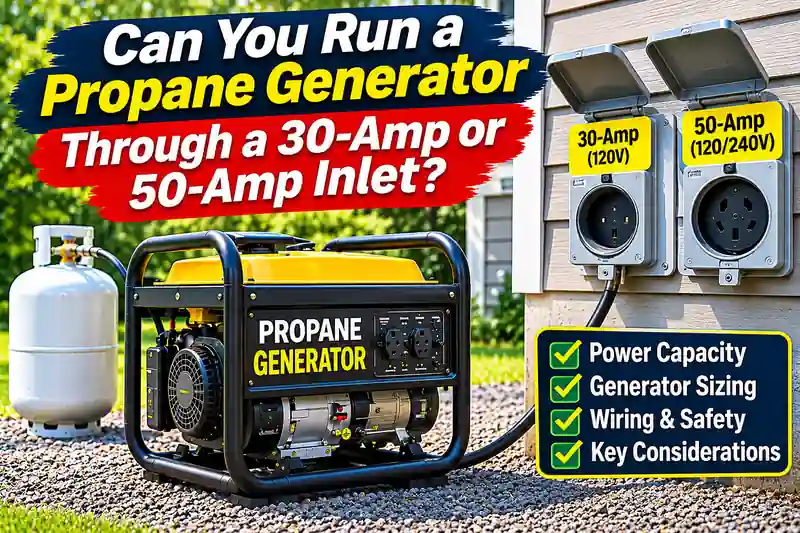
TL;DR: Yes, a propane generator can supply your home through a properly installed 30-amp or 50-amp power inlet. A typical 120/240-volt 30-amp inlet is rated for up to 7,200 VA; a 50-amp inlet is rated for up to 12,000 VA. But the generator’s propane output, breakers, wiring and transfer equipment may impose lower limits. Never backfeed a household outlet or use a homemade adapter. Have a qualified electrician install and test the system.
If you want to connect a portable propane generator to your home during a blackout, choosing between a 30-amp and a 50-amp inlet is one of the first decisions you will face. I would not make that decision from the inlet label alone. The real goal is to connect the generator safely, supply the loads that matter, and avoid buying components that do not work together.
Can a propane generator connect to a 30-amp or 50-amp inlet?
Yes, provided the generator, inlet, cord, transfer equipment, circuit protection and house wiring are designed to work together. The inlet is a connection point, not a device that increases generator output. A 30-amp inlet does not turn a 3,000-watt generator into a 7,200-watt generator, and a 50-amp inlet does not automatically make 12,000 watts available.


I would start by checking the generator’s actual propane-rated output and its available receptacles. Many dual-fuel generators have different running and peak ratings on propane than on gasoline. Then I would compare the generator’s voltage, outlet configuration, neutral arrangement and circuit protection with the inlet and transfer equipment specified by the electrician.
The safest setup uses a properly installed outdoor power inlet, a compatible generator cord, and an approved transfer switch or listed interlock that prevents the utility and generator from energizing the same circuits at the same time. Never use a male-to-male cord or plug the generator into an ordinary dryer or household receptacle.
What a generator inlet actually does
A generator inlet is a fixed, appropriately rated connection point through which a portable generator supplies a building’s approved backup-power system. It is normally mounted outdoors and wired to transfer equipment and the distribution panel. Unlike a standard outlet, an inlet is intended to receive power from the generator cord through a protected connection.


The inlet alone does not provide safe utility isolation. That function must be provided by correctly selected and installed transfer equipment. Nor does an inlet solve grounding, bonding, overload protection or load-management problems.
In my view, the most important question is not “Which inlet looks bigger?” but “What is the complete power path from the generator breaker to the loads?” The answer includes every connector, conductor and protective device along that path.
30-amp versus 50-amp generator inlets
| Specification | 30-amp inlet | 50-amp inlet |
|---|---|---|
| Common residential generator configuration | 120/240 V, four-wire | 120/240 V, four-wire |
| Nominal maximum at 240 V | 7,200 W | 12,000 W |
| Nominal current per hot leg | 30 A | 50 A |
| Common connector family | NEMA L14-30 | NEMA 14-50 or listed 50 A locking arrangement |
| Typical application | Selected home backup loads | Higher-capacity home backup connections |
| Installation | Requires correctly rated wiring and transfer equipment | Requires correctly rated wiring and transfer equipment |
These are common configurations, not universal product specifications. A 30-amp 120-volt connector is not interchangeable with a 30-amp 120/240-volt connector. Check the exact NEMA configuration and voltage printed on each component.
For a 120/240-volt system, multiplying 240 volts by 30 amps gives 7,200 volt-amperes, and 240 volts by 50 amps gives 12,000 volt-amperes. For approximately unity-power-factor household loads, these figures are often expressed as watts. They are connection ratings, not a guarantee of generator capacity or permission to operate all loads simultaneously.

Why voltage matters as much as amperage
A house commonly uses 120/240-volt split-phase service. That means many lights and receptacles operate at 120 volts, while some larger appliances use 240 volts. A generator that supplies only 120 volts may not be suitable for a conventional 120/240-volt inlet and panel configuration, even if an adapter physically fits.
Some generators provide a 120/240-volt receptacle with two hot legs, neutral and equipment grounding conductor. Others have a 120-volt-only output. Certain generators also have voltage-selector switches that change the available output and current distribution. I would check the generator manual before buying an inlet or cord.
Never use a homemade adapter that bridges both hot legs of a 120/240-volt panel. Such arrangements can create hazards, including overloaded shared neutrals on multiwire branch circuits and damage to 240-volt equipment. A qualified electrician should design any special 120-volt-only backup arrangement.


How much power can a 30-amp inlet carry?
For a typical 120/240-volt 30-amp inlet, the nominal upper connection rating is 7,200 VA. But the generator may produce substantially less. If a propane generator is rated for 5,500 running watts, the usable continuous power is governed by the generator’s rating and all applicable equipment limitations—not the 7,200-VA inlet calculation.
| Generator propane running rating | 30 A inlet nominal rating | Practical upper limit before other factors |
|---|---|---|
| 3,500 W | 7,200 VA | Generator rating |
| 5,500 W | 7,200 VA | Generator rating |
| 7,000 W | 7,200 VA | Generator rating |
| 9,000 W | 7,200 VA | Inlet/circuit rating, subject to proper protection |
Do not overlook leg balancing. A split-phase generator may have limits on the amount of current available on either 120-volt leg. A large 120-volt load concentrated on one leg can overload that leg even when the combined wattage looks acceptable.
I also leave room for motor-starting surges. Refrigerators, freezers, well pumps and some air conditioners can draw considerably more power when their motors start. For real examples of appliance sizing, see Can a Propane Generator Run a Refrigerator and Freezer? and Can a Propane Generator Power a Well Pump?.
How much power can a 50-amp inlet carry?
A common 120/240-volt 50-amp inlet has a nominal connection rating of 12,000 VA. That does not mean every 50-amp generator outlet provides 12,000 watts continuously. A generator with a 50-amp connector might have a lower engine or alternator running rating, and its breaker may limit output.
For example, a propane generator rated at 9,500 running watts connected through a properly designed 50-amp inlet remains a 9,500-watt generator. The extra inlet capacity may be useful for a larger generator in the future, but the system must still be protected and installed according to its actual design.
I would avoid using the 50-amp label as a shortcut for “whole-house power.” Whether the generator can operate a central air conditioner, electric range, water heater or electric heating depends on the simultaneous load, startup current, power management and generator capacity.
30-amp or 50-amp: which should you choose?
| Situation | What I would evaluate |
|---|---|
| Small propane generator, essential circuits only | Whether a correctly designed 30 A system matches the generator and loads |
| Medium generator with 120/240 V output | Actual output breaker, receptacle type and load schedule |
| Large portable generator | Whether a 50 A system is appropriate and properly protected |
| Future generator upgrade planned | Whether wiring and transfer equipment can be sized for an approved future configuration |
| 120 V-only generator | Special compatibility review rather than assuming a standard split-phase inlet will work |
For a basic emergency setup serving lighting, refrigeration, internet and a few receptacles, a 30-amp connection may be sufficient. For larger loads and a suitably rated generator, a 50-amp inlet may offer more capacity. I would still choose the inlet after calculating the loads, not before.
Generator wattage and household load calculation
Here is an illustrative backup-load schedule. Actual appliance ratings vary, and starting watts must be checked separately.
| Appliance | Illustrative running watts |
|---|---|
| Refrigerator | 150 W |
| Chest freezer | 120 W |
| LED lighting | 180 W |
| Router and laptop | 130 W |
| Gas furnace blower | 600 W |
| Well pump when operating | 1,000 W |
| Microwave while operating | 1,200 W |
| Illustrative simultaneous running total | 3,380 W |
A 3,380-watt running load might appear comfortable on a 5,000-watt generator, but the well pump and refrigeration compressors may need additional starting capacity. The generator also has to maintain acceptable voltage and frequency when the load changes.
I would prepare two numbers: maximum expected steady running demand and the worst credible starting surge. Then I would compare those numbers with the generator’s propane running and surge ratings and its per-leg current limits. If several large appliances are connected, a load-management strategy may be necessary.
How a transfer switch makes the connection safe
A transfer switch selects the permitted power source for the backed-up circuits. A properly listed panel interlock may also be used where allowed, provided it is compatible with the exact panel and installed correctly. The critical requirement is preventing simultaneous connection of utility and generator sources.
Without proper isolation, a generator can backfeed utility lines and endanger utility workers, neighbors and people inside the home. The risk exists even when the generator is small. I would never connect a generator using a dryer outlet, a modified extension cord or an improvised double-male cable.
A manual transfer switch can serve selected circuits, while an approved panel interlock arrangement may allow carefully managed use of existing panel circuits. These are not interchangeable in every installation. Your electrician must select a design that meets the locally adopted electrical code and equipment instructions.
Do you need a 30-amp or 50-amp generator cord?
The cord must be listed or appropriately rated for the intended application and compatible with the generator output connector and inlet. A 30-amp L14-30 generator output normally requires a matching four-conductor arrangement for a corresponding 120/240-volt connection. A 50-amp installation uses its own approved connector and cord configuration.
I would check the cord’s current rating, conductor size, voltage, connector type, outdoor suitability and condition. Longer cords introduce voltage drop and physical hazards. Avoid running cords through doors where they can be crushed, across standing water or near hot exhaust components.
Never assume an adapter makes a lower-rated outlet capable of delivering the inlet’s full rating. Any adaptation must preserve correct circuit protection, voltage, conductor assignments and neutral/ground relationships, and it must be permitted by the equipment manufacturers and installation design.
Can you use a 30-amp generator with a 50-amp inlet?
Sometimes a lower-capacity generator can supply a higher-rated inlet through an approved, properly protected arrangement, but compatibility must be assessed by a qualified electrician. The higher inlet rating does not authorize greater current than the generator outlet, cord, breaker or transfer equipment allows.
I would not recommend purchasing a generic 30-to-50-amp adapter without verifying the exact generator output, inlet configuration, neutral arrangement, circuit protection and manufacturer instructions. Connector adapters are particularly risky when they obscure differences between 120-volt and 120/240-volt systems.
Similarly, a 50-amp generator should not simply be connected to a 30-amp inlet to obtain more power. The inlet and its branch wiring must be protected against overcurrent. Any lower-rated part in the power path constrains the system.
What about neutral bonding and a ground rod?
A generator’s neutral may be bonded to its frame or floating, depending on the model. Whether the home transfer equipment switches the neutral affects how the grounding and bonding system must be designed. A mismatch can create unwanted current paths or cause GFCI devices to trip.
I would have the electrician confirm the generator’s neutral arrangement and the transfer equipment’s neutral-switching behavior before the first connection. Never remove a factory bond, install a homemade bonding plug or disable GFCI protection simply to make a connection work.
A separate ground rod is not automatically required for every portable generator, and it is not a substitute for proper equipment grounding and bonding. See Do You Need a Ground Rod for a Portable Propane Generator? for a detailed explanation.
Does propane fuel delivery affect inlet choice?
The inlet carries electrical power, so the fact that the generator runs on propane does not change the inlet’s electrical rating. However, propane operation can reduce the generator’s rated output compared with gasoline on a dual-fuel machine. It can also introduce fuel-delivery constraints during heavy loads or cold weather.
At higher generator loads, propane consumption increases. A small cylinder may struggle to vaporize fuel quickly enough in freezing temperatures. Long or undersized hoses, incorrect regulators and insufficient stationary-tank vaporization can also restrict supply. Electrical load planning therefore needs to be paired with a realistic propane supply plan.
If you use a stationary tank, have a qualified propane professional confirm the regulator and piping arrangement. My guides to propane vaporization capacity and propane pressure problems explain the fuel-side issues.
Portable generator placement during an outage
Operate the generator outdoors, far from doors, windows, vents and occupied spaces, and follow the manufacturer’s minimum clearances. Never run it in a garage, basement, shed, enclosed porch or near an open window, even if a door is open. Carbon monoxide can enter a home quickly and can be fatal.
Place the generator on a stable surface protected from flooding and dangerous weather exposure, without enclosing the exhaust or blocking ventilation. Route the approved generator cord to the outdoor inlet so it is protected from vehicle traffic, standing water and physical damage. Install and maintain carbon monoxide alarms indoors.
Do not route a generator exhaust toward the inlet, the house or the propane cylinder. If the site cannot accommodate safe generator placement and cord routing, discuss a different inlet location with your electrician.
Common mistakes with 30-amp and 50-amp inlets
| Mistake | Why it is dangerous or ineffective | Better approach |
|---|---|---|
| Assuming inlet rating equals generator output | Generator may supply less power | Use propane running rating and circuit limits |
| Using an unapproved adapter | Voltage, wiring or protection mismatch | Match approved connector and system design |
| Backfeeding through a dryer receptacle | Can energize utility lines | Use listed transfer equipment |
| Ignoring 120 V leg loading | One generator leg can overload | Balance loads and check per-leg limits |
| Changing neutral bonds by guesswork | Shock or nuisance-tripping hazards | Have bonding reviewed professionally |
| Running the generator indoors | Carbon monoxide poisoning risk | Operate outdoors with proper clearances |
| Assuming every 50 A outlet is identical | Connector and voltage differences | Verify exact NEMA configuration |
How much does a 30-amp or 50-amp inlet installation cost?
Costs vary widely with panel location, inlet distance, conductor route, transfer equipment, permits, inspection, service configuration and local labor rates. A 50-amp installation may require larger conductors and different components than a 30-amp installation, but distance and electrical-panel complexity can matter more than the inlet itself.
I would request an itemized quote that identifies the inlet, approved transfer device or interlock, wiring, overcurrent protection, grounding and bonding work, permits and testing. I would also ask whether the estimate includes a compatible generator cord.
Be cautious of very low estimates that omit transfer equipment or imply the generator can be connected directly to a general-purpose outlet. The cheapest connection is not a bargain if it creates a shock or backfeed hazard.
My installation planning checklist
| Item | Question to answer |
|---|---|
| Generator output | What are the propane running and surge watts? |
| Voltage | Does the generator provide the required 120/240 V output? |
| Receptacle | What exact NEMA type and breaker rating are provided? |
| Inlet | Is its voltage, connector and current rating compatible? |
| Transfer equipment | How is utility backfeeding prevented? |
| Neutral | Is it switched, and is the generator neutral bonded? |
| Loads | What are running watts, starting watts and leg balance? |
| Cord | Is it properly rated, compatible and suitable for outdoors? |
| Propane supply | Can the tank and regulator support expected demand? |
| Commissioning | Has the system been tested under representative loads? |
My recommendation is to have the electrician document these answers before buying parts. That reduces the chance of paying for an inlet that does not match your generator or the circuits you want to operate.
Frequently asked questions
Can I run my whole house through a 30-amp inlet?
You may be able to supply selected household circuits, but a 30-amp 120/240-volt inlet has a nominal 7,200-VA connection rating, and your generator may supply less. Large simultaneous loads often require load management.
Is a 50-amp inlet always better?
No. A 50-amp inlet offers a higher nominal connection rating, but it does not increase generator output. The best choice matches the generator, loads and electrical design.
Can a 120-volt generator use a 240-volt inlet?
Not automatically. A standard split-phase home connection may require 120/240-volt output. Never bridge hot legs with a homemade adapter.
Does a 30-amp inlet provide 30 amps on each leg?
For a common 120/240-volt split-phase 30-amp connection, each hot leg is limited to 30 amps. Generator per-leg and total ratings may be lower.
Can I plug a 50-amp generator into a 30-amp inlet?
Only through an engineered, properly protected and approved configuration that respects the 30-amp system limit. Do not assume an adapter is sufficient.
Do I need a transfer switch if I have an inlet?
You need approved means of preventing simultaneous utility and generator connection. A properly installed transfer switch or compatible listed interlock may provide this function where permitted.
Can I use the same inlet for propane and gasoline operation?
On a dual-fuel generator, the electrical connector may be the same, but output ratings can differ by fuel. Size and operate using the propane rating when running on propane.
Do I need a ground rod?
Not automatically. Grounding and bonding depend on generator neutral configuration, transfer equipment and the applicable electrical code. Have a qualified electrician evaluate the complete system.
Can I run an air conditioner through a 30-amp inlet?
Possibly, if its running and starting requirements fit the generator, inlet and transfer design. Many central air conditioners have substantial starting demands, so verify the actual equipment specifications.
Final recommendation
Yes, a portable propane generator can supply a home through a correctly installed 30-amp or 50-amp inlet. The right inlet is the one that matches your generator’s real output, its voltage and connector, the loads you need, and an approved transfer and grounding design.
I would prioritize safe utility isolation, correct circuit protection, leg balancing and a reliable propane supply over simply buying the largest inlet available. With those details addressed, an inlet can make emergency generator use much more convenient without relying on unsafe improvised connections.

Mike is an experienced propane technician with over 15 years of professional experience in the field. He has dedicated his career to helping customers with their propane needs, from installation to maintenance and repair. Together with Jeremy, he co-founded this website to provide useful information and guidance to customers seeking reliable propane services.