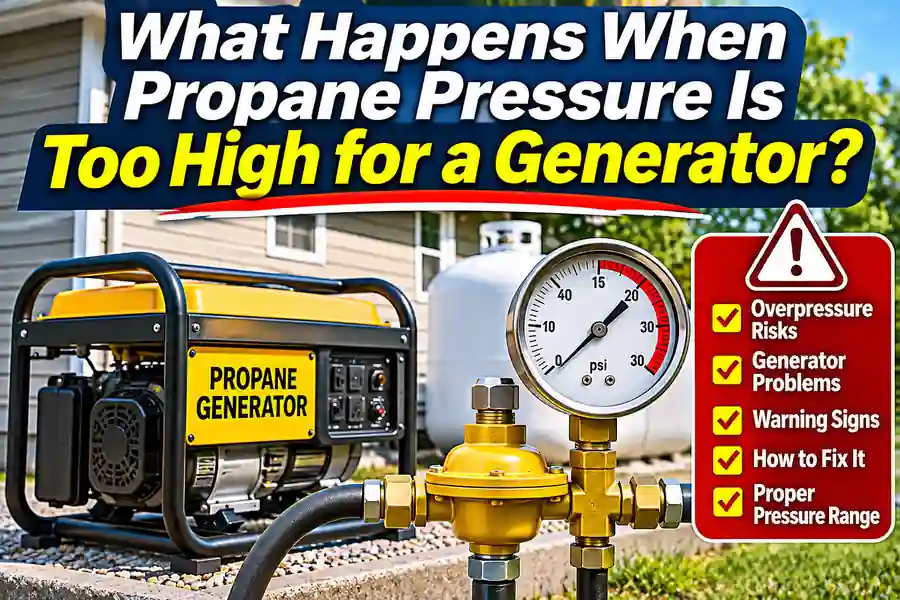
Yes. Propane pressure above a generator’s specified inlet range can cause unstable operation, overly rich fuel delivery, hard starting, stalling, safety shutdowns and, in severe cases, damage to fuel-system components. The exact consequences depend on the generator’s design and whether its valves and regulators prevent the excess pressure from reaching the engine.
I would not run a generator that I suspect is receiving excessive propane pressure. Stop using it, follow the manufacturer’s shutdown instructions and have a qualified propane technician check the supply and equipment. Do not try to solve the problem by turning a regulator adjustment screw without the proper specifications, instruments and authorization.
The safest approach is to match the complete propane system—not just the hose fitting—to the generator’s published fuel pressure, flow and regulator requirements.


Why propane pressure matters to a generator
A propane generator needs a controlled flow of gaseous fuel mixed with air in the correct proportion. Fuel-system components are designed around a particular pressure range. If the pressure is too low, the engine may starve for fuel under load. If it is too high, the fuel delivery system may admit more gas than intended or fail to regulate consistently.
Unlike a gasoline generator that draws liquid fuel through a carburetor or injection system, a propane generator often depends on one or more pressure-reduction stages between the tank and the engine. The tank itself contains propane under a pressure that varies greatly with temperature. That tank pressure is not normally the pressure the generator should receive.
I think of pressure as a controlled operating condition, not a performance upgrade. Increasing propane pressure does not safely increase a generator’s rated electrical output.
Tank pressure is not generator inlet pressure
Propane in a storage tank exists as liquid and vapor. Its equilibrium vapor pressure rises as the tank warms and falls as it cools. The pressure at the tank outlet can therefore be far higher than the low-pressure gas supply required by many appliances.


A regulator reduces the pressure to a controlled downstream level. Some installations use two-stage regulation, while others incorporate manufacturer-specific regulation at or near the generator. The exact architecture matters. A regulator supplied with a portable dual-fuel generator may perform a different function from the regulators installed on a home’s stationary propane system.
Never assume that a tank valve, hose, quick-connect or matching thread proves the pressure is correct. Mechanical compatibility is not the same as fuel-system compatibility.
What does ‘too high’ actually mean?
There is no single pressure threshold that applies to every propane generator. Many residential appliances operate on low-pressure propane expressed in inches of water column, but portable and standby generator models can have different inlet requirements and regulator arrangements.
I would look up the generator’s installation manual and identify the allowable inlet pressure range, the specified pressure measurement point, whether the rating applies while running, and any restrictions on the regulator or fuel type. If the manufacturer lists minimum and maximum pressures, both are important.
The difference between static pressure and operating pressure is particularly important. A line may show an acceptable pressure with all appliances off but drift or fluctuate when the generator and other appliances are operating.



Pressure units explained
Propane documentation may use psi, inches of water column (in. WC), kilopascals (kPa) or millibars. These are simply different units for measuring pressure. Confusing them can produce a serious installation error.
One psi is approximately 27.7 inches of water column. That means a reading expressed in psi is not interchangeable with the same number expressed in inches of water column. The generator’s own published specification takes priority over any generic example.
I would have a qualified technician measure pressure with an appropriate calibrated instrument at the test point specified by the manufacturer. Do not use a tire gauge or improvised fitting to check a low-pressure gas supply.
| Unit | Equivalent (approx.) | Typical use |
|---|---|---|
| 1 psi | 27.7 in. WC | Higher pressure ranges |
| 1 in. WC | 0.0361 psi | Low-pressure gas systems |
| 1 psi | 6.895 kPa | Metric specifications |
| 1 kPa | 10 mbar | Metric specifications |
Symptoms of excessive propane pressure
A generator supplied with too much propane pressure may be difficult to start, run roughly, surge, stall, emit an unusual exhaust odor or shut down under its protective controls. Depending on the engine and fuel-system design, excessive fuel delivery can produce a rich mixture and poor combustion.


However, none of these symptoms proves high propane pressure. Low pressure, a blocked air intake, ignition faults, stale gasoline in a dual-fuel generator, an overloaded electrical circuit or a defective fuel component can produce overlapping symptoms.
I would record when the symptom occurs: at startup, during idle, after connecting a load or when another propane appliance starts. That timeline helps a professional distinguish supply-pressure problems from engine or electrical problems.
| Observed symptom | Possible fuel-related explanation | Important caveat |
|---|---|---|
| Hard starting | Incorrect mixture or pressure | Ignition faults may also cause it |
| Surging | Unstable fuel delivery | Low pressure can look similar |
| Stalling | Fuel or protective shutdown | Overload can also cause stalling |
| Unusual exhaust | Combustion issue | Not proof of overpressure |
Can high pressure damage the regulator or fuel valve?
Yes, excessive pressure can exceed the design limits of downstream components. A regulator, solenoid valve, demand regulator or flexible connector may be damaged if subjected to pressure beyond its rated maximum. Some components have protective features, but those features are not a substitute for proper upstream regulation.
The precise failure mode depends on the hardware. I would avoid claiming that every high-pressure event automatically destroys a generator. Instead, I would treat any confirmed overpressure as a reason for inspection before the generator is restarted.
A qualified technician may need to assess the regulator, valves, hoses, seals and engine-side fuel controls and follow the manufacturer’s service procedure. Replacing a visibly damaged hose alone may not address the underlying pressure fault.
Why a generator may run rich when pressure is too high
The engine must receive the right amount of fuel for the air available. If excessive supply pressure causes the fuel-metering system to deliver more propane than intended, the mixture can become too rich. Rich operation can lead to unstable combustion, reduced efficiency, hard starting and increased emissions.
The response is not identical across models. Electronic fuel control, demand regulators, pressure sensors and shutdown logic can change how a generator reacts. Some systems may shut down before noticeable engine symptoms occur.
I would never try to ‘tune out’ an overpressure condition by changing air settings or restricting the fuel hose. The correct repair is to restore the specified fuel supply and repair any damaged components.
High pressure versus low pressure: how to tell the difference
High and low propane pressure can cause surprisingly similar symptoms. A generator that surges under load may be receiving too little gas because of an undersized pipe, a cold tank or a failing regulator. A generator that floods or runs rich may have excessive fuel delivery, but ignition or engine problems can look similar.
This is why I recommend measured diagnosis rather than guessing. The technician should compare pressure readings against the manufacturer’s requirements under the conditions that reproduce the complaint.
For cold-weather supply limitations, read how to calculate propane vaporization capacity for a generator and why a propane tank freezes while running a generator.
Common causes of excessive propane pressure
One cause is using the wrong regulator type or a regulator with the wrong outlet setting. Another is a malfunctioning regulator that no longer controls downstream pressure correctly. Incorrect plumbing, bypassed regulation, an incompatible portable-generator conversion or a misidentified high-pressure line can also create hazardous conditions.
A system modified by several contractors over time deserves particular attention. The tank regulator, house regulator, generator-specific regulator and appliance connections may not have been designed as one system.
I would ask the installer to identify every pressure-reduction stage and confirm the permitted inlet and outlet ranges of each component. The purpose is not to add regulators blindly; it is to verify that the system matches the equipment manufacturer’s intended configuration.
| Potential cause | What a technician verifies |
|---|---|
| Wrong regulator | Correct stage, rating and outlet range |
| Failed regulator | Lockup and operating pressure behavior |
| Unapproved hose or adapter | Manufacturer-approved fuel connection |
| Misidentified supply line | Actual pressure at approved test point |
| Altered piping | Pressure staging and component ratings |
What happens if you connect directly to a propane tank?
Connecting a generator designed for regulated vapor supply directly to unregulated tank pressure can be dangerous. Tank vapor pressure changes with temperature and can greatly exceed the allowable pressure of downstream generator components.
Some portable generators include a factory-specified hose and regulator assembly intended for a cylinder connection. That assembly is part of the approved fuel path. Removing it, substituting an unapproved hose or connecting to a different pressure system can defeat the intended regulation.
If you are planning to use a stationary propane tank, check the manufacturer’s approved connection method and have a qualified installer design the system. See whether a generator can share a propane tank with a furnace for shared-system planning.
What if the pressure is high only when the generator is off?
Pressure measured with no gas flowing is sometimes called static or lockup pressure. A regulator may behave differently under no-flow and flowing conditions. A professional must evaluate both conditions according to the regulator and generator specifications.
If the downstream pressure rises beyond the allowed range while appliances are off, the regulator or system may have a fault. I would not dismiss that reading simply because the generator appears to run normally once started.
The correct test method, allowable lockup behavior and test locations depend on the installed equipment. These are not checks I would recommend homeowners perform by loosening fittings or opening gas lines.
Can other appliances cause a pressure problem?
A generator sharing a tank with a furnace, water heater or range depends on a properly designed distribution system. When appliances cycle, pressure and flow conditions change throughout the piping network.
An undersized system more commonly creates a pressure drop under simultaneous demand, but an incorrectly configured regulator arrangement can also produce pressure-control problems. I would avoid blaming another appliance without measuring the system.
For shared-tank considerations, see can a propane generator share a tank with a furnace? and how far a propane tank can be from a generator.
How professionals diagnose suspected overpressure
A qualified technician begins by confirming the exact generator model and fuel specification. They then review the tank connection, regulator models, piping layout, appliance loads and any recent modifications.
Using approved test ports and calibrated instruments, they can compare actual static and operating pressures against the published limits. They may also check for regulator creep, incorrect pressure staging, insufficient flow, leaks and fuel-system component damage.
I would ask for the measured results and the manufacturer’s permitted range in writing. That creates a useful baseline for future service and avoids repeated adjustments based only on engine sound.
| Diagnostic step | Purpose |
|---|---|
| Confirm generator model | Find manufacturer fuel limits |
| Review regulator and piping layout | Identify pressure stages |
| Measure approved test points | Compare static and running conditions |
| Inspect for leaks or component damage | Assess safety |
| Document results | Establish service baseline |
What should you do immediately if pressure seems too high?
If the generator is behaving abnormally and you suspect a fuel-pressure issue, stop operation using the manufacturer’s instructions if it is safe to do so. Keep people away from the equipment and arrange professional service before restarting.
If you smell propane or hear a hiss, do not operate electrical switches, phones or ignition sources in the affected area. Leave the area immediately and call the propane supplier or emergency services from a safe location. Follow their instructions and do not re-enter until cleared.
Never vent propane intentionally, loosen a fitting to ‘bleed off’ pressure, bypass a regulator or apply heat to a cylinder or tank. These actions can create fire and explosion hazards.
Can adjusting the regulator fix it?
Sometimes an incorrectly set or failed regulator is the cause, but adjustment is not a safe do-it-yourself shortcut. Many regulators are factory-set or require specific service procedures. Some must be replaced rather than adjusted.
Changing the regulator without confirming its pressure range, capacity and compatibility can make the problem worse. A regulator sized for a small appliance may not support a standby generator, while a regulator intended for another stage of the system may deliver the wrong outlet pressure.
I would have a qualified propane professional identify the correct regulator and confirm both pressure and capacity under the generator’s required load.
Does higher propane pressure increase generator wattage?
No. A generator’s electrical output is limited by its engine, alternator, controls, cooling system and manufacturer rating. Supplying more propane pressure does not safely increase its designed wattage.
At best, excess pressure is wasted because the fuel system controls it. At worst, it causes poor combustion, shutdown or damage. If the generator struggles with the household load, the right response is to evaluate electrical load and fuel delivery separately.
For selecting an appropriate generator, see what size generator you need to run a house.
A practical installation example
Suppose a homeowner replaces a portable generator with a standby unit and assumes the existing propane connection will work because both use the same fuel. The older portable unit may have relied on a particular cylinder-mounted regulator, while the new standby model specifies a different regulated inlet arrangement.
The installer must verify the pressure available at the new generator, the permitted operating range, the regulator configuration and the total gas flow. The line may need to be resized or rerouted, and the system may need a dedicated branch.
I would never approve the change based only on connector size. A threaded fitting can physically connect two components even when their pressure requirements are incompatible.
Preventing high-pressure problems during installation
I recommend treating the generator fuel supply as a complete engineered system. Confirm the model’s fuel specifications before choosing the regulator, pipe and connection hardware. Keep manufacturer instructions available to everyone working on the installation.
The gas installer should verify component ratings, required shutoff and test arrangements, proper pressure regulation, pipe sizing and leak tightness. The generator should then be commissioned according to the manufacturer, including appropriate operational checks.
I would keep a simple record of the regulator models, test readings, service dates and any later modifications. This becomes especially valuable when a second appliance is added to the tank.
| Installation check | Why it matters |
|---|---|
| Generator inlet pressure range | Avoid overpressure and underpressure |
| Regulator type and capacity | Control pressure at required flow |
| Pipe size and developed length | Reduce excessive pressure loss |
| Approved connectors and shutoffs | Maintain component compatibility |
| Commissioning and leak testing | Verify safe operation |
Maintenance checks that reduce risk
A generator that ran correctly last year can develop fuel-system problems as components age or the installation changes. Regular service helps identify damaged hoses, corrosion, regulator problems and signs of leakage.
I would follow the generator manufacturer’s maintenance schedule and ask the propane supplier about periodic inspection of regulators and exposed piping. I would also have the system checked after major fuel-line work, a regulator replacement or an unexplained shutdown.
Do not use the absence of propane odor as proof that pressure is correct. Pressure and leak tightness are different checks, and neither can be established reliably by smell alone.
Frequently asked questions
Can too much propane pressure make a generator stall? Yes, excessive fuel delivery or a protective shutdown can cause stalling, although other faults can look similar.
Will high pressure always damage the engine? No. The outcome depends on the equipment and how long the condition persists, but overpressure requires professional assessment.
Can I measure propane pressure with a tire gauge? No. Use the approved measurement method and an instrument suited to the specified range.
Is tank pressure the same as inlet pressure? Usually not. Regulators reduce and control the pressure delivered to the generator.
Does a bigger propane tank create too much generator pressure? Tank size alone does not determine regulated outlet pressure. The regulator arrangement is critical.
Can a wrong regulator cause high pressure? Yes. Incorrect, damaged or improperly configured regulation can lead to unsafe downstream pressure.
Should I turn the regulator screw to lower pressure? No. Have a qualified technician diagnose and correct the issue.
Does higher pressure produce more electrical power? No. It can cause poor operation or damage instead.
What if I smell propane? Leave the area, avoid ignition sources and contact the supplier or emergency services from a safe location.
Should pressure be checked while running? The appropriate static and operating checks depend on the equipment specifications and should be performed by qualified personnel.
Final recommendation
If you suspect your generator is receiving excessive propane pressure, do not experiment with the regulator or fuel hose. Stop using the equipment and have the entire fuel path evaluated against the manufacturer’s requirements.
The most reliable propane generator is not the one with the highest fuel pressure. It is the one with a properly designed tank, regulators, piping and approved connection that deliver the correct fuel supply under real operating conditions.

Mike is an experienced propane technician with over 15 years of professional experience in the field. He has dedicated his career to helping customers with their propane needs, from installation to maintenance and repair. Together with Jeremy, he co-founded this website to provide useful information and guidance to customers seeking reliable propane services.