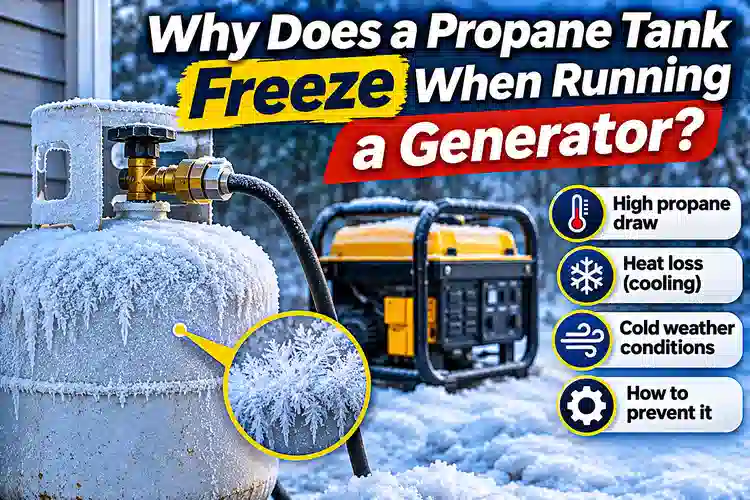
TL;DR: A propane tank can develop frost while running a generator because liquid propane absorbs heat as it changes into vapor. Heavy fuel demand, cold air and a low fill level make cooling more noticeable. Frost alone does not mean a leak, but surging or stalling can signal inadequate vapor supply. Reduce load and have the tank, regulator and fuel system sized correctly; never use improvised heaters.
Why propane tanks frost over during generator operation
I often hear people say their propane tank is freezing because the propane inside is turning into ice. That is usually not what is happening. In a normal vapor-withdrawal system, liquid propane evaporates inside the cylinder to replace the vapor being consumed by the generator. Evaporation requires energy, and that energy is drawn as heat from the remaining liquid, the cylinder wall and surrounding air. As the wall temperature falls below the dew point, moisture condenses; if it is cold enough, that moisture freezes into visible frost.
A thin frost band is therefore not automatically evidence of a leaking tank. It is a clue that the container is cooling as propane vaporizes. The important question is whether the tank and fuel-delivery equipment can continue supplying the generator at the pressure and flow it requires. If the engine runs steadily and the system is operating within its rated conditions, frost alone does not prove a failure.


If the generator surges, stalls, loses power or repeatedly shuts down under load, however, inadequate vapor supply is one possible explanation. I would not immediately blame the regulator or assume the cylinder is empty. I would compare the generator’s propane demand with the container’s vaporization capability at the current temperature and fill level.
The physics: vaporization absorbs heat
Propane is stored as a liquid under pressure. At ordinary outdoor temperatures, vapor occupies the space above the liquid. When a generator consumes vapor, more liquid must boil to restore equilibrium. That boiling absorbs latent heat and cools the liquid and container. The greater the withdrawal rate, the more heat must enter from the environment to sustain the process.
The propane cylinder is not a refrigerator with a compressor; its cooling is a natural consequence of phase change. This is why a cold or frosty band often follows the approximate liquid level. The wetted wall area helps conduct environmental heat into the liquid, and that available area generally declines as the cylinder empties.
The boiling point of pure propane at atmospheric pressure is about −44°F (−42°C), but that does not mean a cylinder will reliably supply any generator above that temperature. Vapor pressure, heat transfer, fuel composition, regulator performance and electrical demand all affect practical operation. A small cylinder can be unable to meet a high fuel demand at temperatures well above propane’s atmospheric boiling point.


When frost is normal and when it signals a problem
A modest patch of frost on the cylinder during heavy use may simply show that propane is evaporating rapidly. A generator running normally with a properly designed fuel system is different from a machine that begins hunting or stalls when you switch on a large appliance. Symptoms and context matter more than the appearance of frost alone.
Look for changes in generator sound, electrical output, controller warnings and whether the problem appears only when load increases. If you smell propane, hear hissing or see damaged fittings, treat that as a potential leak rather than a vaporization question. Shut off the supply if safe, avoid sparks and flames, leave the area and contact your propane supplier or emergency services.
I would not chip ice from valves, pour boiling water over a regulator or try to warm the tank with a flame. If a regulator or line is actually obstructed by moisture or ice, a qualified technician should identify the cause. Propane cylinders and fuel systems should be used only as their manufacturers specify.
| Observation | What it may mean | Action |
|---|---|---|
| Light frost, steady generator | Normal vaporization cooling | Monitor operation |
| Frost plus surging under load | Possible inadequate vapor supply | Reduce load and assess sizing |
| Propane odor or hissing | Potential leak | Shut off if safe, evacuate, call for help |
| Iced regulator with poor operation | Possible restriction or moisture | Qualified inspection |
How temperature changes the amount of vapor available
A cylinder exposed to 50°F air can absorb heat more readily than the same cylinder exposed to 0°F air, assuming other conditions are equal. At low temperatures, propane vapor pressure is lower and the temperature difference driving heat transfer may be smaller. Wind, precipitation, the cylinder’s surface condition and whether the cylinder is in direct sunlight can also affect heat exchange.
There is no single universal vaporization-capacity number for every 20-pound or 100-pound cylinder. Published charts vary with container dimensions, liquid level, ambient temperature and assumptions about continuous versus intermittent withdrawal. A chart intended for one cylinder design should not be treated as an exact rating for another.

For cold-weather backup planning, I recommend using the propane supplier’s sizing data for the minimum expected temperature and lowest planned fill level, not a summer runtime estimate. My winterization guide for propane generators covers the broader cold-weather checklist.
Why the generator’s electrical load matters
When you plug in more appliances, the generator engine must produce more mechanical power. It usually consumes more propane to do that. A lightly loaded generator may run from a cylinder that cannot support the same machine near full electrical output during a cold night.
Consider a hypothetical generator using 0.5 gallon per hour at modest load and 1.1 gallons per hour at higher load. The higher rate requires more than twice as much propane to evaporate per hour. The exact values vary by generator model, but the principle is important: vaporization demand tracks fuel consumption, not just the cylinder’s advertised capacity.
An air conditioner or well pump can add a brief electrical starting surge. That surge is not necessarily the same as a prolonged fuel-flow increase, but an already marginal fuel system may show problems when the engine must respond. For load planning, see running multiple appliances on a propane generator.


Propane consumption and heat input calculations
Propane contains approximately 91,500 BTU per US gallon. Multiply a generator’s gallons-per-hour consumption by that figure to estimate its fuel-energy input. A generator using 0.6 gallon per hour consumes about 54,900 BTU per hour of fuel energy; at 1.2 gallons per hour, about 109,800 BTU per hour. These are not the generator’s electrical output ratings and should not be confused with watts delivered to appliances.
If consumption is expressed in pounds per hour, one gallon of propane weighs approximately 4.24 pounds under typical conditions. A consumption rate of 4.24 pounds per hour is approximately one gallon per hour. These conversions are useful for discussing system capacity with a propane supplier.
A regulator must be rated to provide the necessary flow at the specified inlet and outlet conditions. Its advertised maximum BTU-per-hour capacity alone is not sufficient if the tank cannot vaporize enough propane or the hose arrangement causes excessive pressure drop. All three parts—tank, regulator and line—must be evaluated together.
| Consumption | Fuel-energy input | Propane mass per hour |
|---|---|---|
| 0.4 gal/hr | 36,600 BTU/hr | 1.70 lb/hr |
| 0.6 gal/hr | 54,900 BTU/hr | 2.54 lb/hr |
| 0.8 gal/hr | 73,200 BTU/hr | 3.39 lb/hr |
| 1.0 gal/hr | 91,500 BTU/hr | 4.24 lb/hr |
| 1.2 gal/hr | 109,800 BTU/hr | 5.09 lb/hr |
Does tank size make a difference?
Yes. Larger tanks generally offer more liquid storage and more surface area through which environmental heat can enter. They can often support greater continuous vapor withdrawal than small portable cylinders, although actual capacity must still be checked against manufacturer or supplier data. Two small cylinders in an approved simultaneous-withdrawal manifold may perform differently from one cylinder, but a reserve-only changeover arrangement does not automatically increase instantaneous vapor supply.
A typical 20-pound cylinder holds about 4.7 gallons of propane. A 100-pound cylinder holds roughly 23.5 gallons. Stationary tanks are commonly filled to about 80% of their nominal capacity, so a 250-gallon tank may contain approximately 200 gallons when filled to that level. These are storage quantities, not guaranteed withdrawal rates.
For a generator that must operate for days during winter outages, I would consider whether a professionally sized stationary tank is more appropriate than multiple portable cylinders. See the propane tank size chart for generators and connecting two propane tanks to one generator for related decisions.
| Container | Approximate usable propane | Important note |
|---|---|---|
| 20-lb cylinder | 4.7 gal | Limited cold-weather vaporization |
| 40-lb cylinder | 9.4 gal | More storage, verify withdrawal |
| 100-lb cylinder | 23.5 gal | Larger cylinder, handling constraints |
| 250-gal stationary tank | 200 gal at 80% | Professional sizing and installation |
| 500-gal stationary tank | 400 gal at 80% | Verify vaporization at minimum temperature |
Why a tank can frost even when it is not empty
Fuel quantity and vaporization capability are separate questions. A cylinder can still contain several pounds of liquid propane while its wall temperature falls enough to produce frost. As the liquid level declines, less wall area remains in contact with liquid, which can reduce heat transfer and available vapor withdrawal. The effect is especially noticeable during sustained heavy demand.
A frost line may roughly suggest where the liquid level sits, but it is not a calibrated fuel gauge. Surface moisture, sunlight, airflow and operating conditions can distort what you see. If you need an accurate inventory, use a suitable scale or a tank-level system approved for the container.
I would not rely on frost patterns to decide how much longer a generator will run. Use measured or known fuel quantity and the generator’s actual consumption. For practical estimates, consult how often to refill a propane generator.
Regulator icing versus cylinder frosting
A cylinder coated with frost is not necessarily experiencing the same problem as a regulator that is obstructed by ice. Regulators reduce pressure, and cooling can occur during pressure reduction. Moisture contamination can sometimes freeze and interfere with operation. The cause, severity and safe remedy depend on the system design.
If a regulator appears iced and the generator is malfunctioning, do not disassemble it, apply a torch or bypass it. Shut down according to the generator manual and have the propane supplier or a qualified technician check the fuel quality, regulator selection, orientation, vent protection and supply pressure.
Regulators should be installed in the orientation and location required by their manufacturers, protected from weather as specified and sized for the generator’s full propane demand. A generic regulator that fits the connection is not necessarily suitable. My propane generator leak-prevention guide explains warning signs that warrant immediate action.
Practical example: a 20-pound cylinder in winter
Suppose a portable generator consumes 0.8 gallon per hour while powering several household essentials. A full 20-pound cylinder contains approximately 4.7 gallons, giving a simple theoretical runtime of about 5.9 hours. That calculation says nothing about whether the cylinder can vaporize 0.8 gallon per hour at a particular outdoor temperature and fill level.
Now imagine the generator runs well early in the evening but begins surging after midnight as the cylinder empties and temperatures fall. Inadequate vaporization is a plausible explanation, but so are overload, equipment faults and fuel-delivery restrictions. I would reduce load safely, follow shutdown instructions and ask a qualified propane professional to assess the setup before repeating the same operating pattern.
If you need reliable overnight operation, a larger properly sized fuel supply may be better than simply bringing more small cylinders. The goal is not only enough gallons for the night but enough vapor flow during the coldest and lowest-fill conditions.
| Fuel use | 20-lb cylinder theoretical runtime | 100-lb cylinder theoretical runtime |
|---|---|---|
| 0.5 gal/hr | 9.4 hr | 47.0 hr |
| 0.8 gal/hr | 5.9 hr | 29.4 hr |
| 1.1 gal/hr | 4.3 hr | 21.4 hr |
| 1.5 gal/hr | 3.1 hr | 15.7 hr |
Safe ways to reduce freezing-related interruptions
First, reduce unnecessary electrical loads so the generator consumes less propane. Second, keep the cylinders upright and positioned exactly as the generator and cylinder manufacturers require, with proper outdoor clearances and protection from damage. Third, confirm that the hose and regulator are rated for the required propane flow and pressure.
For persistent cold-weather issues, ask your propane supplier to size a larger cylinder, approved manifold or stationary tank for the generator’s maximum demand and minimum expected temperature. A professionally engineered vaporizer may be appropriate in some industrial or high-demand installations, but it is not a do-it-yourself fix for a portable home generator.
Never heat a propane cylinder with an open flame, portable space heater, heating blanket not specifically approved for the application or other improvised device. Never enclose a running generator to keep it warm: carbon monoxide can accumulate rapidly. Follow the manufacturer’s outdoor placement instructions and keep exhaust away from doors, windows and vents.
Troubleshooting checklist
I start with the simplest observations: ambient temperature, cylinder fill level, electrical load, generator error messages and whether the problem happens only under heavy demand. These clues help distinguish normal frosting from a fuel-flow limitation. Do not open fittings or alter regulator adjustments as part of an informal test.
If the generator runs normally after reducing electrical load, that is useful evidence but not a definitive diagnosis. If it stalls regardless of load, other mechanical or fuel-system faults may be involved. A qualified technician can measure pressure and flow using approved procedures and determine whether the supply system meets the generator’s specifications.
Any propane odor, suspected leak, damaged valve or unusual hissing takes priority over performance troubleshooting. Move people away, avoid ignition sources and seek professional assistance.
| Symptom | Possible cause | Safer response |
|---|---|---|
| Frost with normal operation | Evaporation cooling | Observe, follow manual |
| Stalling in cold weather | Insufficient vapor or other fault | Reduce load; inspect sizing |
| Frost on regulator and no flow | Possible regulator restriction | Qualified propane service |
| Odor, hissing or damaged fittings | Possible propane leak | Stop, evacuate, seek help |
Frequently asked questions
Is frost on a propane tank dangerous? Frost by itself is not proof of a leak or emergency, but abnormal operation, damaged components or a propane odor require attention. Never ignore suspected leaks.
Can propane itself freeze in a tank? Under ordinary generator-use conditions, the visible frost is usually frozen moisture on the outside. Propane’s actual freezing point is far below normal outdoor temperatures.
Will a bigger propane tank stop frosting? It may improve continuous vapor supply, but even larger tanks can cool during withdrawal. The system still needs proper sizing.
Should I wrap the tank in a blanket? Do not use improvised insulation or heating arrangements. Insulation can reduce heat transfer from surrounding air and worsen vaporization under some conditions.
Why does the tank freeze more when the generator runs at full load? Higher fuel consumption requires faster liquid-to-vapor conversion, which draws more heat from the tank and surroundings.
Can I pour hot water on the tank? I do not recommend improvised warming. Use a correctly sized fuel supply and consult the propane supplier about safe approved solutions.
Why is the regulator icy? Pressure reduction and moisture-related freezing are possible causes. A malfunctioning regulator should be evaluated professionally.
Does connecting two tanks help? An approved simultaneous-withdrawal arrangement can increase available vaporization surface, but a changeover-only system may not. The components must be rated and approved for the generator.
Will the generator stop when the cylinder frosts? Not necessarily. It stops or malfunctions only if some operating requirement is no longer met, such as adequate fuel delivery or electrical capacity.
Is propane usable in freezing weather? Yes, when the container, regulator and fuel system are designed for the expected temperature and demand.
My bottom line
A frosty propane tank is often a sign of normal evaporation cooling, not frozen fuel. The risk is that a small or nearly empty cylinder may fail to deliver enough vapor during sustained generator operation, especially in cold weather. I would evaluate load, fuel consumption, temperature, tank size and regulator capacity together rather than chasing the frost itself. For reliable winter backup, correctly sized equipment and a safe outdoor setup matter much more than any quick warming trick.

Mike is an experienced propane technician with over 15 years of professional experience in the field. He has dedicated his career to helping customers with their propane needs, from installation to maintenance and repair. Together with Jeremy, he co-founded this website to provide useful information and guidance to customers seeking reliable propane services.