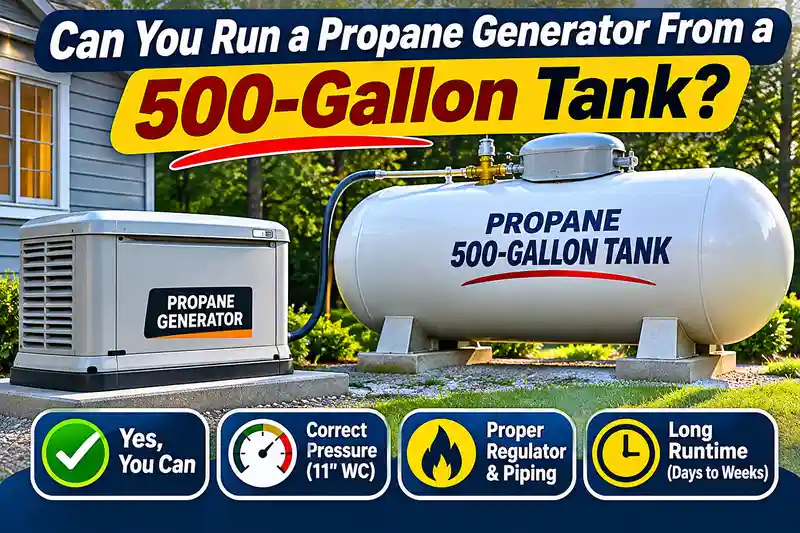
TL;DR: Yes, you can run many propane generators from a properly installed 500-gallon tank. A typical 80% fill gives about 400 gallons of propane, but successful operation depends on the generator’s fuel-input rating, tank vaporization in cold weather, regulators, piping, and other appliances sharing the tank. Have a qualified propane professional verify the complete system before connecting it.
Can a 500-gallon propane tank supply a generator?
Yes. A properly installed 500-gallon ASME stationary propane tank can supply many residential standby generators and, in some circumstances, a compatible portable generator. I would not treat the tank’s size as automatic proof of compatibility, though. The generator must be designed or manufacturer-approved for propane, and the entire fuel system must deliver the required vapor flow at the specified pressure.
The tank itself is a storage vessel. Between that tank and the generator are regulators, piping, shutoff valves and potentially other appliances. Those components determine whether the generator actually receives sufficient fuel. A 500-gallon tank connected to undersized piping can perform worse than a smaller but properly engineered system.


For a home backup installation, I would have the propane supplier and generator installer confirm the appliance’s maximum BTU-per-hour input, required inlet pressure, minimum outdoor temperature, piping distance and whether the tank already serves a furnace, water heater or range. Those details make the difference between a dependable system and a generator that starts but stalls under load.
How much propane does a 500-gallon tank actually hold?
A tank described as 500 gallons is rated by its nominal water capacity, not by the amount of liquid propane you should expect to receive. A common maximum filling practice for stationary propane tanks is approximately 80 percent of nominal capacity, allowing room for liquid expansion. That means about 400 gallons of propane at the 80 percent fill level. The exact permitted fill depends on temperature, container and applicable filling rules.
If the tank gauge shows 50 percent, that ordinarily represents roughly 250 gallons of liquid propane on a 500-gallon nominal tank, not 200 gallons. Gauges are approximate, and some tanks have different markings or calibration. I would use delivery tickets and supplier records rather than treat the float gauge as laboratory-grade measurement.
A generator’s usable fuel reserve is also smaller than the total gallons in the tank if you plan to keep a safety margin. During a long outage, I would avoid planning all the way to an empty tank, especially when other household appliances depend on the same supply.


| Tank gauge | Approx. gallons in tank | Gallons above 20% reserve |
|---|---|---|
| 80% | 400 | 300 |
| 70% | 350 | 250 |
| 60% | 300 | 200 |
| 50% | 250 | 150 |
| 30% | 150 | 50 |
| 20% | 100 | 0 |
How long will a generator run on a 500-gallon tank?
Runtime is determined by usable gallons divided by the generator’s average gallons-per-hour consumption. For example, if the tank contains 400 gallons and a generator averages 2.0 gallons per hour, the simple mathematical runtime is 200 hours, or about 8.3 days. That is an illustration, not a promise of continuous service.
Fuel consumption changes with electrical load, generator size, efficiency, ambient conditions and maintenance. Manufacturer specification sheets often provide propane consumption at several load percentages. Those figures are a much better basis for planning than the generator’s rated kilowatts alone.
For an emergency reserve, I would calculate both a full-tank scenario and a more conservative scenario that stops at 20 percent indicated tank level. Going from 80 percent to 20 percent on a 500-gallon tank represents approximately 300 gallons. That conservative budget protects fuel for cooking, heating or other needs and provides flexibility if deliveries are delayed.
Runtime table: illustrative consumption rates
The table below assumes a 500-gallon nominal tank with 400 gallons at an 80 percent fill and a second scenario with 300 gallons available between 80 percent and 20 percent indicated fill. These are mathematical estimates only. They do not verify that the tank can vaporize the required propane at the expected temperature, or that the generator can operate continuously for the calculated period.
To calculate your own runtime, find the generator’s propane consumption at the load you expect, then divide the gallons you intend to use by that consumption rate. If you plan to power only essential circuits rather than the entire home, the average consumption may be substantially different.

Do not use these figures to size the regulator or pipe. Fuel-system sizing must use the generator’s maximum required input and any other simultaneous loads, not the average consumption used for a runtime budget.
| Average propane use | Runtime with 400 gal | Runtime using 300 gal |
|---|---|---|
| 0.8 gal/hr | 500 hr (20.8 days) | 375 hr (15.6 days) |
| 1.2 gal/hr | 333 hr (13.9 days) | 250 hr (10.4 days) |
| 1.5 gal/hr | 267 hr (11.1 days) | 200 hr (8.3 days) |
| 2.0 gal/hr | 200 hr (8.3 days) | 150 hr (6.3 days) |
| 2.5 gal/hr | 160 hr (6.7 days) | 120 hr (5 days) |
| 3.0 gal/hr | 133 hr (5.6 days) | 100 hr (4.2 days) |
Will the tank supply enough propane vapor in winter?
A large stationary tank generally has more liquid-contact surface area than a portable cylinder, which can improve its ability to vaporize propane. But vaporization capacity falls as ambient temperature drops and as the tank’s liquid level declines. The coldest day of the year, not a mild autumn afternoon, is the important design case.
When a generator withdraws vapor, liquid propane inside the tank evaporates to replace it. That process draws heat from the tank and surroundings. A frost band on the tank can be normal, but insufficient vaporization can eventually lead to inadequate pressure and unstable operation. I explain the physics in why a propane tank freezes while running a generator.
A propane supplier can consult tank vaporization charts for the specific container and minimum temperature. If the same tank also serves a furnace, the supplier should account for the furnace and generator operating simultaneously during an outage. This is especially important because cold-weather generator demand often coincides with maximum heating demand.


The critical issue: generator fuel pressure
Most residential standby generators require propane vapor at a specified low inlet pressure, but the exact acceptable range varies by model. I would never assume that a regulator labeled for an outdoor grill or another appliance is suitable. The installation manual controls the required pressure range, connection size, regulator arrangement and permitted fuel type.
A stationary tank installation often uses staged pressure regulation, with a first-stage regulator near the tank and a second-stage regulator serving the building or generator. The correct arrangement depends on local codes, the piping design and the appliances connected. Inadequate pressure under full load can prevent starting, cause poor combustion or make the generator shut down.
Pressure testing and adjustment should be performed by qualified personnel using the procedures and instruments specified for the installation. I would not recommend bypassing regulators, connecting a generator directly to a tank valve or improvising adapters. Propane pressure at the tank is far higher than the inlet pressure many generators are designed to receive.
Can you connect a portable propane generator to the same tank?
Sometimes, but only when the generator manufacturer permits the connection and the supply system is engineered for it. Many portable dual-fuel generators are sold with a specific hose and regulator assembly intended for approved portable cylinders. Replacing that assembly with a direct connection to a stationary tank may violate the manufacturer’s instructions or deliver incorrect pressure.
Before making any change, I would confirm whether the generator expects tank pressure at its supplied regulator, an intermediate pressure, or already-regulated low-pressure vapor. The answer is model-specific. A fitting that physically connects does not prove the pressures or flow are compatible.
For a detailed discussion of the equipment and approval issues, see how to connect a portable generator to a propane line. Never run a portable generator inside a house, garage, shed or enclosed porch, even with doors open. Carbon monoxide can enter the home from outdoor locations as well, so follow the generator’s required clearances and exhaust-placement instructions.
Can a 500-gallon tank serve a generator and home heating?
Yes, a shared tank is common, provided the total fuel demand is within the tank’s vaporization capability and the regulators and piping are correctly sized. What matters is simultaneous demand. A generator rated for a high propane input and a large furnace may together require considerably more vapor than either appliance needs by itself.
I would ask the propane supplier to create a load schedule that includes the generator at its maximum fuel input and other appliances that could operate at the same time. Some loads are intermittent, but assuming they will never overlap can lead to undersizing. The installer can then assess regulator capacities, piping lengths, fittings and acceptable pressure drop.
The 500-gallon tank may contain enough gallons for several days while still being unable to provide adequate vapor flow during the coldest hours. Storage capacity and withdrawal capacity are different engineering questions, and both must be answered.
| Equipment | Example input | Combined demand |
|---|---|---|
| Generator | 180,000 BTU/hr | 180,000 BTU/hr |
| Furnace | 100,000 BTU/hr | 280,000 BTU/hr |
| Water heater | 40,000 BTU/hr | 320,000 BTU/hr |
| Range | 30,000 BTU/hr | 350,000 BTU/hr |
Pipe size, run length and pressure drop
The farther the generator is from the tank, the more attention the piping system needs. Pipe diameter, material, route, number of elbows, operating pressure and total BTU-per-hour demand all influence pressure drop. A long line that works for a small water heater may not be adequate for a high-output generator.
I would never size the gas line by looking only at the threaded connector on the generator. A nominal connector diameter is not the same thing as an approved pipe diameter for a given run. Qualified installers use the applicable fuel-gas code tables, manufacturer specifications and regulator data to determine the correct configuration.
The piping should be protected from physical damage, installed with approved materials, tested for leaks and inspected as required. Buried lines need suitable burial depth, corrosion protection and marking according to local requirements. Do not dig around an existing propane line without identifying its location first.
Installation and safety requirements
A 500-gallon tank is a permanent fuel-storage installation, and generator placement introduces additional requirements. Tank setbacks, generator clearances, property lines, openings, ignition sources and accessibility all matter. Requirements depend on the adopted fire and fuel-gas codes, local jurisdiction and equipment listing.
A licensed propane professional should evaluate the tank and piping; a qualified generator installer or electrician should handle the generator and electrical connection. The generator must connect to the home through an approved transfer mechanism that prevents backfeeding utility lines. For electrical options, see transfer switch versus interlock kit.
Never attempt to refill a stationary tank yourself, modify tank valves or bypass safety devices. If you smell propane or suspect a leak, leave the area, avoid ignition sources and contact the propane supplier or emergency services. If the generator is already running, follow emergency shutdown guidance only when it is safe to do so.
Above-ground versus underground 500-gallon tanks
Both above-ground and underground 500-gallon tanks can be used for a generator when the installation is designed correctly. Above-ground tanks are usually easier to inspect visually and may be less expensive to install, while underground tanks reduce visual impact but require suitable corrosion protection and excavation.
An underground tank’s surrounding soil can moderate temperature swings, but it is not a guarantee of unlimited vaporization. Soil conditions, fill level, demand and tank design still matter. For the full comparison, read underground versus above-ground propane tanks for generators.
I would choose the tank configuration based on the property, service access, local requirements, installed cost and long-term maintenance rather than assuming one is universally better for generator runtime.
What does the installation cost?
If you already own or lease a compliant 500-gallon tank, the incremental cost of supplying a generator may involve a new service line, regulator changes, trenching, permits, pressure testing and labor. If the tank is not already present, purchasing or leasing it and installing its foundation or underground system can add significantly to the project.
I would request a written quote separating tank cost or lease terms, propane delivery, piping, regulators, electrical work, transfer equipment, permits and commissioning. That makes it easier to compare proposals and understand who owns and maintains each component.
I would not publish a single universal installation price because regional labor, site conditions and supplier contracts vary substantially. For a broader cost framework, see whole-house generator installation cost with a propane tank.
A practical planning example for a home backup system
Imagine a homeowner has a 500-gallon above-ground tank that serves a propane furnace and a new standby generator. The tank is at 70 percent indicated fill, or roughly 350 gallons. The homeowner wants to preserve at least 20 percent indicated fill, leaving approximately 250 gallons for the outage budget.
If the generator averages 1.8 gallons per hour while operating, dividing 250 by 1.8 gives about 139 hours of generator-only runtime. That is roughly 5.8 days before accounting for the furnace, water heater, cooking or variations in generator load. If the furnace consumes additional fuel, the actual shared-tank duration will be shorter.
Now add a cold snap and a long pipe run. The tank may hold enough gallons but still need an engineering review to confirm adequate vapor supply and pressure at peak demand. This is why I recommend treating runtime, vaporization and pressure delivery as three separate checks.
How I would evaluate your existing 500-gallon tank
First, identify the exact generator model and obtain its installation manual and propane fuel-consumption table. Second, confirm whether the generator is approved for vapor propane and note its maximum BTU-per-hour input and inlet-pressure specification. Third, ask the supplier for the tank’s vaporization capability at the lowest expected temperature and minimum planned fill level.
Fourth, list every appliance sharing the tank and estimate the maximum simultaneous load. Fifth, have a qualified installer assess regulators, pipe size, run length, connection points and local permits. Finally, have the complete system commissioned and tested under appropriate load using the manufacturer’s procedure.
For a system already in service, I would keep records of propane deliveries, gauge readings and generator exercise results. This helps refine runtime estimates without confusing ordinary fuel use with a supply problem. For tank-size comparisons, see the generator propane tank size chart.
| Design check | What to confirm | Who should verify |
|---|---|---|
| Generator fuel specification | Propane approval, maximum input, inlet pressure | Generator installer |
| Tank vaporization | Minimum temperature and fill level | Propane supplier |
| Shared loads | Furnace and other simultaneous appliances | Propane supplier |
| Regulators and piping | Capacity, pressure drop, materials | Qualified gas installer |
| Electrical connection | Approved transfer equipment and grounding | Qualified electrician |
| Commissioning | Leak checks and loaded operation | Qualified installers |
Frequently asked questions
Is a 500-gallon tank big enough for a whole-house generator? Often yes for storage, but suitability depends on the generator’s fuel demand, winter vaporization and the shared household load.
Does a 500-gallon tank hold 500 gallons of propane? No. A typical fill near 80 percent represents approximately 400 gallons of liquid propane.
Can I run a generator directly from the tank valve? Do not bypass the required regulator system. The generator needs the pressure and connection arrangement specified by its manufacturer.
Can a generator share the tank with a furnace? Yes, when the complete system is sized for simultaneous demand.
Will the tank freeze in winter? Frost can form from vaporization cooling. Adequate vapor supply must be checked for cold-weather conditions.
Is underground installation better? Not automatically. Above-ground and underground installations have different cost, access and maintenance considerations.
Can a portable dual-fuel generator use a 500-gallon tank? Only when the manufacturer permits the arrangement and qualified personnel provide the correct pressure regulation and piping.
How many days will 400 gallons last? At an illustrative 2 gallons per hour, about 200 hours before accounting for other appliances and reserve fuel.
Should I use average or full-load consumption for sizing? Use appropriate maximum input for fuel-system sizing and realistic average consumption for runtime estimates.
Who should install the connection? A qualified propane professional and, where applicable, a licensed generator installer and electrician.
Final recommendation
A 500-gallon propane tank can be an excellent fuel source for a home standby generator, but I would never make the decision based on gallons alone. The tank needs to vaporize enough fuel in cold weather, and the regulator and piping system must deliver the generator’s specified inlet pressure under peak load.
If you already have a 500-gallon tank, ask your propane supplier to evaluate the entire system before adding a generator. If you are installing both from scratch, have the fuel and electrical designs coordinated early. That approach is more reliable than discovering after installation that the tank is full but the generator is starved for fuel.

Mike is an experienced propane technician with over 15 years of professional experience in the field. He has dedicated his career to helping customers with their propane needs, from installation to maintenance and repair. Together with Jeremy, he co-founded this website to provide useful information and guidance to customers seeking reliable propane services.