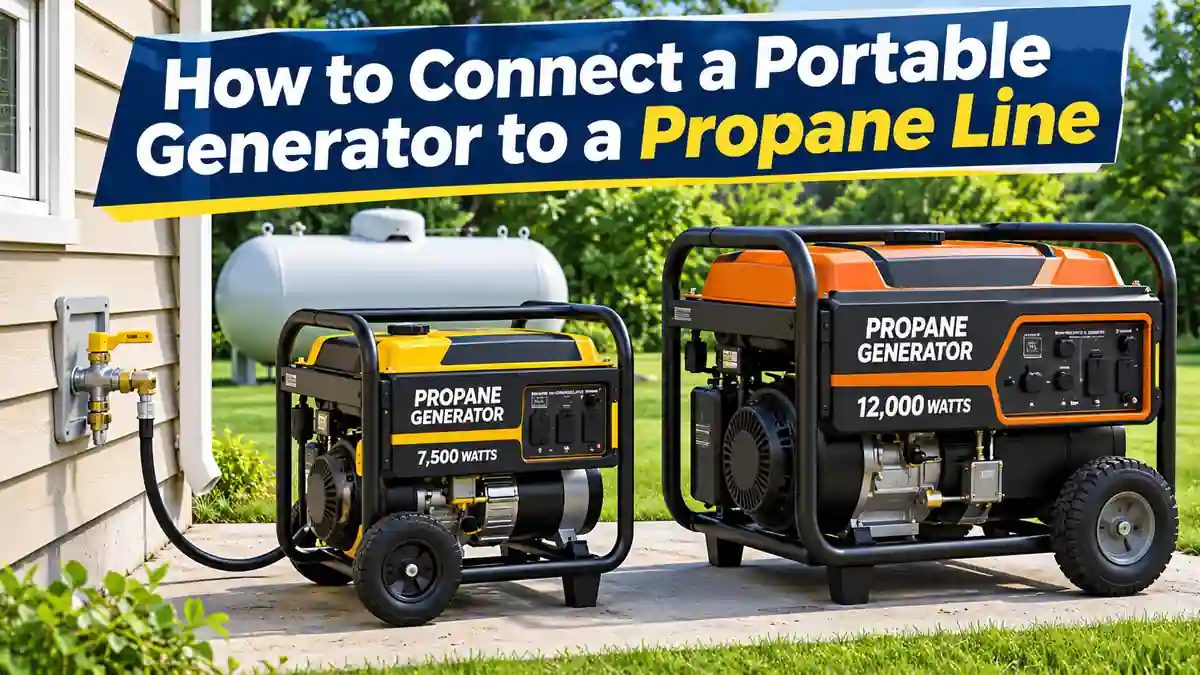
Yes, some portable generators can use an existing home propane supply—but only when the generator manufacturer permits that type of connection and a qualified propane professional confirms the correct pressure, flow capacity, piping, and approved outdoor connection. You cannot safely assume that a hose fitting on a 20-pound cylinder is interchangeable with a household propane outlet.
- Check the exact generator model and its approved fuel-supply arrangement before purchasing connectors.
- A residential propane regulator may be suitable, undersized, or incompatible; its presence alone proves nothing.
- Have a qualified gas professional design, install, and test permanent piping and the dedicated connection.
- Operate every portable generator outdoors, well away from doors, windows, vents, and occupied spaces; follow the manufacturer’s distance requirements.
- If you want to power household circuits, the electrical connection also requires approved transfer equipment and a qualified electrician.
Can You Connect a Portable Generator to Your Home Propane Line?
I would start with the generator manual, not the hardware store. A unit labeled “dual fuel” may be designed to draw propane vapor through its supplied cylinder hose and regulator. That does not necessarily mean it is approved to receive gas from a fixed low-pressure house branch. Some models offer a manufacturer-approved fixed-supply arrangement; others do not.


| Generator type | Can use a home propane line? | What to verify |
|---|---|---|
| Propane-only | Possibly | Exact inlet-pressure range and approved connection method |
| Dual-fuel (gasoline/propane) | Possibly | Propane-side specifications; whether fixed supply is expressly allowed |
| Tri-fuel | Possibly | Propane and natural-gas modes are different; follow the correct mode and fuel specification |
| Gasoline-only | Not without an explicitly approved conversion | Do not improvise a fuel-system conversion |
The word “propane” on both products is not enough. Cylinders, bulk tanks, first-stage and second-stage regulators, and engine-mounted demand regulators can be configured very differently. Even visually similar quick-connects may have different ratings, seals, or intended gases.
How Does a Portable Generator Connect to a Propane Line?
A professionally engineered system typically starts at a bulk tank, passes through the appropriate pressure-control equipment, and reaches a dedicated outdoor outlet through properly sized piping. The precise order and location of regulators depend on the actual design. The generator’s own fuel system must be compatible with the delivered pressure.
Bulk propane tank → approved pressure regulation → sized branch piping → accessible shutoff → approved outdoor connection → manufacturer-approved generator fuel assembly → generator


A first-stage regulator commonly reduces tank pressure to an intermediate distribution pressure. A second-stage regulator may reduce that pressure further for household appliances. A branch line carries vapor to the dedicated connection, while an accessible shutoff allows the supply to be isolated. The connector and hose must be approved for the actual fuel, pressure, outdoor exposure, and generator configuration.
Do not treat this sequence as instructions for adding a tee, relocating a regulator, or building a manifold. Those decisions require system-specific calculations, local code review, and professional testing.
What Do You Need to Connect a Portable Generator to a Propane Line?
| Component | Purpose | Important consideration |
|---|---|---|
| Propane-approved generator | Produces electrical power | Fixed supply must be allowed by the manufacturer |
| Correct pressure regulation | Controls fuel pressure | Never assume the house regulator matches generator requirements |
| Approved gas piping | Carries propane vapor | Professional sizing for distance and total demand |
| Gas-rated hose assembly | Connects portable equipment | Use only approved length, type, and fittings |
| Accessible shutoff valve | Isolates supply | Installed in an approved location |
| Approved outdoor connector | Provides a connection point | Gas, pressure, flow and connector design must match |
| Qualified installer | Evaluates and tests the system | Permits, pressure verification and leak testing |
I would ask the installer for a written description of which parts are permanent and which, if any, are user-connectable. That simple distinction helps prevent a future homeowner from mistakenly swapping an approved hose for a convenient but incompatible one.
How to Connect a Portable Generator to a Propane Line Safely
1. Confirm the generator’s propane approval
Find the model number and read the manufacturer’s fuel-supply instructions. Look specifically for permission to use a fixed residential propane source. If the manual discusses only a supplied cylinder regulator, ask the manufacturer rather than guessing.
2. Record the actual fuel specifications
Write down the specified inlet-pressure range, maximum propane consumption, required regulator arrangement, and permitted hose assembly. A wattage rating by itself cannot establish the correct gas connection.



3. Arrange a qualified propane-system evaluation
Have a licensed or otherwise locally qualified propane professional inspect the tank, existing regulators, available branch capacity, equipment location, and applicable codes. Ask whether other appliances could run simultaneously.
4. Check total system capacity
The installer should compare expected generator demand with furnace, water heater, range, dryer, and other connected loads. They must account for piping length, pressure drop, regulator ratings, and cold-weather vaporization capacity.
5. Obtain permits and have the outlet installed
Where required, obtain gas permits and inspections. A professional should select and install the dedicated outdoor outlet, approved piping, shutoff, and connection hardware. Homeowners should not cut, tap, or modify permanent gas piping.
6. Require testing and documentation
Before commissioning, the installer should perform the applicable pressure and leak tests and verify operating pressure under representative demand. Ask for the results and a clear explanation of the user-operated shutoff.


7. Use only the approved user connection
After professional commissioning, connect or disconnect only as the generator manual and installer expressly permit. Never replace a manufacturer-specified regulator with a generic adapter or remove a safety component to make fittings mate.
8. Place and start the generator safely
Keep the generator outdoors, away from openings and occupied spaces, with exhaust directed away. Follow manufacturer clearance and startup requirements. Install working carbon monoxide alarms inside the home.
9. Stop if anything seems abnormal
If the generator stalls, surges, smells of gas, or performs poorly under load, stop operation and have the equipment checked. Do not compensate by turning regulator screws or experimenting with fittings.
What Propane Pressure Does a Portable Generator Need?
Pressure is where many otherwise sensible plans fail. PSI means pounds per square inch; inches of water column (in. WC) is a much smaller pressure unit commonly used for appliance gas supplies. Approximately 27.7 inches WC equals 1 psi. A common nominal low-pressure propane appliance supply is 11 inches WC, or about 0.40 psi. That is not a universal portable-generator specification.
| Example | Approximate pressure | Interpretation |
|---|---|---|
| Nominal residential low-pressure propane | 11 in. WC ≈ 0.40 psi | Common appliance reference; not universal |
| Illustrative intermediate distribution | 10 psi ≈ 277 in. WC | Not appropriate to feed directly into a low-pressure inlet |
| Propane tank vapor pressure | Varies greatly with temperature | Requires properly designed pressure regulation |
| Generator inlet | Model-specific | Read the exact manual and approved fuel assembly |
Some generators rely on a particular hose-mounted regulator and demand-regulator system. Others specify a low-pressure source. A pressure that looks “close enough” on paper can still be outside the permitted range or incompatible with the fuel train. A professional must verify pressure during operation, not merely when all appliances are off.
Can You Use Your Existing Propane Tank Regulator?
Sometimes, but the right question is whether the complete system can safely supply the new demand at the required pressure. A regulator’s rated capacity, the length and size of downstream piping, and the number of operating appliances all matter. Simply installing a larger regulator can create new hazards if the rest of the system was not designed for it.
Illustrative combined-demand calculation
Suppose a hypothetical generator uses 1.2 gallons of propane per hour at a particular load. At 91,500 BTU per gallon, that is 109,800 BTU per hour of fuel input. Add a furnace rated at 80,000 BTU/h, a water heater at 40,000 BTU/h, and a range at 30,000 BTU/h. The combined nameplate-style planning total becomes 259,800 BTU/h. The technician then checks which loads may run together and whether the regulator, distribution system, and tank vaporization capacity can handle the design case.
This arithmetic does not establish an acceptable regulator size. Ratings, allowable pressure drop, supply temperature, and applicable sizing rules still need professional evaluation. For the practical tradeoffs of a fixed installation, compare our whole-house generator installation cost guide.
What Size Propane Line Do You Need for a Portable Generator?
There is no safe one-size-fits-all answer such as “use a half-inch line for every 7,500-watt generator.” A pipe-sizing calculation requires fuel input, material, internal diameter, total equivalent length, delivery pressure, allowable pressure loss, fittings, and simultaneous downstream demand. A long run with several elbows behaves differently from a short straight branch.
| Generator output rating | Illustrative fuel input at rated output* | Why line size cannot be inferred |
|---|---|---|
| 3,500 W | ~28,000–45,000 BTU/h | Engine efficiency and approved supply differ |
| 5,000 W | ~40,000–65,000 BTU/h | Actual fuel consumption varies by model |
| 7,500 W | ~60,000–100,000 BTU/h | Branch length and pressure drop matter |
| 9,500 W | ~75,000–125,000 BTU/h | Simultaneous appliances may dominate sizing |
| 12,000 W | ~95,000–160,000 BTU/h | Regulator and tank capacity also matter |
*These are broad hypothetical planning ranges, not verified specifications for particular models. They assume roughly 25–43% conversion of propane fuel energy into electrical output and are not a substitute for the manufacturer’s maximum fuel-input rating. The installer must use approved gas-piping tables or engineering calculations under the locally adopted code.
How Much Propane Does a Portable Generator Use?
For budgeting, the most reliable number is the manufacturer’s gallons-per-hour consumption at a stated electrical load. You can convert gallons per hour into thermal input using this simple equation: gallons per hour × 91,500 = BTU per hour. If the manual reports pounds per hour, use an appropriate propane mass-to-volume conversion instead of mixing units.
| Rated output | Example operating load | Estimated propane use* | Approx. fuel input | 24-hour fuel |
|---|---|---|---|---|
| 3,500 W | 1,750 W (50%) | 0.35–0.55 gal/h | 32,000–50,300 BTU/h | 8.4–13.2 gal |
| 5,000 W | 2,500 W (50%) | 0.45–0.75 gal/h | 41,200–68,600 BTU/h | 10.8–18 gal |
| 7,500 W | 3,750 W (50%) | 0.65–1.05 gal/h | 59,500–96,100 BTU/h | 15.6–25.2 gal |
| 9,500 W | 4,750 W (50%) | 0.8–1.3 gal/h | 73,200–119,000 BTU/h | 19.2–31.2 gal |
| 12,000 W | 6,000 W (50%) | 1.0–1.6 gal/h | 91,500–146,400 BTU/h | 24–38.4 gal |
*Illustrative consumption ranges, not tested model data. Actual engines may use substantially more or less depending on design, ambient conditions, and electrical load. Twenty-four-hour totals assume uninterrupted operation at the stated consumption. Use your manual’s figures for purchasing and installation decisions.
For example, a generator consuming 0.9 gal/h requires approximately 82,350 BTU/h of fuel input. Over ten hours, that is 9 gallons of propane. This is the number I would bring to an installer, together with the maximum consumption listed in the manual. For refill planning, see our propane generator refill and tank-runtime guide.
Can You Connect Multiple Propane Appliances to the Same Supply?
Yes, a properly designed propane system can supply several appliances, but adding a generator changes the demand calculation. A furnace, tankless water heater, clothes dryer, gas range, and pool heater may overlap during a power outage. The fact that each appliance works independently does not prove that the system can run all of them together.
| Hypothetical appliance | Input rating |
|---|---|
| Portable generator | 109,800 BTU/h |
| Furnace | 80,000 BTU/h |
| Water heater | 40,000 BTU/h |
| Range | 30,000 BTU/h |
| Dryer | 22,000 BTU/h |
| Total before diversity assessment | 281,800 BTU/h |
An installer will assess which loads must be accommodated, whether upstream regulators can sustain pressure, and whether the propane tank can vaporize fuel fast enough in winter. A larger tank does not automatically fix a narrow pipe or inadequate regulator. A small tank can also struggle to vaporize propane quickly in cold weather even when it contains plenty of liquid.
How Much Does It Cost to Connect a Portable Generator to a Home Propane Line?
A short, accessible outdoor branch can cost much less than a long buried run requiring trenching, new regulators, and inspections. The ranges below are illustrative US budgeting allowances—not contractor quotes, a national price survey, or promises that a job can be completed for these amounts.
| Budget item | Illustrative allowance (USD) | Notes |
|---|---|---|
| Site evaluation | $100–$350 | May be included in an installation quote |
| Short approved piping run | $250–$900 | Distance, material, access, and labor vary |
| Long or buried piping run | $900–$3,000+ | Excavation and restoration can dominate |
| Shutoff and approved connection hardware | $75–$350 | Depends on approved system |
| Regulator changes, if needed | $150–$650+ | Professional assessment required |
| Gas permit and inspection | $50–$300+ | Jurisdiction-specific |
| Electrical transfer equipment and installation | $500–$2,500+ | Separate electrical scope; varies widely |
These line items may overlap: a contractor’s piping quote may already include labor, valves, and fittings. Do not simply add every maximum together. Ask for an itemized quote showing the gas work, inspections, any tank or regulator modifications, and the separate electrical work. A portable generator is not a legal or safe substitute for an installed transfer switch merely because it has a propane supply.
Common Problems When Connecting a Generator to a Propane Line
| Symptom | Possible explanation | Safe next step |
|---|---|---|
| Will not start | Wrong fuel setting, incompatible supply, empty tank | Follow manufacturer checks; contact installer if supply is uncertain |
| Starts then stalls | Insufficient flow or pressure under load | Stop and request a professional operating-pressure check |
| Low pressure reported | Regulator, piping, or demand mismatch | Do not adjust regulators yourself |
| Insufficient gas flow | Undersized branch, restriction, cold-weather vaporization | Have system capacity evaluated |
| Struggles under load | Electrical overload or fuel-delivery issue | Reduce electrical load per manual; seek service |
| Regulator icing | Cooling, moisture, or supply limitations | Stop if performance is abnormal; contact propane professional |
| Propane odor | Potential leak | Leave area; contact supplier or emergency services from safety |
| Connector does not fit | Incompatible gas-rated components | Do not use improvised adapters |
| Incompatible fuel system | Generator not approved for fixed supply | Use only manufacturer-approved fuel arrangement |
I would not treat a generator that runs briefly as proof that a connection is correct. Fuel pressure can change dramatically when a furnace starts or when generator demand rises. If symptoms recur, discontinue operation until a qualified person diagnoses the complete system.
Portable Propane Tank vs. Home Propane Line: Which Is Better?
| Factor | Portable cylinder | Approved home propane connection |
|---|---|---|
| Upfront cost | Usually lower | Professional installation can be significant |
| Installation | Manufacturer-approved cylinder setup | Fixed piping and permits may be needed |
| Portability | Easy to relocate within safe-use rules | Tied to a specific approved outlet |
| Runtime | Limited by cylinder inventory and vaporization | Potentially longer with bulk tank |
| Refueling | Cylinder exchange or refill | Bulk deliveries to existing tank |
| Convenience | Cylinder changes required | Fewer changes once installed |
| Maintenance | Inspect cylinder and hose | Periodic professional system checks |
| Safety | Cylinder storage and handling rules | Piping integrity and correct pressure are critical |
A 20-pound cylinder holds roughly 4.7 gallons when properly filled; a 100-pound cylinder holds roughly 23.6 gallons. At 0.9 gal/h, the theoretical fuel-only runtimes are about 5.2 and 26.2 hours respectively, before accounting for usable residual fuel and vaporization limitations. Larger cylinders are not always suitable for every generator or location. If you are choosing equipment first, our budget propane generator comparison can help frame the purchase.
Safety Mistakes to Avoid
- Never attach a generator to an unapproved outlet simply because the threads seem to match.
- Never substitute ordinary compressed-air hose, plumbing hose, or improvised adapters for approved gas-rated components.
- Never bypass, remove, or alter a manufacturer-required regulator or fuel shutoff.
- Never convert a gasoline-only engine using an unauthorized kit or homemade parts.
- Never operate a portable generator in a garage, basement, shed, enclosed porch, or attached structure—even with a door open.
- Never place exhaust near windows, doors, soffit vents, air intakes, or occupied areas. Follow the manufacturer’s outdoor placement requirements and maintain working indoor CO alarms.
- Never ignore a propane odor, hissing, or signs of damaged fittings.
- Never backfeed household wiring through a dryer outlet or improvised cord. Use approved transfer equipment installed by a qualified electrician.
Carbon monoxide is odorless and can be fatal. A generator may also create an electrical hazard even when its propane fuel supply is correctly installed. For broader considerations, read about propane generator disadvantages and safety tradeoffs and powering a house during an outage.
Do You Need a Permit or Licensed Installer?
Requirements differ across US states, counties, municipalities, and utilities. The locally adopted fuel-gas code may reference NFPA 54 or another applicable code, with local amendments. Some areas require permits and inspection for a new outdoor propane branch; others have different procedures. Your propane supplier may also impose requirements before authorizing modifications to its equipment.
A qualified propane technician or appropriately licensed gas contractor should handle permanent piping, regulator changes, testing, and commissioning. A separate licensed electrician may be required for a transfer switch, inlet box, or panel work. Before scheduling, ask the local building department and propane supplier what approvals apply. Never assume that an RV hookup, grill outlet, or existing quick-connect is automatically suitable.
Propane Connection Readiness Checklist
- I have the generator’s exact model number and manufacturer manual.
- The manual explicitly permits the intended propane supply arrangement.
- I have the specified inlet pressure and maximum fuel-consumption figure.
- I know my tank size, current regulator arrangement, and other propane appliances.
- I have chosen an outdoor location that meets manufacturer clearance and exhaust requirements.
- I have contacted a qualified installer and asked about permits and testing.
- I understand that household electrical circuits require approved transfer equipment.
- I have a written plan for safe shutoff, inspection, and future maintenance.
If any of these boxes is unanswered, that is a reason to pause the purchase of hoses or connectors—not a reason to improvise. The best result is a connection that remains safe when other household appliances start, the weather turns cold, and the generator operates near its maximum intended load.
Frequently Asked Questions
Can I connect my portable generator directly to my 500-gallon propane tank?
Not directly to unregulated tank pressure. A qualified professional must verify an approved pressure-regulated supply and the generator’s compatibility.
Can I use my home’s existing propane regulator?
Possibly, if its pressure and capacity are appropriate for the complete system. The installer must verify rather than assume.
Do I need a separate regulator for my generator?
That depends on the manufacturer’s approved fuel train and the supply pressure. Never add or remove a regulator by guesswork.
Can I connect a dual-fuel generator to a residential propane line?
Only if the specific dual-fuel model is approved for that arrangement and the installed system meets its requirements.
Can I use a natural gas quick-connect fitting for propane?
Do not assume so. Fuel compatibility, pressure rating, seals, and flow capacity must all be verified.
How long can a portable generator run on a 250-gallon propane tank?
A nominal 250-gallon tank commonly holds about 200 gallons at an 80% fill. At 1 gal/h, the theoretical figure is 200 hours from that fill, but actual usable runtime is lower and depends on reserve and vaporization.
Can a 20-pound propane tank run a 9,500-watt generator?
Some compatible models can operate on an approved 20-pound cylinder, but high fuel demand and cold-weather vaporization may limit performance and runtime. Follow the manual.
What happens if propane pressure is too low?
The engine may fail to start, stall, or lose power under load. Stop and have the system checked rather than adjusting regulators.
Can I run my furnace and propane generator simultaneously?
Only if the supply, regulators, and piping can support the combined design demand while maintaining required pressure.
Do I need a plumber or propane technician?
Use a contractor licensed or qualified for propane gas piping under your local rules. Electrical transfer work is a separate specialty.
Can I use a 20-foot propane hose?
Only if that exact hose length and assembly are permitted by the generator manufacturer and suitable for the installed supply. Longer hoses can create pressure losses.
Is connecting to a home propane line cheaper than using portable cylinders?
It may reduce cylinder-handling inconvenience, but installation costs can outweigh savings for occasional use. Compare total installed cost and your expected hours of operation.
Conclusion: Get the Fuel Specifications Before the Installation Quote
Connecting a portable generator to a propane line can be convenient when a bulk tank is already on the property, but convenience does not make the connection interchangeable with a cylinder. The generator must be approved for the intended supply, the gas system must deliver the specified pressure and flow, and permanent piping changes must be evaluated and installed professionally.
My practical recommendation is to take the generator model number, fuel-input specifications, and a list of existing propane appliances to a qualified propane contractor before buying any fittings. Ask for an itemized proposal, applicable permits, and commissioning checks. That approach gives you a safer, more predictable setup—and avoids paying twice for incompatible parts.

Mike is an experienced propane technician with over 15 years of professional experience in the field. He has dedicated his career to helping customers with their propane needs, from installation to maintenance and repair. Together with Jeremy, he co-founded this website to provide useful information and guidance to customers seeking reliable propane services.