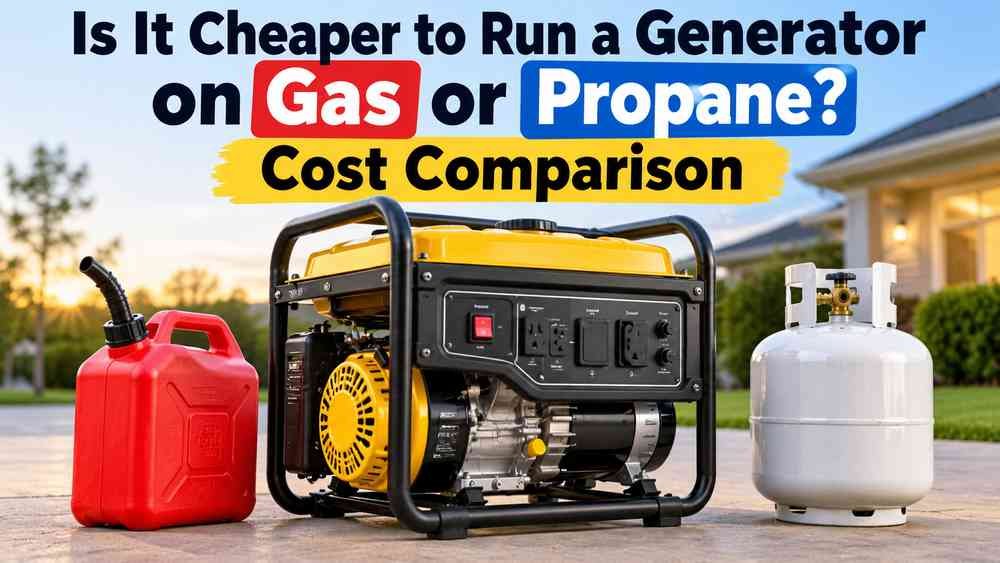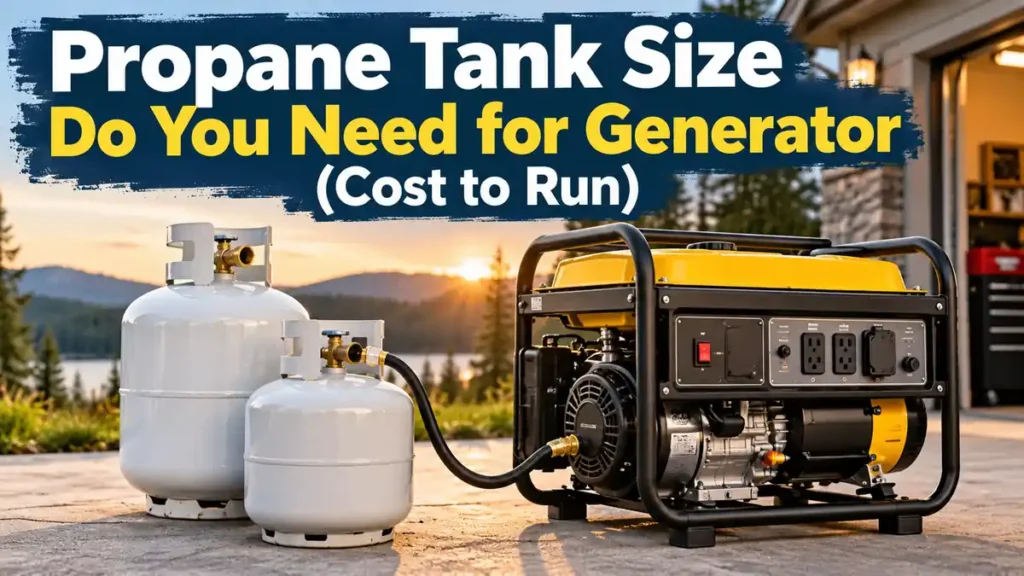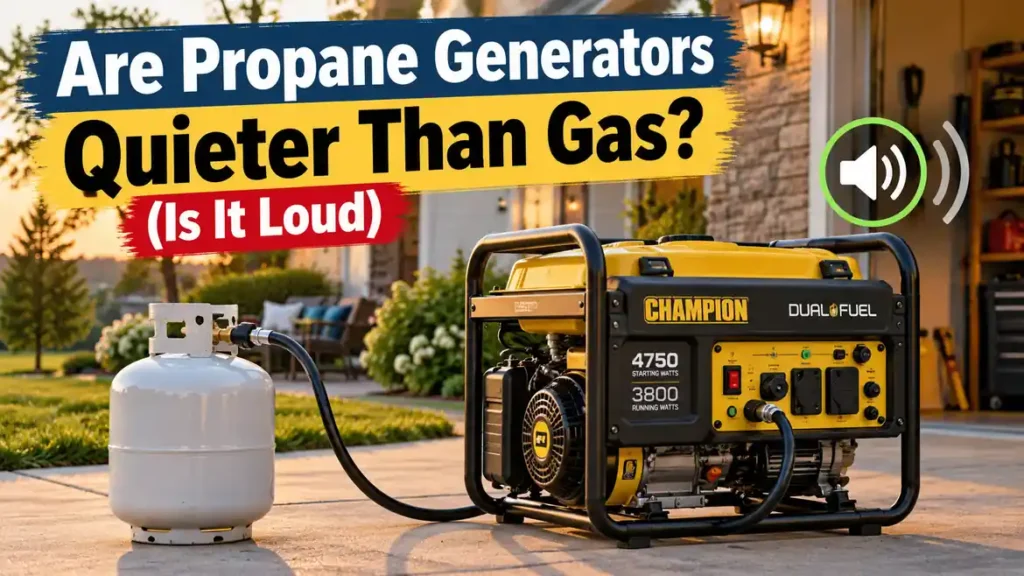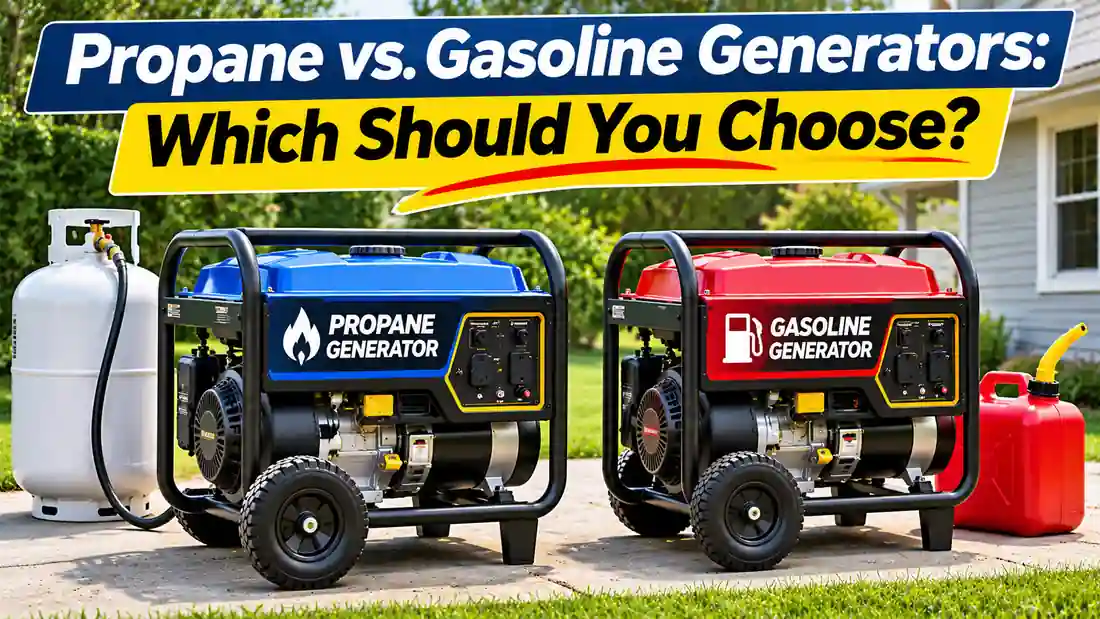
I would choose propane for long-term emergency readiness and a convenient bulk fuel supply, gasoline when portable high-output performance and readily available pump fuel matter most, and dual-fuel when flexibility justifies the price. Neither fuel is automatically cheaper. The real decision depends on load, fuel price, runtime, storage, maintenance and local availability.
When you compare propane vs. gasoline generators, it is tempting to ask which fuel is “better.” I think a more useful question is: which generator will actually be ready when you need it, produce enough power and have a safe fuel supply? I will walk you through the numbers and the ownership tradeoffs so you can choose with confidence.


Propane vs. Gasoline Generators: Quick Comparison
| Factor | Propane | Gasoline |
|---|---|---|
| Fuel delivery | Pressurized liquid stored in approved cylinders or tanks; engine consumes vapor | Liquid gasoline supplied from onboard tank |
| Output on same dual-fuel model | Often lower rated running and starting watts | Often higher rated running and starting watts |
| Fuel economy | Often more gallons per kWh; varies by engine and load | Often fewer gallons per kWh; varies by engine and load |
| Operating cost | Depends on delivered/refill/exchange price and actual consumption | Depends on pump price and actual consumption |
| Runtime | Expandable with properly sized cylinders or bulk supply | Limited by fuel tank and safe stored reserves |
| Long-term storage | Fuel itself remains stable; containers and valves need inspections | Fuel can deteriorate; stabilization and rotation matter |
| Fuel availability | Refill/exchange and bulk delivery networks | Gas stations; pumps may be down in outages |
| Maintenance | Engine maintenance plus propane regulator/hose inspections | Engine maintenance plus gasoline fuel-system upkeep |
| Starting | Adequate vapor supply, oil and battery are important | Fuel freshness, choke/injection, oil and battery are important |
| Freezing weather | Small cylinders may struggle to vaporize enough fuel | Cold-start issues with battery, oil and stale fuel |
| Emissions | Typically lower particulate/soot; still produces CO | Emissions vary with engine and controls; produces CO |
| Noise | No universal fuel-only advantage | No universal fuel-only advantage |
| Portability | Cylinder adds bulk; no liquid-fuel pouring | Integrated tank is convenient; spills possible |
| Storage hazards | Pressurized flammable gas; store cylinders properly outdoors | Flammable liquid and vapors; approved containers and ventilation |
| Best fit | Standby readiness, existing bulk tanks, infrequent use | Portable high-output tasks, readily available pump fuel |
The most important factors change with your use case. If you need to start a large motor, fuel-specific wattage may dominate. If you run a generator only a few times a year, fuel storage becomes a major issue. If a storm may interrupt deliveries, your stored reserve matters more than a small difference in hourly cost.
How Do Propane and Gasoline Generators Work?
Both designs turn chemical energy into shaft power with an internal combustion engine, then use an alternator to make electricity. A gasoline engine meters liquid fuel through a carburetor or fuel-injection system. A propane engine receives gaseous fuel through approved regulation and fuel-control components. A dual-fuel model is engineered to accept either fuel, but it does not necessarily deliver identical electrical output on both.
I would never choose a fuel based on its name alone. Start with the exact generator’s specification sheet: compare running watts, starting watts, fuel-specific runtime, operating temperature and approved supply equipment. Some products marketed as “gas generators” mean gasoline, while natural gas is an entirely different fuel with different requirements.
Which Generator Produces More Power: Propane or Gasoline?
On many dual-fuel portable generators, the gasoline rating is higher. Fuel mixture, engine calibration and combustion characteristics influence output. This matters most when a motor starts: a refrigerator, well pump or air conditioner may demand a short burst well above its normal running load. You must satisfy both the continuous and starting requirements.


| Illustrative gasoline running W | Illustrative propane running W (90%) | Possible impact |
|---|---|---|
| 3500 | 3150 | Small appliance reserve |
| 5000 | 4500 | Motor starting headroom |
| 7500 | 6750 | Multiple household loads |
| 9500 | 8550 | Air conditioner starting margin |
| 12000 | 10800 | Large load management |
Illustration only: the propane figures assume 90% of the gasoline running rating. This is a teaching scenario, not a tested or manufacturer-published derating rule. Real products differ, and starting watts must be checked separately. A 7,500-watt gasoline rating does not guarantee that the unit can supply a 7,500-watt load on propane.
For sizing multiple appliances, see my generator wattage guide. I recommend leaving practical headroom rather than planning to operate continuously at the advertised maximum.
Propane vs. Gasoline Generator Fuel Consumption
One US gallon of propane contains approximately 91,500 BTU of energy, compared with approximately 114,000–116,000 BTU for a gallon of conventional gasoline; blends vary. That does not mean the ratio of generator runtimes is fixed. Engine efficiency, throttle strategy, load, ambient conditions and alternator losses all matter.
For a transparent comparison, I will use a 5,000-running-watt-class generator and assume the following consumption rates. They are hypothetical values selected for calculation, not verified specifications for a particular generator. A real generator’s manual is the better source.
| Electrical load | Gasoline gal/hr | Propane gal/hr | Gasoline $3.50/gal | Propane $3.00/gal |
|---|---|---|---|---|
| 25% | 0.20 | 0.24 | $0.70/hr | $0.72/hr |
| 50% | 0.34 | 0.43 | $1.19/hr | $1.29/hr |
| 75% | 0.49 | 0.63 | $1.71/hr | $1.89/hr |
| 100% | 0.68 | 0.87 | $2.38/hr | $2.61/hr |
At a 50% load, our model produces 2.5 kWh per operating hour. Gasoline at $1.19/hour works out to approximately $0.48/kWh, while propane at $1.29/hour is approximately $0.52/kWh. That is a modest difference, not a universal verdict. At other local prices the result can reverse.



Which Is Cheaper to Run: Propane or Gasoline?
My first rule is to compare cost per useful kilowatt-hour, not simply dollars per gallon. The basic formula is hourly fuel cost = gallons per hour × dollars per gallon. At 50% load in the illustration, propane costs $1.29/hour and gasoline costs $1.19/hour. At $2.50 propane, however, the propane cost falls to $1.08/hour; at $4.00 propane, it rises to $1.72/hour. Gasoline at $3.00, $3.50 and $4.00 costs $1.02, $1.19 and $1.36 per hour respectively.
| Run time at illustrative 50% load | Gasoline: 0.34 gal/hr × $3.50 | Propane: 0.43 gal/hr × $3.00 |
|---|---|---|
| 8 hours | 2.7 gal / $9.52 | 3.4 gal / $10.32 |
| 24 hours | 8.2 gal / $28.56 | 10.3 gal / $30.96 |
| 72 hours | 24.5 gal / $85.68 | 31.0 gal / $92.88 |
| 168 hours | 57.1 gal / $199.92 | 72.2 gal / $216.72 |
These totals assume the generator operates at exactly the same 50% electrical load without interruptions. Actual loads cycle and fuel consumption is nonlinear. A cylinder exchange may cost substantially more per gallon than a refill; delivered bulk propane has a different pricing structure again. I would check your supplier’s effective delivered price, including minimum orders and fees, before buying a large tank solely for generator economics.
For a deeper breakdown of fuel-price economics, see my comparison of generator efficiency. This article instead concentrates on which ownership arrangement is practical.
Propane vs. Gasoline Generator Runtime
Runtime is a fuel-quantity question and a fuel-delivery question. A larger tank stores more propane, but it must also vaporize fuel fast enough at the expected temperature. The simple calculation is usable gallons ÷ gallons per hour = theoretical running hours.


Here I assume the illustrative 50% load rates of 0.43 gal/hour propane and 0.34 gal/hour gasoline. For stationary tanks I use an approximate 80% fill, and for propane cylinders approximate nominal propane capacities. Actual usable fuel, minimum operating level, reserve needs and vapor-withdrawal capability can reduce the available runtime.
| Fuel supply | Assumed usable gallons | Estimated hours at 50% load |
|---|---|---|
| 20-lb cylinder | 4.7 | 10.9 |
| 40-lb cylinder | 9.4 | 21.9 |
| 100-lb cylinder | 23.6 | 54.9 |
| 120-gal stationary tank | 96 | 223.3 |
| 250-gal stationary tank | 200 | 465.1 |
| 5 gal gasoline | 5 | 14.7 |
| 10 gal gasoline | 10 | 29.4 |
A 20-pound cylinder at roughly 4.7 gallons provides about 10.9 theoretical hours in this model. A 100-pound cylinder provides about 54.9 hours. A 250-gallon stationary tank at an 80% fill gives a theoretical 465 hours, but that does not establish that the tank can sustain the required vapor flow or that the engine may run unattended for that long.
I treat fuel supply and maintenance intervals separately: refueling and checking engine oil, manufacturer shutdown instructions, weather exposure and safe operation still apply. For more detailed cylinder calculations, consult my propane generator tank-size chart and refill frequency guide.
Which Fuel Is Better for Long-Term Storage?
This is where propane often becomes attractive for an emergency generator. Properly stored propane fuel does not suffer the same oxidation and gum-forming problems as gasoline. A sound cylinder or tank still needs proper inspection, maintenance and safe storage; “fuel lasts indefinitely” does not mean equipment can be neglected.
Gasoline ages. Heat, air exposure and fuel formulation affect its stability. Stale gasoline can create starting trouble and deposits, particularly in carbureted equipment. Stabilizer may help when used according to instructions, but it does not restore badly degraded fuel. Rotate stored gasoline, use approved containers, and follow local fire-safety requirements. Do not keep gasoline or propane cylinders in living spaces or use unsafe indoor storage arrangements.
If I were buying a generator that might sit unused for months, I would give propane extra weight. If I ran it regularly and could rotate gasoline reliably, the storage disadvantage would be less significant.
Which Generator Requires Less Maintenance?
Propane avoids some gasoline-related deposits, but both generator types have engines with oil, air filters, spark plugs and service intervals. Propane fuel components introduce their own inspection needs. A clean fuel system is not a substitute for routine service.
| Task | Propane | Gasoline |
|---|---|---|
| Oil, air filter, spark plug | Follow manual intervals | Follow manual intervals |
| Fuel system | Inspect approved hose, connections, regulators | Maintain tank, carburetor/injector and fuel lines |
| Storage | Inspect cylinder dates, valves, outdoor storage | Rotate gasoline; use stabilizer as instructed |
| Battery/electric start | Maintain charge | Maintain charge |
| Exercise | Follow manufacturer schedule | Follow manufacturer schedule |
| After extended storage | Check leaks and supply compatibility | Check fuel freshness and deposits |
When comparing total ownership cost, include the time spent rotating fuel, buying stabilizer, arranging propane refills, checking hoses and maintaining batteries. For the engine service schedule, see my propane generator maintenance checklist. Follow your specific owner’s manual if its intervals differ from general advice.
Which Generator Starts More Reliably in Cold Weather?
There is no blanket winner. Propane must vaporize in the tank or cylinder before it can feed most portable vapor-withdrawal generators. As temperatures fall, available vapor pressure and vaporization capacity fall. A small cylinder can struggle under a high load even when it contains liquid propane. A qualified supplier can assess tank size and minimum-temperature demand; never improvise heating a cylinder.
Gasoline generators have their own cold-weather problems: weak starting batteries, incorrect oil viscosity, stale fuel and carburetion issues. I would compare cold-start ratings, approved winter oil and the manufacturer’s fuel-system guidance for the exact model. Normal external frost is not proof of a defective propane regulator, but abnormal icing or fuel-flow trouble warrants inspection. My winterization guide covers preparation.
Are Propane Generators Cleaner Than Gasoline Generators?
Propane generally burns with less soot and particulate formation than gasoline in comparable applications, although real emissions depend on engine design, load and controls. Carbon dioxide emissions should be compared per useful kilowatt-hour, not merely per gallon, because the fuels have different energy content and engines differ in efficiency. Both can emit nitrogen oxides and other pollutants.
Do not confuse propane’s cleaner-burning reputation with permission to operate a generator indoors. For placement hazards, read where propane generators can and cannot operate.
Are Propane Generators Quieter Than Gasoline Generators?
Fuel alone is not a dependable noise specification. A large open-frame generator can be loud on either fuel; a properly enclosed inverter model can be much quieter. Compare manufacturer sound measurements at the same distance and electrical load. An idle or eco-mode reading should not be compared with a competitor’s full-load figure.
If you are buying for a neighborhood or campground, prioritize enclosure design, inverter operation, load level and local quiet hours. A small change in fuel may matter less than choosing a different generator class.
Which Is Better for Home Backup Power?
For a short outage, a gasoline generator can be convenient if you have fresh fuel and a safely stored reserve. For extended outages, propane can be appealing when an appropriately sized bulk tank and dependable supplier are already available. Gas stations and propane delivery services can both be disrupted during severe weather, so fuel logistics deserve as much attention as engine specifications.
Refrigerators and freezers usually need modest continuous power but can require startup surges. Well pumps and air conditioners may have significant motor-start demands. Whole-house coverage requires an appropriately sized generator, proper fuel capacity and electrical design; a small portable unit should not be marketed as a whole-house solution just because it has a high peak-watt label.
Never backfeed household wiring through an outlet or improvised cord. Use approved transfer equipment installed by a qualified electrician. For load planning, see how portable propane generators can support a home during an outage.
Which Is Better for RVs, Camping, and Boondocking?
If your RV already carries propane for cooking and heating, a propane-capable generator may simplify fuel planning. But every appliance draws from the same reserve, so running the generator can shorten the supply available for the furnace or water heater. Gasoline may be easier to replenish on the road, while an integrated gasoline tank can simplify moving a small portable unit.
Check campground generator hours, sound limits, ventilation and fire rules. A portable generator must remain outside and away from occupied spaces. Size the unit for the RV air conditioner’s starting load rather than just its running wattage. My RV propane generator sizing guide offers a separate appliance-focused approach.
Which Is Better for Construction Sites and Outdoor Work?
On a job site, I would look first at starting watts, tool duty cycles, fuel access and safe refueling. Gasoline units can be convenient for mobile crews, especially when higher gasoline-mode output makes the difference between starting a compressor and tripping the overload. Propane may be practical where cylinders are routinely delivered and stored under site rules.
Never refuel a hot gasoline engine. Protect both fuel types from vehicle traffic and damage, keep generators away from workers and air intakes, and follow electrical grounding and job-site requirements. Compare the actual cost of moving and replacing fuel containers, not just pump prices.
Should You Buy a Dual-Fuel Generator Instead?
For many households, dual-fuel is the most balanced purchase. You can keep propane for long-term readiness and use gasoline when available or when the additional rated watts are needed. However, two fuels do not eliminate maintenance. The gasoline system still requires attention, and switching fuels must follow the manufacturer’s exact procedure.
Check whether the generator can switch fuels while running, whether the included propane hose is compatible with your cylinders, and whether its propane wattage supports your loads. Never assume a cylinder hose can connect to a home’s fixed propane line without manufacturer approval and professional assessment.
Propane vs. Gasoline Generator Purchase Price
Purchase prices depend heavily on output, inverter versus open-frame design, brand, electric start, enclosure and emissions compliance. For planning only, I might use rough illustrative US budgets of $300–$700 for a small portable class, $600–$1,400 for a mid-size class and $1,000–$2,500 or more for larger units. These are not verified current retail listings and are not intended as quotes.
Dual-fuel capability can carry a premium, but sometimes competing models have similar prices. Compare warranty, local service, fuel accessories, transfer equipment, propane supply setup and expected ownership years. The cheapest generator at checkout may not be the most economical one to keep ready.
Which Generator Should You Choose? My Decision Guide
I use the following decision matrix as a starting point, then check the exact generator’s output, your local fuel price and your emergency plan. None of these recommendations overrides the manufacturer’s ratings.
| Situation | My starting recommendation | Reason / qualification |
|---|---|---|
| Occasional emergency backup | Propane or dual-fuel | Stable fuel storage |
| Frequent short outages | Dual-fuel | Flexible sourcing |
| Multi-day outage | Propane with adequate bulk supply | Fuel logistics; confirm vaporization |
| RV camping | Propane if already carried | Fuel integration; check campground rules |
| Off-grid cabin | Propane with planned delivery | Long storage and large-tank option |
| Construction site | Gasoline or dual-fuel | Portability and peak wattage |
| Very cold weather | Model-specific decision | Cylinder vaporization and cold starting |
| Home with bulk propane tank | Propane | Potential convenient shared supply if professionally sized |
| Lowest purchase budget | Compare gasoline models | May have lower entry cost |
| Maximum flexibility | Dual-fuel | Two approved fuel options |
For a household with an existing bulk tank, I would investigate propane first—but I would still have a qualified professional verify the fuel system and reserve capacity. For a mobile contractor with regular access to gasoline, I would give gasoline-mode output more weight. For someone who values choice during an emergency, dual-fuel deserves a serious look.
My 72-Hour Power Outage Comparison: Propane vs. Gasoline
Here is a practical planning exercise, not a claim about a particular product. Assume a dual-fuel portable generator supplies an average 2.5 kW of essential household load for 72 continuous hours. That is 180 kWh of electricity. Use our illustrative consumption rates at 50% load: 0.34 gal/hr gasoline and 0.43 gal/hr propane. Assume gasoline costs $3.50/gal and propane costs $3.00/gal.
| Metric | Gasoline | Propane |
|---|---|---|
| Total fuel | 24.48 gallons | 30.96 gallons |
| Estimated fuel cost | $85.68 | $92.88 |
| Fuel logistics | About five 5-gallon cans, plus reserve | About seven full 20-lb cylinders, or a properly sized larger supply |
| Cost per generated kWh | $0.48 | $0.52 |
| Important complication | Fresh fuel, safe outdoor storage and engine shutdown for refueling | Cylinder swaps, adequate vaporization, approved hoses and engine shutdowns |
The arithmetic is simple: 72 × 0.34 = 24.48 gallons gasoline; 72 × 0.43 = 30.96 gallons propane. At 4.7 gallons per nominal 20-pound cylinder, 30.96 ÷ 4.7 = 6.59 cylinders, so seven full cylinders is the theoretical minimum without an extra reserve. A stationary tank could make the propane option substantially easier, subject to sizing and withdrawal capacity.
In this specific scenario, gasoline is $7.20 cheaper across three days, but that narrow difference may not justify storing nearly 25 gallons of gasoline for an occasional emergency. Conversely, swapping seven cylinders is cumbersome if you lack a bulk tank. My recommendation: choose the fuel arrangement you can safely maintain and replenish, then compare the cost. Never assume uninterrupted 72-hour operation is permitted by the generator’s service instructions.
Frequently Asked Questions
Is it cheaper to run a generator on propane or gasoline?
Neither is universally cheaper. Compare measured gallons per hour at your intended load and the actual price you pay for each fuel.
Does a propane generator use more fuel than gasoline?
It often consumes more gallons for the same electrical output, but the difference depends on the engine and operating load.
Why do generators produce fewer watts on propane?
Fuel-specific engine calibration and combustion characteristics can reduce the available rated output; consult both fuel ratings.
How long will a 20-pound propane tank run a generator?
At an illustrative 0.43 gal/hr and 4.7 usable gallons, about 10.9 hours; actual runtime can be much shorter or longer.
Can a propane generator run continuously for 24 hours?
Only if its manufacturer permits the operating schedule and its fuel supply, oil checks and safe setup support it. Fuel capacity alone is insufficient.
Are propane generators better for emergency backup?
They can be especially convenient when stored for long periods or connected to an approved bulk supply, but gasoline may be easier to source in some areas.
Does propane go bad when stored?
The fuel itself is stable in properly maintained equipment; cylinders, valves and tanks still require inspection and safe storage.
Can propane generators operate in freezing temperatures?
Yes, within model specifications, provided the cylinder or tank can deliver adequate vapor at the minimum expected temperature.
Are propane generators safer than gasoline generators?
Both present serious fire, fuel-handling and carbon monoxide hazards. The safer option is the one properly installed, stored and operated.
Do propane generators last longer than gasoline generators?
Not necessarily. Engine design, maintenance, loading and storage practices matter more than a universal fuel-based lifespan claim.
Is a dual-fuel generator worth buying?
Often yes if you value two fuel sources and understand the different power ratings and maintenance needs.
Which fuel is better for a whole-house generator?
For permanent standby use, propane can be practical with a professionally designed bulk supply. Generator size, local infrastructure and service access determine the right choice.
Final Verdict: Propane or Gasoline Generator?
For most occasional home-backup buyers, I lean toward propane or dual-fuel because stable stored fuel makes emergency readiness easier. For high-output mobile use, gasoline may be more convenient and can deliver more watts from the same dual-fuel generator. If you already have a properly sized bulk propane tank, that is a compelling practical advantage—but not a substitute for professional fuel-system verification.
Before buying, check five things: the fuel-specific running and starting watts, real-world consumption at your expected load, safe usable fuel reserve, the maintenance schedule and your plan for safe outdoor operation and electrical transfer. Those answers matter more than a universal fuel winner.
Featured image recommendation: a side-by-side outdoor view of a propane-cylinder-powered portable generator and a gasoline-powered portable generator. Suggested alt text: “Propane vs. Gasoline Generators: Which Should You Choose?”

Mike is an experienced propane technician with over 15 years of professional experience in the field. He has dedicated his career to helping customers with their propane needs, from installation to maintenance and repair. Together with Jeremy, he co-founded this website to provide useful information and guidance to customers seeking reliable propane services.