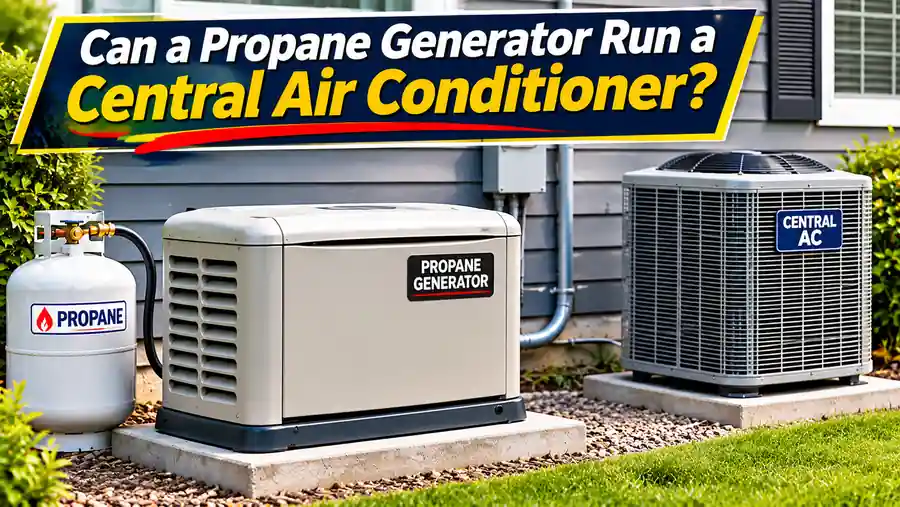
TL;DR: A propane generator can power central AC when its propane-rated continuous output and motor-start capability meet the condenser, indoor blower and other household loads. Check actual equipment data; AC tonnage alone does not determine generator size.
Can a propane generator actually start central AC?
Yes, but a central air conditioner is one of the more demanding household loads to start on backup power. A compressor motor can draw a brief surge that is several times its normal running current. The generator must handle that event without an unacceptable voltage or frequency drop, while also supplying the indoor blower and other loads already operating.
I would never select a generator by the air conditioner’s tonnage alone. A three-ton unit is not guaranteed to require the same electrical input as another three-ton unit. Efficiency rating, compressor technology, supply voltage, installation condition and starting method all affect demand. The most useful information is on the condenser nameplate and in the equipment manufacturer’s electrical data.


The practical answer is therefore conditional: a correctly sized propane generator with appropriate transfer equipment may run central AC, but the same generator can struggle with a different condenser or an added water heater, range or well pump. Use the propane-rated generator output, not the gasoline output printed in large type on the box.
Understand running watts, starting watts and power factor
Running watts are the real electrical power a machine consumes after starting. Starting watts describe the brief extra demand associated with energizing certain motors. Compressor inrush is usually discussed in amps, and converting it to watts by multiplying voltage and current yields volt-amperes, not necessarily true watts. The distinction matters because generators must supply both real power and apparent power while controlling voltage.
For a single-phase 240-volt compressor, 20 running amps correspond to 4,800 volt-amperes. Actual running watts depend on power factor. A 60-amp starting event corresponds to 14,400 volt-amperes, but that does not automatically mean the generator needs a 14.4-kW continuous rating. Starting duration, alternator response, compressor behavior and any soft starter influence whether the generator can tolerate it.
I recommend comparing the generator manufacturer’s motor-start capability with the HVAC equipment’s actual starting characteristics. A marketing label such as “10,000 starting watts” does not describe every motor-start scenario, especially when several appliances are already operating.


Read the AC nameplate before buying a generator
The outdoor condenser nameplate may show minimum circuit ampacity (MCA), maximum overcurrent protection (MOCP), rated-load amps (RLA) and locked-rotor amps (LRA). These values have different purposes. MCA helps size the branch circuit conductors; MOCP sets a maximum protective-device rating. Neither is simply the condenser’s measured running draw.
LRA is a standardized motor-current rating associated with a stalled or locked rotor. It can help identify starting severity, but actual startup waveforms and durations vary. The indoor blower is a separate load, often powered by the furnace or air handler, and must be included in a backup plan. Some systems also require controls, condensate pumps or other accessories.
If you have a variable-speed or inverter-driven central AC, its startup may be much gentler than that of a conventional single-stage compressor. Nevertheless, you should verify the specific model’s requirements instead of assuming that every inverter system will work with a small generator.
| Nameplate term | Meaning | Generator sizing use |
|---|---|---|
| RLA | Rated-load amps for motor | Reference, not guaranteed measured draw |
| LRA | Locked-rotor amps | Indicator of severe starting current |
| MCA | Minimum circuit ampacity | Branch conductor sizing; not actual watt draw |
| MOCP | Maximum overcurrent protection | Protection rating; not running watts |
Generator output on propane versus gasoline
A dual-fuel generator often produces less rated electrical output on propane than on gasoline. The reduction varies by engine and manufacturer; use the actual propane running-watt and peak-watt ratings printed in the model’s manual. A unit advertised as 10,000 starting watts on gasoline may have a lower propane peak rating.
Standby generators sold for natural gas and propane may also have different ratings on each fuel. Propane’s energy content is not a reason to ignore those manufacturer ratings. Altitude, high ambient temperature, maintenance condition and fuel pressure can further affect available output.

I also look for the generator’s ability to hold voltage and frequency when a compressor starts. A short transient that a resistive heater tolerates may cause an HVAC control board to fault or a contactor to drop out. For a broader home load plan, read how to calculate your home’s power needs.
Build a realistic simultaneous-load budget
Central air conditioning rarely runs alone. During an outage, a refrigerator may cycle, a well pump may start, lights and network equipment may be on, and an air handler must run with the condenser. A generator sized only for the outdoor unit can be overloaded when these demands overlap.
My preferred approach is to list each essential circuit, identify continuous demand, note motor-starting loads and decide which appliances can be managed manually. I would exclude electric resistance heat, an electric water heater and large cooking appliances from a small generator plan unless capacity calculations show they can be supported.
Load management can reduce generator size. For example, you may choose to delay a well pump or electric dryer while the AC compressor starts. Some standby systems use load-shedding modules to disconnect lower-priority circuits temporarily. The controls must be compatible with the electrical installation and the HVAC equipment.


Soft starters: useful, but not a universal fix
A compatible soft starter can reduce compressor starting current by controlling the startup process. This may allow an appropriately sized generator to start a conventional compressor that would otherwise be too demanding. The reduction is highly model-specific, and marketing percentages should not replace measured data or manufacturer approval.
A soft starter does not eliminate the air conditioner’s normal running demand. It also does not increase the generator’s continuous watt rating or cure undersized propane supply. If the unit’s running load already exceeds available generator capacity, reducing starting current alone will not solve the problem.
Installation and compatibility should be evaluated by a qualified HVAC or electrical professional. Some modern inverter-driven systems already use electronic motor controls and may not be suitable for a separate aftermarket soft starter. Check warranty and manufacturer guidance before modifying controls.
Worked example: a central AC backup plan
Consider a hypothetical 240-volt condenser drawing 14 amps during normal operation. Its apparent running load is about 3,360 VA. Add an indoor blower drawing 500 watts, a refrigerator averaging 150 watts while running, lighting and communications drawing 250 watts, and a well pump that can draw 1,000 watts while operating. These figures are illustrative, not equipment specifications.
If the condenser, blower, refrigerator and lights run together, their nominal combined demand is roughly 4,260 watts when we treat the condenser’s 3,360 VA as a conservative proxy for watts. If the well pump runs too, the arithmetic total rises to about 5,260. The actual generator sizing decision must still account for power factor, compressor starting behavior, the pump’s own surge and reserve capacity.
Now imagine the compressor demands a brief 60-amp event at 240 volts. That corresponds to 14,400 VA of apparent inrush, but its duration and generator response determine the practical effect. A professional should evaluate motor starting using the specific condenser and generator data. I would not declare a 7-kW or 10-kW generator sufficient solely from this simplified calculation.
| Illustrative load | Approx. running demand | Additional concern |
|---|---|---|
| Central condenser | 3,360 VA at 240 V × 14 A | Compressor starting current |
| Indoor blower | 500 W | Fan motor starting |
| Refrigerator | 150 W | Compressor cycling |
| Lights and network | 250 W | Mostly steady demand |
| Well pump | 1,000 W | High motor-start surge |
How much propane will central AC backup use?
Propane consumption depends on generator size, electrical load, engine efficiency and duty cycle. Central AC does not necessarily run continuously; its compressor cycles according to temperature, thermostat settings and home heat gain. A larger generator operating lightly loaded can also use more fuel than a smaller properly sized unit, depending on design.
For an illustrative planning calculation, suppose a generator averages 1.0 gallon per hour while supplying the selected household loads. A 20-pound cylinder holding about 4.7 gallons would have roughly 4.7 hours of theoretical fuel runtime, which is usually impractical for prolonged whole-home AC backup. A 100-pound cylinder holding about 23.5 gallons would have about 23.5 hours by simple division.
Those figures are not guaranteed runtimes. Cold-weather vaporization, cylinder fill level, duty cycle and actual consumption all matter. A stationary tank can be a better fit for a permanent standby generator. For tank comparisons, see the propane generator tank size chart and 100-pound cylinder runtime.
| Illustrative fuel use | 20-lb cylinder (4.7 gal) | 100-lb cylinder (23.5 gal) | 500-gal tank at 80% (400 gal) |
|---|---|---|---|
| 0.7 gal/hr | 6.7 hr | 33.6 hr | 571 hr |
| 1.0 gal/hr | 4.7 hr | 23.5 hr | 400 hr |
| 1.5 gal/hr | 3.1 hr | 15.7 hr | 267 hr |
| 2.0 gal/hr | 2.4 hr | 11.8 hr | 200 hr |
Central AC versus window units and mini-splits
If the main goal is cooling one bedroom or a small occupied area during an outage, a high-efficiency window unit or inverter mini-split may require much less generator capacity than whole-house central cooling. This is not a direct apples-to-apples comparison: cooling capacity, comfort and installation needs differ.
A central system may distribute cooling throughout the house, but it can bring substantial startup demand. A small inverter window unit may ramp up gradually and allow a modest backup generator to power other essential loads. A mini-split’s startup behavior depends on its electronics and model.
I would choose the cooling strategy based on the outage scenario. For a short outage in mild weather, keeping the refrigerator, lights and fans running may be enough. For long outages in extreme heat, reliable cooling can be a safety priority, and a properly engineered standby solution may be justified.
Transfer equipment and electrical safety
Never backfeed a home through a dryer outlet, receptacle or improvised cord. A portable generator supplying central AC or other household circuits needs approved transfer equipment or a permitted interlock arrangement that prevents utility and generator sources from energizing the panel simultaneously. A permanently installed standby generator normally uses appropriately rated transfer equipment.
An electrician should verify generator voltage, frequency, neutral and grounding configuration, branch-circuit loads and transfer-equipment compatibility. Central AC may use 240 volts, and a 120-volt-only generator cannot power a conventional 240-volt condenser. Some systems also have special control requirements during restoration of utility power.
My transfer switch versus interlock comparison explains the main choices. For generator placement, keep the engine outdoors away from openings and follow carbon monoxide and fire-clearance requirements. Never place a portable generator in a garage, porch enclosure or other partly enclosed space.
What to check if the AC will not start
If the compressor tries to start and the generator bogs down, the cause may be excessive starting demand, inadequate available generator output, an overloaded circuit or fuel-delivery problems. Stop repeated failed starts, which can stress equipment. Do not bypass overload protection or increase regulator pressure to force operation.
If the blower runs but the outdoor condenser does not, inspect the system through normal controls and have a qualified technician diagnose contactors, capacitors, controls and compressor conditions. A generator cannot compensate for a defective air conditioner.
If the AC runs for several minutes and then shuts off, examine total load, generator alarms, voltage/frequency behavior and HVAC fault codes. Troubleshooting should be guided by both manufacturers’ instructions. I would not assume that a soft starter is the cure without identifying the actual failure.
| Symptom | Potential issue | Next action |
|---|---|---|
| Generator slows when compressor starts | Starting demand too high | Assess motor start and reduce loads |
| Breaker trips | Overcurrent or circuit fault | Do not bypass protection; diagnose |
| Blower works, condenser does not | HVAC controls or condenser fault | Qualified HVAC diagnosis |
| Generator stalls after running | Overload, fuel supply, heat | Follow manuals and check operating data |
Frequently asked questions
Will a 5,000-watt propane generator run central AC? Sometimes a small, efficient system with manageable starting demand may work, but many conventional central systems will not. Check measured demand and propane-rated generator performance.
Is 10,000 watts enough for a three-ton AC? It may be, but tonnage alone is not enough to answer. Starting current, blower load and other circuits matter.
Does a soft starter guarantee success? No. It may reduce inrush, but generator continuous output, voltage stability and fuel delivery must still be adequate.
Can I use a 120-volt generator? Not for a conventional 240-volt central condenser unless the equipment is specifically designed for that supply. Do not improvise voltage conversion.
Will the AC damage my generator? Repeated overloads or unsuitable operation can cause faults or equipment stress. Use proper sizing, protection and approved transfer equipment.
What if I only want to cool one room? Consider a suitably sized efficient room air conditioner or inverter unit, subject to generator capacity and safe installation.
Should I buy a whole-house standby generator? It may make sense if central cooling is a critical outage load and you want automatic operation. Compare installation cost, fuel storage, maintenance and the essential circuits you need.
Does propane work better than gasoline for starting AC? The answer depends on the generator’s rated output and motor-start performance on each fuel, not just the fuel name.
My recommendation
Before buying a generator for central air conditioning, obtain the condenser’s model number and electrical data, include the air handler and other essential loads, and confirm the generator’s propane-specific output. Ask an electrician or generator installer to assess motor starting and transfer equipment. If the numbers are marginal, consider load management, a manufacturer-approved soft starter or a smaller cooling strategy rather than gambling on a generator label. Also read what size propane generator a house needs and running multiple appliances on propane backup.

Mike is an experienced propane technician with over 15 years of professional experience in the field. He has dedicated his career to helping customers with their propane needs, from installation to maintenance and repair. Together with Jeremy, he co-founded this website to provide useful information and guidance to customers seeking reliable propane services.