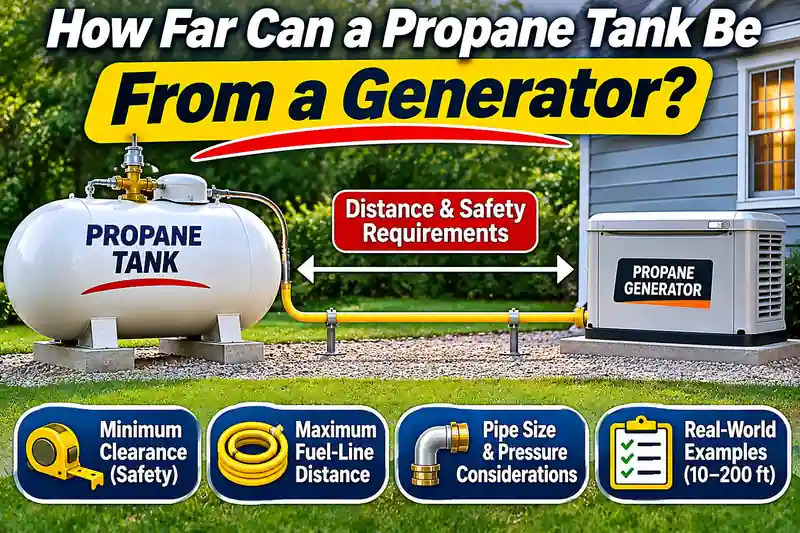
TL;DR: There is no single maximum distance between a propane tank and a generator. A tank may be 50, 100 or even 200 feet away when the piping and regulators are professionally sized, but minimum safety setbacks also apply. A common rule requires certain stationary tank fill and vent connections to be at least 10 feet from ignition sources. Follow the locally adopted code and the exact generator manual; never assume a long hose is an acceptable substitute for designed gas piping.
The short answer: there is no universal maximum distance
A propane tank can be located dozens or even hundreds of feet from a standby generator when the fuel system is professionally designed for that distance. But there is no single maximum number of feet that works for every generator. The permitted layout depends on the tank type, applicable separation rules, operating pressure, pipe diameter, total fuel demand, regulator placement, and local codes.
I would separate two questions before choosing a location. First, how close is the tank legally and safely allowed to be to the generator and other ignition sources? Second, how far away can the tank be while still delivering the correct propane pressure and volume? Those are different calculations. A line can be physically long enough to reach a generator but too small to supply it under full load.


For a new installation, ask the propane supplier and generator installer to agree on a site plan before trenching or pouring a concrete pad. Moving a tank or generator after installation is much more expensive than correcting the layout on paper.
Minimum clearance is not the same as maximum pipe distance
Minimum clearances are about fire safety, tank relief and fill connections, access, and protection from ignition sources. Maximum practical distance is mainly about pressure drop and the economics of installing appropriately sized piping. Treating these as one number can create a dangerous misunderstanding.
A frequently encountered rule for ASME propane tanks filled on site is that the filling connection and fixed maximum liquid-level gauge vent connection must be at least 10 feet from an external ignition source. A generator may be an ignition source, so a 10-foot separation is a common starting consideration, but the exact measurement points and governing requirements must be verified for the specific tank and generator.
The 10-foot figure is not a universal instruction to put every tank exactly 10 feet from every generator. Other rules may require greater setbacks, and generator manufacturers specify their own clearances from buildings, windows, air intakes, vegetation and other equipment. Local authorities can adopt and amend codes.


Typical separation considerations by tank type
Portable DOT cylinders and stationary ASME tanks do not necessarily follow identical placement provisions. The tank’s nominal capacity and whether it is filled on site can also matter. Underground tanks have different measurement details from above-ground tanks, particularly at valves and relief or vent connections.
For example, a 500-gallon above-ground tank often needs a setback from buildings and property lines as well as appropriate clearance from ignition sources. A portable 20-pound cylinder supplied with a generator’s approved hose assembly should be positioned according to the generator and cylinder manuals, not moved farther away with a random extension hose.
Because published spacing diagrams can simplify exceptions and measurement rules, I would not use a general internet chart as a substitute for the locally adopted NFPA 58 edition, applicable fire code and the installation manual. The propane supplier should approve the final position.
| Tank or installation | Placement issue | Important qualification |
|---|---|---|
| Portable DOT cylinder | Cylinder relief, ventilation and approved hose | Follow cylinder and generator instructions |
| Above-ground ASME tank | Building/property setbacks and ignition sources | Tank size and local code determine exact distances |
| Underground ASME tank | Relief, fill and vent connection locations | Underground placement rules differ |
| Tank filled on site | Fill and level-gauge vent separation | 10 ft from ignition sources is a common requirement |
How pipe length affects generator fuel supply
Every foot of piping and every fitting introduces some resistance to gas flow. The pressure lost through a line increases with demand and depends on pipe diameter, material, inlet pressure, fittings and the gas properties. This is why an installer may choose a larger pipe for a generator 100 feet from the tank than for the same generator 20 feet away.
A standby generator needs adequate inlet pressure not only while idling but also while starting and operating under substantial electrical load. If the pressure falls below the manufacturer’s required range, the generator may fail to start, surge or shut down. A pipe that passes a simple leak test is not necessarily large enough for full-load operation.

A qualified gas installer uses the appropriate sizing method and tables for the system pressure, developed length, connected BTU-per-hour demand and acceptable pressure drop. I would not recommend selecting pipe diameter solely from the generator’s threaded inlet fitting.
Why a longer run can still be practical
A distant tank is not automatically a problem. Properly engineered installations can use a suitable pressure-regulation arrangement and pipe diameter to carry propane vapor across longer distances. The required components must match the tank supply, generator fuel specifications and local code.
The installer may place regulators at designated points to provide a suitable distribution pressure, then reduce pressure near the appliance as required. That is a professional design decision. Running high-pressure or intermediate-pressure gas through an improvised hose or bypassing the generator’s specified regulator is not an acceptable shortcut.
The practical distance limit is often set by trenching cost, route obstacles, material requirements, accessibility and the pressure-drop calculation. The safe answer to “Can I put the tank 150 feet away?” is “possibly, if the complete installation is designed and approved for 150 feet,” not a universal yes or no.


Illustrative planning distances: 10, 25, 50, 100 and 200 feet
When I plan a layout, I use distances as discussion points rather than automatic approvals. A short run may make installation simpler, but it must still satisfy all tank and generator clearances. A longer run may be desirable to keep the tank accessible for delivery or to place the generator away from windows and occupied spaces.
The table below is deliberately not a pipe-sizing chart. It shows which questions become important as the proposed separation increases. A 200-foot run may be feasible with appropriate design, while a 20-foot run can fail if its regulator or pipe is wrong.
If the tank is already installed, measure the actual route the pipe must follow, not just the straight-line distance across the yard. Include vertical changes, bends, fittings and any sections routed around foundations or landscaping.
| Illustrative pipe route | Design priority | Not a universal approval |
|---|---|---|
| 10 ft | Verify tank and generator clearances | May be too close for a particular layout |
| 25 ft | Regulator and line sizing | Check all measurement points |
| 50 ft | Developed length and fittings | Pressure drop matters |
| 100 ft | Pipe sizing and installed cost | Often feasible if engineered |
| 200 ft | Distribution pressure, routing and cost | Requires project-specific design |
Generator size changes the answer
A 7.5-kW generator and a 26-kW generator do not generally require the same propane flow. Larger units can demand more fuel at full load, which can make pipe sizing and tank vaporization more challenging for a given distance. Actual consumption and maximum input must come from the model’s specification sheet.
I would obtain the generator’s rated fuel input in BTU per hour or its manufacturer-specified propane flow at full load. The gas piping is then sized for the required peak demand, including other appliances served by the same branch or supply arrangement. Average fuel consumption is useful for runtime budgeting, but it is not a substitute for maximum input in a pipe-sizing calculation.
If you are comparing generator sizes, my 20-kW versus 26-kW propane generator guide discusses how electrical demand affects equipment selection. Fuel-line engineering should follow the final model choice, not precede it.
What about a 500-gallon propane tank?
A 500-gallon tank can be an appropriate supply for many standby generators, but its storage capacity does not determine the maximum distance to the generator. You can have a large tank and still have a poor installation if the line is undersized or the regulators are incorrectly selected.
At a common 80-percent fill level, a nominal 500-gallon tank contains about 400 gallons of propane. That tells you something about possible runtime, not how much pressure will reach a generator 100 feet away. The design must also confirm vaporization capability at the minimum expected outdoor temperature.
For a detailed discussion of shared household loads, pressure and runtime, see running a generator from a 500-gallon propane tank. I would have the propane supplier assess the tank, regulators and piping together rather than buying a longer hose as a workaround.
Portable generator cylinders: avoid improvised hose extensions
Portable propane generators are commonly supplied with a model-specific hose and regulator assembly for approved DOT cylinders. The manufacturer’s specified cylinder placement and hose configuration should control. An arbitrary 25-foot or 50-foot extension may change pressure delivery, introduce damage risks and conflict with the equipment listing.
Keep portable generators outdoors in the location required by the manufacturer, well away from doors, windows and vents. Never move a generator into a garage, enclosed patio or shed to make a short hose reach. Carbon monoxide exposure can be fatal even when an opening is nearby.
If a portable generator must draw from an existing stationary propane system, ask the manufacturer and a qualified gas installer whether that model supports the arrangement. Read how to connect a portable generator to a propane line for the compatibility issues to check.
Tank placement and generator exhaust are separate safety issues
Even when a propane tank is far enough from ignition sources, the generator itself must be positioned so its exhaust cannot enter the home. Many standby generators have model-specific minimum clearances from structures, openings and combustible materials. A distance that satisfies the propane tank rules does not automatically satisfy generator placement requirements.
I would review the actual installation manual, local fire requirements, air-intake locations, neighboring buildings and prevailing site conditions. Exhaust should never discharge toward windows, doors, vents or occupied areas. Outdoor operation alone is not a guarantee against carbon monoxide entering a building.
The tank must also remain accessible to the delivery truck and technicians. Do not block fill connections, relief devices or service access with a generator enclosure, fence or landscaping. Keep the area protected from vehicle impact where necessary.
Above-ground versus underground pipe routes
Above-ground piping and underground piping can each be appropriate when approved for the application. Exposed piping may need protection from impact, corrosion and weather, while buried piping needs approved materials, proper burial, corrosion considerations and careful routing around other utilities.
A buried line can make a long run less visually intrusive, but excavation can be a major cost. Before any digging, arrange utility locating through the appropriate local service and have the installer determine the required depth, transitions, tracer or marking requirements and inspection process.
If you are deciding between tank locations, my underground versus above-ground tank guide covers the broader installation tradeoffs. Underground storage does not remove the need for compliant valve and vent clearances.
Regulator location and inlet pressure
The propane tank contains fuel at pressure that varies with temperature. Many generators need substantially lower regulated vapor pressure at the fuel inlet. The appropriate regulator arrangement depends on the generator and the piping system. Some installations use multiple stages of regulation; others follow a manufacturer-specific configuration.
One Generac portable multi-fuel manual, for example, specifies 10–12 inches of water column at the propane fuel inlet for that particular model. That number should not be copied to every generator. Always use the exact pressure range and maximum fuel demand in your own generator manual.
The installer should verify inlet pressure under the required operating conditions and test the completed gas system for leaks. I would not adjust a regulator based on how the engine sounds or assume a regulator is correct because the threads fit.
How to estimate the total fuel demand
Fuel piping must support all loads that can reasonably operate at the same time. Imagine a generator with a maximum input of 250,000 BTU per hour, a furnace rated at 100,000 BTU per hour and a water heater rated at 40,000 BTU per hour. If all are served by the same relevant supply section, the combined connected demand may be 390,000 BTU per hour.
That example is not a claim about a specific generator or home. It illustrates why a pipe sized for the generator alone may be inadequate if other appliances share part of the route. The installer will determine which loads apply to each segment and use the correct sizing method.
The propane tank must also be capable of vaporizing sufficient fuel during cold weather. My guide to propane tank frosting during generator operation explains why temperature and withdrawal rate matter.
| Illustrative appliance | Maximum fuel input | Running total |
|---|---|---|
| Generator | 250,000 BTU/hr | 250,000 BTU/hr |
| Furnace | 100,000 BTU/hr | 350,000 BTU/hr |
| Water heater | 40,000 BTU/hr | 390,000 BTU/hr |
Cost considerations when the tank is far away
Longer routes often mean more pipe, fittings, trenching, labor and site restoration. A route through a paved driveway or landscaped yard can cost more than a longer route through open soil. Additional regulators, protective barriers or access work may also be needed depending on the design.
I would request an itemized quote for at least two compliant tank positions. Ask the installer to include the pipe size and material, regulator arrangement, trenching, permits, testing and restoration. Comparing only the price per foot of pipe misses much of the project cost.
The least expensive position on a sketch may not be the least expensive compliant installation. Tank delivery access, future maintenance and generator exhaust placement deserve attention from the beginning.
My site-planning checklist
Before approving a tank location, I want the installer to show the property boundaries, building openings, generator pad, tank fill and relief connections, access route, underground utilities and proposed pipe path. I also want the exact generator model and its maximum propane demand documented.
Next, the propane professional should confirm the applicable separation rules and size the piping and regulators for the complete connected load. If the design uses a long run, ask how pressure drop was evaluated and how pressure will be verified during commissioning.
Finally, the generator installer should verify exhaust and ventilation clearances, electrical transfer equipment and service access. A good installation is one where all three systems—fuel storage, gas delivery and generator placement—work together.
| Site check | Responsible professional |
|---|---|
| Tank setbacks, fill/vent clearances | Propane supplier |
| Gas pipe sizing and regulator locations | Qualified gas installer |
| Generator exhaust and service clearances | Generator installer |
| Electrical transfer equipment | Licensed electrician |
| Permit and adopted code verification | Local authority / installers |
| Final leak and operating-pressure tests | Qualified technicians |
Frequently asked questions
Can a propane tank be 100 feet from a generator? Often yes with properly designed piping and regulators, but there is no blanket approval for every generator or site.
Can a propane tank be 200 feet away? Potentially. The installer must verify pressure drop, pipe size, route and applicable codes.
Is 10 feet always the required separation? No. Ten feet is a common consideration for certain ASME tank fill or vent connections relative to ignition sources, but other rules and model-specific requirements apply.
Does a bigger tank allow a longer gas line? Not by itself. Distance depends on the pressure-regulation and piping design, while tank size affects storage and vaporization.
Can I use a long rubber hose? Only if the generator manufacturer specifically approves the hose and configuration. Do not improvise extensions.
Does the propane tank have to be next to the generator? No. Many compliant systems place the tank away from the generator and connect them through engineered piping.
Can a generator share the tank with a furnace? Yes, provided the tank and relevant piping sections are sized for simultaneous demand.
Does underground piping eliminate setbacks? No. Tank and vent placement, pipe routing and generator clearances still matter.
Who determines the correct distance? A qualified propane installer and generator installer working under the locally adopted codes and manufacturer instructions.
Can I move an existing tank closer? Only through the propane supplier or other qualified personnel after reviewing required setbacks and access.
My bottom line
The safe distance between a propane tank and a generator is not one universal number. You need enough separation to satisfy tank and ignition-source rules, and a properly engineered fuel line to maintain the generator’s specified pressure over the actual run. Ten feet may appear in common placement rules, but it is not a universal maximum or complete site-plan answer.
I would start with the generator manual, the propane supplier and the local authority having jurisdiction. Once they approve the layout, a qualified installer can size the pipe and regulators. That is a much better investment than guessing at a distance and discovering the generator cannot run at full load.

Mike is an experienced propane technician with over 15 years of professional experience in the field. He has dedicated his career to helping customers with their propane needs, from installation to maintenance and repair. Together with Jeremy, he co-founded this website to provide useful information and guidance to customers seeking reliable propane services.