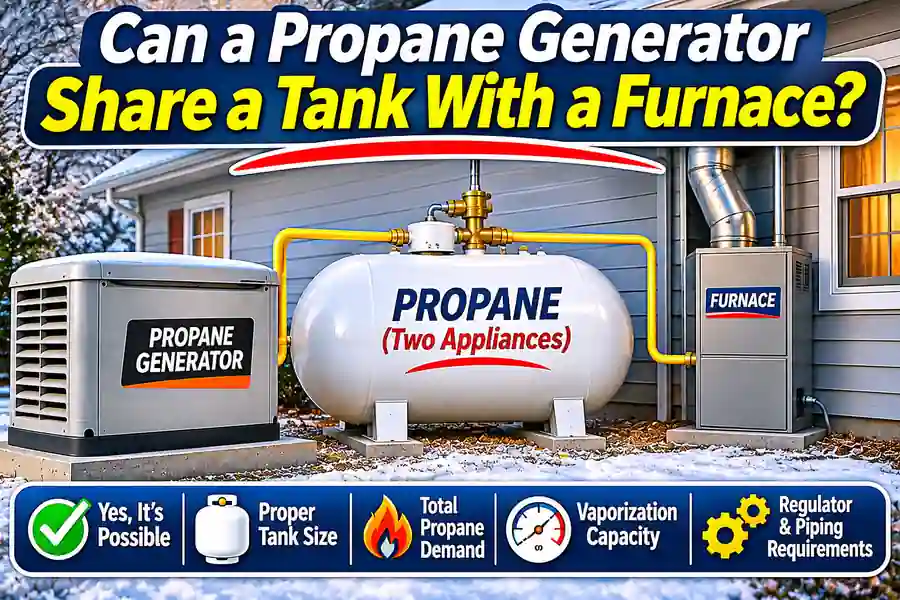
TL;DR: Yes, a propane generator can often share a stationary propane tank with a furnace. The tank must have sufficient cold-weather vaporization capacity, and the regulators and gas piping must support the combined simultaneous demand at the correct appliance pressures. A 500-gallon tank may work, but size alone is not proof. Have the propane supplier and qualified installers evaluate the entire system before making the connection.
Can a generator and furnace use the same propane tank?
Yes. A propane standby generator and a propane furnace can often share one stationary propane tank. In fact, a shared supply is a practical arrangement for many homes because it avoids maintaining two separate fuel inventories. But I would never approve the connection simply because the tank is large or both appliances use propane.
The important question is whether the tank can vaporize enough propane for both appliances during the coldest weather, and whether the regulators and piping can deliver the correct pressure at the same time. The furnace and generator may be needed together precisely when the outdoor temperature is lowest.


A properly designed shared system can be reliable. An undersized one may let the generator start but then cause the furnace to lose pressure, or make the generator stumble when the heating system fires. I would have the propane supplier and qualified installer evaluate the complete load before adding a generator to an existing tank.
TL;DR: what I would check first
Before connecting a generator to a furnace’s propane tank, I would confirm five things: the generator’s maximum propane input, the furnace’s input rating, the capacity of any other propane appliances, the tank’s cold-weather vaporization capability, and the regulator and piping arrangement.
The generator and furnace must each receive the inlet pressure specified by their manufacturers. A shared tank does not necessarily mean they should share one undersized branch line or one regulator. The layout must be engineered for the total demand on each part of the system.
If you already have a 500-gallon tank, it may be a good starting point, but tank capacity alone cannot prove that the system will work. My guide to running a generator from a 500-gallon propane tank explains the difference between stored fuel, runtime and supply capacity.


Why winter makes a shared propane tank more demanding
During an outage in cold weather, the generator may supply electricity to the furnace blower, ignition controls, circulation pumps and other equipment. At the same time, the furnace burns propane for heat. That means the generator and furnace can draw fuel from the same tank simultaneously.
Cold weather also reduces the tank’s ability to turn liquid propane into vapor. As propane vapor is withdrawn, liquid propane evaporates to replace it, absorbing heat from the tank and its surroundings. At lower ambient temperatures and lower tank fill levels, the available vaporization rate generally falls.
I would not size a shared tank based only on a mild-weather generator exercise test. The design case should include the lowest expected outdoor temperature, the lowest planned fill level and the relevant simultaneous heating and generator loads. A frost band on a tank can be normal, but insufficient vapor supply can become a real performance problem.
Start with appliance input ratings, not electrical watts
A generator’s electrical output in kilowatts is not the same as its propane fuel-input requirement. A 20-kW generator does not consume just 20 kW worth of propane heat energy. Engine efficiency, load and model-specific design all affect fuel demand.
I would find the generator’s maximum propane input in the manufacturer’s fuel specifications, typically expressed as BTU per hour or as a flow rate that can be converted using the appropriate basis. Then I would locate the furnace nameplate, which usually lists its fuel input in BTU/hr. The furnace’s heat output or efficiency rating is not a substitute for its input rating.



If the tank also supplies a water heater, range, clothes dryer, pool heater or fireplace, those appliances belong in the load assessment as well. The installer can determine which demands must be combined for each tank, regulator and pipe segment.
Example: generator, furnace and water heater
Imagine a home with a standby generator requiring a maximum propane input of 250,000 BTU/hr, a furnace rated at 100,000 BTU/hr and a water heater rated at 40,000 BTU/hr. If all three can operate at the same time, their combined illustrative input is 390,000 BTU/hr.
Those numbers are examples, not specifications for any particular generator or furnace. Your real figures should come from the equipment nameplates and manuals. The installer must also consider how the appliances are connected: a pipe serving only the furnace carries a different load from the upstream section supplying all three appliances.
I would rather have a professional verify the simultaneous-demand assumptions than assume the furnace will not run when the generator reaches high electrical load. Winter outages are precisely when both can be important.


| Appliance | Illustrative maximum input | Running total |
|---|---|---|
| Standby generator | 250,000 BTU/hr | 250,000 BTU/hr |
| Furnace | 100,000 BTU/hr | 350,000 BTU/hr |
| Water heater | 40,000 BTU/hr | 390,000 BTU/hr |
How large should the shared propane tank be?
There is no universal tank size that fits every generator-and-furnace combination. A 250-gallon tank may be appropriate for some lower-demand systems, while a 500-gallon or 1,000-gallon tank may be preferred for greater fuel storage and higher vaporization capability. The answer depends on generator input, heating demand, climate, tank geometry, fill level and delivery logistics.
A nominal 500-gallon stationary tank commonly contains about 400 gallons of liquid propane at an 80-percent fill. A nominal 1,000-gallon tank commonly contains about 800 gallons at that fill level. These figures describe stored liquid, not the tank’s guaranteed maximum vapor withdrawal rate.
I would ask the propane supplier to compare the tank’s documented vaporization performance at the local winter design temperature and minimum planned fill with the combined BTU/hr demand. For a deeper explanation, see how to calculate propane vaporization capacity for a generator.
| Nominal stationary tank | Approximate liquid at 80% fill | Key limitation |
|---|---|---|
| 250 gallons | 200 gallons | Check winter vaporization and reserve |
| 500 gallons | 400 gallons | Check combined peak load |
| 1,000 gallons | 800 gallons | Still requires engineered gas delivery |
Runtime: how long will the shared tank last?
Runtime is a separate calculation from vaporization capacity. For a preliminary estimate, add the expected propane use of the generator and furnace over the same period, along with other appliances. Divide the usable fuel budget by the average combined consumption rate, or calculate each appliance’s daily use separately and add the totals.
For example, suppose a generator averages 1.8 gallons per hour during an outage and runs continuously for 24 hours. That is 43.2 gallons in a day. Suppose the furnace and other propane appliances together consume another 12 gallons over the same day. Total daily use would be about 55.2 gallons.
If you start with 400 gallons and plan to preserve a 100-gallon reserve, the 300-gallon budget would last approximately 5.4 days at that illustrative combined rate. Actual runtime can vary widely with generator load, furnace cycling, outdoor temperature and household behavior.
| Illustrative daily consumption | Gallons |
|---|---|
| Generator: 1.8 gal/hr × 24 hr | 43.2 |
| Furnace and other appliances | 12.0 |
| Total daily use | 55.2 |
| 300-gallon planned budget ÷ 55.2 | 5.4 days |
Why the furnace may affect generator fuel pressure
A furnace typically cycles on and off as the thermostat calls for heat. When its gas valve opens, the demand on the shared supply system rises. If a regulator or upstream pipe is undersized, that added demand can reduce pressure available to the generator or other appliances.
A properly sized regulator and distribution system should maintain acceptable pressure across expected operating conditions. The correct pressure ranges are model-specific. Many residential propane appliances use low-pressure vapor, but I would never assume every generator uses the same inlet specification as a furnace.
I would ask the installer to verify pressure under simultaneous operation, using the procedures and limits in the equipment manuals. Adjusting a regulator by ear, adding a larger regulator without calculations, or bypassing safety components is not an acceptable solution.
One tank does not mean one shared branch pipe
There are several possible ways to distribute propane from a stationary tank, depending on the site and equipment. Some installations use a first-stage regulator near the tank and second-stage regulation at appropriate locations. The generator and house may have separate downstream branches, with each sized for its own load.
The right arrangement depends on tank pressure, regulator capacities, the generator’s required inlet pressure, pipe material, developed length and local code. A generator may require a dedicated line from a suitable point in the system rather than a tee installed into a small existing furnace branch.
I would not recommend connecting the generator to a furnace’s flexible appliance connector or modifying the furnace’s gas valve assembly. Have a qualified gas installer design and test the connection.
What if the generator is 100 feet from the tank?
Distance matters because pressure is lost as propane vapor flows through piping. The longer the run and the greater the demand, the more important pipe sizing becomes. A 100-foot route may be entirely feasible, but the pipe diameter and regulator arrangement must be calculated for the relevant load.
I would measure the actual developed piping route rather than the straight-line distance between tank and generator. Bends, fittings and branches affect the calculation. A pipe sized for a furnace alone may not be large enough for the added generator.
For a fuller explanation of placement and pressure drop, read how far a propane tank can be from a generator. Tank setbacks, generator exhaust clearances and fuel-line sizing are three different requirements.
Can a portable propane generator share the furnace tank?
Sometimes, but this is a different problem from connecting a listed standby generator. Many portable dual-fuel generators are supplied with a specific cylinder hose and regulator assembly. The manufacturer may not permit direct connection to a stationary low-pressure line, or may require a particular approved conversion or connection kit.
A fitting that screws together does not establish compatibility. The generator’s required supply pressure and regulator arrangement must match the installed fuel system. I would ask the manufacturer and a qualified propane professional before changing any portable generator fuel connection.
Portable generators must run outdoors in a location that prevents exhaust from entering buildings. Never operate one in a garage, basement, shed or enclosed porch. For compatibility considerations, see how to connect a portable generator to a propane line.
Can the furnace still run during a power outage?
A propane furnace burns propane for heat, but many modern furnaces also need electricity for controls, ignition, blower motors or pumps. If utility power is out, a furnace may not operate unless the generator supplies the appropriate electrical circuits through an approved transfer arrangement.
The electrical side should be planned separately from the fuel side. A generator must have enough running and starting capacity for the furnace’s electrical loads along with other selected circuits. A properly installed transfer switch or other approved transfer equipment prevents dangerous utility backfeeding.
For an overview of electrical connection choices, see generator transfer switch versus interlock kit. A gas connection alone does not make the furnace usable during an outage.
What if the tank starts frosting over?
Frost can form on the outside of a propane tank because vaporization absorbs heat from the liquid and tank wall. Visible frost is not automatically proof of a leak or failure. The more important question is whether the fuel system continues to deliver sufficient pressure and vapor to the appliances.
If the generator surges, stalls or shuts down when the furnace fires, I would stop treating it as a routine frost issue and arrange a professional assessment. Other causes are possible, but inadequate vaporization or gas delivery should be checked.
Never apply a torch, open flame or improvised heater to a propane tank, cylinder or regulator. If you smell propane, leave the area, avoid ignition sources and contact the propane supplier or emergency services from a safe location. See why propane tanks freeze during generator use for the underlying physics.
Above-ground versus underground shared tanks
Both above-ground and underground stationary propane tanks can supply a furnace and generator when properly designed. Above-ground tanks are generally easier to inspect visually, while underground tanks may offer a less visible installation and different temperature behavior due to the surrounding soil.
Underground placement does not eliminate vaporization limits or regulator and piping requirements. The tank type and installation conditions must match the data used in the supplier’s vaporization assessment. Underground tanks also have specialized corrosion-protection and installation requirements.
I would compare installed cost, service access, available space, local setbacks and long-term maintenance before choosing a tank location. My underground versus above-ground propane tank guide
How I would plan fuel deliveries and reserve
During a winter outage, delivery schedules may be disrupted by road conditions, widespread demand or access problems. I would avoid planning to run the shared tank completely empty. A reserve helps protect the home’s heating supply and provides flexibility if refilling takes longer than expected.
For a nominal 500-gallon tank, going from 80 percent indicated fill to 20 percent represents approximately 300 gallons. That can be a useful planning budget, although gauge readings are approximate and the supplier may recommend a different refill threshold. A low tank level can also reduce vaporization capacity in cold weather.
I would keep a simple log of gauge readings, generator run hours and propane deliveries during an outage. Those records help estimate actual use more accurately than relying only on advertised full-load consumption.
How much does adding a generator to an existing tank cost?
The cost depends on whether the existing tank is adequate, whether regulators or piping need replacement, how far the generator is from the supply, and whether trenching, permits or site modifications are necessary. A shared tank can avoid the cost of a second container, but it does not guarantee a cheap connection.
I would request a written quote that separates fuel-system assessment, regulators, piping, trenching, pressure testing, permits and generator commissioning. If the existing tank is too small for winter demand, the proposal should also explain whether upgrading the tank or changing the system design is appropriate.
For a broader budgeting framework, see whole-house generator installation cost with a propane tank. I would compare total installed cost and future maintenance rather than the price of a tee fitting alone.
Safety checks before commissioning
A shared propane system should be installed and tested by qualified personnel. The installer should verify tank and regulator suitability, pipe sizing, required shutoff arrangements, leak tightness, appliance inlet pressures and proper operation under the expected simultaneous load.
Generator placement also matters. Tank fill and relief connections must meet applicable separation rules, and generator exhaust must be located so carbon monoxide cannot enter the home. The generator and furnace manufacturers’ installation instructions, locally adopted fuel-gas and fire codes, and permit requirements all apply.
I would ask for documentation of the final configuration and test results. This makes future troubleshooting easier and helps another technician understand the system without guessing at regulator settings or pipe capacities.
Troubleshooting when the furnace and generator run together
If both appliances work separately but one fails when they run together, inadequate gas delivery is one possibility. The system may have insufficient vaporization capacity, a regulator that cannot support the combined demand, excessive pipe pressure drop or another fuel-system issue.
But not every failure is caused by propane. A furnace that stops during generator operation might also be experiencing electrical power-quality, grounding, control or transfer-equipment problems. A generator that stalls may have its own mechanical or control faults.
I would document exactly when the problem occurs and have qualified technicians check both the gas and electrical systems. Do not bypass pressure switches, safety controls or regulators to keep the equipment running.
My shared-tank planning checklist
Before installation, I would collect the generator model and maximum propane input, furnace nameplate input, ratings of other appliances, tank dimensions and type, and the minimum expected winter temperature. I would also note the minimum tank fill level the homeowner plans to maintain.
Next, I would ask the propane supplier for a tank vaporization assessment and the installer for regulator and piping calculations. I would verify that the generator location meets the applicable exhaust and tank-clearance requirements, and that the furnace’s electrical circuit is appropriately supplied during outages.
Finally, I would require commissioning under appropriate operating conditions and keep the manuals, piping layout and service contacts together. A shared tank is most useful when you can trust it during a long winter outage.
| Symptom | Possible issue | Safe next step |
|---|---|---|
| Generator surges when furnace starts | Gas pressure drop or other generator fault | Professional gas and generator diagnostics |
| Furnace stops on generator power | Electrical supply or gas-delivery problem | Qualified HVAC and electrical inspection |
| Frost appears on tank | Normal cooling or excessive withdrawal | Check operating performance; consult supplier |
| Tank level falls rapidly | Combined consumption higher than expected | Review delivery and run-hour records |
Frequently asked questions
Can a propane furnace and generator run at the same time? Yes, if the tank and fuel distribution system are designed for their simultaneous demand.
Do I need two propane tanks? Not necessarily. One properly sized stationary tank can often supply both appliances.
Is a 500-gallon tank enough? It may be, but the answer depends on maximum fuel demand, climate, fill level and other loads.
Will the furnace use more propane when the generator runs? The furnace’s fuel use is determined mainly by its own operation. Total tank consumption increases when the generator also runs.
Can I connect the generator to the furnace’s gas line? Do not assume so. The branch may be undersized or the pressure arrangement incompatible; have a professional design the connection.
What if the tank freezes? Frost may be normal, but inadequate vapor supply requires professional assessment. Never heat the tank with an open flame.
Will my furnace work without electricity? Many modern furnaces need electricity for blowers and controls, so an approved backup electrical supply may be necessary.
Can I use a portable dual-fuel generator? Only if its manufacturer permits the stationary-tank connection and the supply system is correctly engineered.
Should I size the system for average fuel consumption? Fuel-system capacity generally needs to account for maximum relevant demand, not merely average consumption.
Who should install it? Qualified propane and generator professionals, with a licensed electrician for the electrical connection where required.
| Check | Who should confirm |
|---|---|
| Generator and furnace fuel input | Generator/HVAC installer |
| Tank vaporization at winter design temperature | Propane supplier |
| Regulator capacity and pipe sizing | Qualified gas installer |
| Electrical transfer and furnace power | Licensed electrician |
| Pressure and leak testing | Qualified technicians |
| Tank fill and service access | Propane supplier |
Final recommendation
I consider a shared propane tank a sensible choice when it is properly sized and installed. The goal is not simply to make two appliances connect to one tank; it is to make sure both can operate safely during the coldest, most demanding outage conditions.
If you already heat with propane, ask your supplier to assess the existing tank before buying a standby generator. If you are planning a new home backup system, coordinate the propane and electrical designs from the start. That approach is far more dependable than adding a generator connection and hoping the existing furnace supply has enough spare capacity.

Mike is an experienced propane technician with over 15 years of professional experience in the field. He has dedicated his career to helping customers with their propane needs, from installation to maintenance and repair. Together with Jeremy, he co-founded this website to provide useful information and guidance to customers seeking reliable propane services.