TL;DR: Which Butane Should I Buy?
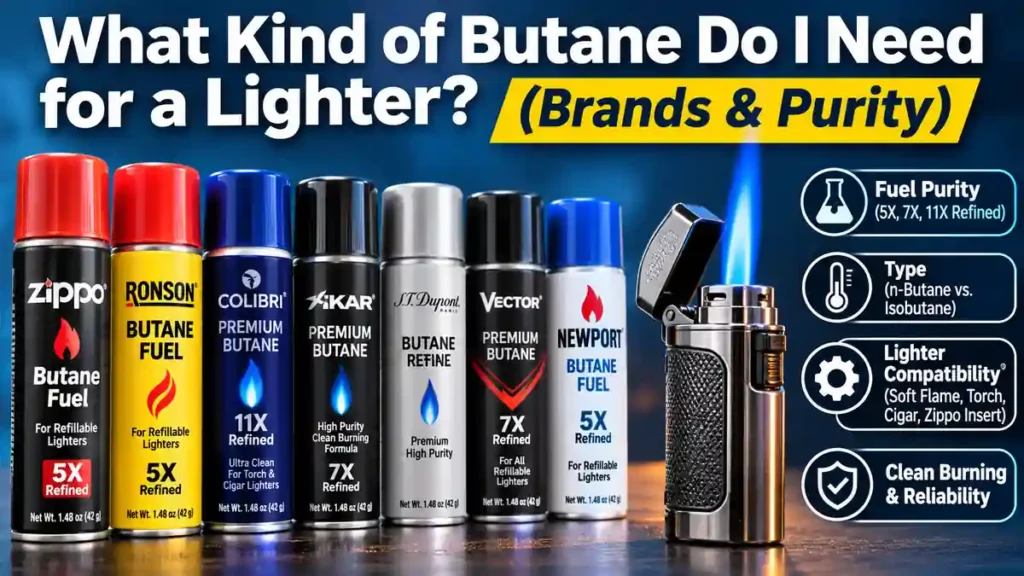
If your lighter has a refill valve and is designed for butane, buy a reputable lighter-refill can that the manufacturer approves. For a Zippo butane insert, Zippo or Ronson is a sensible starting point; for Colibri, use the recommended Colibri fuel; for Xikar and S.T. Dupont, check the exact model. Vector and Newport are alternatives only where compatible. Do not fill a traditional wick-style Zippo with butane, refill a disposable nonrefillable lighter, or substitute a camping propane/isobutane blend. My buying order is compatibility, correct nozzle, documented cleanliness, authenticity, then price.
What Kind of Butane Do I Need for a Lighter?
There is no single can of butane that is automatically best for every lighter. I first identify whether the device is a soft-flame butane lighter, a single-jet torch, a multi-jet cigar lighter, a butane insert or a wick-style liquid-fuel lighter. The label on the case alone may not identify its fuel system. I then check the instructions for fuel type, approved refills, adapter and filling method. A pressurized fuel refill should fit cleanly without force. If the fuel or connection is uncertain, I do not improvise. For a premium lighter with narrow jets, I pay particular attention to fuel cleanliness and the maker’s warranty instructions.
For related guidance, read whether different butane grades matter.


| Lighter | Fuel | Check |
|---|---|---|
| Refillable soft-flame | Approved lighter butane | Valve and nozzle |
| Single-jet torch | Approved clean butane | Manufacturer specification |
| Multi-jet cigar lighter | Recommended premium butane | Fuel delivery |
| Traditional Zippo | Liquid lighter fluid | Not butane |
| Nonrefillable disposable | No refill | Do not modify |
Zippo Butane: Best for Compatible Zippo Inserts
Zippo sells butane fuel for its butane inserts and other compatible products. A conventional Zippo windproof lighter uses liquid lighter fluid in a wick-and-cotton fuel system, not butane gas. That distinction is critical because the outer case may look similar. Zippo has also identified Ronson butane as a fuel option in its torch-insert troubleshooting guidance. I would verify the insert model and follow the corresponding refill instructions, including the waiting period before ignition. A weak flame after filling does not justify forcing more fuel into the reservoir.
For related guidance, read using butane in a Zippo.
Ronson Butane: A Familiar Standard Refill
Ronson is an established lighter and refill-fuel brand. It can be a practical choice for refillable butane lighters that accept its nozzle and fuel specification, including compatible Zippo torch inserts. I would not assume a particular Ronson can fits every refill valve; packaging and nozzle configurations can change. Check the net contents, instructions and seal before purchase. When comparing Ronson with a more expensive premium product, I would focus on documented compatibility rather than assuming a higher price automatically means better combustion.
Colibri Premium Butane: For Precision Torch Lighters
Colibri sells premium butane and recommends its own fuel for its lighters. Precision cigar lighters may use small valves and multiple burners, making reliable fuel delivery important. Contamination can interfere with a fine fuel passage, although a sputtering flame can also be caused by ignition, temperature or mechanical problems. I would start with the specified Colibri refill when servicing a Colibri lighter, particularly if the manufacturer ties warranty or maintenance guidance to approved fuel. The correct nozzle and safe filling technique still matter.


Xikar Premium Butane: For Cigar and Torch Models
Xikar offers refillable cigar lighters and butane fuel. If you own a Xikar torch, consult the model’s documentation to determine its recommended refill grade and filling procedure. Different products can have different valves and flame adjustments. I would avoid buying an unfamiliar refill just because it advertises many refining passes. A reputable compatible product is more useful than an impressive but unverifiable label. Do not attempt to clear a clogged jet with a needle or dismantle a pressurized lighter without authorized service instructions.
S.T. Dupont Butane: Check the Exact Refill System
S.T. Dupont is a luxury lighter maker with multiple lighter families. Some models have dedicated refill arrangements, and their fuel and adapter requirements should not be generalized. Before purchasing, identify the exact model rather than choosing a can based on the brand name alone. I would use the manufacturer’s recommended refill for an expensive lighter and retain the packaging so I can verify the product later. An adapter that appears close enough but leaks is not acceptable.
Vector and Newport: Other Butane Refill Options
Vector and Newport are additional names encountered in lighter-refill products. Their suitability depends on the actual product formulation and the lighter’s requirements. I would verify that the can is sold for refillable lighters, that the nozzle fits the valve and that the product is genuine. A generic brand can be perfectly adequate for a compatible lighter, but no brand is universally safe for every device. Never force an incompatible refill tip or use a makeshift connector.
How I Compare Butane Brands
I use a simple ranking of purchasing criteria. First, is the refill specifically approved or recommended for my lighter? Second, does the can’s nozzle or supplied adapter fit? Third, is there useful documentation of composition, quality and handling? Fourth, is the product authentic and sold through a reputable supplier? Finally, what is the price per gram? I do not rank brands by claims of hotter flames unless there are comparable controlled tests on the same lighter. Differences in flame behavior can reflect burner design, valve setting, ambient temperature and maintenance.
For related guidance, read top butane brands.

| Brand | Relevant use | What to verify |
|---|---|---|
| Zippo | Zippo butane inserts | Insert type |
| Ronson | Compatible butane lighters | Nozzle fit |
| Colibri | Colibri cigar torches | Maker recommendation |
| Xikar | Xikar torches | Model instructions |
| S.T. Dupont | Luxury lighters | Exact refill system |
| Vector | Compatible refillables | Fuel specification |
| Newport | Compatible refillables | Adapter fit |
Does Butane Purity Matter?
Yes, especially in precision torch lighters, but purity is not the only variable. Chemical purity describes how much of a product is made of the stated compounds. Cleanliness also concerns trace residues and contaminants that may affect tiny passages. Compatibility includes the fuel mixture, pressure characteristics and filling connection. A can could be very clean yet unsuitable for a particular lighter. I prefer documented specifications and maker guidance over marketing slogans. If a lighter repeatedly fails, I investigate the entire fuel and ignition system rather than blaming fuel purity automatically.
For related guidance, read how to determine butane quality.
What Do 5X, 7X and 11X Refined Mean?
Some cans advertise five, seven or eleven refining passes. Those labels are not a universal industry standard establishing a precise purity percentage across brands. More passes do not necessarily mean a higher quality finished fuel if different processes, starting materials or testing methods are involved. I would look for credible composition information and any manufacturer approval. For everyday users, a correctly matched refill from an established supplier is a better starting point than a number on the label. Refining claims also do not override nozzle compatibility.
For related guidance, read 5X versus 11X butane.


Technical Properties of n-Butane and Isobutane
Normal butane and isobutane are structural isomers with formula C4H10 and molar mass about 58.12 g/mol. At atmospheric pressure, n-butane boils near −0.5°C (31°F) and isobutane near −11.7°C (11°F). Isobutane has higher vapor pressure at the same temperature, so mixtures can behave differently in the cold. Butane vapor is heavier than air and can accumulate in low or poorly ventilated spaces. Fuel composition and ambient temperature influence delivery pressure; never assume a camping fuel blend containing propane can replace a lighter refill. Physical properties are approximate and vary with mixture and temperature.
For related guidance, read butane in cold weather.
| Property | n-Butane | Isobutane |
|---|---|---|
| Chemical formula | C4H10 | C4H10 |
| Molar mass | 58.12 g/mol | 58.12 g/mol |
| Normal boiling point | −0.5°C | −11.7°C |
| Vapor pressure at same temperature | Lower | Higher |
What Butane Should I Use for a Torch Lighter?
For a single-jet or multi-jet torch lighter, I prioritize the manufacturer-approved refill. Multiple jets can consume fuel more rapidly, but the exact runtime depends on valve settings, reservoir size and flame design. A concentrated blue torch flame does not prove the fuel is purer than a soft yellow flame; burner air mixing matters. If the flame becomes erratic, inspect the model’s approved troubleshooting instructions. Do not alter the fuel valve, pierce a cartridge or attempt to increase pressure with an unapproved mixture.
Does Premium Butane Make a Hotter Flame?
Not by itself. Flame temperature is influenced by fuel chemistry, oxygen availability, burner design, mixture ratio and heat loss. A premium can may emphasize cleanliness and consistency, but a higher price or refining count is not a guaranteed temperature upgrade. I would avoid buying fuel based on an advertised flame temperature unless the test conditions are clear and relevant to the same lighter. If you need a different flame pattern or heat output, selecting a properly designed lighter is more appropriate than experimenting with fuel.
Choosing the Correct Refill Nozzle
Some cans use an integral filling tip and others include plastic adapters. The correct tip must match the lighter’s refill valve without bending, widening or forcing it. Check the manufacturer’s diagram and make sure the valve is clean and undamaged. If fuel sprays or leaks continuously around the connection, stop and move away from ignition sources. Do not fabricate adapters from tubing, modify a valve or transfer fuel from a large camping cartridge. A fitting that seems close but does not seal is not safe.
How to Refill a Butane Lighter Safely
Confirm that the lighter is refillable and designed for the chosen fuel. Work in a well-ventilated area, away from open flames, cigarettes, electrical sparks and hot surfaces. Allow the lighter to cool. Follow its model-specific instructions for flame adjustment, can orientation, refill duration and waiting before lighting. Many lighters are filled upside down, but this is not a universal substitute for the manual. If you smell gas or notice leakage, do not ignite the lighter. Do not routinely depress a filling valve to purge air unless the manufacturer expressly instructs you to do so. Keep the can away from children and wash off any liquid fuel contact as directed by safety guidance.
How Many Times Can a Butane Can Refill a Lighter?
Theoretical refill count equals the net mass of fuel in the can divided by the mass required for a full lighter reservoir. A 100-gram can could theoretically fill a 2-gram reservoir fifty times, but real-world results will be lower because of transfer losses, remaining fuel and incomplete fills. The weight printed on the refill can matters more than its outer dimensions. Larger or multi-jet lighters can use more fuel per ignition. I would not promise a fixed number of fills without the lighter’s actual reservoir capacity and the refill can’s usable net mass.
For related guidance, read how to make butane last longer.
| Reservoir | Theoretical fills from 100 g |
|---|---|
| 0.9 g | 111 |
| 1.5 g | 66 |
| 2.0 g | 50 |
| 3.0 g | 33 |
| 4.0 g | 25 |
Why a Lighter Stops Working After Refilling
A weak flame can reflect low fuel, cold temperature, poor filling technique or restricted delivery. Gas flow without ignition can indicate an ignition fault. Sputtering may involve fuel delivery instability or contamination. A persistent gas smell suggests leakage and requires stopping use. I do not recommend dismantling pressurized lighter valves or probing tiny jets with sharp objects. Follow the maker’s troubleshooting guide or seek service. If the nozzle leaks while filling, change to the approved adapter rather than pressing harder.
Can You Mix Butane Brands or Fuel Types?
Do not deliberately mix fuels unless the lighter manufacturer authorizes it. Different cans can contain different hydrocarbon proportions or additives. A product labeled camping gas may include propane or isobutane and operate at a different pressure. I would never try to improve a lighter by adding propane, heating a can or transferring fuel through an improvised adapter. Even if two lighter-refill brands are both acceptable for a particular device, follow the manufacturer’s procedure when changing products.
Safe Storage and Disposal of Butane Refills
Store refill cans according to their labels, away from direct sunlight, excessive heat, sparks and flames. Avoid leaving them in hot vehicles or near heating equipment. Butane is flammable, and heavier-than-air vapor can gather in low areas. Keep cans secured from children and do not puncture or incinerate them. Disposal rules vary by locality, so follow the applicable household hazardous-waste or aerosol guidance. If a container is damaged or leaking, avoid ignition sources and seek local safety guidance rather than attempting repairs.
Frequently Asked Questions
Can I use any butane in a lighter? No; confirm fuel and valve compatibility. Is Zippo butane for every Zippo? No; traditional wick-style models use liquid lighter fluid. Is 11X always better than 5X? Not proven by a universal refining standard. Can I use a camping cartridge? Only if explicitly approved, and never through improvised transfer equipment. Why does my lighter fail in the cold? Butane vapor pressure falls with temperature. Can I refill a disposable lighter? Not if it is not designed for refilling. Does a premium refill guarantee a hotter flame? No. Can I switch brands? Check the lighter manufacturer’s approved fuel guidance.
Additional Buying, Performance and Safety Guidance
How to Identify Your Lighter Before Buying Fuel
I begin by checking the bottom of the lighter for a refill valve and the manufacturer’s model number. A refill valve is typically a small recessed fitting, but its presence alone does not establish which gas is approved. Some lighters use proprietary refill arrangements. I also check the product packaging, instructions or manufacturer support pages for the fuel specification. A torch lighter produces a concentrated jet, while a soft-flame lighter produces a more conventional flame, but neither flame appearance is a substitute for model identification. If I inherited a lighter without its instructions, I look up the exact model before attempting a refill. I do not guess based on the color of the case or the shape of the nozzle.
Understanding Fuel Composition Versus Marketing Claims
A butane refill may contain primarily normal butane, isobutane or a manufacturer-selected mixture, depending on the product. Composition matters because different hydrocarbons have different vapor-pressure characteristics. Marketing phrases such as ultra-pure, premium and multi-refined do not necessarily disclose a comparable laboratory test. I look for clear product identification and instructions, and I avoid claims that one brand must be best simply because it advertises more purification stages. For a valuable lighter, compatibility and the maker’s service recommendations outweigh small savings on fuel. For a basic compatible lighter, a reputable standard refill may be entirely sufficient.
Why Cold Weather Changes Lighter Performance
Temperature affects how readily liquid fuel produces vapor. Normal butane’s atmospheric boiling point is near freezing, so a cold lighter may deliver less pressure than it does indoors. This can make a flame weak or prevent reliable ignition. Isobutane has a lower boiling point, but I would not substitute a different fuel simply to solve a cold-weather problem unless the manufacturer approves it. Letting the lighter return naturally to a safe ambient temperature may help. Never heat a lighter or refill can with a flame, stove, hot water or other improvised heat source. If performance remains poor at ordinary room temperature, investigate the lighter’s condition rather than forcing additional fuel into it.
Fuel Consumption: Why Two Lighters Differ
A single soft-flame lighter and a triple-jet torch can have dramatically different consumption even if both are filled from the same can. The reservoir volume, flame height, valve opening, burner efficiency and duration of each ignition all matter. This is why I treat refill-count estimates as illustrations rather than promises. A lighter used for one-second ignitions will typically last longer between fills than a torch held on for extended periods. Wind can also affect use patterns: a wind-resistant jet may stay lit where a soft flame struggles, but that does not mean the torch uses less fuel. Comparing lighter models is more informative than comparing refill-can advertising alone.
Signs of an Incompatible Refill Connection
An adapter that requires substantial force, sits at an angle or allows continuous gas escape is not a proper fit. I stop the attempt immediately rather than trying to compensate by pushing harder. Liquid butane can cause cold-contact injury, and released vapor is highly flammable. I check the lighter’s manual for the correct tip or adapter and inspect the valve only as permitted by the manufacturer. I never widen a valve opening, cut a nozzle or attach a homemade hose to a fuel cartridge. The safest refill is one that uses the approved equipment and procedure without unusual resistance or leakage.
How to Evaluate Cost Per Refill
I compare products by their net fuel mass and price rather than by the apparent size of the can. For example, if a 100-gram refill costs $6, the nominal price is six cents per gram; a 200-gram refill costing $10 is five cents per gram. These are hypothetical figures, not current retail quotes. Actual cost per successful refill also depends on transfer losses and whether the can’s nozzle works with the lighter. A cheaper can that wastes fuel through a poor connection is not necessarily economical. I also factor in the risk of using an unapproved product with an expensive lighter.
When to Stop Troubleshooting and Seek Service
If a lighter leaks, has a damaged valve, ignites unpredictably or continues to malfunction after the manufacturer’s basic checks, I stop using it. Pressurized fuel systems and ignition components are not appropriate for improvised repair. Persistent fuel odor is a reason to avoid ignition sources and move to a safe ventilated area. A specialist or manufacturer service center can assess a valuable lighter. Repeatedly adding fuel to a malfunctioning lighter is not a diagnostic method. The goal is reliable, controlled operation, not simply making the flame appear once.
A Practical Buying Checklist
Before checkout, I confirm seven points: the lighter’s exact model; whether it is designed for butane; the maker’s approved fuel specification; the nozzle or adapter required; the can’s intact condition; the supplier’s authenticity; and the storage instructions. I also consider how often I refill and whether the net fuel weight makes sense for my usage. If any of the first four points is unclear, I postpone buying rather than choosing a can based on a brand ranking. This checklist works for inexpensive pocket lighters and premium cigar torches alike, because correct fit and safe handling are fundamental.
Final Verdict: Buy for Compatibility First
My recommendation is straightforward: identify the lighter model, read its fuel requirements, buy an authentic manufacturer-approved refill and verify the nozzle. Zippo, Ronson, Colibri, Xikar, S.T. Dupont, Vector and Newport are useful brand names to research, but the right choice depends on the specific lighter. A clean, compatible refill and safe technique matter more than the biggest refining number on the can.

Mike is an experienced propane technician with over 15 years of professional experience in the field. He has dedicated his career to helping customers with their propane needs, from installation to maintenance and repair. Together with Jeremy, he co-founded this website to provide useful information and guidance to customers seeking reliable propane services.