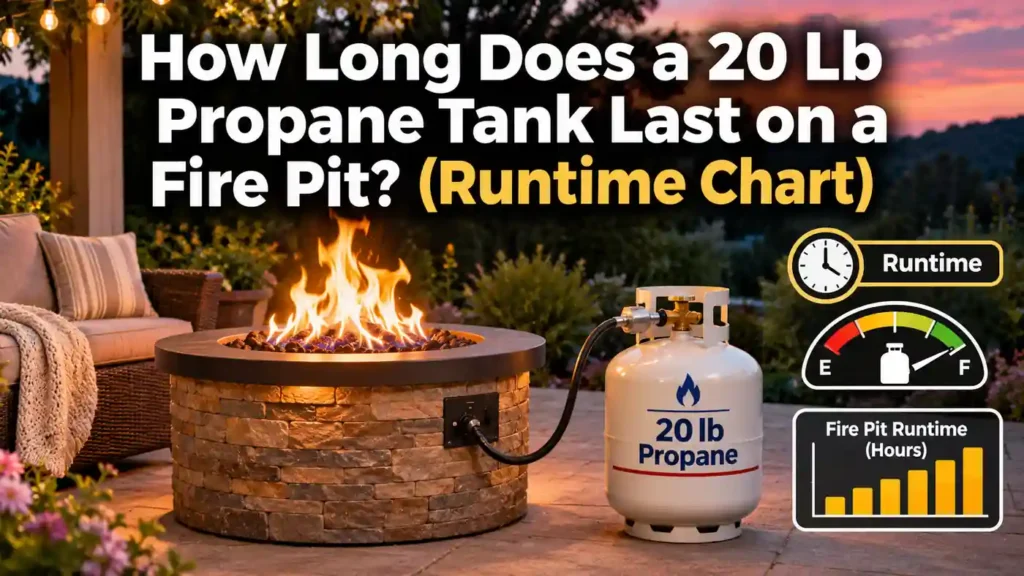
A standard 20 lb propane cylinder can keep your outdoor fire pit burning for several evenings, but the exact time depends on the burner’s BTU rating, the amount of propane actually in the tank, and your flame setting. I’ll show you how to calculate the hours instead of guessing from the size of the fire pit.
Quick Answer
A full 20 lb propane tank lasts approximately 8.6 hours on a 50,000 BTU/hour fire pit at full input. Expect about 10.8 hours at 40,000 BTU/hour or 7.2 hours at 60,000 BTU/hour. These theoretical estimates assume 20 lb of propane, providing about 430,000 BTU of fuel energy. Lower flame settings often extend runtime, while an underfilled cylinder or inadequate vaporization can shorten usable operating time.
20 Lb Propane Tank Fire Pit Runtime Chart
This is the quick-reference chart I’d use before hosting a gathering. Find the rated BTU per hour input on the fire pit’s label or in the manufacturer’s manual. A bigger table does not necessarily use more gas; it is the burner input that matters.


| Fire pit BTU/h | Fuel consumption | Full 20 lb tank runtime | Complete 2-hour sessions |
|---|---|---|---|
| 20,000 | 0.22 gal/h | 21.5 hours | 10 |
| 30,000 | 0.33 gal/h | 14.3 hours | 7 |
| 40,000 | 0.44 gal/h | 10.8 hours | 5 |
| 50,000 | 0.55 gal/h | 8.6 hours | 4 |
| 60,000 | 0.66 gal/h | 7.2 hours | 3 |
| 65,000 | 0.71 gal/h | 6.6 hours | 3 |
| 75,000 | 0.82 gal/h | 5.7 hours | 2 |
| 80,000 | 0.87 gal/h | 5.4 hours | 2 |
| 100,000 | 1.09 gal/h | 4.3 hours | 2 |
All values are approximate, rounded and based on continuous operation at the stated burner input. They are not guaranteed runtimes. For practical planning, allow a reserve: the calculated final hour is not the hour I would count on for an important event.
How Much Propane Does a 20 Lb Cylinder Actually Hold?
The 20 lb designation describes the rated mass of propane, not the empty cylinder weight and not a 20-gallon tank. A nominal full 20 lb cylinder holds roughly 4.7 gallons of liquid propane, with vapor space left for expansion. Its chemical energy is approximately 430,000 BTU, using about 91,500 BTU per gallon.
| Technical detail | Approximate value | Practical meaning |
|---|---|---|
| Rated propane contents | 20 lb | Amount of propane when filled to rated capacity |
| Liquid fuel | 4.7 US gal | Used in gallons-per-hour calculations |
| Fuel energy | 430,000 BTU | Total mathematical energy budget |
| Energy density | 91,500 BTU/gal | Used for consumption estimates |
| Empty steel cylinder | Varies; check stamped TW | Needed to weigh remaining fuel |
| Cylinder position | Upright for conventional vapor withdrawal | Follow appliance and cylinder instructions |
A tank marketed as a ’20 lb exchange’ may be a 20 lb-capacity cylinder filled with less than 20 lb of propane. Read the net contents on the exchange label. This distinction explains why one owner reports six hours while another gets almost nine from similar 50,000 BTU fire tables.
The Fire Pit Runtime Formula
I prefer a calculation you can adapt to any fire pit. Multiply the pounds of propane by approximately 21,500 BTU per pound, then divide by the fire pit’s input in BTU per hour. Alternatively, multiply gallons by approximately 91,500 BTU per gallon.


For a full 20 lb cylinder, use 430,000 ÷ burner BTU/hour.
Worked example: a 50,000 BTU fire table
Imagine your fire table is labeled 50,000 BTU/h and the cylinder truly contains 20 lb of fuel. Divide 430,000 by 50,000: the answer is 8.6 hours. To find consumption in gallons, divide 50,000 by 91,500: approximately 0.546 gallon per hour. A three-hour evening uses about 1.64 gallons of propane.
| Step | Calculation | Answer |
|---|---|---|
| Full tank energy | 20 × 21,500 | 430,000 BTU |
| Rated runtime | 430,000 ÷ 50,000 | 8.6 hours |
| Hourly fuel burn | 50,000 ÷ 91,500 | 0.546 gal/h |
| Fuel in 3 hours | 0.546 × 3 | 1.64 gal |
| Share of tank in 3 hours | 3 ÷ 8.6 | About 35% |
That last figure is especially practical. A three-hour evening at the maximum 50,000 BTU input consumes roughly a third of the tank. Two similar evenings should fit within a full cylinder mathematically, while a third may depend on exactly how much fuel was originally present and whether you ran at lower heat.
15 Lb Exchange Cylinder vs Full 20 Lb Cylinder
Here is the distinction many runtime calculators omit. Some exchange providers fill a 20 lb-capacity cylinder with 15 lb of propane. Because you have 25% less propane, you also have 25% fewer theoretical hours at the same burner input. I would compare the price per pound or gallon received rather than assume every exchanged cylinder contains a full 20 lb.



| Burner input | Full 20 lb fill | 15 lb fill | Hours difference |
|---|---|---|---|
| 30,000 BTU/h | 14.3 h | 10.8 h | 3.6 h |
| 40,000 BTU/h | 10.8 h | 8.1 h | 2.7 h |
| 50,000 BTU/h | 8.6 h | 6.5 h | 2.2 h |
| 60,000 BTU/h | 7.2 h | 5.4 h | 1.8 h |
| 80,000 BTU/h | 5.4 h | 4.0 h | 1.3 h |
If you have experienced a fire pit going out after about six hours, that does not automatically mean the appliance is faulty. A 15 lb fill on a 50,000 BTU burner could explain it. Check the fill label, the burner rating and how many hours it ran before investigating more complicated causes.
Does a Low Flame Make the Tank Last Longer?
Usually, yes. An adjustable flame valve can reduce the actual propane flow, saving fuel. However, a control knob turned halfway does not necessarily mean the burner consumes exactly half its rated BTU input. Different valve designs behave differently. Manufacturer-published runtime data, or your own measured fuel use, is more reliable.
The next table is a hypothetical example for a fire pit rated at 50,000 BTU/h. These percentages describe assumed fuel input, not calibrated knob positions.
| Example input level | Assumed BTU/h | Calculated runtime |
|---|---|---|
| Maximum: 100% | 50,000 | 8.6 hours |
| 75% of rated input | 37,500 | 11.5 hours |
| 50% of rated input | 25,000 | 17.2 hours |
| 35% of rated input | 17,500 | 24.6 hours |
My approach would be to use the flame level needed for comfort rather than operating at full heat all evening automatically. If your manufacturer permits flame adjustment, gradually reducing the flame may conserve fuel. Still, your patio’s temperature, wind exposure and seating arrangement all affect how warm you feel.


Five Reasons Your Actual Runtime May Be Different
1. The cylinder was not full
A partially filled cylinder cannot deliver the runtime of a full one. Use the known fuel weight or compare the stamped tare weight with the current measured weight. A propane pressure gauge alone may not reliably show the amount of liquid remaining because pressure varies with temperature.
2. Cold weather limits vapor delivery
Conventional fire pits burn propane vapor, not liquid propane drawn straight from the tank. When it is cold, a high-demand burner can draw vapor faster than a small cylinder can produce it. Frost, weak flames and interruptions may develop even though liquid remains. Never heat a cylinder with a heater, flame, hot water or improvised warming device.
3. Wind changes how you use the fire
Wind does not automatically change the rated input of a regulated burner, but it carries warmth away. You may turn up the flames to compensate, consuming more propane. Wind can also interfere with stable combustion. Use only manufacturer-approved wind protection and maintain the specified clearances.
4. Equipment is not operating properly
An unsuitable regulator, pinched hose, obstructed burner or defective connection can affect flame quality and safety. If the appliance behaves unpredictably, turn it off and follow the manual’s inspection procedures or consult a qualified technician. Do not modify gas orifices or raise regulator pressure to increase the flame.
5. You burn gas before and after the gathering
If you light the fire 30 minutes before guests arrive and leave it going after they move indoors, those minutes still count. I would track the total time the burner is on rather than only the hours spent sitting around it.
How Many Evenings Can You Get From One Tank?
Here is a useful planning idea: convert your available propane into complete gatherings. Thinking in evenings rather than vague gauge percentages makes it easier to decide when to refill. The figures assume a genuinely full cylinder and uninterrupted high-input operation.
| Fire pit | 2-hour evenings | 3-hour evenings | 4-hour evenings |
|---|---|---|---|
| 30,000 BTU/h | 7 | 4 | 3 |
| 40,000 BTU/h | 5 | 3 | 2 |
| 50,000 BTU/h | 4 | 2 | 2 |
| 60,000 BTU/h | 3 | 2 | 1 |
| 80,000 BTU/h | 2 | 1 | 1 |
For a casual evening, you may be comfortable using nearly all the remaining propane. For a birthday or family gathering, I’d prefer a full approved spare cylinder. I would never promise guests an uninterrupted evening based on a theoretical number with no margin.
How Much Does It Cost to Run a Propane Fire Pit?
Your actual cost depends on what you pay for the amount of fuel supplied. If a refill costs a given amount per gallon, multiply that price by your burn rate in gallons per hour. The table below uses hypothetical U.S. refill prices, not live prices or quoted offers.
| Example propane price | 40,000 BTU/h | 50,000 BTU/h | 60,000 BTU/h |
|---|---|---|---|
| $3.00/gal | $1.31/hour | $1.64/hour | $1.97/hour |
| $4.00/gal | $1.75/hour | $2.19/hour | $2.62/hour |
| $5.00/gal | $2.19/hour | $2.73/hour | $3.28/hour |
For example, at $4 per gallon, three hours at 50,000 BTU/h costs around $6.56 in propane: 50,000 ÷ 91,500 × 3 × $4. I exclude the original cylinder purchase, delivery fees and taxes. To compare exchange with refill, divide the total price by the pounds or gallons actually received.
How to Estimate the Propane Left in Your Cylinder
Weighing the tank can be more informative than relying on a pressure-based gauge. Locate the stamped TW tare weight on the cylinder collar. Weigh the cylinder upright using an appropriate scale, then subtract its tare weight. The remaining difference approximates the propane mass.
| Illustrative scale example | Amount |
|---|---|
| Stamped tare weight | 18 lb |
| Current measured weight | 27 lb |
| Calculated fuel remaining | 9 lb |
| Available fuel energy | About 193,500 BTU |
| 50,000 BTU/h burner runtime | About 3.9 hours |
This gives you a clear decision. If you have four calculated hours left and expect a five-hour fire pit session, secure more propane before inviting people. Remember that tare weights vary by cylinder, so use your particular tank’s stamp, not a generic empty weight found online.
What If You Choose a Larger Cylinder?
A bigger tank may reduce how frequently you refill, but only where the appliance manual approves the cylinder, fuel connection and installation arrangement. Never force a large cylinder into a 20 lb compartment or use improvised adapters.
| Nominal propane quantity | Approximate gallons | At 50,000 BTU/h |
|---|---|---|
| 5 lb | 1.2 | 2.2 hours |
| 10 lb | 2.4 | 4.3 hours |
| 15 lb | 3.5 | 6.5 hours |
| 20 lb | 4.7 | 8.6 hours |
| 30 lb | 7.1 | 12.9 hours |
| 40 lb | 9.4 | 17.2 hours |
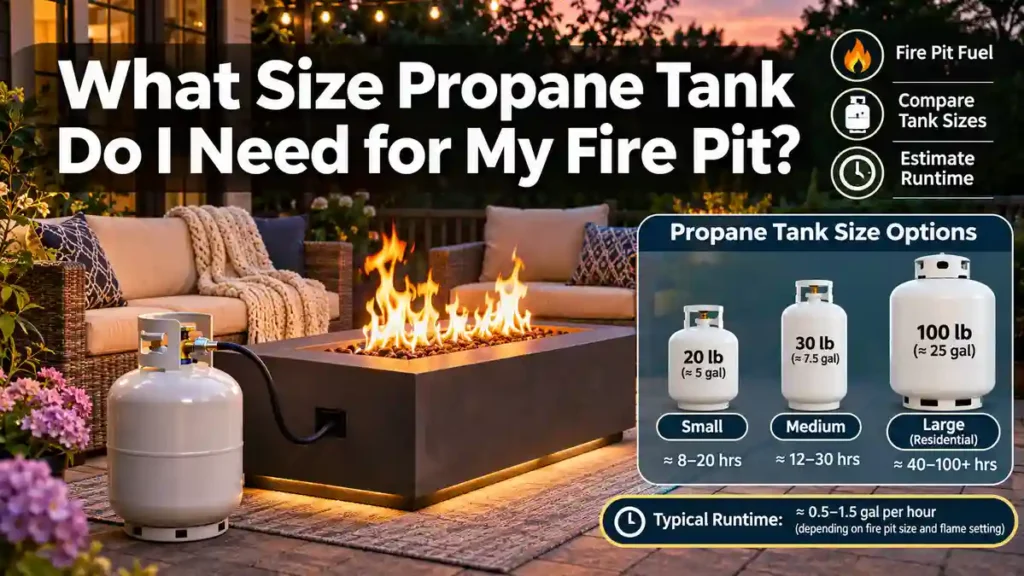
A compatible 30 lb or 40 lb cylinder can be useful for frequent patio use, but manufacturer requirements, local codes and safe cylinder placement govern your choices. For a complete tank-selection guide, read What Size Propane Tank Do I Need for My Fire Pit?, now published in the Propane Fire Pits category.
Decision Guide: When Should You Refill or Keep a Spare?
| Your plan | My suggested approach | Reason |
|---|---|---|
| Two-hour casual evening | One known-full cylinder | Plenty of mathematical margin for common 40k–50k BTU units |
| Four-hour gathering | Check actual tank contents | A 50k BTU burner consumes about 46% of a full tank |
| Six- to eight-hour event | Keep a compatible spare | Avoids betting the event on the last calculated hour |
| Weekly fire pit use | Record burn hours and refill weights | Builds a personalized fuel budget |
| Cold night or high-input burner | Confirm vapor supply with manufacturer/supplier | Supply limitations can occur before tank is empty |
I like this approach because it converts an abstract runtime estimate into an action. Rather than worry about a gauge reading, you decide what event you are planning and how serious it would be if the flame stopped early.
Fire Pit and Propane Tank Safety Checklist
Propane fire pits are outdoor combustion appliances. Never run them in a house, garage, tent, enclosed porch or any enclosure prohibited by the manufacturer; dangerous carbon monoxide can accumulate. Respect the appliance’s required open-air ventilation, clearances from combustible materials, overhead structures and flooring restrictions.
Keep a standard vapor-withdrawal cylinder upright and stable. Follow the manual for cylinder location: some tables require an external tank, while others include an approved ventilated compartment. Do not assume one fire table’s instructions apply to another.
Before use, inspect accessible hoses and fittings for obvious damage. After connecting a cylinder, perform the manufacturer-prescribed leak check using the recommended detection solution. Never look for leaks with an open flame. If you smell propane or hear hissing, stop use, shut off the supply if safe, keep people away from ignition sources and follow local emergency or supplier instructions.
Never try to extend runtime by bypassing a regulator, modifying the burner, tipping the cylinder or applying direct heat to it. Keep children and pets away from flames and hot surfaces. Never leave a lit fire pit unattended or operate it while everyone sleeps.
Troubleshooting: When Your Fire Pit Runs Out Too Soon
| Symptom | Possible explanation | Safe response |
|---|---|---|
| Flame ends earlier than chart | Exchange tank underfilled or partly used | Confirm fuel quantity and rated input |
| Weak flame in cold weather | Inadequate vaporization | Stop and consult manual or qualified supplier |
| Flame fluctuates in wind | Airflow disturbance | Use only approved shielding |
| Low flame after reconnecting cylinder | Connection, regulator or flow-limiting device issue | Shut down and follow manufacturer checks |
| Propane smell or hissing | Potential leak | Stop use, avoid ignition, follow emergency procedures |
Do not interpret repeated shutdowns or gas odors as a normal sign of low fuel. If a fire pit behaves strangely, safety takes priority over recovering the remaining theoretical burn time.
Frequently Asked Questions
Will a 20 lb propane tank last all night?
A 50,000 BTU/h fire pit has about 8.6 theoretical hours with a true 20 lb fill, which may cover a long evening but not continuous overnight use. Never leave an outdoor fire burning unattended or while sleeping.
How long does a 20 lb tank last at 40,000 BTU?
About 10.8 hours with a full nominal 20 lb fill at full rated input. Lower actual input extends the hours, while less fuel reduces them.
How long does it last at 60,000 BTU?
About 7.2 hours from 20 lb of propane at full rated input, or roughly 5.4 hours with 15 lb of propane.
Why did my tank last only six hours?
A 15 lb fill powering a 50,000 BTU/h fire pit is calculated to last roughly 6.5 hours. A higher-output burner, earlier use of the same cylinder or low-temperature vapor delivery can also explain a shorter session.
Can a 20 lb propane tank last 20 hours?
It can if the actual fuel input averages about 21,500 BTU/h or less. A burner rated 50,000 BTU/h would need to run substantially below its maximum input to approach 20 hours. Do not assume its control knob provides a specific percentage reduction without supporting data.
Does propane last longer with lava rocks or fire glass?
Fire media can influence appearance and radiant comfort, but it does not independently guarantee lower fuel consumption. Use approved media amounts and arrangements; never block burner ports or pile media in ways the manufacturer prohibits.
Can I connect my fire pit to my home’s gas supply?
Only if the appliance and installation are approved for the intended gas type and a qualified professional performs any required conversion and connection. Propane and natural gas systems are not automatically interchangeable.
Ready to replenish your cylinder? See my guide to refilling a propane tank for your fire pit for transport, professional refill steps and cost comparisons.
Final Thoughts: Use the Chart, Then Leave a Margin
The answer to how long does a 20 lb propane tank last on a fire pit is about 8.6 hours for a common 50,000 BTU/h fire pit at full input. But your real decision should be based on the propane actually inside your cylinder and the time you want to entertain.
For the next gathering, I would check the BTU rating, read the net contents, estimate the number of complete evenings available and keep a suitable reserve if running out would be inconvenient. That simple habit makes the runtime chart useful instead of merely interesting.
My Simple Fire Pit Fuel Log for Repeatable Results
One practical way to make this guide more useful over time is to build a small log of how you actually use your own fire pit. Generic runtime charts assume that you burn continuously at a known input rate. Your home pattern may be different: perhaps the flame stays high during dinner but low when you only want atmosphere. A record lets you estimate that mix rather than pretend every evening is identical.
Start with a cylinder whose propane quantity is known. Record the fire pit model, rated BTU input, total operating hours and the approximate flame setting used. When the cylinder is safe and cool, weigh it upright before and after use using a suitable scale. Subtract the difference to determine the approximate pounds consumed. Divide that by the hours the burner operated to estimate your own average pounds per hour.
For example, suppose a 50,000 BTU/h fire table consumes 5 pounds over three evenings totaling six operating hours. Its observed average was about 0.83 pound per hour, considerably below the roughly 2.33 pounds per hour expected at continuous full rated input. That suggests the burner was operating at a reduced average fuel input or that the measurements or records need checking. Treat one session as a starting observation, not a certified performance test.
Repeat the measurements after several gatherings. If your numbers are consistent, use the average to plan future sessions: divide remaining propane pounds by your observed pounds per hour. Always allow a margin, particularly when temperatures, guests or flame preferences will differ. Never perform measurements that require disassembling the regulator, loosening connections or handling a hot, operating appliance.
Before Your Next Backyard Gathering
My final pre-event check would be simple: confirm the cylinder is approved and properly connected, check it contains sufficient fuel, read the burner rating, inspect visible hose condition, review manufacturer clearance requirements and keep an approved reserve if necessary. These steps take far less effort than troubleshooting an unexpectedly extinguished fire in the middle of a gathering.
Explore the Propane Fire Pits category for this topic cluster. Natural follow-up articles include What Size Propane Tank Do I Need for My Fire Pit?, Can You Use a 15 Lb Propane Tank on a Fire Pit?, How Much Does a Propane Fire Pit Cost? and What Are the Downsides of Using a Propane Fire Pit?. These are future internal-link opportunities; I have not presented unpublished pages as live links.

Mike is an experienced propane technician with over 15 years of professional experience in the field. He has dedicated his career to helping customers with their propane needs, from installation to maintenance and repair. Together with Jeremy, he co-founded this website to provide useful information and guidance to customers seeking reliable propane services.