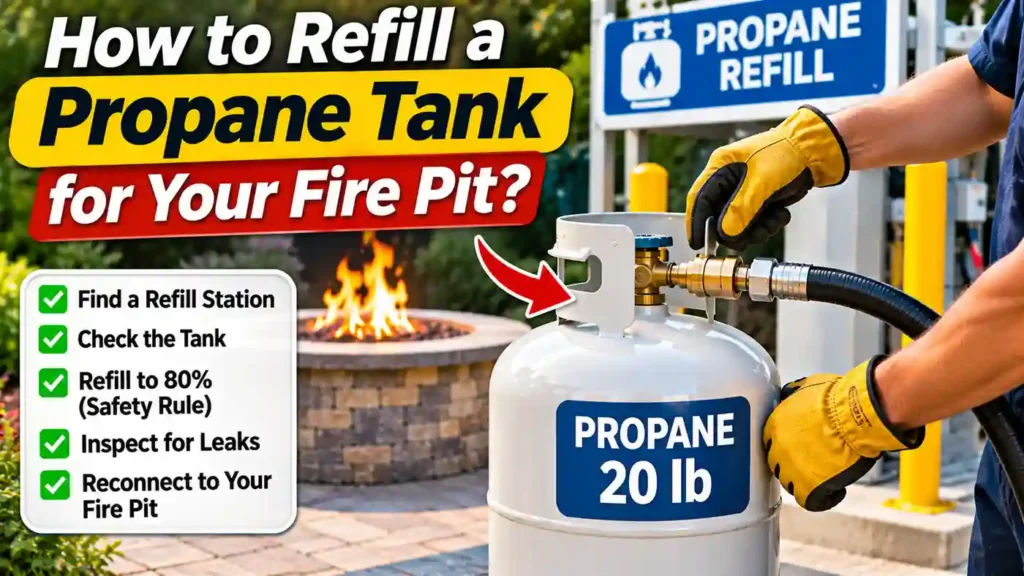
If your propane fire pit is running low, knowing where and how to refill the cylinder can save you money and prevent an inconvenient interruption in the middle of an evening. I’ll walk you through how I would prepare a fire pit cylinder for a professional refill, what happens at the refill station, how to compare refill and exchange prices, and how to estimate your next refill date using the burner’s BTU rating.
Quick Answer
To refill a propane tank for your fire pit, turn off the fire pit and cylinder, allow the appliance to cool, disconnect the cylinder according to its manual, secure it upright for transport, and bring it to a qualified propane refill station. The trained attendant checks the cylinder, verifies that it is eligible for filling, and performs the refill using approved equipment and procedures. Never attempt to transfer propane from another cylinder yourself or bypass the filling safeguards. A standard 20 lb cylinder holds approximately 4.7 gallons of propane when properly full; a 50,000 BTU/hour fire pit uses approximately 0.55 gallon per hour at maximum input.
Where Can You Refill a Propane Tank for a Fire Pit?
I would begin by looking for a retailer or propane supplier that explicitly offers propane cylinder refilling, not only cylinder exchange. Refill services may be available at propane dealers, some hardware or farm stores, RV service businesses, equipment suppliers, and dedicated filling stations. Services differ by location, so call ahead to confirm availability, accepted cylinder sizes, operating hours, and whether attendants are present.


A refill business generally adds propane to your own eligible cylinder. An exchange business provides another cylinder that has already been filled and inspected through its exchange program. Some retailers offer both services, but I never assume that a propane sign means the location offers refilling.
| Where you might go | Service to ask for | Question I would ask |
|---|---|---|
| Dedicated propane supplier | Cylinder refill | Do you fill standard 20 lb fire pit cylinders? |
| Hardware or farm supply store | Refill or exchange | Is the filling station operating today? |
| RV or outdoor equipment center | Cylinder refill | Can you fill my cylinder type and valve? |
| Exchange cage at retailer | Pre-filled exchange | What is the net propane weight included? |
| Cylinder specialist | Inspection and requalification | Can you evaluate an out-of-date cylinder? |
For the fastest trip, I would confirm the price structure before leaving home. Some locations charge by gallons dispensed, while others use a flat price, minimum fee, or specific refill program. Those arrangements can substantially affect value when the cylinder is only partly empty.
How to Prepare Your Fire Pit Propane Tank for Refilling
The consumer’s job is to prepare and transport a safe cylinder, not to operate the filling machinery. I follow a simple sequence designed to avoid disconnecting a pressurized supply while an appliance is running. Your particular fire pit manual always controls the shutdown and disconnection details.
1. Turn off the fire pit completely
Use the burner controls and cylinder valve in the sequence specified by the appliance manufacturer. Allow the appliance and nearby components to cool. Never attempt to change the cylinder while the flames are burning, and do not move a hot fire table to reach an awkward tank compartment.


2. Close the cylinder valve and disconnect correctly
Once the system is shut down and safe, disconnect the approved hose or regulator using the method in your fire pit manual. Do not use unnecessary force or tools on hand-tight connections. If the connection is stuck, damaged, leaking, or unfamiliar, stop and get assistance from a qualified professional.
3. Inspect what you can see without taking the valve apart
Look for visible dents, deep corrosion, fire damage, broken foot rings, missing collars, or damaged valves. These may make the cylinder unacceptable for refill. I would also check the cylinder’s manufacture and requalification markings, although the filling attendant must determine its eligibility.
4. Secure the cylinder upright for the trip
Close its valve, fit any required protective accessories, and secure it upright so it cannot fall or roll. Keep it away from ignition sources. Follow transportation rules, avoid the passenger compartment where possible, and never leave it in a parked hot vehicle. If a cylinder appears to be leaking, do not transport it; withdraw to a safe place and contact the propane supplier or emergency services.
5. Tell the attendant it is a fire pit cylinder
Identify the cylinder type and explain that you want an approved refill. The filling operator should handle the equipment checks, fill-limit determination, and filling process. If the attendant rejects a cylinder because of condition or an expired qualification, do not try a second station hoping to bypass that decision.
What Happens at a Professional Propane Refill Station?
Knowing the general sequence helps you understand what you are paying for, without needing to handle liquid propane yourself. The station assesses whether the cylinder can be safely filled, confirms required markings and condition, uses approved filling equipment, and verifies the appropriate fuel quantity according to applicable procedures.



| Station stage | What the attendant handles | What it means for you |
|---|---|---|
| Cylinder identification | Checks markings, type and capacity | Determines whether the station can fill it |
| Safety screening | Examines damage and required dates | Unsafe cylinders must not be filled |
| Approved filling procedure | Uses the required equipment and filling controls | Prevents uncontrolled or excessive filling |
| Completion check | Verifies fill and connection integrity as required | Cylinder is returned ready for safe transport |
| Billing | Measures dispensed fuel or applies station price | Check how many gallons or pounds you received |
There is no reason for a fire pit owner to learn how to open liquid-withdrawal valves, transfer liquid propane, or manipulate a fixed liquid-level gauge for self-filling. These are jobs for trained filling personnel. The useful skill for a homeowner is recognizing a legitimate, well-managed refill service and keeping the cylinder in good condition.
How Much Propane Goes Into a 20 Lb Fire Pit Tank?
A conventional nominal 20 lb cylinder holds approximately 20 pounds of propane, equivalent to about 4.7 U.S. liquid gallons at a typical reference density. The 20 lb figure is the nominal propane capacity, not the empty container’s weight. It already reflects the required expansion space. Do not multiply the stated 20 lb propane capacity by 80% again.
| Tank contents | Approximate propane gallons | Fuel energy | 50,000 BTU/h runtime |
|---|---|---|---|
| 5 lb remaining | 1.18 | 107,500 BTU | 2.2 h |
| 10 lb remaining | 2.36 | 215,000 BTU | 4.3 h |
| 15 lb exchange fuel load | 3.54 | 322,500 BTU | 6.5 h |
| 20 lb full fuel load | 4.72 | 430,000 BTU | 8.6 h |
When you bring a partially full cylinder for refill, the amount added is the difference between its starting fuel and the permitted final contents, subject to the filling station’s approved method and actual conditions. Do not assume every visit requires exactly 4.7 gallons. A professional filling station will establish the safe amount.
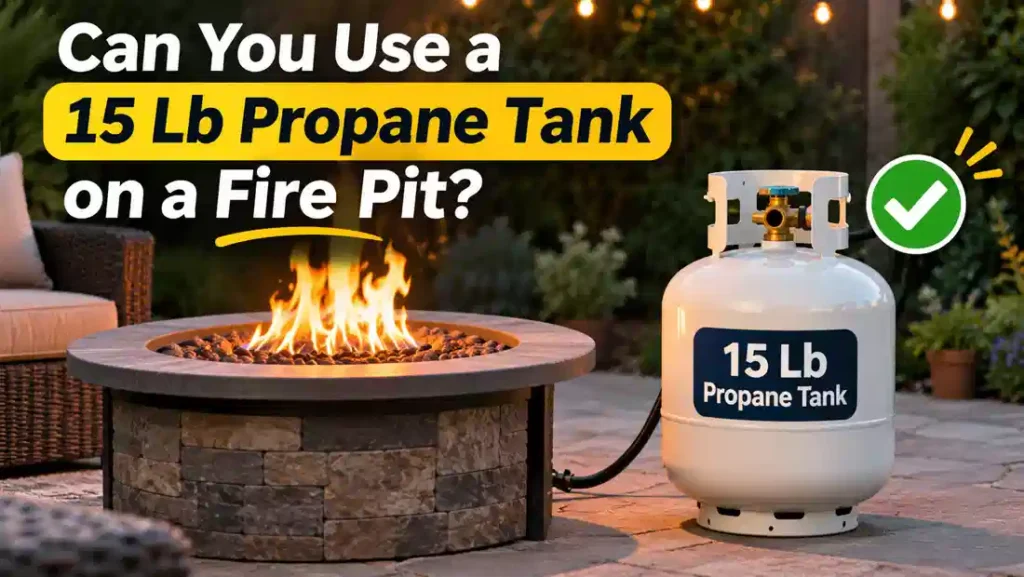
A common confusion is the difference between a standard 20 lb cylinder and a retail cylinder exchange that supplies only 15 lb of propane. I compare those situations in Can You Use a 15 Lb Propane Tank on a Fire Pit?. This matters when comparing refill receipts with exchange labels.


Refill vs Exchange: Which Is Better for a Fire Pit?
I see refill and exchange as two different services rather than one universally better option. Refilling may be attractive when the cylinder is in good condition, within its qualification period, and you pay for the amount of propane supplied. Exchange can be convenient when you want a ready-to-use cylinder and the exchange program accepts the container.
The essential comparison is the net quantity received. If you are quoted $22 for an exchange with 15 lb of propane and $24 for a full 20 lb refill, the $22 option is not necessarily cheaper per pound. You would be buying less fuel.
| Illustrative transaction | Fuel delivered | Total price | Price per propane lb | Price per propane gal |
|---|---|---|---|---|
| 15 lb exchange | 15 lb | $22 | $1.47 | $6.22 |
| 15 lb exchange | 15 lb | $26 | $1.73 | $7.35 |
| 20 lb refill | 20 lb | $20 | $1.00 | $4.24 |
| 20 lb refill | 20 lb | $24 | $1.20 | $5.09 |
These are hypothetical examples rather than live store quotations. A refill that adds only 10 lb of propane would need a different comparison than a refill that supplies the full 20 lb. Ask for the quantity dispensed, not simply the word ‘refill’ on the sign.
My preference would depend on the condition of the cylinder and the local options. If I have a serviceable cylinder and a convenient nearby refill location, I would compare per-pound costs. If my cylinder is nearing a required requalification or is damaged, I would investigate an approved exchange or replacement instead.
How Much Does It Cost to Refill a 20 Lb Propane Tank?
A useful budgeting method is to multiply actual gallons added by the station’s per-gallon price. A theoretical full 20 lb fuel load is about 4.72 gallons. At a hypothetical $3.50 per gallon, 4.72 gallons would cost about $16.52 before taxes or fees. But a cylinder that still contains fuel will usually take less.
| Illustrative fuel price | 5 lb added (1.18 gal) | 10 lb added (2.36 gal) | 20 lb added (4.72 gal) |
|---|---|---|---|
| $3.00/gal | $3.54 | $7.08 | $14.15 |
| $3.50/gal | $4.13 | $8.25 | $16.51 |
| $4.00/gal | $4.72 | $9.43 | $18.87 |
| $4.50/gal | $5.31 | $10.61 | $21.23 |
| $5.00/gal | $5.90 | $11.79 | $23.58 |
For example, if your existing cylinder contains 6 lb and the station fills it to an actual 20 lb fuel load, that is roughly 14 lb added, or 3.30 gallons. At a hypothetical $4 per gallon, that would be approximately $13.21 in fuel. Local minimum charges or a flat-rate policy can change the final bill.
I would also factor in the cost of travel. A station that saves $2 but requires a long drive may not be the best practical choice, particularly if you refill only once every few months. Convenience is an economic factor too, although it does not appear on the price per gallon label.
Worked Example: What Will My Fire Pit Refill Really Cost?
Suppose your 50,000 BTU/hour fire table has run for five hours at its maximum input since you last filled a standard 20 lb cylinder. Start by estimating consumption in pounds: five hours multiplied by 50,000 BTU/hour equals 250,000 BTU. Divide that by approximately 21,500 BTU per pound.
| Calculation step | Formula | Result |
|---|---|---|
| Energy consumed | 50,000 × 5 | 250,000 BTU |
| Propane burned | 250,000 ÷ 21,500 | 11.63 lb |
| Approximate fuel remaining | 20 − 11.63 | 8.37 lb |
| Potential propane to add | 20 − 8.37 | 11.63 lb |
| Approximate gallons added | 11.63 ÷ 4.24 | 2.74 gal |
| Illustrative price at $4/gal | 2.74 × $4 | $10.96 |
This is an approximate planning example, not an instruction to fill to a particular weight. Only a qualified attendant determines the actual allowable fill under the applicable conditions. It also assumes the fire pit consumed propane at its full rating for all five hours. If you spent much of that time at low flame, the actual consumption could be less.
The key insight is that your refill bill depends on what is missing, not merely on the name ’20 lb cylinder.’ Keeping an hour log can make that fuel expense more predictable over time.
How Long Will Your Refilled Cylinder Last?
Use a fire pit’s BTU-per-hour input to convert propane into expected hours. I use approximately 430,000 BTU for a full 20 lb fuel load, then divide by the fire pit’s maximum rated BTU/hour input. The result is a useful starting point for scheduling the next refill.
| Burner rating | Propane per hour | Full 20 lb runtime | 15 lb exchange runtime |
|---|---|---|---|
| 20,000 BTU/h | 0.22 gal/h | 21.5 h | 16.1 h |
| 30,000 BTU/h | 0.33 gal/h | 14.3 h | 10.8 h |
| 40,000 BTU/h | 0.44 gal/h | 10.8 h | 8.1 h |
| 50,000 BTU/h | 0.55 gal/h | 8.6 h | 6.5 h |
| 60,000 BTU/h | 0.66 gal/h | 7.2 h | 5.4 h |
| 75,000 BTU/h | 0.82 gal/h | 5.7 h | 4.3 h |
| 100,000 BTU/h | 1.09 gal/h | 4.3 h | 3.2 h |
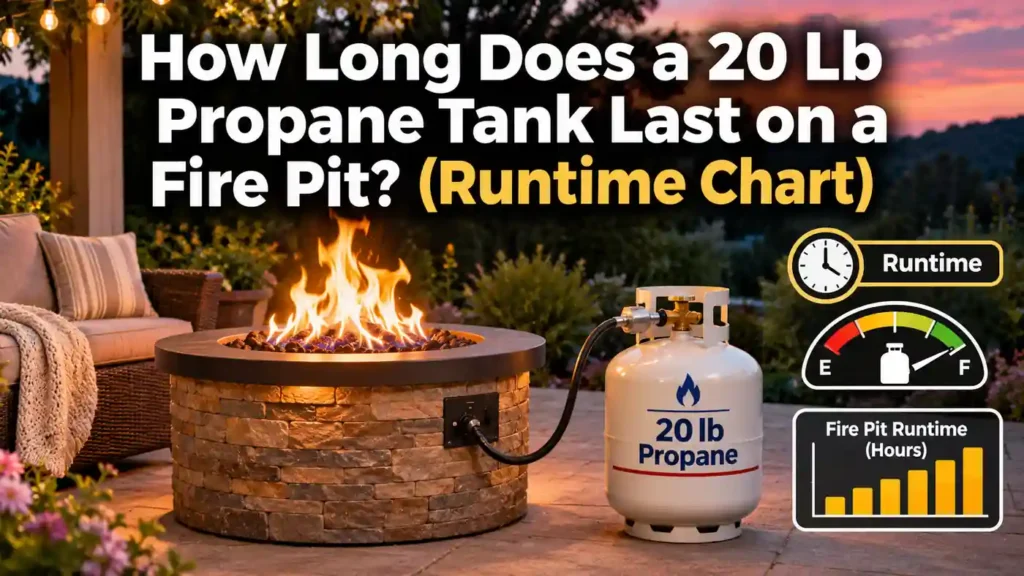
These are theoretical results at full rated input. Wind, cold temperatures, underfilling and reduced flame settings can change actual operating hours. For a focused discussion of those differences, see How Long Does a 20 Lb Propane Tank Last on a Fire Pit? (Runtime Chart).
Interactive Runtime Estimates: Choose Your Fire Pit Rating
Open the panel matching your burner to see how many hours different fuel amounts could provide. These native expandable panels work on mobile and desktop without additional software. You can compare a nearly empty cylinder, a 15 lb exchange fuel load, and a nominally full 20 lb cylinder.
30,000 BTU/hour — expand estimated runtime
| Propane available | Full-rate runtime | Complete 3-hour evenings |
|---|---|---|
| 5 lb | 3.6 hours | 1 complete 3-hour gatherings |
| 8 lb | 5.7 hours | 1 complete 3-hour gatherings |
| 10 lb | 7.2 hours | 2 complete 3-hour gatherings |
| 12 lb | 8.6 hours | 2 complete 3-hour gatherings |
| 15 lb | 10.8 hours | 3 complete 3-hour gatherings |
| 18 lb | 12.9 hours | 4 complete 3-hour gatherings |
| 20 lb | 14.3 hours | 4 complete 3-hour gatherings |
40,000 BTU/hour — expand estimated runtime
| Propane available | Full-rate runtime | Complete 3-hour evenings |
|---|---|---|
| 5 lb | 2.7 hours | 0 complete 3-hour gatherings |
| 8 lb | 4.3 hours | 1 complete 3-hour gatherings |
| 10 lb | 5.4 hours | 1 complete 3-hour gatherings |
| 12 lb | 6.5 hours | 2 complete 3-hour gatherings |
| 15 lb | 8.1 hours | 2 complete 3-hour gatherings |
| 18 lb | 9.7 hours | 3 complete 3-hour gatherings |
| 20 lb | 10.8 hours | 3 complete 3-hour gatherings |
50,000 BTU/hour — expand estimated runtime
| Propane available | Full-rate runtime | Complete 3-hour evenings |
|---|---|---|
| 5 lb | 2.1 hours | 0 complete 3-hour gatherings |
| 8 lb | 3.4 hours | 1 complete 3-hour gatherings |
| 10 lb | 4.3 hours | 1 complete 3-hour gatherings |
| 12 lb | 5.2 hours | 1 complete 3-hour gatherings |
| 15 lb | 6.5 hours | 2 complete 3-hour gatherings |
| 18 lb | 7.7 hours | 2 complete 3-hour gatherings |
| 20 lb | 8.6 hours | 2 complete 3-hour gatherings |
60,000 BTU/hour — expand estimated runtime
| Propane available | Full-rate runtime | Complete 3-hour evenings |
|---|---|---|
| 5 lb | 1.8 hours | 0 complete 3-hour gatherings |
| 8 lb | 2.9 hours | 0 complete 3-hour gatherings |
| 10 lb | 3.6 hours | 1 complete 3-hour gatherings |
| 12 lb | 4.3 hours | 1 complete 3-hour gatherings |
| 15 lb | 5.4 hours | 1 complete 3-hour gatherings |
| 18 lb | 6.5 hours | 2 complete 3-hour gatherings |
| 20 lb | 7.2 hours | 2 complete 3-hour gatherings |
75,000 BTU/hour — expand estimated runtime
| Propane available | Full-rate runtime | Complete 3-hour evenings |
|---|---|---|
| 5 lb | 1.4 hours | 0 complete 3-hour gatherings |
| 8 lb | 2.3 hours | 0 complete 3-hour gatherings |
| 10 lb | 2.9 hours | 0 complete 3-hour gatherings |
| 12 lb | 3.4 hours | 1 complete 3-hour gatherings |
| 15 lb | 4.3 hours | 1 complete 3-hour gatherings |
| 18 lb | 5.2 hours | 1 complete 3-hour gatherings |
| 20 lb | 5.7 hours | 1 complete 3-hour gatherings |
For a burner with a different input, multiply pounds of propane by 21,500 and divide by BTU per hour. Don’t assume that a knob turned halfway reduces BTU consumption by exactly half. Use manufacturer data or observed fuel use for an improved low-setting estimate.
How Do You Know When the Fire Pit Tank Needs a Refill?
I prefer a practical usage record to guessing from flame height. A scale can also help estimate how much propane remains, provided you know the cylinder’s stamped tare weight. The difference between the measured total weight and tare weight gives an approximate fuel mass.
| Example measurement | Weight or result |
|---|---|
| Stamped empty tare weight (TW) | 18 lb |
| Cylinder measured on scale | 27 lb |
| Estimated remaining propane | 9 lb |
| Available propane energy | 193,500 BTU |
| 50,000 BTU/h estimated runtime | 3.87 h |
Pressure-only fuel gauges are often unreliable as a precise measure of the liquid remaining because cylinder pressure changes with temperature. A scale and a simple record of burner hours give you a more meaningful estimate. A cylinder that feels heavy is not necessarily sufficiently full for a long gathering.
Before an important event, I would compare the planned hours with the estimated remaining fuel and keep a correctly stored, approved spare if necessary. I wouldn’t arrange a five-hour gathering around a cylinder with only 3.9 theoretical hours of fuel.
Can You Refill a Propane Tank Before It Is Empty?
Often yes, provided the cylinder is eligible and the service station permits partial refills. A professional filling operation determines the actual quantity added using the applicable procedure. Some businesses charge by the gallon dispensed and others may impose a minimum amount or flat price, so ask before visiting.
An early refill can be useful when you want a full cylinder before a family party. But if the retailer charges a substantial minimum, topping off after every short fire pit session may be expensive. My decision would be based on the next event date, estimated fuel remaining and the refill business’s pricing structure.
When a Propane Cylinder May Be Refused for Refilling
An attendant may refuse to fill a cylinder due to expired qualification, excessive corrosion, damaged valves, missing protective components, dents, bulges, heat damage or other disqualifying conditions. That is an important safety decision, not an inconvenience to get around.
U.S. DOT cylinders have manufacturer and, where applicable, requalification markings. Federal requirements include periodic requalification; the applicable interval depends on cylinder type and test method. Many common cylinders need initial requalification within 12 years of manufacture, with later intervals depending on the method. Always rely on the current marking and the filling professional’s assessment rather than assuming one date applies to every cylinder.
| What to inspect | Why it matters | What I’d do |
|---|---|---|
| Manufacture/requalification markings | Helps establish legal filling eligibility | Ask qualified station to verify |
| Dents or bulges | May compromise pressure vessel | Do not use; seek assessment |
| Deep rust or pitting | May weaken the cylinder | Avoid refill until assessed |
| Valve or relief-device damage | Leak and overpressure risk | Do not attempt repair yourself |
| Damaged collar or foot ring | Unsafe protection or standing stability | Have a professional inspect |
| Evidence of fire or extreme heat | Potential material damage | Remove from use and seek qualified advice |
If your cylinder is rejected, ask whether an approved exchange, replacement or authorized requalification service is appropriate. Do not scrape over markings, paint over damage or try to replace valve components yourself. A rejected cylinder should be handled through a proper supplier or qualified facility.
What Is the 80% Fill Rule for Fire Pit Propane Tanks?
Propane needs vapor space inside a cylinder because the liquid expands with warming. The familiar 80% fill principle refers to a typical liquid volume limit relative to the container’s internal water volume. It does not mean a standard cylinder rated for 20 pounds of propane should automatically be filled with only 16 pounds.
The nominal 20 lb propane rating already reflects the cylinder’s designed fuel capacity. A 15 lb exchange label generally identifies the net fuel quantity the exchange seller supplied, not a universal legal limit of 15 lb. A properly trained attendant determines the actual fill according to the applicable cylinder and temperature requirements.
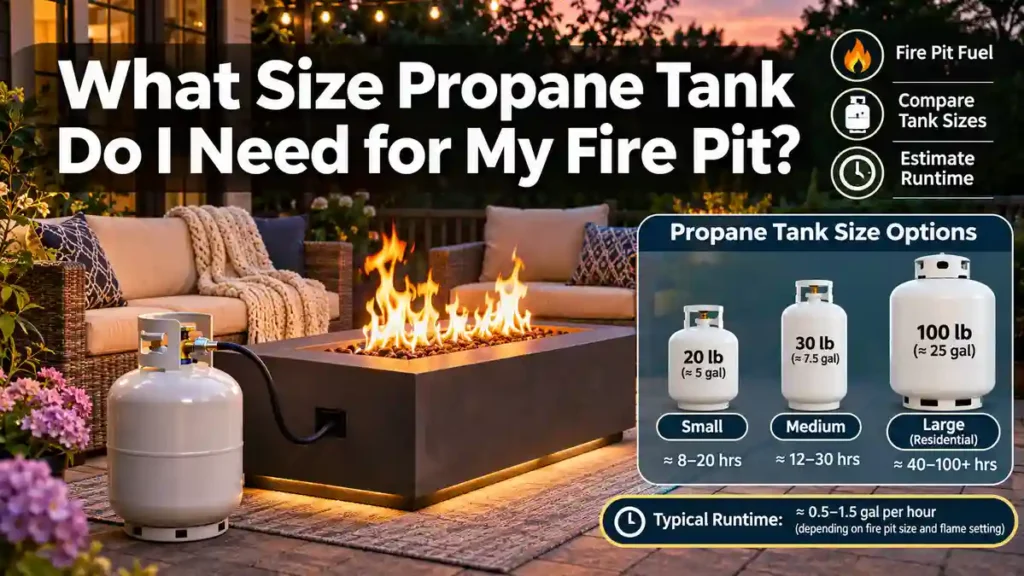
If you are wondering whether a different cylinder size is appropriate for your fire pit, read What Size Propane Tank Do I Need for My Fire Pit?. That companion article separates energy capacity from physical compatibility.
How to Transport a Propane Cylinder Safely After Refilling
The trip home deserves as much attention as the visit to the filling station. I would secure the cylinder upright in a well-ventilated appropriate vehicle area, use restraints to keep it from rolling, and drive directly home. Keep the valve closed, avoid sources of ignition and follow local rules and the supplier’s transport guidance.
Do not place a cylinder loosely on its side, and never carry one that has a suspected leak. Avoid the passenger compartment where possible. Never leave a cylinder in a closed vehicle or trunk exposed to heat, particularly during a long shopping stop. If you cannot arrange proper transport, ask whether the supplier offers a suitable delivery option.
Once home, store the cylinder outdoors in its required upright position, away from ignition sources and protected against being knocked over. Never store spare propane cylinders in living spaces, basements or attached garages. Keep the cylinder valve closed when not connected.
How to Reconnect the Refilled Tank to Your Fire Pit
Use only the cylinder, hose and regulator arrangement specified by the fire pit manufacturer. With the burner off and all components cool, place the cylinder in its approved location and connect it exactly as described in the manual. Do not use a homemade adapter or substitute regulator to make an incompatible valve fit.
Follow the fire pit manufacturer’s leak-check instructions each time you reconnect a cylinder. Approved leak-detection solution is commonly used on relevant connections; a match or lighter must never be used to find leaks. If bubbles indicate leakage or you smell gas, close the valve if safe, stop use and have the problem corrected.
After a satisfactory connection and leak check, operate the burner only according to the approved lighting procedure. If the flame is abnormally weak or the appliance shuts off repeatedly, do not force more gas through the system. Consult the manual or a qualified service professional.
My Refill or Exchange Decision Guide
| Your situation | What I would choose | Reason |
|---|---|---|
| Cylinder in good condition; refill nearby | Compare professional refill price | May pay for actual fuel added |
| No convenient refill service | Approved exchange option | Convenience may outweigh cost difference |
| Cylinder overdue for requalification | Qualified inspection or approved exchange | Filling eligibility must be restored |
| Party planned tomorrow; tank partly full | Check actual fuel and station pricing | Avoid mid-party interruption |
| Old cylinder with serious damage | Stop using and seek replacement guidance | Safety takes priority over savings |
| Frequent fire pit use | Log fuel consumption and compare options | Makes long-term costs clearer |
I would not judge a refill service solely by the lowest price. Professional handling, proper inspection, accurate quantity measurement and a convenient location all matter. The difference between a reliable fueling option and a risky shortcut is worth more than a small price saving.
My Personal Planning Method: Record Cost per Fire Pit Evening
For better long-term planning, I suggest a small fuel log with the date, whether you refilled or exchanged, the net propane quantity, the price, and estimated burner hours. After several gatherings, the log lets you compare cost per hour with your own actual usage rather than generic claims about how long a tank ought to last.
| Example fuel log | Fuel bought | Fuel cost | Recorded burn hours | Effective fuel cost/hour |
|---|---|---|---|---|
| Example refill A | 20 lb | $20 | 8.0 h | $2.50 |
| Example exchange B | 15 lb | $24 | 6.0 h | $4.00 |
| Example refill C | 20 lb | $24 | 9.5 h | $2.53 |
These numbers are entirely illustrative. The real cost per hour in your own log will vary with flame settings, weather, actual fuel delivered and whether you used up the whole fill. A record of several complete cycles is more reliable than dividing one receipt by an incomplete evening.
I consider this a particularly useful engagement feature for repeat visitors: readers can return after each refill, compare new results with the reference chart and refine their own estimate. Unlike a claimed universal burn rate, a household fuel log adapts to the way someone actually uses their patio.
Common Refill Mistakes I Would Avoid
Assuming exchange and refill mean the same thing
A refill returns your own cylinder with propane added; an exchange swaps it for another. Compare actual fuel quantities and cylinder eligibility, not only the word on the retailer’s sign.
Driving around with a loose cylinder
Even a seemingly empty cylinder may contain propane vapor. Always secure it upright, close the valve, protect it from damage and follow transport guidance.
Trying to squeeze more propane into a full tank
Overfilling is dangerous because liquid propane needs expansion space. Leave filling and fill-limit verification to trained attendants. Never bypass protective devices.
Ignoring the manufacture or requalification date
A cylinder can look acceptable but still be overdue for required requalification. A legitimate filling station must check eligibility before refilling.
Waiting until a party to learn the tank is empty
Make a quick fuel estimate before guests arrive and consider an approved spare. A little planning prevents a preventable interruption.
Frequently Asked Questions
Can I refill my fire pit propane tank myself?
I recommend taking it to a qualified propane filling station rather than attempting cylinder-to-cylinder transfer at home. Propane filling involves pressurized flammable liquid, controlled fill limits and equipment checks. Untrained transfer can cause serious fire, explosion or injury hazards.
How much does it cost to refill a 20 lb propane tank?
It depends on local prices and how much fuel is added. A nominally full 20 lb cylinder contains about 4.7 gallons. At a hypothetical $4 per gallon, that quantity costs roughly $18.87 before fees and taxes. A partially full cylinder generally takes less fuel.
Can I refill a tank that still contains propane?
Often yes, if the cylinder is eligible and the filling station offers partial refills. Ask whether the station charges for actual gallons, has a minimum fee or uses flat pricing.
How often should I refill my propane fire pit tank?
At 50,000 BTU/hour, a full 20 lb fuel load provides about 8.6 theoretical hours at maximum rated input. If you use the fire pit two hours per weekend, it may last approximately four such sessions. Your actual interval depends on flame settings, refill amount and conditions.
Is a 15 lb propane exchange the same as a full 20 lb refill?
No. A cylinder rated to hold 20 lb may be exchanged with just 15 lb inside. That provides roughly 25% less fuel energy than a full 20 lb load. Check the net contents label.
Do I need to replace the cylinder instead of refilling?
Possibly if it is damaged, cannot be requalified, has defective components or has reached the relevant service limitations. A qualified refill station or cylinder specialist should assess it.
Is it safe to transport a propane cylinder in a car?
Follow local transport rules and supplier advice. The cylinder should be upright, secured, valve closed and kept away from heat and ignition. Avoid passenger areas when possible, and never transport a leaking cylinder.
Why does the fire pit have a low flame after a refill?
Possible causes include incorrect connection, flow restriction, cold-temperature vaporization limitations or equipment malfunction. Shut down and consult the manufacturer’s instructions rather than altering pressure or parts.
Final Thoughts: A Safe Refill Is More Than Adding Fuel
The best way to refill a propane tank for your fire pit is to use a qualified filling service, confirm the cylinder is eligible, transport it correctly and reconnect it according to the manufacturer’s instructions. For a typical 20 lb cylinder and 50,000 BTU/hour fire pit, I use about 8.6 hours as the theoretical maximum-input planning figure.
Beyond the refill itself, I would keep a record of gallons purchased, price paid, and burn hours. That turns a vague question like ‘when will my tank be empty?’ into a realistic fuel plan that helps you budget for the next evening.
Continue your fire pit planning with How Long Does a 20 Lb Propane Tank Last on a Fire Pit?, What Size Propane Tank Do I Need for My Fire Pit?, and Can You Use a 15 Lb Propane Tank on a Fire Pit?. All three belong to the Propane Fire Pits article hub; no external links are required to navigate this cluster.

Mike is an experienced propane technician with over 15 years of professional experience in the field. He has dedicated his career to helping customers with their propane needs, from installation to maintenance and repair. Together with Jeremy, he co-founded this website to provide useful information and guidance to customers seeking reliable propane services.