QUICK ANSWER
Why Won’t My Propane Fire Pit Stay Lit?
If your propane fire pit lights but keeps going out, I would check the propane supply, the lighting procedure, wind, burner obstructions and the flame-safety system before assuming the whole fire pit is defective. A weak flame from the start may mean low fuel or restricted flow. A flame that disappears the moment you release the control knob may indicate that the thermocouple has not heated sufficiently or the safety valve is not detecting a flame. A flame that gradually shrinks after several minutes may point toward limited propane vaporization or inadequate gas supply.
My first rule: If you smell gas, hear gas escaping, notice damaged connections or see flames where they do not belong, stop using the unit. Shut off the supply only if it is safe to do so, move people away and contact your gas supplier or emergency services. Never defeat a thermocouple, alter an orifice or increase regulator pressure to force a flame to stay lit.
When a fire pit repeatedly shuts off, the most useful clue is when it happens. I prefer to describe the exact symptom first, then make one safe change at a time. That avoids spending money on a replacement regulator when the real problem is an almost-empty cylinder, or blaming wind when the burner is barely receiving gas.
What Does the Flame Do Before It Goes Out?
This is the quick-reference chart I would use to decide where to investigate first. It is a diagnostic starting point, not a substitute for the instructions for your particular model.
| What you observe | Possible explanation | My next safe check |
|---|---|---|
| Flame dies as soon as the knob is released | Lighting sequence, thermocouple or safety-valve issue | Follow the exact knob-hold time in the manual; then seek service if persistent |
| Tiny flame immediately after opening a new tank | Excess-flow protection may be limiting supply | Shut down and follow the model-specific reset procedure |
| Normal flame becomes smaller after several minutes | Low fuel, cold cylinder, limited vaporization or supply restriction | Check cylinder fuel quantity and environmental conditions |
| Flame goes out during gusts | Wind disrupting combustion or flame sensing | Stop use in windy conditions; follow approved wind-protection guidance |
| Only part of the burner stays lit | Covered or blocked ports; inappropriate fire media placement | Cool unit, inspect visible ports and media arrangement per manual |
| Lights inconsistently after rain | Moisture at ignition or burner components | Allow everything to dry fully before using the prescribed relight procedure |
| Black soot, unusual roaring or flames underneath | Potential combustion or gas-system fault | Turn off and arrange professional inspection |
Eight Reasons a Propane Fire Pit Keeps Going Out
1. The Propane Cylinder Is Empty or Lower Than You Think
I begin with fuel quantity because it is simple to check and often overlooked. A cylinder can still feel heavy because the steel container itself weighs quite a bit. A pressure dial is not a reliable measure of liquid propane remaining: propane pressure depends heavily on temperature and often changes little until the cylinder is nearly empty.
For an ordinary portable 20-pound cylinder, I would look for the tare weight marked TW on the collar. With the cylinder safely disconnected, upright and cool, its approximate fuel weight is the measured total weight minus TW. For example, if TW is 18 pounds and the scale reads 24 pounds, about 6 pounds of propane remain. That is roughly 30% of a true 20-pound fill by weight.


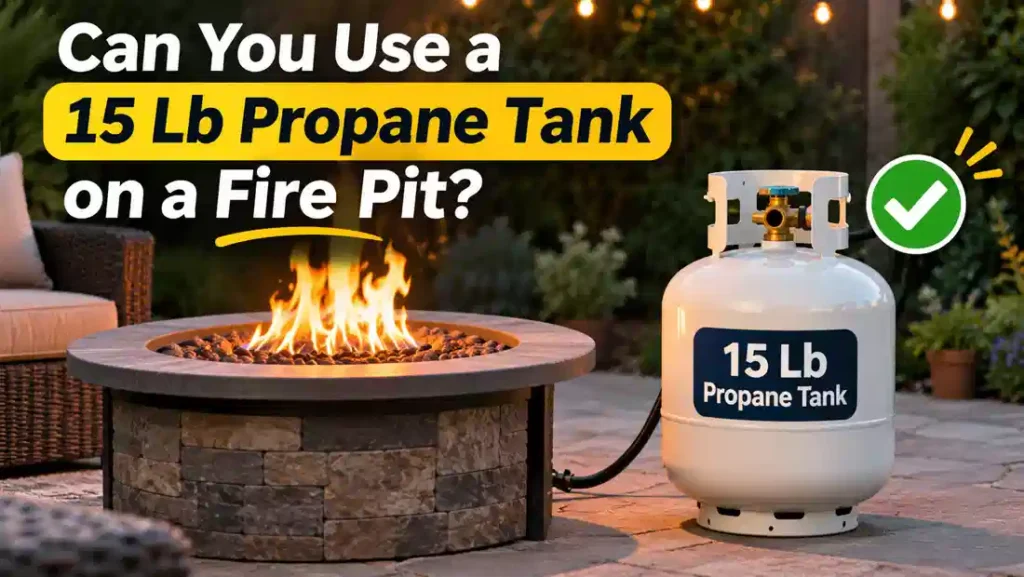
Do not confuse a 20-pound cylinder’s rated fuel capacity with the amount sold in every tank exchange. Some exchanged cylinders contain only 15 pounds of propane even though the steel cylinder is rated for 20. If a fire pit runs for a shorter time after an exchange, the actual net fuel weight deserves attention.
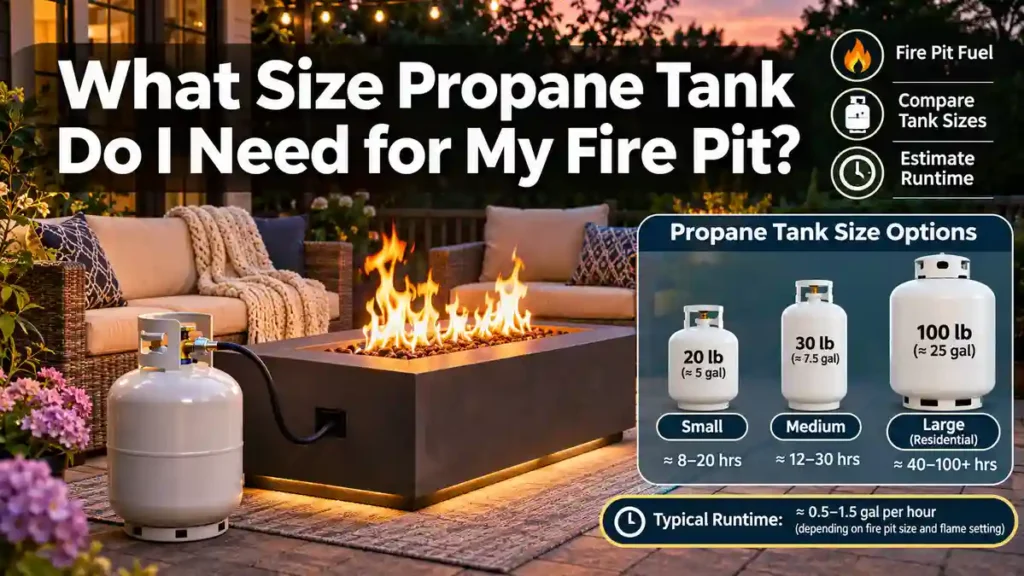
If you are comparing tank sizes, begin with a cylinder specifically approved for your model. More propane does not automatically solve a faulty valve, and a larger tank does not make an unsafe burner safe.
2. The Excess-Flow Safety Device Has Restricted the Gas
Many portable fire pits use a Type 1/QCC1 hose-and-regulator assembly with excess-flow protection. If the system senses an abnormally rapid flow, it can restrict the fuel supply. To you, it may appear that the fire pit starts, produces only a small flame and then dies. This can happen after a tank change or an incorrect lighting sequence, although a genuine leak can also cause excess flow.
I would first turn the burner off and close the cylinder valve. After the waiting period specified by the fire-pit manual, I would follow the manufacturer’s reset instructions, which often include disconnecting and reconnecting the regulator while everything is off, leak-checking the connection, and reopening the cylinder valve slowly before lighting. There is no universal reset sequence for every fire pit.
If the safety device restricts flow again after a correct reset, I would stop repeating the procedure. A connection leak, damaged hose or defective part needs proper evaluation. I would never disable the flow limiter or use an adapter to defeat it.



3. The Thermocouple Is Not Detecting a Stable Flame
On some push-button and pilot-equipped propane fire pits, a thermocouple is part of the flame-failure safety mechanism. The sensing tip must be heated by the intended flame before the safety valve will stay open. If that does not happen, the gas supply shuts off as a protective measure.
The classic clue is that the fire pit burns while the control knob is held in but goes out when the knob is released. Sometimes the correct fix is simply to follow the required holding time in the owner’s manual. Different models require different sequences, so I do not prescribe one hold time for every appliance.
After the fire pit is off, disconnected where instructed, and fully cool, you may inspect the visible area around the sensor for loose decorative material or surface debris if your manual permits that inspection. Do not bend the sensor, disconnect safety wiring, bypass the magnetic valve or try to keep the knob physically wedged open. If correct lighting and permitted exterior cleaning do not solve it, a qualified service technician should diagnose the thermocouple, pilot assembly and valve.
4. Wind Is Blowing the Flame Away From the Burner
A decorative flame is exposed to the weather. Sudden gusts can blow it off the burner ports, disturb the pilot flame or keep the thermocouple from receiving steady heat. I would compare behavior on a calm evening with what happens when the wind picks up rather than immediately blaming a regulator.


I would not build a makeshift wind shield from combustible boards or glass that was not approved for that fire pit. Some manufacturers offer compatible guards; others specifically say not to add one because it changes airflow. Follow the manufacturer’s instructions and keep all required side and overhead clearances. If conditions are too windy, the correct solution is to turn the fire pit off and use it another time.
5. Burner Ports, Air Inlets or Fire Media Are Blocking the Flame
Fire glass, lava rock, leaves, dust, spider webs and insect nests can interfere with a burner’s intended airflow. Too much decorative media or material piled directly over an ignition component can also change the flame pattern. I particularly look for the difference between a flame that stays strong along the entire burner and one that only appears in a few patches.
With all gas controls off, the cylinder valve closed, and the appliance completely cool, compare the fire glass or lava rock layout with the manufacturer’s diagram. Remove only the material the manual permits you to move and clear visible loose debris using the approved method. Never enlarge a burner hole, drill an orifice, push a tool into a gas valve or take apart a sealed gas train. If you find heavy soot, corrosion, damaged components or a suspected blockage inside a closed assembly, get professional help.
Media is not merely decoration. Its placement can affect ignition, airflow and flame stability, so I treat the manufacturer’s approved type, depth and layout as operating specifications.
6. The Hose or Regulator Cannot Deliver the Required Gas Flow
The regulator must deliver the correct pressure and enough gas volume for the burner’s maximum input. Those are different things. A regulator that produces the right low pressure at zero flow may still have insufficient capacity when the fire pit is turned to high. A pinched hose can produce the same general symptom.
For many portable low-pressure propane fire pits, the nominal pressure is around 11 inches of water column, or roughly 0.40 psi. Other fire-feature systems use different specifications. I always check the exact rating plate or installation manual rather than treating 11 inches as universal. You can read my dedicated propane fire pit regulator pressure and sizing guide for the pressure-versus-capacity distinction.
Visually check whether a flexible hose is crushed, kinked, abraded or touching a hot surface. Do not attempt to repair a damaged gas hose with tape. For fixed-pipe installations, intermittent flames can also reflect undersized piping or pressure drop elsewhere in the system. Measuring operating gas pressure, changing regulators and modifying a fixed gas line belong to qualified professionals.
7. Cold Weather Is Limiting Propane Vaporization
Propane is stored as a liquid but most residential fire pits burn vapor. The cylinder must absorb enough heat from its surroundings to turn liquid into gas. During heavy withdrawal, the cylinder cools. When the air is cold, the cylinder is small, or the liquid level is low, vapor production may not keep up with a high-BTU burner.
That explains why some fire pits begin with a strong flame, gradually weaken, and then go out even when fuel remains. Frost on the cylinder can accompany high withdrawal; frost alone does not prove a leak or an empty tank. I would shut the unit down and let a cylinder return naturally to normal conditions. Never use a heater, hot water, open flame or direct heat to warm a propane cylinder.
A model-approved larger fuel supply can offer greater vaporization capability, but not every portable fire pit permits larger cylinders or custom connections. Check the manufacturer’s approved configurations and ask your propane supplier if high-BTU demand repeatedly overwhelms a cylinder.
8. Moisture, Ignition Trouble or an Internal Valve Fault Is Involved
A fire pit exposed to rain may have a damp igniter electrode or wet burner media. A low igniter battery can prevent startup on models that use one. These issues matter more when the fire pit will not light at all, but incomplete ignition and a poorly established pilot can also make the flame appear unreliable.
With the unit safely off and cool, check only user-serviceable items identified in the manual, such as an igniter battery or accessible moisture. If it lights consistently but switches off after a repeatable interval despite adequate fuel and calm weather, the internal valve, flame-sense circuit or electronic control may need qualified testing.
I would never experiment by repeatedly lighting a fire pit that hisses, backfires, produces excessive soot or shuts off with an unusual odor. Those are reasons to end the session, not try a stronger flame setting.
My Safe Troubleshooting Checklist, in Order
Once you know the symptom, I would work through this sequence. Every step assumes the fire pit is designed for outdoor propane use, the appliance is cool where inspection is needed, and you have its manual available.
- Check for an emergency condition. If there is a gas smell, hissing, visible damage or abnormal flame outside the burner, stop immediately and move away. Do not operate switches or attempt a relight near suspected leaking gas.
- Read the model plate and lighting instructions. Confirm the appliance is configured for propane and uses the correct listed hose, regulator and cylinder type.
- Verify the fuel amount. Use net cylinder weight or a reliable fill record, not the cylinder’s apparent heaviness alone.
- Inspect accessible exterior parts. Check the hose visually for kinks and damage, and make sure vents and exposed burner areas are not blocked.
- Check decorative media placement. Follow the fire pit’s diagram and permitted cleaning instructions; never rearrange parts while they are hot.
- Follow the proper lighting procedure once. Observe the prescribed waiting and control-knob instructions. Do not improvise a reset sequence.
- Record exactly when the flame changes. Note whether it is immediately, upon releasing the knob, during wind, or after several minutes of operation.
- Stop if the symptom persists. Have the manufacturer or a qualified gas-service professional inspect components that are not explicitly user-serviceable.
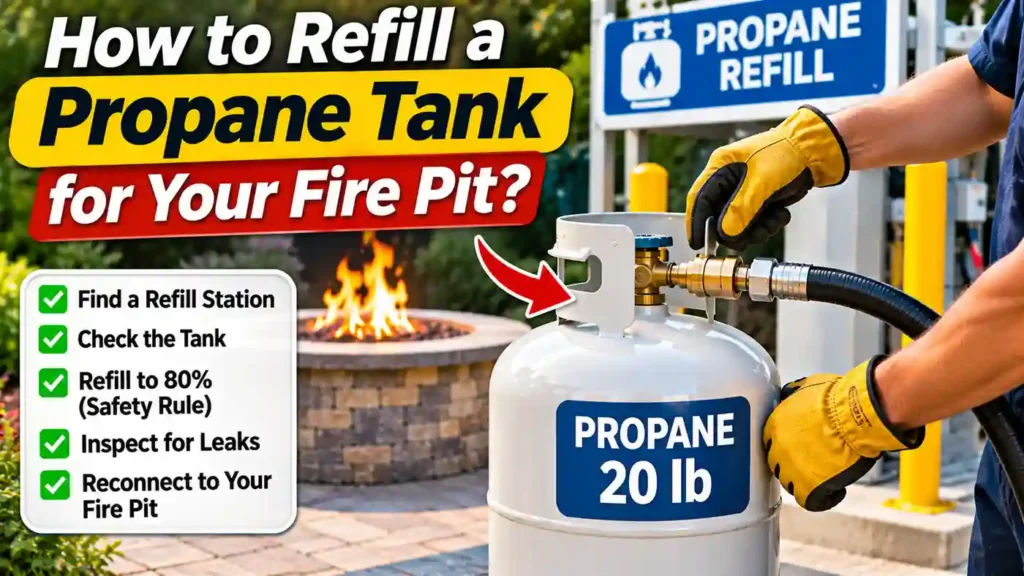
Whenever the cylinder or regulator connection has been disconnected and reconnected, perform the manufacturer’s prescribed leak check with approved leak-detection solution before lighting. Bubbling is a stop-and-repair warning, not permission to keep testing. Never check for leaks with a flame.
Technical Comparison: Why Different Fire Pits Behave Differently
Portable bowls, fire tables and permanently installed fire features do not all have the same gas system. I use the following illustrative ranges to frame the problem, not as specifications for an unverified brand or model.
| Fire pit type | Illustrative input | Typical fuel arrangement | What may affect flame stability |
|---|---|---|---|
| Compact portable bowl | 30,000–45,000 BTU/hr | Manufacturer-approved portable cylinder | Wind, cylinder level, hose flow |
| Outdoor propane fire table | 40,000–60,000 BTU/hr | Often a 20-lb cylinder and matched regulator | Ignition sequence, thermocouple, blocked ports |
| Large portable fire bowl | 50,000–80,000 BTU/hr | Approved cylinder and hose kit | High vapor demand, cold weather, regulator capacity |
| Built-in manual fire feature | 75,000–150,000+ BTU/hr | Professionally sized fixed propane supply | Line pressure, piping capacity, media configuration |
| Large electronic-ignition feature | 100,000–200,000+ BTU/hr | Manufacturer-specified fixed system | Flame sensing, power/control issues, supply design |
Technical note: Many small portable units operate around 11 inches water column (approximately 0.40 psi) downstream of a matched regulator, but built-in and electronically controlled products can require a different inlet range. A fire pit rated 100,000 BTU/hr also cannot be safely supplied by an undersized regulator just because the hose threads fit. This is why I would not substitute a high-pressure adjustable regulator or a generic grill hose without manufacturer approval.
How Much Propane Should Your Fire Pit Use? BTU Calculations
Fuel math helps separate normal run time from a premature shutdown. It cannot diagnose a safety valve or measure propane pressure, but it can answer a very useful question: should this cylinder already be empty?
I use approximately 91,500 BTU per US gallon of propane and 4.24 pounds of propane per gallon. Actual figures vary slightly with temperature and composition. For a burner firing continuously at its rated maximum input:
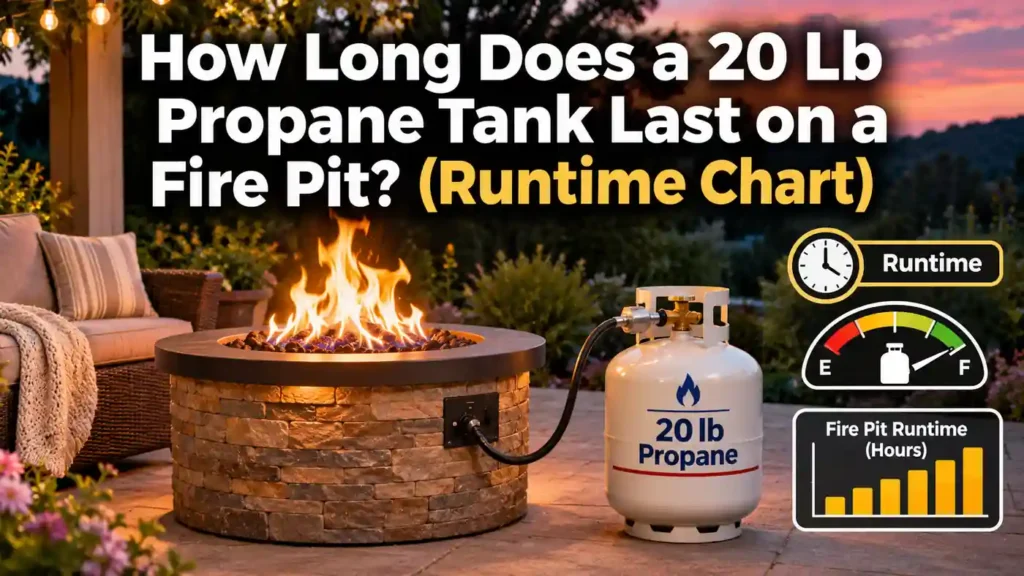
For a full 20-pound net propane fill, 20 ÷ 4.24 is about 4.72 gallons, often rounded to 4.7 gallons. For a 15-pound exchange fill, the fuel amount is about 3.54 gallons. The same fire pit therefore runs approximately 25% less time with 15 pounds of propane than with 20 pounds, all else equal.
Propane Consumption and Runtime by Burner Size
These theoretical maximum-flame estimates assume a continuous burn and no flow restrictions. They are useful for budgeting, not a guarantee that a cylinder can vaporize fuel fast enough in every temperature.
| Burner input | Fuel rate | Full 20 lb (4.72 gal) | 15 lb fill (3.54 gal) |
|---|---|---|---|
| 25,000 BTU/hr | 0.27 gal/hr | 17.3 hr | 12.9 hr |
| 30,000 BTU/hr | 0.33 gal/hr | 14.4 hr | 10.8 hr |
| 40,000 BTU/hr | 0.44 gal/hr | 10.8 hr | 8.1 hr |
| 50,000 BTU/hr | 0.55 gal/hr | 8.6 hr | 6.5 hr |
| 60,000 BTU/hr | 0.66 gal/hr | 7.2 hr | 5.4 hr |
| 80,000 BTU/hr | 0.87 gal/hr | 5.4 hr | 4.0 hr |
| 100,000 BTU/hr | 1.09 gal/hr | 4.3 hr | 3.2 hr |
For a broader explanation of cylinder energy content, see my 20-pound propane tank runtime guide. Always use this fire pit’s exact approved fuel configuration rather than selecting a cylinder based only on the table.
Worked Example: A 50,000-BTU Fire Table Goes Out After Two Hours
Suppose you have a fire table rated 50,000 BTU/hr, you put in a genuinely full 20-pound cylinder, and the flame goes out after only two hours. At rated input, two hours use about 100,000 BTU, equal to roughly 1.09 gallons or 4.64 pounds of propane. A correctly filled 20-pound cylinder should still have about 15.36 pounds of fuel, assuming no other appliance is sharing it.
That does not prove the fire pit is defective; it tells me that normal fuel depletion alone is an unlikely explanation. I would look instead at whether the initial fill was genuinely 20 pounds, whether the tank became too cold to vaporize gas, whether the regulator restricted flow, and whether wind or flame sensing caused shutdown. This combination of an observed time and a fuel calculation is much more useful than guessing by flame color.
Fuel-Cost Scenarios at Different Propane Prices
Propane costs vary by retailer, region and refill method. I use illustrative prices of $3, $4 and $5 per gallon below, not live retail quotations. The table assumes continuous maximum-rate operation.
| Burner input | At $3/gal | At $4/gal | At $5/gal |
|---|---|---|---|
| 30,000 BTU/hr | $0.98/hr | $1.31/hr | $1.64/hr |
| 40,000 BTU/hr | $1.31/hr | $1.75/hr | $2.19/hr |
| 50,000 BTU/hr | $1.64/hr | $2.19/hr | $2.73/hr |
| 60,000 BTU/hr | $1.97/hr | $2.62/hr | $3.28/hr |
| 80,000 BTU/hr | $2.62/hr | $3.50/hr | $4.37/hr |
For example, a 50,000-BTU fire pit at $4 per gallon costs about $2.19 per hour at full rated input. A three-hour evening costs approximately $6.56, and four three-hour gatherings cost about $26.23 in fuel. Turning down the flame may reduce consumption, but knob position is not a calibrated percentage: I treat lower-setting estimates as scenarios until actual usage is measured.
Interactive Propane Fire Pit Runtime & Cost Estimator
Enter the net pounds of propane actually available, the fire pit’s input rating, an estimated average burn-rate percentage and your local price. The calculator estimates ideal fuel-limited runtime and consumption. For most troubleshooting, I start with 100% rated input so the calculation does not falsely exaggerate how long a tank should last.
Estimates use 91,500 BTU/US gal and 4.24 lb/US gal. A 60% setting means an assumed measured average input of 60% of maximum, not that turning the knob 60% of the way produces that fuel rate. This calculator cannot predict thermocouple shutoffs, regulator faults, weather or cylinder vaporization limits.
Should You Retry, Clean, Replace the Cylinder or Call a Professional?
Here is my decision guide. I put safety first, followed by checks that don’t require opening or modifying the gas system.
| Situation | Decision | Why |
|---|---|---|
| Wind gusting or rain striking burner | Wait | Use only in safe, manufacturer-approved conditions |
| Cylinder confirmed nearly empty | Refill or exchange | Normal fuel depletion may explain low flame or shutdown |
| Low flame immediately after cylinder change | Follow manual reset once | May be excess-flow protection; repeating failures require inspection |
| Visible loose debris on cool, accessible burner | Clean only as directed | Approved exterior maintenance can restore unobstructed operation |
| Flame dies when knob is released repeatedly | Arrange service | Flame-sensing or safety-valve system may be involved |
| Strong flame then fading in cold conditions | Stop and verify fuel supply | Possible vaporization or supply-capacity limitation |
| Gas odor, bubbling leak test, damaged line or abnormal flame | Stop use immediately | Possible dangerous leak or combustion fault |
How I Would Prevent the Same Problem Next Time
After the root cause is resolved, I favor a short maintenance routine over buying replacement parts at random. I would store and handle cylinders upright in approved outdoor locations, keep the fire pit covered only after it is fully cool, and inspect visible hose condition before each use. If leaves or insects are common around the patio, I would check the approved burner openings regularly.
I would also keep a simple usage log: cylinder net fill, approximate ambient temperature, burner setting, hours burned and whether any flame problem occurred. After three or four burns, patterns become easier to see. If the unit fails only when the temperature drops, the supply may be marginal. If it fails exactly when I release the knob, the flame-safety sequence deserves attention. If it fails only after changing tanks, I would check connections and the correct restart sequence first.
Finally, I keep the manual accessible. The proper regulator, clearance, ignition sequence, media arrangement, leak-test method and parts list are model-specific. That information is usually more valuable than a generic online repair trick.
Frequently Asked Questions
Why does my propane fire pit light and then go out immediately?
If it goes out exactly when you release the knob, the flame-sensing safety system or the prescribed startup sequence may be involved. If the flame is tiny from the first second, restricted gas flow or an insufficient fuel supply is another possibility. Follow the manual, then stop and seek service if the problem continues.
Can a bad thermocouple make my propane fire pit shut off?
Yes, on models that use a thermocouple. A dirty, poorly heated or failed sensor can prevent the safety valve from remaining open. But not all propane fire pits use the same ignition system, and I would not call the thermocouple defective without checking the approved lighting sequence and having the assembly diagnosed.
Why does my fire pit go out after 10 or 20 minutes?
A delayed shutdown makes me investigate low cylinder level, reduced vaporization in cold weather, inadequate regulator or piping capacity, gusty wind and controls that stop detecting a stable flame. The exact number of minutes alone does not identify the faulty component.
Should I open the propane tank valve all the way?
I follow the cylinder and appliance manufacturer instructions. The important part during startup is to keep the burner control off and open the cylinder valve slowly so the system does not experience an abrupt gas-flow surge. I do not use a partly open cylinder valve as an improvised flame adjustment.
Will replacing the regulator fix a fire pit that will not stay lit?
Only if an approved inspection shows the regulator or hose assembly is the problem. A similar-looking regulator can have the wrong outlet pressure, gas capacity or safety characteristics. I would use the exact specified replacement and let a qualified professional assess fixed systems.
Can I keep using the fire pit if the flame is yellow?
Some decorative flames naturally show yellow tips, so color alone is not a diagnosis. But unusual soot, a sudden major color change, a strong odor, or unstable combustion merits shutting the appliance down and arranging inspection. I would not adjust gas pressure or air-mixing components without manufacturer directions and appropriate qualifications.
Why does my fire pit have propane left but won’t stay lit?
Having liquid propane in a cylinder is not proof that the appliance is receiving enough vapor at the right pressure. Cold temperatures, high burner demand, a restricted hose or regulator, a tripped excess-flow device, or a flame-safety fault can interrupt operation while some propane remains.
Bottom Line: Follow the Symptom, Not a Guess
When a propane fire pit won’t stay lit, I start by asking one question: does it die immediately, when the control knob is released, in the wind, or after running for several minutes? Each pattern points toward a different set of checks. I verify the fuel level, use the correct lighting procedure, inspect only accessible cooled parts, and compare expected runtime with actual fuel consumption before buying anything.
For pressure and gas-flow questions, continue with my propane fire pit regulator guide. If your biggest question is how many hours a cylinder should deliver, use the 20-pound cylinder fuel and runtime guide. Above all, if the issue suggests a leak or defective safety component, I would stop using the fire pit until it has been properly repaired.

Mike is an experienced propane technician with over 15 years of professional experience in the field. He has dedicated his career to helping customers with their propane needs, from installation to maintenance and repair. Together with Jeremy, he co-founded this website to provide useful information and guidance to customers seeking reliable propane services.