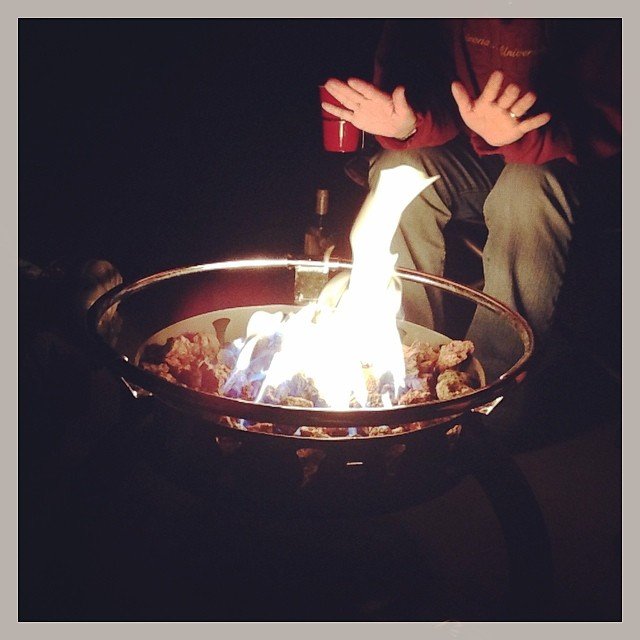
Can You Leave a Propane Fire Pit Burning All Night? (Safety Risks Explained)
If you’re thinking, “My propane fire pit is clean, it has a sturdy table, and the flame is small—what could go wrong?” I understand the appeal. I like the idea of an outdoor fire that keeps the patio welcoming late into the evening. But I separate two very different questions: How long can the fire pit burn? and How long is it safe to leave it burning without supervision? The first question involves BTUs, gallons, and a calculator. The second is a safety decision, and the answer is to turn it off whenever you cannot supervise it.
Below, I’ll walk you through overnight hazards, typical fire-pit specifications, an original eight-hour fuel calculation, real-world limitations, a cost comparison, a practical shutoff checklist, and an interactive runtime estimator. The math is for planning attended use—not for scheduling unattended operation.
Why I Wouldn’t Leave a Propane Fire Pit Burning Overnight
Propane burns cleanly when an appliance is working as designed, and a modern fire pit can be easy to operate. Neither feature makes an open flame safe to abandon. Many manufacturers specifically instruct owners not to leave a fire pit unattended while it is operating or still hot. That warning applies to a small camping bowl as much as a more expensive fire table.
1. The wind can change after you go to sleep
At 9 p.m., your patio may be perfectly calm. At 2 a.m., a gust can push a flame toward nearby outdoor cushions or shift a light item into a hot surface. Screens and wind guards may reduce some effects, but they do not make an outdoor flame unattended-safe. I would follow the exact wind restrictions and clearance distances stated in my model’s manual, rather than treating a generic distance found online as universal.
2. A hose or fitting can fail
Connections can loosen, hoses can deteriorate, and components can be damaged by movement, heat, weather, or animals. A leak is particularly serious when nobody is present to detect it. Propane gas is heavier than air and can collect in low areas. Do not assume that you will always smell a leak or hear a hiss from inside the house.
3. A flame can go out while gas is still a concern
Some appliances incorporate a flame-failure device or thermocouple intended to stop gas flow if the flame goes out. Others have different ignition and control systems. These devices are valuable, but I never treat them as a substitute for an awake adult watching the fire. If your burner goes out unexpectedly, follow the manual’s shutdown and relighting instructions. Do not immediately click the igniter over and over.
4. Heat can ignite or damage nearby materials
The burner is only one part of the heat hazard. Lava rock, glass media, the fire-pit rim, the enclosure, and the ground immediately around the unit may retain heat after the visible flame disappears. An outdoor cover placed on a still-hot burner can melt or ignite. Likewise, a child or pet can touch a surface that looks harmless after shutdown.


5. Enclosed areas increase carbon monoxide danger
A propane fire pit intended for outdoor use should never be moved into a bedroom, living room, garage, tent, screened-in enclosure that fails the appliance’s outdoor requirements, or other enclosed area for overnight heat. Carbon monoxide is odorless and potentially fatal. Even a roofed patio can present problems depending on the enclosure and manufacturer’s instructions. If I want overnight heating indoors, I choose an appliance specifically listed and installed for indoor heating—not an outdoor fire pit.
6. Rain and cold can change operating conditions
Sudden rain can damage unprotected parts or affect flames and ignition components. In cool weather, a cylinder supplying a high-output burner can struggle to vaporize propane fast enough, making the flame weaken even before the cylinder is empty. That is another reason I never infer safety or reliable operation merely from an estimated number of gallons remaining.
Technical Comparison: Different Types of Propane Fire Pits
I use BTU per hour to compare fire pits because physical size can be misleading. A 42-inch decorative table may have less burner input than a compact camping bowl. The following are illustrative categories, not ratings for every product; always use the actual nameplate specification and approved tank setup for your model.
| Fire-pit type | Illustrative input | Typical use | Key overnight issue |
|---|---|---|---|
| Compact tabletop model | 10,000–20,000 BTU/hr | Decorative seating area | Small flame still requires supervision; tiny tanks may empty quickly |
| Portable camping bowl | 40,000–60,000 BTU/hr | Outdoor gatherings | High fuel draw and wind exposure |
| Residential fire-pit table | 30,000–50,000 BTU/hr | Patio conversation area | Hot surfaces and nearby cushions |
| Large outdoor fire bowl | 50,000–80,000 BTU/hr | Open-air landscape feature | Greater fuel demand and manufacturer-specific clearances |
| Built-in propane feature | 60,000–100,000+ BTU/hr | Permanent outdoor installation | Professional gas-line design and valve access; still not unattended-safe |
If you are comparing styles before buying, my propane fire pit buying guide explains how to look at burner rating, features, and layout. Confirm the link slug when publishing if your site uses a different permalink. The crucial point here is that a “built-in” installation is not automatically approved for unattended overnight use.
How Long Can a Propane Fire Pit Burn on One Tank?
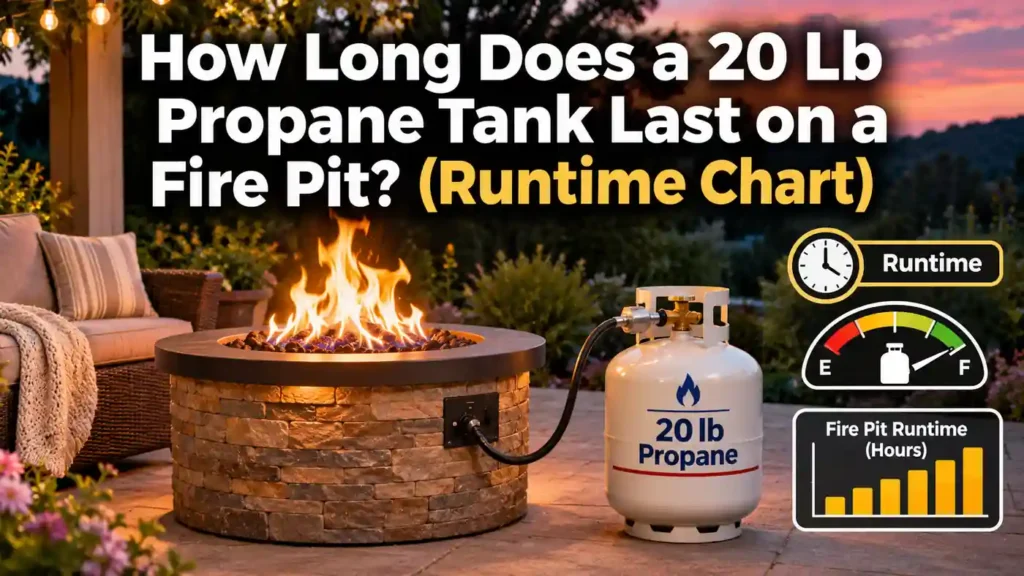
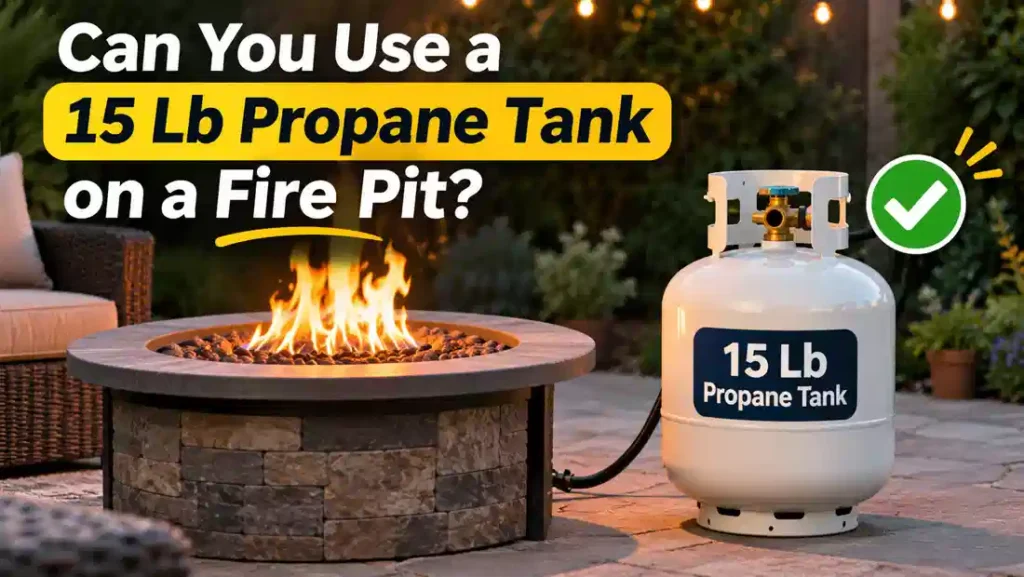
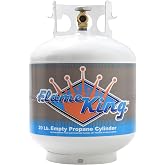
For fuel estimates, I use a rounded 91,500 BTU per gallon of propane. A commonly used 20-pound cylinder contains about 4.7 gallons when properly filled by weight; an exchange cylinder may contain only 15 pounds of propane, about 3.5 gallons. The distinction matters because “one tank” does not always mean the same fuel quantity.

Gallons burned per hour = burner BTU/hr ÷ 91,500. Then I estimate runtime as available gallons ÷ gallons per hour. This simplified calculation assumes constant input and ideal access to all stated fuel. In the real world, temperature, regulator behavior, flame adjustment, and cylinder vaporization can limit performance.
| Burner input | Approx. gallons/hr | 20-lb full cylinder (4.7 gal) | 15-lb exchange fill (~3.5 gal) |
|---|---|---|---|
| 10,000 BTU/hr | 0.109 | 43.0 hr | 32.0 hr |
| 20,000 BTU/hr | 0.219 | 21.5 hr | 16.0 hr |
| 30,000 BTU/hr | 0.328 | 14.3 hr | 10.7 hr |
| 40,000 BTU/hr | 0.437 | 10.8 hr | 8.0 hr |
| 50,000 BTU/hr | 0.546 | 8.6 hr | 6.4 hr |
| 60,000 BTU/hr | 0.656 | 7.2 hr | 5.3 hr |
| 80,000 BTU/hr | 0.874 | 5.4 hr | 4.0 hr |
These numbers help me budget an outdoor evening. They do not mean I can leave a 40,000-BTU fire pit on while I sleep just because the tank might last ten hours. My complete 20-pound tank runtime guide goes deeper into fuel planning.
Worked example: a 50,000-BTU fire table
Suppose I start with a properly filled 20-pound cylinder holding about 4.7 gallons. At a sustained 50,000 BTU/hr, fuel use is 50,000 ÷ 91,500 = 0.546 gallons per hour. The theoretical runtime is 4.7 ÷ 0.546 = 8.60 hours. After two attended hours, I’d expect about 1.09 gallons consumed, leaving about 3.61 gallons. That remaining fuel could theoretically support roughly 6.6 more hours at the same input.
Here is the useful insight: although the same calculation produces an “all-night” number, the responsible decision does not change. When the gathering ends, I shut off the appliance. I use the calculation to decide whether I need a refill before the next gathering, not whether I can leave a flame burning while everyone is asleep.


Interactive Propane Fire Pit Runtime and Cost Calculator
Enter your fire-pit’s nameplate BTU rating, actual propane available, and refill cost. This estimator calculates approximate fuel consumption, theoretical full-tank runtime, and the fuel expense for a planned session. I intentionally show the safety reminder directly beside the result.
Safety: This is a fuel-planning tool, not a recommendation to leave any fire pit unattended. Results are theoretical and depend on fuel fill, temperature, flame setting, and appliance performance.
WordPress editor note: Many WordPress setups remove inline <script> when saving content, depending on permissions and plugins. If the calculator does not work after publication, place its JavaScript in an approved site-code snippet or custom plugin and leave its HTML in the post.
How Much Propane Would Eight Hours Use—and Cost?
I include an eight-hour scenario because readers often wonder about “overnight” fuel use. It is a hypothetical comparison only. Eight hours unattended remains unsafe regardless of cost. For the table below I multiply gallons per hour by eight, then compare three illustrative retail refill prices: $3, $4, and $5 per gallon. Local prices and cylinder-exchange charges may differ sharply.
| Burner rating | Fuel for 8 hr | At $3/gal | At $4/gal | At $5/gal |
|---|---|---|---|---|
| 20,000 BTU/hr | 1.75 gal | $5.25 | $7.00 | $8.74 |
| 30,000 BTU/hr | 2.62 gal | $7.87 | $10.49 | $13.11 |
| 40,000 BTU/hr | 3.50 gal | $10.49 | $13.99 | $17.49 |
| 50,000 BTU/hr | 4.37 gal | $13.11 | $17.49 | $21.86 |
| 60,000 BTU/hr | 5.25 gal | $15.74 | $20.98 | $26.23 |
| 80,000 BTU/hr | 6.99 gal | $20.98 | $27.98 | $34.97 |
What stands out to me is that a 60,000-BTU portable bowl would consume more than a full 20-pound cylinder’s nominal 4.7 gallons in eight hours. Even if overnight operation were acceptable—which it is not—the fuel supply might not support it. This is why cost and safety are separate considerations.
Monthly fuel planning for normal, supervised evenings
Instead of budgeting eight unattended hours, I calculate planned awake-time use. For a 40,000-BTU fire pit, the ideal consumption rate is about 0.437 gallons/hr. At $4 per gallon, that is approximately $1.75 per hour.
| Attended use pattern | Hours/month | Estimated fuel | Fuel cost at $4/gal |
|---|---|---|---|
| One two-hour evening weekly | 8 | 3.50 gal | $13.99 |
| Two two-hour evenings weekly | 16 | 6.99 gal | $27.98 |
| Three three-hour gatherings monthly | 9 | 3.93 gal | $15.74 |
| One hour on 20 evenings | 20 | 8.74 gal | $34.97 |
I prefer this method to vague monthly estimates because you can change only two inputs—your burner rating and observed hours—and immediately see the approximate budget. You can explore more examples in my propane fire pit running-cost guide. Again, check the exact permalink against your live site before publishing.
Does a Flame-Failure Shutoff Make Overnight Operation Safe?
No. An automatic flame-failure system may reduce the risk of continued gas discharge following flame loss, when fitted and functioning correctly. It does not remove the risk of fire contacting nearby objects, someone touching the burner, wind-driven flame movement, damage to gas connections, or problems arising from incorrect installation. An electronic timer is likewise not an overnight babysitter.
There is also no single universal fire-pit safety design. A built-in feature may have a wall switch, emergency stop, electronic ignition, and specialized controls; a portable bowl may have a manual valve; a table may use a thermocouple. I never assume that a safety device exists just because a product photo looks sophisticated. I verify the exact feature in the owner’s manual and test/maintain it only as the manufacturer directs.
What If My Propane Fire Pit Accidentally Stayed On All Night?
Finding a fire pit still burning in the morning can be alarming. I would not immediately lean over it or start moving a hot propane cylinder. My first steps depend on what I observe from a safe distance.
- Check for immediate danger. If there’s a spreading fire, a suspected leak, unusual odor, damaged equipment, or people in danger, retreat and call emergency services.
- Keep children and pets away. Do not let anyone investigate the burner or touch hot media.
- Shut it off only if safe. For a normally operating fire pit with no signs of a leak or fire spread, follow the manufacturer’s instructions for turning off the burner and closing the approved supply valve.
- Leave it undisturbed while cooling. Do not put the cover on, disconnect a hot hose, add water, or attempt to reposition the appliance.
- Inspect before next use. Once fully cool, look for heat damage to nearby materials, hose deterioration, debris, and any abnormal burner behavior. Have a qualified professional inspect questionable components.
- Reconsider the routine. I would assign one responsible adult to confirm shutoff at the end of every gathering and add a phone reminder or checklist—not as a replacement for supervision, but as a backup against forgetting.
If you find the flame already extinguished but suspect gas could be flowing, do not attempt to relight it. Keep ignition sources away and follow leak-emergency procedures. The priority is personal safety, not saving the remaining propane.
My Five-Minute Before-Bed Shutdown Checklist
A consistent shutdown ritual is more useful than hoping everyone remembers. I would make the final adult leaving the patio responsible for these items. No one should leave the area until the flame is fully extinguished, and the area must remain inaccessible while hot surfaces cool.
- Finish the gathering. Tell everyone the fire is going off and move guests away from the burner.
- Turn the control to OFF. Use the exact sequence printed in your appliance manual.
- Close the fuel supply. Close the cylinder valve or approved installed shutoff as specified by the manufacturer; do not force a valve.
- Confirm flame extinction visually. Do not mistake a very low flame for an extinguished burner.
- Check the surroundings. Make sure nothing combustible has shifted near the fire pit.
- Keep the area clear while hot. Supervise access during cooling; do not immediately place a cover or decorative tabletop lid onto hot media.
- Secure the location. Protect the cooled unit from children, pets, and accidental activation according to your manual.
I also recommend a periodic inspection schedule. A quick visual check before use helps identify cracked hoses, blocked burner ports, unstable bases, and worn controls. For broader care instructions, see propane fire pit maintenance, and verify your published slug before adding the link.
Common Mistakes That Make Overnight Use Even Riskier
Turning the flame to its lowest setting and walking away
A low setting reduces approximate fuel use but does not eliminate fire or leak hazards. In wind, a weak flame may also behave differently. I would never use “low” as my signal that supervision is unnecessary.
Putting a cover on to contain the flame
Protective covers are normally for a cooled, unlit fire pit. Placing a fabric or solid cover on a burning appliance can trap heat, damage equipment, or ignite material. Even a metal burner lid should be used only as directed, and never as a substitute for shutting off the gas.
Moving the fire pit into a garage when the weather turns bad
This is especially dangerous for outdoor-only propane appliances. Wind or rain is a reason to stop using the unit, not a reason to move a lit fire pit inside.
Assuming a full tank guarantees a stable flame
Theoretical gallons do not guarantee the required vapor flow. In cold weather or at high burner input, the cylinder may cool and supply pressure may fall. A larger approved fuel setup may solve a supply problem for attended use, but never justifies unattended burning.
Ignoring a flame that won’t stay lit
If the burner repeatedly dies, I stop using it rather than propping open a control or bypassing a safety mechanism. Common causes include fuel supply issues, wind, dirt, and faulty ignition or flame-sensing components. My related guide, Why Won’t My Propane Fire Pit Stay Lit?, helps organize the next troubleshooting step, after confirming the live permalink.
Decision Guide: Should You Keep the Fire Pit On?
| Situation | My decision | Why |
|---|---|---|
| Adults are seated outdoors, awake, and actively supervising | Use only if all manual requirements are met | Supervision and safe setup are necessary |
| Everyone is going to bed | Turn it OFF | No one can monitor conditions |
| You’re going indoors briefly and no one remains outside | Turn it OFF | Even a short unattended period is avoidable |
| Wind strengthens or combustibles move nearby | Stop use | Clearance and flame behavior may change |
| Flame goes out unexpectedly | Shut down; investigate | Follow manual before any relighting attempt |
| Gas odor, leak sound, or fire escaping burner | Retreat and seek emergency help | Possible uncontrolled gas/fire hazard |
| Fire pit is extinguished but hot | Keep access controlled | Burns remain possible during cooling |
My rule is simple: if no responsible, awake adult is willing and able to remain outside supervising the flame, it’s time to turn the fire pit off. I prefer a patio that cools down safely over one that stays warm while the entire household sleeps.
Safer Ways to Enjoy a Comfortable Patio Late at Night
I don’t think the answer has to be giving up the backyard atmosphere. I would use the propane fire pit during the part of the evening when friends or family are actually gathered around it. Once everyone moves inside, I switch off the flame. For a lingering outdoor setting without combustion, I might use suitable outdoor-rated lighting, insulated blankets while sitting outside, or other outdoor products used within their instructions.
If you need heating while people are actively using the patio, consider whether a properly selected outdoor-rated electric heater better suits the area. Electric appliances carry their own clearance, wiring, and weather-exposure rules, so they should not be treated as automatically safe for unattended overnight operation either.
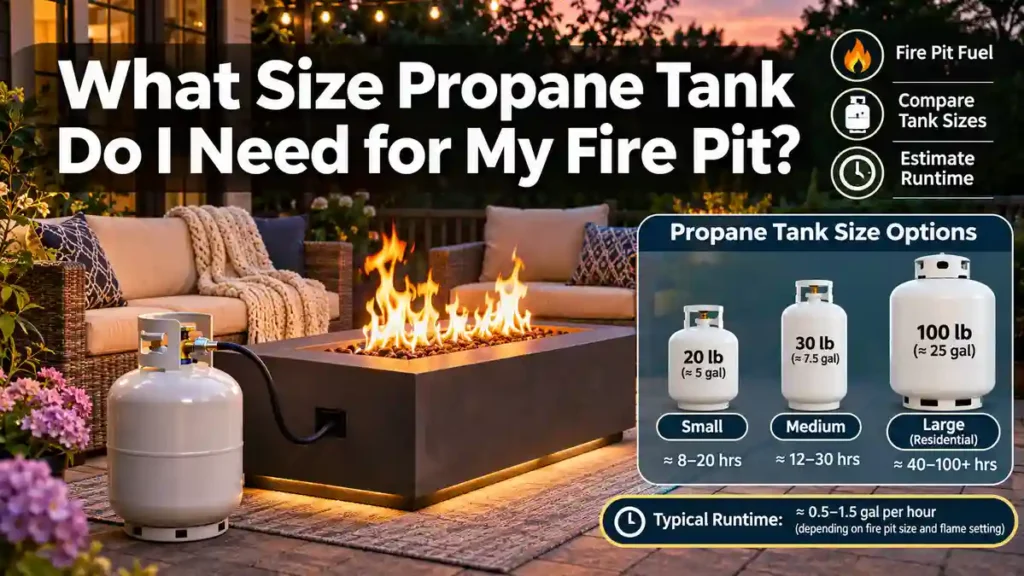
And if the problem is simply that your 20-pound tank runs out halfway through a party, solve that with more accurate planning—not by leaving the unit on overnight. My fire-pit propane tank sizing guide explains how to compare tank capacity with burner demand, subject to the manufacturer’s approved configurations.
Frequently Asked Questions
Is it safe to leave a propane fire pit on while sleeping?
No. A sleeping person cannot supervise an outdoor flame or react to changing conditions. I switch off the burner and fuel supply according to the manual before going to sleep.
Can a propane fire pit stay on for eight hours?
Some fire pits and fuel supplies can theoretically deliver eight hours of fuel at a particular BTU setting, but this is not blanket approval for continuous operation. Follow any manufacturer operating-duration limits, keep the appliance attended, and stop if weather or performance changes.
Will a propane fire pit turn itself off when the tank is empty?
The flame generally dies when usable fuel delivery stops, but I would never rely on “running out” as a shutoff method. Performance may change as pressure drops, and different controls behave differently. Shut down deliberately.
What if my fire pit has an automatic timer?
A timer can be a useful additional feature, but it does not address every hazard. I would still supervise while the flame burns and turn off the appliance before leaving or sleeping.
Can I leave a propane fire pit burning under a covered patio?
Only use it where your specific manual, installation requirements, and local rules explicitly permit. Some models prohibit overhead covers or require substantial clearances and ventilation. A covered patio is not an excuse for unattended operation.
Can I leave the propane cylinder connected overnight after turning the pit off?
Many appliance designs allow the cylinder to remain connected in the approved outdoor configuration when shut down, but you should follow the particular manual’s instructions on closing the cylinder valve, disconnecting for storage, and protecting the unit. Never store a propane cylinder indoors or in an enclosed garage.
How much does it cost to run a 50,000-BTU fire pit for four hours?
At 91,500 BTU per gallon, estimated consumption is 50,000 ÷ 91,500 × 4 = 2.19 gallons. At $4 per gallon, the fuel cost is about $8.74. This assumes a constant rated input and excludes any fixed delivery or exchange charge.
Are propane fire pits safer than wood-burning pits at night?
Propane avoids flying wood embers and can usually be shut off quickly, but it still involves an open flame, hot surfaces, and a flammable gas supply. I would not leave either type burning unattended. Read more in my propane fire pit safety guide after confirming the site’s final URL.
My Final Take: Burn for the Gathering, Not Through the Night
When someone asks me whether a propane fire pit can burn all night, I separate the numbers from the decision. The numbers may show an eight-hour runtime for a particular tank and burner. They may also reveal that high-output fire pits would exhaust a standard cylinder well before morning. But neither outcome changes the safety guidance: do not leave a propane fire pit burning while everyone is sleeping or away.
For me, the best plan is to check the manufacturer’s instructions, choose a safe outdoor location, inspect the gas system, estimate fuel for the hours I will actually enjoy the flame, and create a repeatable shutdown routine. The fire pit does its job while we’re together outside. At the end of the night, I turn it off. That one habit matters more than any calculator.
Editorial note: BTU figures, cost scenarios, and run times above are original illustrative calculations based on approximately 91,500 BTU/gal. They are not field-test results, product certifications, or permission for unattended use. Appliance manuals and local requirements take precedence. Internal link destinations should be verified in WordPress before publication.

Mike is an experienced propane technician with over 15 years of professional experience in the field. He has dedicated his career to helping customers with their propane needs, from installation to maintenance and repair. Together with Jeremy, he co-founded this website to provide useful information and guidance to customers seeking reliable propane services.