Quick Answer: How Much Is a Propane Tank Exchange at Lowe’s?
Lowe’s sells Blue Rhino propane tank exchanges, but the exchange price depends on the location. I couldn’t verify a single nationwide Lowe’s exchange price for 2027. The Lowe’s product listing identifies a 15-lb prefilled Blue Rhino exchange, and the company advises shoppers to check their local store for price and availability.
- Typical exchange cylinder: a standard 20-lb-capacity shell
- Propane included: approximately 15 lb, or 3.57 gallons
- First-time purchase: generally costs more without an acceptable empty cylinder
- My first comparison: cost per gallon, not just the price on the cage
Bottom line: A tank exchange is convenient, but you may receive less propane than you would from a full 20-lb-cylinder refill. Confirm the current posted price and labeled net weight before paying.
If you’re looking up the Lowe’s propane tank exchange price, you probably want a quick number before driving to the store. I understand that. But when I compare an exchange with refilling my own tank, I want two numbers instead of one: the price at the register and the amount of usable propane that price actually buys.


For this 2027 guide, I separate verified information from planning examples. As of November 2026, 2027 store-specific prices are not yet available. I therefore won’t describe a hypothetical $22 or $26 exchange as an official Lowe’s price. I’ll show you how to use whatever price your store quotes to decide whether an exchange offers good value.
Lowe’s Propane Tank Exchange Price in 2027: What to Expect
Lowe’s lists a Blue Rhino exchange option for customers who already have an eligible cylinder. The price is location-dependent, and the listing may require a ZIP code or local-store selection. The exchange is generally an in-store service rather than a standard item shipped to your door.
For your budget, I would consider several hypothetical exchange prices and compare them against the same 15-lb fuel quantity. These examples are calculations, not advertised Lowe’s prices.
| Illustrative exchange price | Propane supplied | Approx. gallons | Effective price/gallon |
|---|---|---|---|
| $18 | 15 lb | 3.57 gal | $5.04 |
| $22 | 15 lb | 3.57 gal | $6.16 |
| $26 | 15 lb | 3.57 gal | $7.28 |
| $30 | 15 lb | 3.57 gal | $8.40 |
I use approximately 4.2 pounds of propane per US liquid gallon for these calculations. In cold or hot conditions, propane density can vary slightly, so results are planning estimates rather than scale-certified measurements. Taxes, promotions, and supplier changes can affect the final cost as well.


My suggestion is to check the current Lowe’s listing with your local store selected, then contact the store if the price or exchange procedure isn’t clear. If you are comparing several nearby retailers, record each price and the net propane weight written on the exchange label. That second detail can change the outcome more than a small difference in shelf price.
What Tank Sizes Can You Exchange at Lowe’s?
The exchange most shoppers mean is the standard grill-cylinder exchange. The container is commonly called a 20-pound cylinder because that describes its approximate propane capacity when properly filled. However, a Blue Rhino exchange cylinder at Lowe’s is labeled with 15 pounds of propane. Those numbers describe different things, not two different exterior tank sizes.
If you bring a standard, eligible 20-lb cylinder from another brand, Blue Rhino says participating exchange retailers can generally accept it. The specific condition, valve and size must satisfy the exchange program. I would not assume the same cage takes larger 30-lb, 40-lb or 100-lb cylinders; those are different products and may need specialized refill services.
| Tank description | Typical propane capacity | What Lowe’s exchange shoppers should know |
|---|---|---|
| Standard 20-lb grill cylinder | About 20 lb, roughly 4.7 gal when properly filled | Common shell size accepted by standard exchange programs if eligible |
| Blue Rhino exchanged 20-lb shell | Typically 15 lb, roughly 3.57 gal supplied | Same broad shell category, but lower supplied net weight |
| Small disposable camping cylinder | Often 1 lb | Not a substitute for the standard grill-cylinder exchange |
| 30-lb or 40-lb portable cylinder | Varies by rated size | Do not assume it is accepted at a standard Blue Rhino cage |
| 100-lb cylinder | About 23–24 gal when properly filled | Typically handled through dedicated propane supply or refill arrangements |
I always recommend reading the cylinder’s markings instead of judging its capacity from height or color. Cylinders that look similar can be labeled differently. The manufacturing date, requalification status, valve type and overall condition also matter when deciding whether the container should be refilled or exchanged.
Why Does a 20-lb Exchange Tank Contain Only 15 lb of Propane?
It helps to understand what the word full means in retail marketing. A Blue Rhino exchange cylinder is prepared with a specified quantity of propane; that quantity is commonly 15 lb. A conventional 20-lb-capacity cylinder, when refilled within its legal fill limit by weight, may contain around 20 lb. Both can use a standard grill-cylinder shell.



Using rounded propane weight, a 15-lb exchange works out to about 3.57 gallons. A properly filled cylinder with about 20 lb corresponds to roughly 4.7–4.8 gallons. The approximate difference is five pounds of propane, or about 25% of a 20-lb capacity.
When I explain this to someone comparing prices, I emphasize that the label is more useful than a photo of the tank. You’re not necessarily getting a physically smaller cylinder. You’re getting a different fuel quantity inside a familiar shell. That matters directly when you estimate barbecue hours, emergency heater use, and your annual propane spending.
How the Lowe’s Blue Rhino Propane Exchange Works
The typical exchange is straightforward, although individual store arrangements and automated cages can differ. I would call ahead if I have a long drive, an older cylinder, or a question about after-hours availability.
- Check local availability. Verify that your preferred Lowe’s has an operating propane exchange cage and ask for the current exchange price.
- Bring an eligible cylinder. The tank should be disconnected and transported upright, secured against tipping, and handled according to applicable transportation safety requirements.
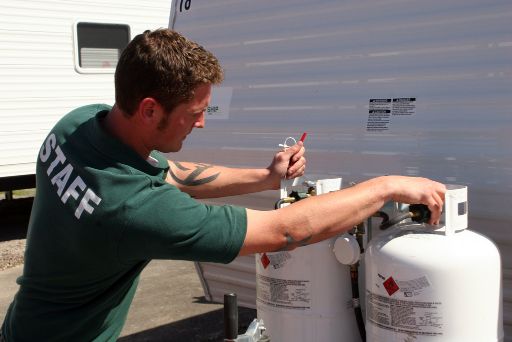
- Arrange the exchange with staff. Depending on the store, you may pay inside, receive a receipt or code, and meet an employee at the outdoor cylinder cage.
- Follow the cage instructions. Exchange your accepted cylinder for the prepared Blue Rhino cylinder. Do not attempt to open a locked display yourself.
- Inspect before leaving. Check the cylinder label, valve, visible condition and any provided instructions. Ask staff for another cylinder if something appears damaged.
Some exchange locations use vending equipment with a different customer sequence. I don’t assume every Lowe’s uses the same setup. Whether a person opens a cage or a machine dispenses a tank, the point is to return an acceptable container and obtain a replacement filled under the exchange program.


My small efficiency trick is to combine the exchange with an existing trip for hardware or home supplies. A lower pump price loses its advantage quickly if I have to make a separate long drive. Travel time and convenience have value, even though they don’t change the gallons in the cylinder.
Buying a Propane Tank at Lowe’s Without an Empty Tank
If you don’t own a cylinder yet, ask for the initial purchase or no-exchange price, not the exchange price. You are paying for the cylinder as well as the included propane. Lowe’s lists a separate Blue Rhino initial-purchase product, and customers should not expect the exchange-only price when arriving empty-handed.
I would compare that option with purchasing an empty, compliant cylinder and filling it at a local propane dealer. The better choice depends on what the two sellers charge, whether the fill station has a minimum purchase, and how quickly you need propane. Before making a decision, make sure the cylinder and valve are approved for your intended appliance.
For somebody preparing a backyard grill before guests arrive, convenience can be worth a little extra. For a household that burns through multiple cylinders every month, the ongoing cost per gallon matters more than the one-time purchase price. I separate those two decisions rather than comparing a first-time cylinder purchase with a recurring exchange.
Lowe’s Propane Tank Exchange vs. Refill: Which Is Cheaper?
This is where I think many cost comparisons go wrong: people compare one exchange receipt against one refill receipt, even though the amount of propane can be different. If the exchange contains 15 lb and the refill contains close to 20 lb, a higher refill ticket may still give you better value.
To compare them fairly, divide the amount paid by gallons received. Using hypothetical prices, a $22 exchange with 3.57 gallons is about $6.16 per gallon. A refill costing $4 per gallon would supply 4.7 gallons for around $18.80. You would receive more fuel and pay less in that particular example.
| Scenario (illustrative) | Propane received | Out-of-pocket cost | Cost per gallon |
|---|---|---|---|
| Exchange for $22 | 3.57 gal (15 lb) | $22.00 | $6.16 |
| Refill at $3.50/gal | 4.7 gal (about 20 lb) | $16.45 | $3.50 |
| Refill at $4.00/gal | 4.7 gal (about 20 lb) | $18.80 | $4.00 |
| Refill at $5.00/gal | 4.7 gal (about 20 lb) | $23.50 | $5.00 |
Those are fuel-price scenarios, not quotations from Lowe’s or a particular refill station. Some locations charge by gallon; others have a flat cylinder price or minimum charge. A refill of a cylinder that is not empty also contains fewer gallons than the full-capacity example above. You should compare the amount actually dispensed on the receipt.
I prefer refilling when I have a compliant cylinder, an accessible station and a competitive price. I prefer exchanging when I value speed, want a prepared replacement cylinder, or have a cylinder the supplier agrees to accept. The cheapest option is not automatically the most convenient, and the most convenient option isn’t always the lowest-cost fuel.
My Worked Example: Comparing the Same Amount of Propane
Suppose a family needs 42.84 gallons of propane over a season. Twelve exchanges containing 3.57 gallons each would supply that amount. At a hypothetical $22 per exchange, the family would spend $264.
What if a refill station charges $4 per gallon? Buying that same 42.84 gallons through refills would cost $171.36, assuming the household could purchase exactly that quantity without extra fees. That’s a difference of $92.64 for equal fuel quantity.
There is another way to look at it. Twelve properly filled 4.7-gallon refills would supply about 56.4 gallons rather than 42.84. At $4 per gallon, those refills would cost $225.60. They cost less than the twelve hypothetical exchanges while delivering more propane overall. But they also require a refill station and a tank that passes its checks.
For a better understanding of fuel weight and gallon conversions, see How Much Does 1 Gallon of Propane Weigh?. The numbers in that guide can help you compare the marked net weight on a cylinder with pump gallons.
How Long Does a Lowe’s Exchange Tank Last?
I use energy consumption to estimate runtime, not a blanket promise of how many days one tank will last. For straightforward calculations, propane supplies about 91,500 BTU per US liquid gallon. At 3.57 gallons, a 15-lb exchange contains about 326,700 BTU of nominal fuel energy.
Divide that energy figure by an appliance’s rated BTU input per hour. The result is an idealized continuous runtime at that input. A grill’s burners may cycle or operate below maximum, so real cooking time can differ. The numbers below also assume the appliance can vaporize and deliver the fuel at the needed rate.
| Appliance input | 15-lb exchange (3.57 gal) | Full 20-lb refill (4.7 gal) | Difference |
|---|---|---|---|
| 10,000 BTU/hr | 32.7 hours | 43.0 hours | 10.3 hours |
| 20,000 BTU/hr | 16.3 hours | 21.5 hours | 5.2 hours |
| 30,000 BTU/hr | 10.9 hours | 14.3 hours | 3.4 hours |
| 40,000 BTU/hr | 8.2 hours | 10.8 hours | 2.6 hours |
| 50,000 BTU/hr | 6.5 hours | 8.6 hours | 2.1 hours |
| 60,000 BTU/hr | 5.4 hours | 7.2 hours | 1.8 hours |
Notice that the gap is a percentage, not a fixed number of hours. A 15-lb fill has about one-quarter less propane by weight than a 20-lb fill. Under identical consumption conditions, you should expect less operating time. For a low-BTU appliance, that can mean many hours of difference; for a high-output appliance, the gap looks smaller on the clock.
If you’re deciding when to replace a cylinder, see How to Tell If You Need Propane?. I wouldn’t use a weak flame alone as a fuel gauge because regulators, supply conditions and equipment faults can also affect burner performance.
Interactive Exchange vs. Refill Cost Calculator
I added this calculator to make the article useful after you’ve obtained your local store’s price. Enter the price of a 15-lb exchange, the advertised refill price per gallon, and the fuel quantity in your exchanged cylinder. The result compares effective fuel price rather than simply comparing receipts.
Figures are illustrative and exclude taxes, travel, refill minimums and extra fees. This calculator does not assess cylinder safety or whether your location can exchange a particular tank.
The value of this tool is its flexibility. If your local Lowe's price is $26, replace $22. If a refill station offers $3.75 per gallon, enter that number. If you exchange just four times per summer, change twelve to four. You can see how small decisions add up over an entire season instead of relying on an example that doesn't match your household.
How to Save Money on a Lowe's Propane Exchange
I would approach savings in three stages: verify the fuel quantity, compare retailers fairly, and avoid unnecessary trips. Discounts can help, but the biggest recurring expense is often the difference in cost per gallon between exchange and a competitively priced refill.
- Check the local price first. Use the store selector or call ahead before driving. Make sure the quote is for exchange, not a first-time cylinder purchase.
- Compare propane net weights. The filled pounds printed on an exchange label matter more than the capacity printed on the steel cylinder.
- Compare refill outlets. If you own a compliant tank and have access to a trained refill operator, obtain the actual per-gallon or flat-rate price.
- Use eligible promotions carefully. Read the conditions of any store discount, membership incentive or manufacturer coupon; do not assume propane is included.
- Keep a spare only when justified. An extra cylinder can prevent a last-minute trip, but it costs money upfront and must be stored safely.
- Combine errands. A small difference in fuel price may not justify another long drive.
- Plan around real use. Track how many cooking sessions a cylinder lasts under your normal burner settings rather than assuming every grill burns at full rated input.
For broader fuel-price decisions, you may also find Is Propane Gas Economical? and What Time of Year Is Propane the Cheapest? helpful. Neither article can replace a current local quote, but they provide useful context for propane budgeting.
When I Would Choose Exchange Rather Than Refill
Even when refilling costs less per gallon, I don't consider exchange a bad decision. A quick exchange can be practical if the refill station is far away, you're short on time, or you want a cylinder that has been inspected and prepared under an established exchange program.
If your existing cylinder is old, rusty or has an outdated requalification, an exchange provider may have a process for accepting certain otherwise eligible tanks. This is not permission to carry or use an unsafe cylinder. Ask the exchange provider whether the particular cylinder is acceptable, and follow all safety and transport rules.
On the other hand, if I own a recently inspected cylinder and a propane dealer offers a competitive metered refill, I generally prefer to keep that cylinder and pay for the propane supplied. Refilling can give a more transparent price per gallon, especially if the supplier charges only for what enters the tank.
Propane Exchange Safety: Transport, Storage and Inspection
I wouldn't treat the cost comparison as a reason to compromise on safe handling. Portable propane cylinders contain pressurized fuel, and a leak can create serious fire or explosion hazards. Once I have an exchanged cylinder, I look for visible damage or unusual conditions before using it.
- Transport the cylinder upright, secured against tipping, in accordance with applicable safety rules.
- Do not leave a propane cylinder in a hot enclosed vehicle or carry it in an unsuitable passenger compartment.
- Store cylinders only where permitted; never keep a standard grill cylinder in a basement or inside a living space.
- Inspect the valve and cylinder condition visually and follow the appliance's connection instructions.
- If you smell gas, hear hissing or suspect damage, stop, move away and contact qualified help; don't use a flame to test for leaks.
- After connecting equipment, follow the manufacturer's prescribed leak-check procedure before normal use.
When propane escapes, it is heavier than air and tends to collect in low areas. That doesn't mean the cloud stays neatly in one place; wind and other air movement can redirect it. For the physics and safety response, read Do Propane Fumes Rise or Fall? and Why Does Propane Smell So Bad?.
My Decision Guide: Exchange at Lowe's or Refill Elsewhere?
Here's the decision framework I would use when standing at the store with a cylinder and a price quote. It combines convenience with the actual fuel quantity rather than judging only the exchange ticket.
| Your situation | My first choice | What to verify |
|---|---|---|
| You have an eligible empty standard grill cylinder and need fuel immediately | Exchange may be simplest | Current local exchange price, hours and net fill |
| You use many cylinders every season and have a nearby refill dealer | Compare refill cost per gallon | Actual pump price, minimum charge and cylinder eligibility |
| You have no cylinder at all | Compare first-purchase options | Initial tank price plus included fuel versus empty cylinder plus refill |
| Your cylinder is questionable or out of qualification | Seek professional assessment or approved exchange | Whether the provider accepts the exact cylinder |
| You make an extra long drive for a cheaper quote | Compare total trip cost | Fuel savings versus travel cost and time |
| You smell gas or discover damage | Do not use or exchange as normal | Follow emergency safety procedures and qualified advice |
My preference is to avoid a false choice between convenience and value. A reliable local exchange can be a smart purchase when time matters. A metered refill can be a smart purchase when cost per gallon matters. A good 2027 buying decision depends on which trade-off fits your household.
Frequently Asked Questions About Lowe's Propane Exchange
How much is a 20-lb propane tank exchange at Lowe's?
Prices vary by store, and a verified nationwide 2027 price is not yet available. Ask your local Lowe's for the current exchange quote and confirm the net fuel weight.
Does Lowe's exchange a Blue Rhino tank from another store?
Blue Rhino says standard 20-lb-capacity cylinders of other brands can generally be exchanged at participating locations if accepted under the program's condition rules. Confirm with the store.
Is a Lowe's exchange tank filled with 20 lb or 15 lb of propane?
The Lowe's Blue Rhino product identified in the listing is a 15-lb prefilled exchange in a standard 20-lb-capacity cylinder.
Does Lowe's refill your own propane tank?
The service described here is cylinder exchange. Do not assume that every Lowe's store offers a metered cylinder refill station; ask your local store about the service available.
Can you buy propane without an empty tank?
Yes, participating stores may sell a prepared cylinder as an initial purchase, generally for a higher price than a qualifying exchange. Confirm the local price and stock.
Is it cheaper to exchange or refill?
Often refilling can be cheaper per gallon, but you must compare the actual volume delivered, the exchange price and any minimum or service charges. Convenience and travel costs also matter.
How many gallons are in a 15-lb Blue Rhino exchange?
Approximately 3.57 US liquid gallons using the rounded conversion of 4.2 lb per gallon. Temperature and rounding can affect the precise value.
Can I exchange a rusty or expired cylinder?
Acceptance depends on the provider's standards and the cylinder's condition. Never assume an unsafe or damaged cylinder is acceptable for ordinary transport or exchange. Contact the retailer or propane supplier for instructions.
Final Verdict: Is Lowe's Propane Tank Exchange Worth It in 2027?
I see Lowe's propane exchange as a convenient option, not automatically the cheapest way to buy propane. The Blue Rhino program makes it easy to trade an eligible standard cylinder for a prepared replacement, and the retailer's listing confirms the common 15-lb fuel fill. But the actual 2027 price will depend on the store and any changes to retail offers.
Before I decide, I calculate the cost per gallon, check whether my tank could instead be refilled, and think about how urgently I need propane. That's more useful than choosing whichever cylinder cage has the lowest visible price. If I buy propane regularly, even a small difference in effective price can become meaningful over a year.
My recommendation: Get the current price for your ZIP code, read the labeled net fuel weight, use the comparison table or calculator, and pick the option that fits your budget, transport situation and equipment safety. You can save money without guessing—and without confusing the capacity of a cylinder with how much propane is inside.

Mike is an experienced propane technician with over 15 years of professional experience in the field. He has dedicated his career to helping customers with their propane needs, from installation to maintenance and repair. Together with Jeremy, he co-founded this website to provide useful information and guidance to customers seeking reliable propane services.