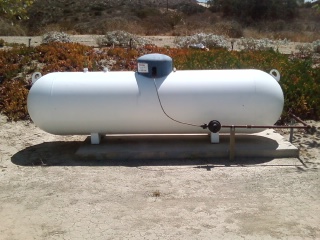
Quick Answer: If you’re looking for propane tanks for sale in Arkansas, common stationary sizes include 250, 500 and 1,000 gallons. A published northern Arkansas dealer price sheet lists the tank purchase portion at $2,350, $2,950 and $4,950 respectively. That dealer’s stated initial fuel, regulator and tax charges are extra, and complete site-work costs vary. For common 250- and 500-gallon stationary tanks, the NFPA 58 setback from important buildings and adjoining buildable property lines is generally 10 feet; a 1,000-gallon above-ground tank generally uses 25 feet unless a specific code exception applies. Have your site evaluated before purchase.
Prices checked November 10, 2026; the 2027 title is a planning guide, not a forecast or guaranteed quote.
Buying a propane tank is a bigger decision than choosing a piece of lawn equipment. You are purchasing a pressure vessel that must store a flammable fuel, fit your property and work with a correctly installed fuel system. The tank’s advertised price is important, but I would put the total installed cost, verified condition and reliable propane deliveries ahead of any bargain that looks too good to be true.


Arkansas homes use propane for heating, hot water, ranges, fireplaces, agricultural equipment and backup generators. A house near Little Rock that uses propane only for cooking has very different needs from a rural home near Mena that uses a propane furnace all winter. I will walk you through realistic tank sizes, local price examples, used-tank checks, Mena-area shopping, Craigslist cautions and the Arkansas placement rules that should shape your plans.
Propane Tanks for Sale in Arkansas: Sizes, Prices and Suppliers
For most residential buyers, I suggest starting with licensed propane providers that can sell or lease a tank and discuss installation requirements in the same conversation. A tank purchased from a marketplace listing might have a low asking price, but the costs of delivery, lifting, foundation work, regulator assemblies and testing can change the economics.
A useful published Arkansas benchmark comes from Anderson’s Propane, which advertises tank sales and installation service for parts of northern Arkansas and southern Missouri. Its online price sheet lists the following sizes and prices. These are a specific seller’s advertised figures, not statewide averages. They can change without notice, and service territories matter.
| Nominal tank size | Advertised tank price | Approx. propane at 80% | First fill at dealer price-sheet rate ($1.69/gal) |
|---|---|---|---|
| 250 gallons | $2,350 | 200 gallons | $338 |
| 500 gallons | $2,950 | 400 gallons | $676 |
| 1,000 gallons | $4,950 | 800 gallons | $1,352 |
Source: Anderson’s Propane published price sheet, viewed November 10, 2026. Its listed tank price includes specified setting and leveling work; its regulator/pigtail combination, initial fuel and tax appear as separate charges. Check the actual quote for all site work. https://www.andersonspropane.com/prices


The 500-gallon unit in this comparison costs $600 more than the 250-gallon tank, while offering twice its rated capacity. The 1,000-gallon unit is $2,000 above the 500-gallon model and again offers twice the rated capacity. Those differences make a larger tank worth asking about, although bigger tanks cost more to fill and require space that may not be available on your property.
How to Compare the Real Cost of Tank Storage
| Tank | Advertised purchase price | Price divided by nominal capacity |
|---|---|---|
| 250-gallon | $2,350 | $9.40 per gallon of tank capacity |
| 500-gallon | $2,950 | $5.90 per gallon of tank capacity |
| 1,000-gallon | $4,950 | $4.95 per gallon of tank capacity |
These figures are my calculations using one supplier’s published tank prices. They are not propane fuel prices or total installed costs.
Cost per gallon of rated capacity is useful, but it is only one metric. A homeowner who consumes 120 gallons in an entire year may not recover the additional initial cost of a larger tank. A household that burns hundreds of gallons during a cold month might appreciate the longer interval between deliveries. Ask several qualified suppliers for a written, apples-to-apples estimate that states what equipment and labor are included.
Propane Tank Capacity Chart: How Much Fuel Can You Store?
A stationary tank’s nameplate size generally refers to its water capacity, not the amount of propane delivered at an ordinary fill. Propane needs expansion space as temperature changes, so the frequently used 80% figure is a practical capacity-planning approximation. Actual lawful fill limits are governed by the applicable filling rules, tank conditions and temperatures; the filling professional determines the safe amount.
| Tank size | Planning fill at 80% | Fuel at 20% gauge | Fuel between 80% and 20% |
|---|---|---|---|
| 120 gallons | 96 gal | 24 gal | 72 gal |
| 250 gallons | 200 gal | 50 gal | 150 gal |
| 500 gallons | 400 gal | 100 gal | 300 gal |
| 1,000 gallons | 800 gal | 200 gal | 600 gal |
The 20% level is a personal planning reserve used for this comparison, not a universal legal minimum or a promise of adequate vaporization.

I like using the last column because it forces you to think about resupply. If your home uses 100 gallons monthly, a 250-gallon tank gives roughly a month and a half of fuel between 80% and 20%. A 500-gallon tank gives approximately three months, while a 1,000-gallon tank gives roughly six. These are arithmetic examples; winter heating demand and appliance cycling can make real refill intervals considerably shorter.
Tank Energy Capacity for Heating and Generators
Propane contains approximately 91,500 BTU per liquid gallon as a rounded planning figure. Multiply usable gallons by that value to estimate stored fuel energy. Appliance efficiency and operating conditions determine the useful heat or electricity you actually receive.
| Tank size | Fuel at approx. 80% | Stored fuel energy |
|---|---|---|
| 250 gallons | 200 gal | 18.3 million BTU |
| 500 gallons | 400 gal | 36.6 million BTU |
| 1,000 gallons | 800 gal | 73.2 million BTU |
For instance, 400 gallons in a filled 500-gallon tank represent about 36.6 million BTU of chemical energy. A furnace’s delivered heat will be lower because no combustion appliance converts all the fuel energy into useful indoor heating. For generator applications, see my detailed propane tank size chart for generators, which explains how consumption rates translate into hours of operation.
What Size Propane Tank Do I Need for My Home?
Square footage alone is a poor sizing method. I would start with a list of every propane appliance, its input rating and expected operating hours. Your climate, insulation, appliance efficiency, occupancy and delivery options matter too. If you already buy propane, last year’s delivery records are far more useful than a generic estimate.


| How you use propane | Tank size to investigate | Reason |
|---|---|---|
| Range and occasional fireplace | 120–250 gal | Typically modest annual fuel demand |
| Cooking, water heating and dryer | 250–500 gal | Several household loads share the fuel supply |
| Propane central heating plus appliances | 500 gal | Meaningful seasonal demand and convenient reserve |
| Larger heated home or frequent generator use | 500–1,000 gal | Higher winter or outage consumption |
| Farm, workshop or commercial loads | 500–1,000+ gal | Must be sized from real equipment demand |
These are discussion starting points only; they do not replace the installer’s load and vaporization assessment.
Consider two houses of the same size. The first uses an electric heat pump, electric water heater and a propane cooking range. The second uses a propane furnace, propane water heater and standby generator. Even though their floor plans match, the second property may need several times as much annual fuel. I would not buy the tank until I understood those differences.
A Simple Refill-Interval Example
Suppose your household consumes 150 gallons per month during the winter. A 250-gallon tank’s 150-gallon operating window from 80% to 20% would cover roughly one month. The 500-gallon tank’s 300-gallon window would cover about two months. A 1,000-gallon tank’s 600-gallon window would cover about four months. A severe cold spell could change those estimates quickly, so build delivery lead time into your decision.
You should also ask the propane installer about the tank’s ability to vaporize fuel in cold weather. A large number of gallons on paper does not guarantee that a tank can deliver a high BTU demand at every outdoor temperature or fuel level. This is especially important when a standby generator and a furnace might operate simultaneously.
Where Can You Buy a 500 Gallon Propane Tank in Arkansas?
A 500-gallon tank is an attractive middle option for many Arkansas homeowners. At a conventional 80% fill it stores around 400 gallons of fuel, and the size is familiar to many installers and propane suppliers. I would begin by asking full-service dealers for both a tank-only price and a complete installed price, because the comparison is otherwise misleading.
Anderson’s Propane advertises a $2,950 500-gallon tank on its current online price sheet. The advertised equipment price is not the same thing as a universal delivered-and-connected price. Ask whether your installation needs additional piping, a specific regulator, concrete or other support preparation, trenching, permits or electrical work near the site.
New vs. Used 500 Gallon Tanks
| Consideration | New tank | Used or refurbished tank |
|---|---|---|
| Initial purchase cost | Usually higher | Can be lower |
| Service history | Starts with new equipment | Ask for prior use and records |
| Physical condition | New manufacturer condition | Must be evaluated individually |
| Warranty | May be available | Often limited or absent |
| Installer acceptance | Still requires confirmation | Especially important to verify before purchase |
| My buying preference | Predictable long-term ownership | Documented condition and real savings |
For a separate discussion of prices and ownership tradeoffs, read my 500-gallon propane tank cost guide. I would not automatically choose a private-sale tank just because it is $1,000 cheaper on the listing. Transportation, approved servicing and installation can absorb that amount surprisingly quickly.
Above-Ground vs. Underground 500 Gallon Tanks
An above-ground tank is normally simpler to inspect visually and avoids excavation. An underground tank hides most of the vessel and can preserve the look of your yard, but it demands approved underground equipment, excavation, suitable backfill, corrosion protection and ongoing access to service components. Ask about existing utility lines before any digging.
Anderson’s Propane states that underground tanks are available for $1,000 more than its above-ground models and include an anode bag. That figure describes one supplier’s advertised tank option, not the full additional cost of a finished underground installation. I would request an excavation-inclusive quote before deciding which one fits your budget.
1,000 Gallon Propane Tank for Sale in Arkansas: Who Needs One?
A 1,000-gallon residential tank can hold roughly 800 gallons of liquid propane at an 80% fill. It makes sense to investigate when you use considerable fuel, want longer intervals between deliveries or have a large house with several propane appliances. Some farms and businesses also choose this size, although their demand must be assessed independently.
| Decision factor | 500-gallon tank | 1,000-gallon tank |
|---|---|---|
| Approx. fuel at 80% | 400 gallons | 800 gallons |
| 80%-to-20% planning fuel | 300 gallons | 600 gallons |
| Published Arkansas tank-price example | $2,950 | $4,950 |
| Illustrative 80% fuel purchase at $3/gal | $1,200 | $2,400 |
| Typical consideration | Moderate to high residential demand | High use or longer delivery interval |
One factor homeowners overlook is the cash needed for the first substantial fill. At an illustrative $3 per gallon, an 800-gallon delivery costs $2,400 before fees and tax. If you are buying the tank and purchasing fuel in the same month, the combined bill may be substantial. Compare larger-tank economics with your monthly budget, not just the listed tank price.
Standby Generator Reserve Planning
Imagine your generator uses three gallons per hour at the electrical load you expect. A 500-gallon tank provides about 300 gallons between the 80% and 20% planning levels. Dividing 300 by three gives 100 hours of theoretical runtime over that window. A 1,000-gallon tank gives 600 divided by three, or 200 hours. These figures are examples, not specifications for a particular generator.
Actual generator use depends on its model, load and operating environment. A furnace, range or water heater connected to the same tank consumes fuel too. I would ask the installing company to verify regulator sizing, piping capacity, vaporization ability and simultaneous appliance demand before relying on a long runtime estimate.
Used Propane Tanks for Sale in Arkansas: How to Buy Carefully
Used tanks are worth considering only when the seller can establish clear ownership and the vessel is suitable for the proposed use. A tank that was left behind at a property is not necessarily the landowner’s to sell. It might belong to a propane supplier under a lease agreement. Before exchanging money, get a written explanation of ownership and any documents that support it.
Then ask for clear photographs of the tank, identification plate, valves and supports. An ASME pressure vessel with missing identification, extensive corrosion, significant dents or questionable modifications is not a purchase I would commit to before professional assessment. Painting a tank does not demonstrate that it has been inspected or refurbished.
Used-Tank Inspection Questions
- Is the identification plate readable and does it confirm the correct pressure-vessel specifications?
- Can the seller provide evidence of ownership and its last use?
- Has a qualified propane professional assessed the shell, valves, fittings and supports?
- Are any repairs or replacement parts necessary before service?
- Will the Arkansas installer accept this particular tank at the proposed location?
- Who pays for safe transportation, lifting, preparation and installation?
- What happens if the installer rejects the tank after delivery?
Do not confuse portable DOT cylinders with large stationary ASME tanks. DOT cylinders have periodic requalification schedules, while stationary ASME tanks follow different inspection and service requirements. My article on who recertifies propane tanks explains the portable-cylinder process. Older ASME tanks still need a professional evaluation; they simply do not share the same routine DOT recertification interval.
How to Compare Used Tank Savings
Consider a hypothetical used 500-gallon tank advertised at $1,500. Add $350 for transport, $400 for approved professional servicing and $700 for separate site work, and your illustrative total reaches $2,950. Those figures are not market quotes, but they show how easily an apparent $1,450 saving over a $2,950 new tank price can disappear. A dealer’s quoted scope may still be different, so compare line items.
I would request the used seller’s documentation before arranging a pickup and ask the proposed installer to approve the plan. This avoids purchasing an unusable pressure vessel or creating an unsafe transport problem. If the price difference becomes small after all costs, a new tank may offer better peace of mind.
Certified Refurbished 250 Gallon Propane Tanks Near Mena
Mena and Polk County buyers may be interested in a refurbished 250-gallon tank for a home with modest or moderate propane use. These tanks offer about 200 gallons at a conventional 80% fill. For homes with heavy propane heating demand, that may still mean frequent winter deliveries, so I would first estimate usage.
Pinnacle Propane advertises a Mena location at 2201 Highway 71 South, Mena, AR 71953, with the number 479-394-5900. The business lists propane equipment and local services. I have not confirmed that its Mena branch currently stocks certified refurbished 250-gallon stationary tanks, so call and ask about that exact item rather than assuming inventory. Source: https://www.pinnaclepropane.com/propane-dealer/menaar
What Should ‘Certified Refurbished’ Actually Mean?
The word certified may be used loosely in classified advertising. I would ask the supplier to identify the inspection performed, who performed it, which parts were replaced and what written records are supplied. An exterior repaint alone should not be treated as evidence that the pressure vessel is suitable for service.
A professionally refurbished tank might receive cleaning, condition evaluation, approved valve or fitting work and a renewed protective coating. The scope depends on the vessel and the business. Ask whether the seller offers a warranty, what it excludes and whether an Arkansas installer is willing to accept the tank. There is no substitute for documenting the actual condition.
| Question for the seller | Why I ask |
|---|---|
| Can you show the tank identification and ownership records? | Confirms what is being offered |
| Who inspected the tank, and when? | Establishes professional assessment |
| What refurbishing work was completed? | Separates cosmetic paint from substantive work |
| Are valves and fittings suitable for service? | Avoids unexpected replacement costs |
| Will my installer accept it? | Prevents an expensive rejected delivery |
| What is the all-in delivered cost? | Makes comparison with a new tank possible |
Certified Refurbished Propane Tanks Near Mena: 250 vs. 500 Gallons
When a supplier offers several refurbished sizes, I recommend comparing each one against the same expected fuel demand. At 100 gallons of consumption per month, a 250-gallon tank has about 1.5 months of fuel between the 80% and 20% planning marks. A 500-gallon tank offers around three months. On a high-demand winter property, the greater storage can reduce delivery pressure.
But a larger tank is not always more economical. It may involve a higher purchase price, added site constraints and more cash during deliveries. Compare the refurbished 250-gallon model with the options in my 250-gallon propane tank guides and review 500-gallon tank resources for ownership and size information.
For properties outside town, also ask about minimum delivery quantities, how a truck reaches the tank after rain or snow, and whether the route remains practical during bad weather. A tank buried behind a steep driveway or installed where a delivery hose cannot reach may create recurring service issues. Local access deserves as much attention as gallon capacity.
Craigslist Arkansas Propane Tanks: Used Listings and Buying Risks
Craigslist and similar platforms sometimes contain inexpensive pressure vessels offered during property cleanouts, farm upgrades or household renovations. I would use these listings only as leads for further investigation. A photo and an asking price do not verify a tank’s identity, condition, ownership or legal suitability for installation.
| Listing detail | My interpretation |
|---|---|
| Readable plate and several clear photos | A useful start, not a safety approval |
| Written proof of ownership | Important to establish before payment |
| Documented professional evaluation | More meaningful than cosmetic condition |
| Seller calls it ‘certified’ without paperwork | Ask for exact records |
| No identification plate or suspicious repairs | Do not commit without expert review |
| Urgent deposit demand or inconsistent history | Reason to walk away |
If a seller says the tank was drained, I would still never assume it is free of propane vapor or safe for casual movement. Transporting a large used tank can involve hazardous-material rules, equipment limitations and handling procedures. Ask a qualified propane contractor to determine the appropriate approach instead of towing or lifting it as an ordinary empty water tank.
I also recommend meeting a prospective seller only after you have spoken with your intended installer. That conversation may identify age, fitting or approval issues that make the advertised bargain unusable. If you cannot establish the tank’s history, move on to documented dealer inventory.
Arkansas Propane Tank Regulations and Permits
Arkansas’s State Liquefied Petroleum Gas Board regulates relevant propane equipment and work. Under 15 CAR § 270-101, Arkansas adopted the 2024 editions of NFPA 58 (Liquefied Petroleum Gas Code) and NFPA 54 (National Fuel Gas Code), subject to state modifications. The adoption took effect July 2, 2026. This is important because older websites may describe a superseded code edition or older state rule language.
The current official rule can be read at Arkansas Code of Rules, 15 CAR § 270-101. NFPA 58 covers container separation and installation matters, while NFPA 54 addresses fuel-gas systems. The applicable authority may impose additional site-specific conditions.
Do You Need a Permit?
There is no responsible one-word answer for every property in Arkansas. The permit or approval process can depend on the work, equipment, local jurisdiction and installer. Before buying, ask the local building or fire authority what is required and confirm that the propane business is authorized for the specific tank and piping installation. Do not confuse a propane contractor’s state business permit with a homeowner’s possible local construction permit.
The Arkansas rules also contain provisions concerning container approval and inspection. Used tanks are not automatically acceptable merely because they operated previously. Ask the qualified installer to verify identification, state approval requirements and compatibility with the proposed system. A properly documented installation is far easier to service later.
Can You Install the Tank Yourself?
I would not treat a stationary residential propane installation as a do-it-yourself project. Improper pressure regulation, piping materials, leak testing or container placement can create fire and explosion hazards. A qualified installer can evaluate appliance loads, support preparation, valve accessibility and the required documentation. Homeowners can help by gathering site details and arranging access, but regulated work belongs with the appropriate professionals.
For practical planning before you speak with an installer, see the propane tank installation category on PropaneHQ. It is also worth asking your prospective propane supplier whether it will fill an owner-installed tank and what tests or approval records it needs before the first delivery.
Propane Tank Distance from a House: NFPA 58 Placement Chart
Tank placement is one of the most important details to establish before purchase. The separation distances below summarize the relevant entries from NFPA 58:2024 Table 6.4.1.1, as adopted by Arkansas, for common stationary ASME tanks. They concern important buildings and the line of adjoining property that can be built upon; they are not complete instructions for every possible hazard or tank arrangement.
| Nominal water capacity | Above-ground separation | Underground separation |
|---|---|---|
| 250 gallons | 10 feet | 10 feet |
| 500 gallons | 10 feet | 10 feet |
| 1,000 gallons | 25 feet generally* | 10 feet |
*Under NFPA 58 §6.4.1.3, a qualifying single above-ground ASME container of 1,200 gallons or less can use a 10-foot distance if it is at least 25 feet from any other LP-Gas container over 125 gallons capacity. Confirm every condition with the installer and authority.
A 1,000-gallon tank is the one that most often causes confusion. The general above-ground table category for 501 to 2,000 gallons lists 25 feet. A specific single-tank exception allows 10 feet only when its conditions are satisfied. Do not assume every 1,000-gallon tank may be placed 10 feet from a building, especially at properties containing multiple substantial propane tanks.
How Are the Distances Measured?
For planning, think about the closest point of the tank relative to the building or the applicable buildable property line rather than measuring from the tank’s center. The code includes more detailed measurement provisions, especially for underground containers and service components. Your installer must also evaluate windows, doors, ignition sources, adjacent tanks, structures, access routes and other constraints under the adopted rules.
For example, if the closest surface of a 500-gallon above-ground tank is eight feet from a house, that proposed spot does not meet the ordinary ten-foot building separation. Shifting the tank to ten feet from the house might resolve that particular distance but still leave a problem at the property boundary or with electrical equipment. A compliant site is the combination of all applicable requirements, not one measurement.
Can the Tank Go Beside a Garage, Shed or Deck?
Do not assume detached structures are automatically exempt. The meaning of an important building and the treatment of specific structures depend on the applicable code and facts about the site. Sheds, garages, electrified outbuildings and other features deserve a deliberate site review. A property survey or accurate site sketch can help the professional identify the limits before a concrete pad or excavation is started.
How Much Does Propane Tank Installation Cost in Arkansas?
Installation pricing varies too much to publish one dependable statewide number. An accessible above-ground installation on suitable ground is a different project from an underground tank on a sloping property with buried utilities and a long gas-piping run. I would request a written itemization rather than an unexplained package price.
| Quote line item | What to confirm |
|---|---|
| Tank delivery, placement and supports | Equipment, leveling, foundation and access |
| Regulators and connection fittings | Correct equipment for appliance load |
| Underground piping or trenches | Included length and backfill responsibility |
| Underground tank protection | Approved anode or other corrosion safeguards |
| Testing and inspection | Who performs and documents the required checks |
| Initial propane delivery | Per-gallon rate, minimum and tax |
| Possible permits or site work | Which party obtains approvals or performs work |
A quote that appears several hundred dollars higher may turn out to include work that another quote omits. Conversely, a lower tank purchase price may be valuable if the supplier offers affordable delivery and your site is straightforward. Ask whether there are charges for future tank relocation, ownership transfer, service calls, after-hours deliveries and eventual removal.
Underground Tank Costs Deserve a Separate Quote
An underground installation must account for soil conditions, utilities, excavation access, corrosion-control design and later testing or maintenance. Landscaping restoration should not be overlooked. If you are comparing underground and above-ground options, ask both contractors to describe the same finished condition, including who is responsible for restoring your yard.
If you are planning construction, I would coordinate the tank location with the building designer early. Moving a patio, driveway, underground water line or electrical service after construction can cost more than deciding on tank placement in the beginning. Make room for the propane delivery vehicle as well as the tank itself.
How Much Does It Cost to Fill a Propane Tank in Arkansas?
Propane prices vary by supplier, delivery size, location, seasonal conditions and contract. Some dealers publish prices, while others give individualized quotes. I recommend asking for the delivered per-gallon rate, minimum purchase, fuel surcharges, taxes and any service fees. Never assume a price intended for a large delivery also applies to a small top-off.
| Tank size | Approx. fuel at 80% | At $2.25/gal | At $3.00/gal | At $3.75/gal |
|---|---|---|---|---|
| 250 gal | 200 gal | $450 | $600 | $750 |
| 500 gal | 400 gal | $900 | $1,200 | $1,500 |
| 1,000 gal | 800 gal | $1,800 | $2,400 | $3,000 |
Prices in this table are hypothetical planning scenarios, not current statewide Arkansas quotes. The tank may already contain fuel and need a smaller delivery.
A 500-Gallon Refill Calculation You Can Reuse
Suppose the gauge on your 500-gallon tank reads approximately 25%, and your delivery ends around 80%. The difference is 55 percentage points. Multiply 500 by 0.55 for an estimated 275-gallon delivery. At $3 per gallon, that is 275 × $3 = $825 before taxes or other charges. The actual number of gallons delivered can differ because gauge readings and filling conditions are approximate.
I would also compare cash-on-delivery pricing with any price-protection or prebuy programs. But read the contract terms carefully: a prepurchased rate might require commitment before the heating season and may cover only a set number of gallons. A low advertised rate is not useful if its restrictions do not match your household.
Should You Buy or Lease a Propane Tank in Arkansas?
Buying often means greater long-term freedom to compare propane suppliers, but it requires a sizable initial expense and ownership-related responsibilities. Leasing can reduce startup expense, yet the contract may require that you buy fuel exclusively from the tank owner and may contain minimum usage or termination provisions.
| Decision point | Owned tank | Leased tank |
|---|---|---|
| Upfront cash | Usually higher | Often lower |
| Who owns the vessel? | You | Supplier |
| Choice of fuel provider | Generally more flexible | May be restricted |
| Service duties | Depends on contract and law | Depends on lease terms |
| Moving or ending service | Owner coordinates next steps | Removal and termination terms matter |
I suggest comparing at least a three- to five-year total based on likely fuel demand, tank costs, quoted propane rates, rental charges and any service fees. A tank lease may still be sensible for a short-term residence or a buyer who prefers a smaller initial outlay. My propane tank lease cost guide covers the factors to negotiate before signing.
Propane Tank Buying Checklist
I would complete the following list before submitting a deposit. It puts installation feasibility and safety ahead of a low sticker price.
- Estimate annual use and the highest expected winter or generator demand.
- Compare 250-, 500- and 1,000-gallon capacity against refill intervals.
- Get two or three written quotes with comparable equipment and labor.
- Confirm the seller owns any used tank and can provide its identification.
- Have the installer review inspection, state approval and service records.
- Mark the proposed placement and confirm code setbacks and delivery access.
- Identify whether an underground tank requires excavation and corrosion protection.
- Verify who arranges necessary permits, testing and installation documentation.
- Check first-fill pricing, delivery minimums and later service charges.
- Keep copies of the purchase documents, installation records and warranties.
Four Buying Scenarios: How I Would Decide
Scenario 1: Light Propane Use in a Smaller Home
If you only run a propane range and occasional fireplace, I would first investigate a smaller stationary tank. The financial benefit of buying a 1,000-gallon vessel is less persuasive if annual use is low. Check whether the dealer can provide a 120- or 250-gallon unit and how often the company will deliver to your area. Also compare leasing if upfront funds are limited.
Scenario 2: A Home Heated Primarily with Propane
For a home with a propane furnace and water heater, I would ask for seasonal consumption estimates and compare a 500-gallon tank with the alternatives. Heating demand is not evenly distributed throughout the year. A tank that seems oversized in June may be much more convenient during a prolonged cold period. Choose based on winter consumption and the supplier’s realistic delivery schedule.
Scenario 3: A Rural House with a Whole-Home Generator
This is where I would investigate 500- or 1,000-gallon storage alongside the generator manufacturer’s hourly fuel figures. If the generator and furnace can run simultaneously, evaluate their combined maximum demand. Set a sensible reorder reserve and discuss what happens if storms delay deliveries. A bigger tank helps with storage but cannot correct undersized piping, an inadequate regulator or insufficient cold-weather vaporization.
Scenario 4: Buying a Refurbished Tank Near Mena
For a buyer considering a refurbished 250-gallon tank near Mena, I would contact an established dealer first, request written documentation and have a local qualified installer review the specific vessel. Then compare the installed total against a new model of the same size. If the used tank offers little real saving after transport and approved work, I would favor the clearer ownership and condition history of a new tank.
Frequently Asked Questions About
What size propane tank is most popular for a whole house?
A 500-gallon tank is a common residential starting point, particularly where propane supplies central heating and multiple appliances. It is not universally best. High fuel demand may justify 1,000 gallons, while limited propane use may make a 250-gallon tank more sensible.
Are used stationary propane tanks allowed in Arkansas?
A used tank is not automatically disallowed because of age or prior service. It must be appropriate for continued use and comply with applicable approval, condition and installation requirements. Do not buy an unidentified or modified vessel and assume that an installer can make it acceptable later.
Do I need propane tank recertification every 12 years?
The often-quoted 12-year initial period refers to certain portable DOT cylinders, not the general lifecycle of a large stationary ASME residential tank. Different rules apply. Ask a qualified provider to inspect a used stationary tank for service suitability instead of relying on a portable-cylinder requalification date.
Can I place a 500-gallon tank five feet from my home?
For the common stationary ASME 500-gallon arrangement covered in the placement chart, the ordinary important-building separation is ten feet, not five. Other site-specific requirements also apply, so get a professional evaluation before choosing the location.
Does a 1,000-gallon propane tank have to be 25 feet from a house?
The general table distance for a 1,000-gallon above-ground tank is 25 feet, but NFPA 58 includes a qualifying single-tank exception that permits ten feet when its conditions are met. Underground separation is generally ten feet for this size. Your installer should apply the actual code language to your site.
Is an underground tank cheaper to maintain?
Not automatically. It can improve appearance and reduce above-ground visual impact, but corrosion protection, monitoring and underground access requirements can add work and expense. Compare quotes for the full ownership period rather than the initial tank purchase alone.
Where can I find propane tanks near Mena, Arkansas?
Start by calling established propane suppliers that serve Mena and Polk County, including the local Pinnacle Propane office. Ask for current inventory, whether the tank is new or refurbished, and whether delivery and installation are available at your address. I have not verified an active refurbished-tank listing at that branch.
Is Craigslist a good place to buy a tank?
It can help locate a seller, but it cannot establish the tank’s suitability. Verify ownership, identification and condition, and obtain professional installation acceptance before paying. Avoid any offer that relies only on photos or an unsupported claim that the vessel is certified.
Final Thoughts
For most Arkansas homeowners, I would begin with the amount of fuel the home actually uses, then compare purchase price, refill frequency and the installed cost. A 250-gallon tank may work well for modest demand. A 500-gallon unit can offer a practical balance. A 1,000-gallon tank is worth examining for high usage or when delivery intervals matter.
Refurbished and used tanks can be worthwhile, but the seller’s paperwork, the tank’s condition and the installer’s acceptance are non-negotiable. Before ordering any tank, confirm the Arkansas requirements, get a code-informed placement review and request a complete written estimate. Those steps do more to prevent an expensive mistake than chasing the lowest advertised price.
Editorial note: Price examples were checked on November 10, 2026. Arkansas adopted NFPA 58:2024 and NFPA 54:2024 effective July 2, 2026. Figures marked illustrative are calculations for comparison, not local quotations. Regulatory requirements and quotes should be confirmed with the current authority and qualified installer.

Mike is an experienced propane technician with over 15 years of professional experience in the field. He has dedicated his career to helping customers with their propane needs, from installation to maintenance and repair. Together with Jeremy, he co-founded this website to provide useful information and guidance to customers seeking reliable propane services.