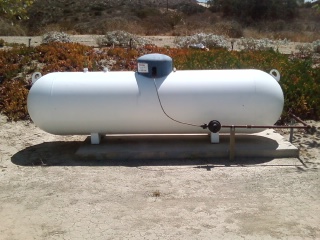


QUICK ANSWER — How Much Does a Propane Tank Cost in California?
The purchase price depends on capacity, construction, condition and supplier. A new 120-gallon above-ground tank has a published mainland equipment price reference of approximately $985, a 250-gallon model $1,950, a 500-gallon model $2,900, and a 1,000-gallon model $4,750. These are not California delivered or installed quotations. Plan separately for delivery, permits, labor, gas piping, regulators and propane. I recommend calculating fuel demand before comparing complete supplier quotes.
| Propane tank size | New above-ground price reference | Propane at 80% fill |
|---|---|---|
| 50 gallons | Model-specific quotation | 40 gallons |
| 100 gallons | Model-specific quotation | 80 gallons |
| 120 gallons | $985 | 96 gallons |
| 250 gallons | $1,950 | 200 gallons |
| 500 gallons | $2,900 | 400 gallons |
| 1,000 gallons | $4,750 | 800 gallons |
Price source: BLT Tanks, a mainland equipment supplier. The examples are price benchmarks, not verified California averages. Actual maximum lawful fills depend on conditions and applicable rules.
If you’re planning to buy a propane tank in California, I recommend looking beyond the advertised tank price. A 500-gallon tank may appear affordable online, but the final installed cost may be considerably higher after you account for delivery, site preparation, piping, permits and the initial fill.
California also has varied climates and installation conditions. A homeowner in Sacramento might need propane primarily for water heating and cooking. A mountain property near Lake Tahoe may rely heavily on propane through the winter, while a ranch in the Central Valley may operate a generator or agricultural equipment. All three can require different storage capacities.


In this guide, I’ll compare tank prices, dimensions, brands, local refill options and California rules. I’ll also show you how to calculate fuel usage and evaluate the long-term cost of a tank instead of choosing simply by its advertised price.
This article is a 2027 planning guide prepared using information available in November 2026. Verify current prices, adopted codes, service coverage and dealer inventory before purchasing.
1. How Much Do Propane Tanks Cost in California?
Two homeowners purchasing the same tank can spend very different amounts because delivery distance, soil conditions, local approvals and piping work differ. I separate the total price into equipment, installation and fuel rather than treating the purchase price as the whole budget.
What Affects Propane Tank Prices?
- Capacity: Larger tanks require more material, although their price per gallon of nominal capacity can be lower.
- Construction: Underground-rated containers need specialized coatings and other protection.
- Condition: Refurbished tanks may cost less but require careful evaluation.
- Location: Shipping a large vessel to a mountain or rural property can add cost.
- Site preparation: Grading, concrete, trenching, and locally required seismic safeguards may affect the quote.
- Contract terms: Leasing and buying allocate equipment responsibility and fuel-supplier choice differently.
How Much Does Installation Add?
| Cost component | What should be included in a quote |
|---|---|
| Tank purchase | Vessel, valves, gauge and listed fittings |
| Delivery | Freight, unloading and equipment placement |
| Site preparation | Level pad, supports, grading or excavation |
| Labor and piping | Regulators, connections, piping and pressure testing |
| Permits and inspections | Applicable building and fire approvals |
| Initial propane fill | Gallons delivered and the price per gallon |
Ask for itemized pricing. One company may include a short piping run while another bills separately for every foot. A low equipment price is not necessarily the least expensive complete installation.


New vs. Used Tank Prices
A refurbished tank may save money upfront. For example, some mainland tank listings in late 2026 advertised rebuilt 250-gallon vessels around $795–$1,095 and certain rebuilt 500-gallon vessels around $1,575–$1,895. These are dated equipment-listing examples rather than California offers. They do not prove that a specific used tank is in acceptable condition.
I would confirm the seller owns it, ask for the readable manufacturer data plate, and have my proposed installer inspect it before arranging transport. Repairs and lifting charges can consume much of the apparent saving. If you are evaluating an older container, see my guide on how frequently to replace a propane tank.
Should You Buy or Lease?
| Factor | Buy a tank | Lease a tank |
|---|---|---|
| Initial equipment expense | Higher | Often lower |
| Ownership | Homeowner | Supplier |
| Fuel supplier choice | Potentially flexible | Often restricted |
| Maintenance responsibility | Contract-dependent | Lease-dependent |
| Recurring equipment rental | Usually none | May apply |
| Home sale | Tank may transfer with property | Lease needs attention |
For a long-term home I would compare the five-year cost of both arrangements. Ask whether the lease includes monitoring, repairs and tank removal, and whether it requires purchasing all fuel from that supplier.
2. Where Can You Buy Propane Tanks in California?
Start with a provider serving your specific ZIP code, not simply a company that operates somewhere in California. Some businesses refill portable cylinders but do not sell or install large stationary vessels. Others install leased tanks and deliver bulk propane but may not sell customer-owned containers.
Southern California Suppliers
Delta Liquid Energy advertises residential propane delivery and tank-installation services in portions of Central and Southern California. If your property is in its service area, ask for an itemized quote for the specific tank size, including the cost of site assessment and first fuel delivery.



Sacramento and Northern California
Kamps Propane, part of the Superior Plus Propane group, has California locations and offers residential and commercial propane services. Coverage and equipment sales arrangements depend on the branch. I would ask about customer-owned tanks, installation, minimum delivery quantities and the procedure for getting a service technician.
Central Valley and Foothills
J.S. West Propane advertises service in Northern and Central California, including the Modesto region and parts of the Sierra foothills. Delta Liquid Energy serves other portions of the broader region. For agricultural uses, I would mention machinery and seasonal peak demand rather than requesting a tank by size alone.
Where Can You Find a Propane Tank Nearby?
Before visiting a dealer, ask whether it sells stationary ASME tanks or only portable propane cylinders. Confirm whether the tank must be ordered, whether it can be delivered to your address, and whether the dealer will service equipment bought elsewhere. A good price is less useful if no local supplier will fill the tank.
Also request confirmation of the proposed installation location, safety distances, delivery-truck access, warranty and responsibility for permits. For a propane-heated home, reliable service can outweigh a modest equipment saving.


3. What Propane Tank Sizes Are Available in California?
Propane cylinders are often rated by the weight of propane they hold, while residential stationary tanks are commonly described by nominal water capacity in gallons. A 100-pound cylinder is not the same as a 100-gallon stationary tank. For an explanation of these different product categories, see my propane tank versus cylinder guide.
California Tank Capacity Chart
| Tank or cylinder | Approximate propane stored | Common application |
|---|---|---|
| 20-lb cylinder | 4.7 gallons | Grills and portable appliances |
| 100-lb cylinder | 23.5 gallons | Auxiliary equipment |
| 50-gallon stationary tank | 40 gallons | Specialty, low-demand use |
| 100-gallon stationary tank | 80 gallons | Limited residential use |
| 120-gallon tank | 96 gallons | Cooking, water heating and fireplaces |
| 250-gallon tank | 200 gallons | Moderate residential demand |
| 500-gallon tank | 400 gallons | Heating, generator and multiple appliances |
| 1,000-gallon tank | 800 gallons | High-demand homes and some business uses |
The stationary figures assume an 80% planning fill. Portable cylinder capacities refer to propane weight and must not be confused with their water capacity.
Small vs. Large Equipment
A grill or occasional-use cabin may need only portable or small stationary storage. A home with full-time propane heating and a standby generator could need much more. I recommend basing size on annual gallons, peak hourly fuel draw, delivery access and how much reserve you want. A tank that holds enough annual fuel can still be undersized for peak demand or vaporization conditions.
4. How Much Does a 1,000-Gallon Propane Tank Cost in California?
A 1,000-gallon stationary tank offers roughly 800 gallons of propane at 80% fill. I would consider it for substantial heating demand, multiple large appliances, farms or properties where frequent deliveries are inconvenient.
Purchase Price and Dimensions
BLT Tanks published equipment references of about $4,750 for a new above-ground 1,000-gallon model and $5,250 for an underground version. Those figures do not include delivery or installation in California. Ask for the exact manufacturer’s specification sheet.
| Specification | Representative measurement |
|---|---|
| Nominal capacity | 1,000 gallons |
| Typical 80% liquid fill | 800 gallons |
| Outside diameter | Approximately 41 inches |
| Overall length | Approximately 16 feet |
| Empty weight | Model dependent; often more than 1,500 lb |
How Much Does It Cost to Fill a 1,000-Gallon Tank?
| Hypothetical propane price | Cost for 800 gallons |
|---|---|
| $2.50 per gallon | $2,000 |
| $3.00 per gallon | $2,400 |
| $3.50 per gallon | $2,800 |
| $4.00 per gallon | $3,200 |
| $4.50 per gallon | $3,600 |
You normally pay only for gallons delivered. Moving a tank gauge from 25% to 80% is a 55-percentage-point change: 1,000 × 0.55 = approximately 550 gallons. At $3.50 a gallon, that delivery would cost $1,925 before taxes and fees.
Is It Worth Buying?
I would not automatically choose a large tank just because its nominal capacity is impressive. Determine whether the higher equipment and initial-fill costs are justified by your actual usage, fewer deliveries or supplier price terms. The supplier should also evaluate the site and connected appliance loads.
5. How Much Does a 500-Gallon Propane Tank Cost in California?
A 500-gallon tank is a common size to evaluate when propane supplies several household appliances, heat or a standby generator. It typically holds about 400 gallons at an 80% fill.
500-Gallon Price and Dimensions
The published equipment-only reference is approximately $2,900 above ground or $3,325 underground. California installation costs will depend on delivery, piping, permits and site work.
| Specification | Representative measurement |
|---|---|
| Nominal capacity | 500 gallons |
| Propane at 80% fill | 400 gallons |
| Diameter | Approximately 41 inches |
| Length | Approximately 8 feet 9 inches |
| Empty weight | Around 980 lb for one representative model |
How Much Does a 500-Gallon Tank Fill Cost?
| Price per gallon | Cost for 400 gallons |
|---|---|
| $2.50 | $1,000 |
| $3.00 | $1,200 |
| $3.50 | $1,400 |
| $4.00 | $1,600 |
| $4.50 | $1,800 |
How Long Does It Last?
If your home consumes four gallons daily, a full 400-gallon supply theoretically represents 100 days. For safer delivery planning, calculate the fuel between 80% and a proposed 20% reorder level: 300 gallons ÷ 4 gallons/day = 75 days. Actual fuel use depends on weather, load and appliance operation.
A 500-gallon tank may be appropriate for many households, but it isn’t automatically right for every California home. I would size it against the winter peak and the supplier’s delivery policy.
6. How Much Does a 250-Gallon Propane Tank Cost in California?
A 250-gallon tank can be a practical middle option when you need greater convenience than a small tank but have moderate total fuel demand. It normally stores approximately 200 gallons at 80% fill.
BLT Tanks lists a new above-ground equipment reference around $1,950 and an underground model around $2,325. Delivered California quotes may be higher or lower.
| Specification | Representative measurement |
|---|---|
| Nominal capacity | 250 gallons |
| Propane at 80% fill | 200 gallons |
| Outside diameter | About 30 inches |
| Overall length | About 7 feet 10 inches |
| Empty weight | Approximately 470 lb for a representative model |
Is a 250-Gallon Tank Enough for Heating?
Suppose a household uses 60 gallons per month. A 200-gallon fill provides about 3.3 months of fuel in theory. Between 80% and a 20% reorder level, however, only 150 gallons are used, equivalent to 2.5 months at that rate.
A home relying heavily on propane heating might favor 500 gallons for fewer deliveries. A home using propane mainly for a range and water heater may not need more than 250 gallons. Ask the installer to verify peak draw as well as storage capacity.
7. How Much Does a 120-Gallon Propane Tank Cost in California?
A 120-gallon tank generally holds about 96 gallons of propane when filled to 80%. This size may work for cooking, limited hot-water demand, a fireplace or another low-to-moderate-demand application.
The published equipment-only reference is approximately $985 above ground or $1,770 underground. Verify model availability and delivery costs locally.
| Specification | Representative measurement |
|---|---|
| Nominal capacity | 120 gallons |
| Approximate propane fill | 96 gallons |
| Diameter | About 24 inches |
| Overall length | About 5 feet 8 inches |
| Empty weight | About 310 lb for one representative model |
Example Delivery Schedule
Suppose your home burns 20 gallons a month. A full 96-gallon supply theoretically lasts about 4.8 months. Between 80% and 20%, 72 gallons are available for use—72 ÷ 20 = 3.6 months between planned fills. Ask whether the supplier’s minimum order is compatible with the smaller container.
8. How Much Does a 50-Gallon Propane Tank Cost in California?
A 50-gallon stationary tank is less commonly stocked than standard 120-, 250- and 500-gallon residential models. Specialty horizontal ASME containers and RV-related equipment may have similar nominal capacities but different mounting and service requirements.
I would request a quote for an exact manufacturer model rather than publish one generic price. A true 50-gallon water-capacity stationary tank holds approximately 40 gallons at an 80% planning fill. At a hypothetical $3.50 per gallon, that is $140 in propane.
40-Gallon vs. 50-Gallon Tanks
A 40-gallon stationary tank stores about 32 gallons at an 80% fill, compared with 40 gallons in a 50-gallon vessel. Eight extra gallons might help a small appliance but is little additional storage for continuous heating.
Before buying any small horizontal tank, verify that its fittings and intended installation type are compatible with your system. I would also compare the availability and long-term service cost of a standard 120-gallon model.
9. Small vs. Large Propane Tanks in California: Which Is Better?
A small tank usually costs less upfront and takes less space. The disadvantage is more frequent refilling when consumption rises. A large tank can reduce delivery frequency, but it costs more to buy, occupies more space and requires a larger initial fuel purchase.
| Your situation | Size worth evaluating |
|---|---|
| Grill or portable equipment | Approved portable cylinder |
| Cooking or limited water heating | 120–250 gallons |
| Several residential appliances | 250–500 gallons |
| Primary home heating | 500–1,000 gallons |
| Regular standby generator use | Use manufacturer’s consumption chart |
| Commercial or agricultural demand | Professional engineering and load sizing |
These are discussion starting points, not guaranteed selections. A qualified supplier should review total gallons, peak BTU input, vaporization capability and site restrictions. For backup power, read my guide on professional installation of propane generators.
10. What Are the Dimensions of Propane Tanks in California?
Tank dimensions matter because the physical length and width do not include mandatory clearances from buildings, lot lines or ignition sources. You also need room for installation equipment and future delivery access.
| Capacity | Approximate diameter | Approximate length |
|---|---|---|
| 50 gallons | Varies by model | Varies by model |
| 100 gallons | Varies by model | Varies by model |
| 120 gallons | 24 inches | 5 ft 8 in |
| 250 gallons | 30 inches | 7 ft 10 in |
| 500 gallons | 41 inches | 8 ft 9 in |
| 1,000 gallons | 41 inches | About 16 ft |
These measurements are examples from typical horizontal configurations. Confirm the actual manufacturer’s drawing and support dimensions before placing an order. Never base a property layout solely on a generic dimensions chart.
11. What Are the Best Propane Tank Brands Available in California?
I would evaluate brand and model together. Construction standards, fittings, documentation, warranties and local service support matter more than a recognizable logo.
Manchester Tank
Manchester Tank manufactures portable cylinders and ASME propane storage vessels. It offers manufacturer drawings that help buyers compare dimensions and installation requirements.
Worthington Enterprises
Worthington is associated with familiar portable propane cylinder products. Ask about the exact cylinder model and certification rather than assuming it supplies every stationary tank size.
Flame King
Flame King provides portable and specialty propane tanks. Check whether a model is intended for an RV, portable application or stationary service before buying.
Quality Steel
Quality Steel produces larger stationary propane storage vessels, including above-ground and underground applications. Confirm coating, burial rating and the local supplier’s product support.
| Manufacturer | Product emphasis | Buyer check |
|---|---|---|
| Manchester Tank | Cylinders and stationary tanks | Specifications and vessel construction |
| Worthington Enterprises | Portable cylinders | Capacity markings and valve compatibility |
| Flame King | Portable and specialty tanks | Intended application and certification |
| Quality Steel | Stationary tanks | Coating, design and burial approval |
12. Where Can You Refill a Propane Tank in California?
First distinguish between portable cylinders and large stationary tanks. Retailers may offer by-the-gallon cylinder refills or retail exchanges; permanent residential tanks generally require delivery by a propane truck.
Los Angeles
Some participating U-Haul locations and independent propane refill businesses serve the Los Angeles area. For example, U-Haul Moving & Storage of Atwater Village is listed at 2671 Fletcher Drive in Los Angeles. Contact the site to confirm current refill service and hours.
San Diego
EZ PZ Propane has been listed at 5596 Kearny Mesa Road in San Diego. Verify availability, eligible cylinder types and current price directly before traveling.
Sacramento
Participating U-Haul dealers and regional suppliers such as Kamps Propane may provide propane-related services. Not every supplier branch offers walk-in cylinder filling; ask about the exact service.
Refill Cost Comparison
| Hypothetical price per gallon | 20-lb cylinder (4.7 gal) | 100-gal tank (80 gal) | 500-gal tank (400 gal) |
|---|---|---|---|
| $2.50 | $11.75 | $200 | $1,000 |
| $3.00 | $14.10 | $240 | $1,200 |
| $3.50 | $16.45 | $280 | $1,400 |
| $4.00 | $18.80 | $320 | $1,600 |
| $4.50 | $21.15 | $360 | $1,800 |
Retail refill prices and bulk delivered rates may be quite different. For an explanation of those differences, see my propane refill cost per gallon guide.
Refill vs. Exchange
An exchange may be convenient but often supplies a cylinder filled with 15 pounds of propane instead of the full 20 pounds of a standard cylinder. Compare the actual fuel received and the total price. For a safe, eligible cylinder, a competitively priced refill may provide better value.
Home Delivery
Companies such as Delta Liquid Energy and J.S. West advertise residential propane delivery in parts of California. Ask for a delivered price, minimum quantity, lease requirements, fuel monitoring options and emergency service details at your precise address.
13. What Are California’s Propane Tank Installation Regulations?
California’s statewide fire-code framework uses the 2025 California Fire Code, effective January 1, 2026, with LP-gas provisions and referenced NFPA standards. Local governments may adopt additional requirements. Confirm the codes that apply to your property before approving a layout.
Do You Need a Permit?
Permanent propane installations may need fire department review, building permits or inspections depending on the jurisdiction, tank capacity and type of work. Contact the local building and fire authorities. A particular exemption from one permit process does not eliminate other safety requirements.
Placement and Separation Distances
| Stationary container capacity | General above-ground planning reference |
|---|---|
| Below 125 gallons | Special provisions may apply |
| 125–500 gallons | Often 10 feet |
| 501–2,000 gallons | Often 25 feet; permitted exceptions may apply |
This is not a complete California approval chart. California Title 8, Section 475 includes details and exceptions for particular containers and installations. Other distances apply to ignition sources, openings, fittings, grouped tanks and specific occupancies. Have the local authority and installer verify the final placement.
Should You Install Your Own Tank?
Large stationary systems involve pressure equipment, appropriate regulators, fuel piping and leak testing. I recommend a qualified professional rather than a do-it-yourself installation. Confirm licensing, code responsibilities and the inspection process before purchasing equipment.
Do Propane Tanks Need Recertification?
Portable DOT cylinders and large stationary ASME tanks have different inspection and requalification systems. A commonly discussed 12-year initial interval for certain DOT cylinders must not be applied automatically to residential stationary tanks. See who recertifies propane tanks for the distinction.
14. Above-Ground vs. Underground Tanks in California
Above-ground tanks are usually easier to install, access and maintain. Underground systems hide much of the equipment but need burial-rated construction, excavation and corrosion protection. Neither installation method is universally preferable.
Soil and Excavation
Rocky slopes, challenging access, underground utilities and soil conditions can increase the cost of burial. Ask the contractor for a site-specific excavation estimate before purchasing an underground tank.
Earthquake Considerations
California seismic conditions make properly designed supports, anchoring and piping protection important. Ask the installer how the proposed tank and connections address expected seismic movement and any applicable local requirements. Don’t modify a leased tank without supplier approval.
Wildfire Considerations
For homes exposed to wildfire hazards, California fire authorities recommend defensible space around structures and propane systems. CAL FIRE guidance recommends keeping a noncombustible area around propane tanks, including 10 feet immediately around the tank and additional vegetation management beyond it. Confirm local requirements and maintain emergency access.
| Comparison | Above ground | Underground |
|---|---|---|
| Equipment cost | Usually lower | Usually higher |
| Excavation | Limited | Required |
| Visual impact | Tank visible | Most of tank concealed |
| Inspection access | Generally easier | More specialized |
| Corrosion protection | Exterior coating/maintenance | Burial-rated system and cathodic protection |
| Site constraints | Placement and access | Additional soil and utility considerations |
15. How Much Does It Cost to Operate a Propane Tank in California?
A gallon of propane contains approximately 91,500 BTU of chemical energy. Appliance consumption can be estimated from its input rating:
Gallons per hour = Appliance BTU input per hour ÷ 91,500
For example, a furnace with an input of 90,000 BTU per hour consumes about 0.98 gallons per hour at full input. Six hours at that rate is approximately 5.9 gallons daily, or about 177 gallons over 30 days. Actual usage changes with load, climate and the way the appliance cycles.
Monthly and Annual Costs
| Hypothetical price | 100 gallons/month | 1,200 gallons/year |
|---|---|---|
| $2.50/gallon | $250 | $3,000 |
| $3.00/gallon | $300 | $3,600 |
| $3.50/gallon | $350 | $4,200 |
| $4.00/gallon | $400 | $4,800 |
| $4.50/gallon | $450 | $5,400 |
These are planning scenarios, not surveyed California prices. Local delivery fees and contract terms can further affect the bill.
Five-Year Cost Example
Suppose a 500-gallon tank costs $2,900 and delivery plus installation costs another $1,200. That’s an initial $4,100. If the household uses 600 gallons yearly at an assumed $3.50 per gallon, annual fuel is $2,100, or $10,500 over five years. The simple five-year sum is $14,600, excluding taxes, maintenance, changing prices and additional fees.
This exercise illustrates why I evaluate fuel-delivery terms alongside the tank itself. A small difference in the cost of equipment may matter less than sustained differences in delivered propane prices.
16. How to Choose the Right Propane Tank for Your California Home
I would calculate total annual usage, the highest expected hourly demand and the length of time between deliveries. Then I would ask the installer to confirm that the regulator, piping and tank vaporization capacity can meet that load.
Buying Decision Guide
| Situation | Tank size worth evaluating |
|---|---|
| Grill or portable appliance | Approved portable cylinder |
| Cooking and limited water heating | 120–250 gallons |
| Several household appliances | 250–500 gallons |
| Primary home heating | 500–1,000 gallons |
| Regular standby generator | Manufacturer consumption and runtime calculation |
| Rural property with difficult delivery access | Additional reserve capacity |
| Tight initial budget | Compare lease and ownership |
| Wildfire or seismic exposure | Emphasize compliant installation and maintenance |
Questions I Would Ask a Dealer
- Which new or refurbished capacities can you actually supply?
- Does your quoted price include delivery, placement and testing?
- Are regulators, fuel piping and appliance connections included?
- Who obtains permits and schedules inspections?
- Will you fill a customer-owned tank?
- What are the minimum gallons and additional delivery fees?
- Who repairs the equipment and what warranty applies?
- Can I change propane suppliers, and what happens if I sell my property?
Written answers make it much easier to compare offers fairly.
17. Frequently Asked Questions About Propane Tanks in California
How Much Is a 500-Gallon Propane Tank in California?
A mainland supplier’s equipment-only reference is around $2,900 for a new above-ground model. Obtain a California delivered and installed quote because site work, permits and fuel can increase the total.
How Much Does a 1,000-Gallon Tank Cost?
A published new-equipment reference is approximately $4,750 for an above-ground model, excluding local transportation, installation and first fill.
Where Can I Buy a Propane Tank Near Me?
Contact suppliers operating in your ZIP code and specify that you need a stationary residential tank, not a portable cylinder. Confirm availability, installation service and refill arrangements.
What Is the Cheapest Propane Tank Size?
Portable cylinders typically have the lowest upfront equipment cost. For stationary tanks, smaller capacities often cost less, but the long-term fuel and delivery economics can differ.
Can I Buy a Used Propane Tank?
Yes, but verify ownership, condition, the manufacturer plate and your installer’s willingness to accept it. A used tank is not automatically fit for service just because it looks intact.
Is Buying Better Than Leasing?
Buying can offer more flexibility, while leasing often reduces initial spending. Compare rental charges, service responsibility and the delivered propane price over multiple years.
Do I Need a Permit for a 500-Gallon Tank?
Requirements vary by local fire and building jurisdiction. Consult the authority responsible for your property before ordering or installing equipment.
Can I Install a Tank Underground?
Yes, if the model is designed and approved for burial and the installation meets applicable requirements. Excavation, corrosion protection and site conditions must be assessed.
How Long Does a 500-Gallon Tank Last?
A tank at 80% contains about 400 gallons. At four gallons daily, that is 100 theoretical days of supply. A delivery plan with reserve will require refilling earlier.
Which Tank Brand Is Best?
Compare exact model documentation, construction standards, warranty, and support from the installing supplier rather than selecting solely by brand.
How Much Does It Cost to Fill a Tank?
Multiply gallons delivered by the per-gallon price. For example, 300 gallons at $3.50 costs $1,050 before taxes or fees.
18. Final Thoughts: Choosing the Best Propane Tank in California
If you’re buying a propane tank in California, I recommend starting with actual fuel demand and the conditions on your property. A smaller tank may work well for cooking or limited water heating, while a 250- or 500-gallon model can provide more storage for several household appliances. A 1,000-gallon tank may suit higher consumption or less convenient deliveries.
But capacity isn’t the only consideration. California homeowners also need to assess local permits, placement distances, wildfire exposure, seismic protection and the reliability of the delivery company.
Get an itemized installation quotation, review the tank’s specifications, confirm that the chosen supplier serves your property and calculate your long-term fuel spending. The most practical tank is the one that meets your demand safely, fits your site and provides manageable overall costs—not necessarily the biggest or lowest-priced tank.
Key source references for editorial review: BLT Tanks equipment pricing; Manchester Tank technical drawings; California Title 8, Section 475; CAL FIRE defensible space. Verify current local requirements and pricing before publication.

Mike is an experienced propane technician with over 15 years of professional experience in the field. He has dedicated his career to helping customers with their propane needs, from installation to maintenance and repair. Together with Jeremy, he co-founded this website to provide useful information and guidance to customers seeking reliable propane services.