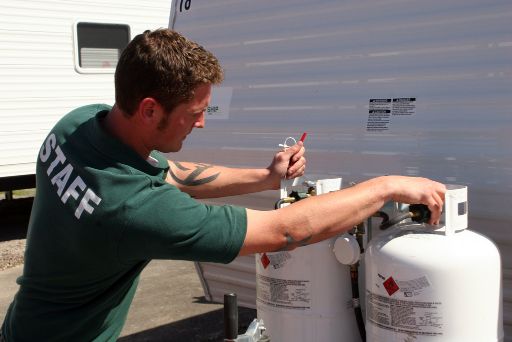
How much does a propane refill cost per gallon? For a portable cylinder, I use $3–$5 per gallon as a practical U.S. shopping budget, not a guaranteed nationwide price. U-Haul described refills at many locations as approximately $3–$4 per gallon in February 2026, and Tractor Supply displayed a $4.29 per-gallon example while noting that store prices vary.
The U.S. Energy Information Administration recorded $2.82 per gallon for nationwide residential delivered propane for the week of November 2, 2026, before taxes. That number is useful context, but it should not be mistaken for the price of filling a barbecue cylinder. The 2027 figures below are budgeting scenarios based on these verified late-2026 benchmarks—not confirmed future prices.
U.S. price guide for 2027 · Source prices checked November 9, 2026 · All costs shown in U.S. dollars


When someone asks me what a propane refill costs, I ask one question first: Are you refilling a small cylinder or ordering a delivery for a stationary home tank? Those are two different markets. If I give you a national heating-fuel average when you are standing beside a grill tank, I have not really answered your question.
I compare propane on three measures: the posted gallon rate, the actual gallons you receive, and the extra money or time required to get them. This gives you a more realistic answer than an attractive exchange sign or an advertised starting price. Below I’ll walk you through portable-cylinder costs, home-tank deliveries, refill-versus-exchange math, how to read a receipt, and my decision guide for saving money without sacrificing safety.
What Is the Current Propane Refill Cost Per Gallon?
A typical small-cylinder refill price isn’t a single national number. It can change with the supplier, city, store staffing, local competition, taxes, and whether the price is a measured-gallon refill or a fixed-price exchange. For a useful 2027 guide, I start with late-2026 reference figures and show the math at several possible rates.
| Pricing channel | Price per gallon | How I use the figure |
|---|---|---|
| U.S. residential delivery, EIA, Nov. 2, 2026 | $2.82 | National home-delivery average, excluding taxes; not a small-tank quote |
| U-Haul refill guidance, Feb. 2026 | About $3–$4 | General guidance for many U-Haul refill locations; local quotes vary |
| Tractor Supply webpage, checked Nov. 2026 | $4.29 shown | Illustrative online store price, explicitly variable by location |
| My portable-cylinder planning range | $3–$5 | Budget scenarios, not a verified average or forecast |
For example, if your station says $3.49 per gallon, that can be a competitive local refill quote; if another store asks $4.79, it may still be worthwhile when the first station is far away. A local price above $5 doesn’t prove you’re being overcharged, especially where access or freight costs are high. I would ask two nearby suppliers for their final out-the-door cost before making that judgment.


I also avoid comparing the EIA’s $2.82 residential price with a Tractor Supply $4.29 cylinder price as though they were identical products. Large-quantity delivery and individual retail filling have different labor, equipment, and logistics. For a broader cost discussion, I cover that distinction in Is Propane Gas Economical?.
Propane Refill Cost by Tank Size: 5 lb to 100 lb
A tank’s size is usually expressed as the nominal pounds of propane it can carry. To convert pounds to liquid gallons for rough planning, I divide by about 4.24 pounds per gallon. The result is close enough to estimate fuel expense, but the fill operator must follow the actual cylinder markings and approved filling procedure.
| Cylinder rating | Approx. propane gallons | At $3.00/gal | At $4.29/gal | At $5.00/gal |
|---|---|---|---|---|
| 5 lb | 1.2 | $3.60 | $5.15 | $6.00 |
| 10 lb | 2.4 | $7.20 | $10.30 | $12.00 |
| 20 lb | 4.7 | $14.10 | $20.16 | $23.50 |
| 30 lb | 7.0 | $21.00 | $30.03 | $35.00 |
| 40 lb | 9.4 | $28.20 | $40.33 | $47.00 |
| 100 lb | 23.5 | $70.50 | $100.82 | $117.50 |
Costs assume each cylinder starts essentially empty and receives the rounded liquid quantity shown. Real fills depend on remaining fuel, temperature, authorized capacity and dispenser measurements. These are calculations, not retailer quotations for every size.
The most common mistake I see in online cost comparisons is subtracting another 20% from the listed capacity of a 20 lb cylinder. The cylinder’s 20 lb propane rating already accounts for the required expansion space. A correctly filled 20 lb grill cylinder holds roughly 4.7 gallons of liquid propane, not 3.8 gallons. The “80% rule” applies to liquid versus water capacity; it does not mean you buy 20 lb and receive only 16 lb at an ordinary full refill.
A 30 lb cylinder typically takes around seven gallons from empty, so at $4.29 per gallon, the fuel is about $30.03. If you are considering that tank size, read my 30 lb propane tank cost guide, which separates buying the cylinder from filling it.



Technical Details That Affect Propane Cost Calculations
I like to keep the physical specifications close to the price tables. These numbers help you compare a fill sold by pounds, gallons, or appliance runtime without using misleading shortcuts.
| Measurement | Working figure | Practical meaning |
|---|---|---|
| Liquid propane density near 60°F | About 4.24 lb/gal | Used to convert nominal cylinder pounds to gallons |
| Energy content | About 91,452 BTU/gal | Useful for appliance runtime and cost per hour |
| 20 lb cylinder | About 4.7 gal | Typical full grill-cylinder refill quantity |
| 30 lb cylinder | About 7.0 gal | Common RV cylinder fuel load |
| 100 lb cylinder | About 23.5 gal | Heavier portable cylinder; dealer rules vary |
| 250-gal stationary tank | About 200 gal at 80% | Water-capacity rating is not fillable gallons |
| 500-gal stationary tank | About 400 gal at 80% | Typical maximum liquid load under normal conditions |
For a precise conversion, see How Much Does 1 Gallon of Propane Weigh?. Density changes with temperature, so I use these round numbers for budgeting rather than for overfilling or verifying a questionable container.
Two operational details matter, too. First, a refill technician inspects the cylinder before filling. A tank with unacceptable corrosion, damage, or an expired qualification may be refused. Second, an RV, grill, or heating appliance can only use the cylinder and regulator arrangement approved for it. Never choose a different tank or connection just because the larger capacity looks cheaper on a spreadsheet.
Propane Refill vs Exchange: The Real Price Per Gallon
This is where I think the biggest opportunity for avoiding a misleading price comparison lies. A standard barbecue cylinder is described as a 20 lb tank because that is its rated propane capacity. But a common Blue Rhino or AmeriGas exchange package contains 15 lb of propane, or about 3.54 gallons. That isn’t the same amount of fuel as a properly refilled 20 lb cylinder. Always check the net-weight label of the specific exchange you buy.


For this calculation I will use a hypothetical $24 exchange and a $4.29 per-gallon refill. The exchange amount is a scenario, not a claimed nationwide chain price.
| What you receive | Fuel quantity | Example payment | Effective price per gallon |
|---|---|---|---|
| Standard exchange containing 15 lb | 3.54 gallons | $24.00 | $6.78 |
| Refill an empty 20 lb cylinder | 4.70 gallons | $20.16 | $4.29 |
| Refill 15 lb of fuel into your own cylinder | 3.54 gallons | $15.19 | $4.29 |
There are two differences. In the example, a measured refill has a lower effective price per gallon, and a completely refilled 20 lb cylinder gives you roughly one-third more propane than a 15 lb exchange. If you’re already halfway through grilling season, that extra fuel can mean another cookout before you need to make a trip.
I do not say exchange is always a bad deal. Exchange cages can have longer access hours, and an acceptable older cylinder may be exchanged without you finding a refill station that will fill it. But convenience is a separate benefit. I would put a dollar value on that convenience rather than pretending the two fuel quantities are equivalent.
Worked Example: How Much Do You Save by Refilling?
Scenario: I need 15 lb of propane, and my choices are a $24 exchange or a measured refill at $4.29 per gallon.
15 lb ÷ 4.24 lb/gal ≈ 3.54 gal
3.54 gal × $4.29 ≈ $15.19
$24.00 − $15.19 ≈ $8.81 saved
If I used 15 lb each time over ten visits, the modeled difference would be approximately $88.10 before travel, taxes, or other fees. That’s a useful household example, but it is not a prediction of anyone’s annual bill. You need to insert your own local exchange and measured-fill prices to know your savings.
Here’s another way to see it. The $24 exchange costs about $6.78 per gallon. Buying the same 4.7-gallon fuel quantity at that unit rate would cost approximately $31.87, versus about $20.16 at the $4.29 refill rate. This equivalent-volume comparison is more accurate than simply claiming an exchange is $24 and a refill is $20, because the volumes differ.
How I Calculate the Total Propane Refill Cost
If you have the gallon price on a sign and the capacity printed on your cylinder, the estimate is easy. For a nearly empty cylinder, I multiply the likely gallons added by the posted price. If some propane remains, I estimate only the top-up amount. For a fixed-price service, I divide the amount paid by the actual gallons received.
For example, suppose my 20 lb cylinder is about half full. A full 20 lb propane load is approximately 4.7 gallons, so topping it up from about half might require roughly 2.35 gallons. If the retailer charges $4.29 per gallon, I estimate 2.35 × $4.29 = $10.08 before fees. The dispenser and the filler’s required procedure determine the actual amount sold, not my rough gauge estimate.
If a store charges a flat $20 regardless of whether the cylinder needs 2.35 gallons or 4.7 gallons, my effective price is very different in those two cases. For 2.35 gallons, $20 means approximately $8.51 per gallon. For 4.7 gallons, it is about $4.26 per gallon. I always find out what “full tank price” means before bringing in a partial cylinder.
| Gallons dispensed | At $3.00 | At $4.00 | At $4.29 | At $5.00 |
|---|---|---|---|---|
| 2 gal | $6.00 | $8.00 | $8.58 | $10.00 |
| 3 gal | $9.00 | $12.00 | $12.87 | $15.00 |
| 4 gal | $12.00 | $16.00 | $17.16 | $20.00 |
| 5 gal | $15.00 | $20.00 | $21.45 | $25.00 |
| 7 gal | $21.00 | $28.00 | $30.03 | $35.00 |
| 10 gal | $30.00 | $40.00 | $42.90 | $50.00 |
For drivers comparing stops, I add one more term: the cost of getting there. A refill at $3.75 per gallon may look much better than $4.29, but the fuel savings on 4.7 gallons are only about $2.54. If reaching the cheaper retailer requires a long detour, the savings can disappear quickly. I call this the trip-adjusted refill cost.
How Much Does Residential Propane Cost Per Gallon?
Stationary home tanks are a different buying situation. For a 250-gallon or 500-gallon tank, propane usually arrives in a supplier’s delivery truck. The invoice can include a contracted gallon price, delivery or minimum-usage rules, taxes, and sometimes tank rental or service charges. You should compare the complete delivered cost, not the published pump price for small cylinders.
The EIA national average was $2.82 per gallon for residential propane in the week of November 2, 2026, before taxes. It is a useful benchmark for the broad residential market, but your individual bill may differ sharply. Some states are above that number; others are below it. Suppliers may also quote different prices for a 100-gallon order versus a 300-gallon order.
| Delivered gallons | At $2.82/gal | At $3.50/gal | At $4.00/gal |
|---|---|---|---|
| 75 gal | $211.50 | $262.50 | $300.00 |
| 100 gal | $282.00 | $350.00 | $400.00 |
| 150 gal | $423.00 | $525.00 | $600.00 |
| 200 gal | $564.00 | $700.00 | $800.00 |
| 250 gal | $705.00 | $875.00 | $1,000.00 |
| 350 gal | $987.00 | $1,225.00 | $1,400.00 |
The $2.82 figure in this table is the November 2, 2026 EIA national benchmark, used here only to illustrate multiplication. It is not a guaranteed delivery quote for these gallon quantities. Other columns are hypothetical prices; taxes, minimums and service fees are excluded.
Worked Example: Refilling a 500-Gallon Home Tank
Imagine a 500-gallon stationary tank showing 30% on its gauge. If the supplier fills it to 80%, the added fuel is approximately 50% of its 500-gallon water capacity, or 250 gallons. At a hypothetical delivered price of $3.50 per gallon, the fuel line item would be $875. At $2.82 it would be $705, before additional charges. I would confirm the quote rather than assume the national average is what I’ll actually pay.
For a 250-gallon stationary tank, 80% represents approximately 200 gallons. If I start at 30% and go to 80%, I am adding approximately 125 gallons. This is a much better way to estimate the next bill than multiplying the full tank capacity by the advertised gallon price.
What Time of Year Is Propane Cheapest to Refill?
Prices often respond to seasonal demand, but they do not follow one perfect calendar. In cold regions, heating season raises demand. In other places, a supplier’s cost, nearby competition, and summer equipment usage might matter more than the month. A low-price month for bulk deliveries is not automatically the cheapest month for a grill cylinder at a retail store.
The EIA’s national residential series moved from $2.586 on October 5, 2026, to $2.820 on November 2, 2026. That is an increase of 23.4 cents per gallon over those four weeks, but it doesn’t establish what will happen next spring—or in 2027. I would use the published series to understand the trend, then ask my supplier about local pricing and refill availability.
When possible, I prefer planning ahead to running out during a weekend, storm, or holiday. A last-minute purchase may leave you with only one open retailer and little ability to compare. For more context, see What Time of Year Is Propane the Cheapest?. It is especially relevant if you purchase hundreds of gallons for home heating.
How to Turn Propane Price per Gallon Into Cost per Hour
A gallon price becomes much more meaningful when I convert it to the cost of operating a specific appliance. Propane contains approximately 91,452 BTU per U.S. gallon. If an appliance uses 40,000 BTU per hour at full input, then its approximate fuel consumption is 40,000 ÷ 91,452 = 0.437 gallons per hour.
At $4.29 per gallon, that works out to about $1.88 per operating hour. A three-hour cookout or outdoor session would use about 1.31 gallons and cost roughly $5.63 in propane. This is an energy-input estimate; actual burner modulation, weather, pressure and usable cylinder vaporization can affect the result.
| Rated input (BTU/h) | Approx. gal/hour | At $3.00/gal | At $4.29/gal | At $5.00/gal |
|---|---|---|---|---|
| 10,000 | 0.109 | $0.33 | $0.47 | $0.55 |
| 20,000 | 0.219 | $0.66 | $0.94 | $1.09 |
| 30,000 | 0.328 | $0.98 | $1.41 | $1.64 |
| 40,000 | 0.437 | $1.31 | $1.88 | $2.19 |
| 50,000 | 0.547 | $1.64 | $2.35 | $2.73 |
| 60,000 | 0.656 | $1.97 | $2.81 | $3.28 |
I use this chart as a practical way to estimate weekly usage. If you run a 40,000 BTU/h appliance for nine hours in a week, the fuel cost at $4.29 per gallon is around $16.89. The physical size of the cylinder does not change the input rating of an appliance. It simply changes how much fuel you have available between refills.
Ten Ways I Would Save on Propane Refills in 2027
Most articles stop at “shop around.” I think it’s better to build a repeatable system. If you buy propane regularly, a few pieces of information will let you choose the less expensive option without driving all over town.
- Ask for the measured gallon rate: compare what the dispenser actually sells, not just the price on a cylinder-sized sign.
- Check exchange net weight: divide the amount charged by the fuel gallons inside, not by the cylinder’s theoretical capacity.
- Top up strategically: if you pay per gallon, filling before you’re empty can be convenient; avoid high flat rates on a partially filled cylinder.
- Compare two local suppliers: a single phone call can uncover different fees, hours or container limitations.
- Group cylinder refills: one trip for several approved cylinders can lower your travel expense per gallon.
- Track each purchase: write down gallons delivered, amount paid, date and effective price per gallon.
- Know when your cylinder needs inspection: a rejected out-of-date tank adds inconvenience and may require requalification or replacement.
- Read home-delivery contracts: look for lease, minimum-use, routing, emergency delivery and termination fees.
- Plan before an urgent refill: fewer time constraints give you more choice.
- Use an appliance that fits the job: don’t run a high-output burner longer than needed, and always follow the manufacturer’s instructions.
One detail I would not overlook is supplier choice. Homeowners who own their tank may have greater freedom to compare delivery companies than customers under a lease arrangement. If you are deciding between ownership and rental, my related article Is Propane Cheaper If You Own the Tank? explains the bigger-picture question.
Refill, Exchange, or Home Delivery? My Decision Guide
The cheapest option depends on your container and how you actually use the fuel. I would not recommend buying a large cylinder if your grill manual only approves a smaller setup, nor would I suggest carrying a 100 lb cylinder to a retailer that cannot accommodate it. Compatibility and safe handling come first.
| Your situation | Option to compare first | Why |
|---|---|---|
| Own an in-date 20 lb grill cylinder | Measured refill | Often better unit cost and potentially a full 20 lb fuel load |
| Need a quick convenient swap | Exchange | Easy access may justify the higher equivalent gallon cost |
| RV with 30 lb cylinders | Qualified refill station | Many exchange cages do not serve this size |
| 100 lb portable cylinder | Call propane dealer | Confirm equipment, handling and filling capability |
| 250- or 500-gallon home tank | Delivered propane quote | Compare gallon price, minimums, tank terms and other charges |
| Used or questionable cylinder | Inspection first | An unsafe or out-of-date container cannot be filled |
If you’re unsure when your cylinder is low enough to need a trip, I suggest How to Tell If You Need Propane. It helps you connect fuel-level checks to refill planning without relying on weak flame output or other potentially misleading appliance symptoms.
Safety Checks Before Filling a Propane Tank
Saving a few dollars is not a reason to cut corners. A trained attendant should inspect a cylinder’s condition, markings and valve before filling it. Never attempt to force a station to fill a tank that was refused due to damage or qualification problems. Don’t assume an old tank is safe because it still contains some fuel.
Safety first: Transport portable cylinders upright and secured as required for their design, with the valve closed and protected. Avoid leaving cylinders in unattended vehicles or storing them indoors, in basements, or in enclosed garages. Don’t perform DIY cylinder refilling, valve replacement, or pressure testing. If you smell propane or suspect a leak, move away from the area and contact emergency services or your propane supplier from a safe place.
I would also distinguish ordinary vapor-withdrawal grill cylinders from specially configured liquid-withdrawal forklift cylinders. They are not interchangeable merely because both contain propane. Use the cylinder, connection, regulator and handling procedures specified for the equipment.
For a bigger picture of the fuel and its behavior, see What Is Propane Gas Used For?. The best savings plan is always one that fits the equipment you already own and can operate safely.
Frequently Asked Questions About Propane Refill Prices
How much does it cost to refill a 20 lb propane tank?
A full 20 lb cylinder holds around 4.7 gallons. At $3 per gallon, fuel costs about $14.10; at $4.29 it is about $20.16; and at $5 it is about $23.50. Your station may add taxes, fees or a minimum charge.
How much does a 30 lb propane refill cost?
Plan for approximately seven gallons from empty. At $3, $4.29 and $5 per gallon, the fuel would cost $21, $30.03 and $35, respectively, before additional charges.
Is propane cheaper when you refill instead of exchange?
Often it is on an equal-fuel basis, but the difference depends on your local posted price, fees and the exchange’s net fuel weight. A common 15 lb exchange contains about 3.54 gallons, not 4.7 gallons.
Does Tractor Supply refill by the gallon?
Its propane refill offering is advertised by the gallon, but the page notes that both pricing and availability vary by store. Check your location before driving over.
Does U-Haul refill propane tanks?
U-Haul advertises staffed refill stations, with current prices and availability shown by location. It also says that some locations offer exchanges; the options depend on the store.
What is the average residential propane price in the United States?
The EIA reported $2.82 per gallon for the week of November 2, 2026, excluding taxes. It describes residential delivery prices rather than a guaranteed small-cylinder pump price.
Is the $2.82 average a prediction for 2027?
No. It is a measured late-2026 national reading. My 2027 guide uses it as background, not a forecast or a promise that next year’s price will match it.
Does a 20 lb grill cylinder hold 20 gallons?
No. It carries about 20 pounds of propane when properly filled, which is approximately 4.7 liquid gallons. Pounds and gallons are different units.
Can I refill a propane tank before it’s empty?
Yes, an authorized provider can usually top up an acceptable cylinder using its approved filling method. At a measured gallon rate, you typically pay for fuel added, subject to minimum charges.
How much does 100 gallons of propane cost?
At a hypothetical delivered price of $3.50 per gallon, 100 gallons costs $350 before fees and taxes. If you’re buying for home heating, request a local delivery quote; don’t assume small-cylinder prices apply.
My Bottom Line: What Should You Pay Per Gallon?
For a portable cylinder, I would start with a $3–$5 per-gallon planning range, then check what two local refill stations actually charge. For stationary home tanks, I’d use the latest residential price data only as a reference and get a real delivered quote that spells out gallons, taxes, delivery terms, and other fees.
Above all, compare the same quantity of fuel. A 15 lb exchange and a full 20 lb refill are not identical purchases, so comparing just their sticker prices can mislead you. The numbers that matter are how much propane you get, what it costs all-in, and whether the trip is worth it.
My next step would be simple: check the cylinder’s markings, confirm a nearby supplier can refill that size, and ask for its current per-gallon price. If you do that and calculate the actual gallons, you can make an informed decision whether 2027 propane prices rise, fall or stay close to late-2026 levels.

Mike is an experienced propane technician with over 15 years of professional experience in the field. He has dedicated his career to helping customers with their propane needs, from installation to maintenance and repair. Together with Jeremy, he co-founded this website to provide useful information and guidance to customers seeking reliable propane services.