

QUICK ANSWER — How Much Does a Propane Tank Cost in Connecticut?
The cost depends on tank size, condition, installation and fuel delivery. Published new equipment-only reference prices are approximately $985 for 120 gallons, $1,950 for 250 gallons, $2,900 for 500 gallons, and $4,750 for 1,000 gallons. These are not installed Connecticut quotations. Connecticut’s surveyed residential propane average for the week of November 16, 2026 was $4.412 per gallon, excluding taxes. I recommend calculating your actual fuel demand, then asking registered local dealers for itemized installed-price quotations.
| Tank size | Published new above-ground equipment reference | Propane at 80% fill |
|---|---|---|
| 120 gallons | $985 | 96 gallons |
| 250 gallons | $1,950 | 200 gallons |
| 320 gallons | $2,350 | 256 gallons |
| 500 gallons | $2,900 | 400 gallons |
| 1,000 gallons | $4,750 | 800 gallons |
These are BLT Tanks equipment comparisons from an out-of-state supplier, not Connecticut installed quotes. Actual permissible fill depends on applicable requirements and conditions.
If you’re shopping for a propane tank in Connecticut, I recommend looking beyond the advertised purchase price. Delivery, winter fuel consumption, permits, and supplier contracts can add substantially to the cost. A homeowner in Stamford who uses propane only for cooking may need a different storage system than a household in Litchfield County that depends on propane heating all winter. A rural home may also require more reliable delivery arrangements when roads are icy.
I’ll compare new and used tanks, dimensions, refill costs, ownership arrangements, local suppliers, and state rules. I’ll also walk you through calculations you can use to estimate a suitable capacity and your five-year fuel expenses.


This 2027 guide was prepared using information available in November 2026. The statewide fuel-price figure is dated November 16, 2026, not a guaranteed 2027 rate. Obtain current prices and code guidance before making decisions.
1. How Much Does a Propane Tank Cost in Connecticut?
There isn’t one statewide equipment price for every home in Hartford, New Haven, Bridgeport, Stamford, and rural Connecticut. I separate the total into tank purchase or lease, site preparation, installation and permits, and first propane fill. This makes quotations much easier to compare.
What Determines the Price?
- Tank capacity: A larger vessel usually costs more upfront, though equipment cost per gallon of nominal storage may be lower.
- Construction: Underground-rated tanks require burial-specific coatings and corrosion protection.
- Condition: Used equipment may cost less but can require inspection, repairs, and replacement fittings.
- Delivery: A narrow driveway, limited truck access, or long distance from the supplier can add expense.
- Installation: A foundation, excavation, piping run, regulators, and system testing may be needed.
- Local approval: Permits and inspections depend on the installation and town.
How Much Does Installation Cost?
Here is a hypothetical budget for a new 500-gallon above-ground installation. Only the fuel-cost calculation uses the dated Connecticut EIA average; the other allowances are illustrations rather than contractor quotes.
| Expense | Illustrative budget |
|---|---|
| New 500-gallon tank | $2,900 |
| Delivery and site preparation | $450 |
| Regulators, piping, installation and testing | $950 |
| Initial 400-gallon fill at $4.412 | $1,764.80 |
| Illustrative total | $6,064.80 |
I recommend asking installers to itemize delivery, pipe length, regulators, foundation, labor, testing, approvals, and the initial fuel. Converting an older heating system may cost more than simply replacing an existing tank.


New vs. Used Propane Tank Prices
BLT Tanks advertised certain rebuilt models in October 2026 at prices shown below. These are historical out-of-state inventory references, not local offers or promises that the tanks are still available.
| Refurbished size | Advertised equipment price range |
|---|---|
| 250 gallons | $795–$1,095 |
| 500 gallons | $1,575–$1,895 |
| 1,000 gallons | $2,755–$3,195 |
I would never buy a used tank without ownership records, a readable manufacturer plate and confirmation that my proposed installer and propane supplier accept it. Transport, servicing, and repairs can erase savings. For an additional maintenance perspective, read how frequently you should replace a propane tank.
Is Buying or Leasing Better?
| Factor | Buying | Leasing |
|---|---|---|
| Initial expense | Higher | Often lower |
| Tank ownership | Homeowner | Propane supplier |
| Supplier selection | Potentially more flexible | Often restricted |
| Repairs | Depends on agreement | Depends on agreement |
| Equipment rental | Usually none | May apply |
| Home sale | Tank may transfer | Lease needs attention |
A lease can reduce initial spending, while buying may provide more control over the equipment. I would compare costs over five years, including fuel-price terms, rental fees, repairs, removal charges, and any restriction on who may fill the tank. Connecticut regulates retail home-heating propane contracts, so read every contract rather than relying on a verbal offer.
2. Where Can You Buy Propane Tanks in Connecticut?
I recommend calling established propane businesses that serve your exact town and asking whether they sell customer-owned stationary tanks, lease them, or only refill portable cylinders. These are different services, and a retail grill refill location may not handle a 500-gallon residential installation.
Hocon Gas
Hocon Gas advertises residential installation and propane delivery services across its Connecticut service territory. It discusses above-ground and underground tank solutions, including larger residential capacities. Its locations include Waterbury. I would request quotations for the selected tank and ask whether the equipment is customer-owned or leased.



Connecticut Propane & Petroleum
Connecticut Propane & Petroleum advertises service from Marlborough, Oxford, and Waterbury and discusses both tank ownership and rental arrangements. It is worth contacting if you’re comparing delivery programs, tank purchase terms, and equipment servicing.
Santa Energy
Santa Energy advertises residential propane and tank installation in portions of Fairfield and New Haven Counties. The company discusses above-ground and underground installations and purchase or lease arrangements. Ask about service availability for your specific ZIP code.
A-1 Propane
A-1 Propane advertises equipment purchasing, leasing, installation, replacement, and delivery. Its listed address is 36 Sheldon Road, Manchester, CT 06045. I would confirm current availability of 250-, 500-, and 1,000-gallon vessels before visiting.
| Supplier | Advertised service focus | What to verify |
|---|---|---|
| Hocon Gas | Installation and delivery | Buy vs. lease, service town |
| Connecticut Propane & Petroleum | Tank programs and delivery | Ownership, contract and fuel prices |
| Santa Energy | Fairfield/New Haven area | Installation scope, current coverage |
| A-1 Propane | Tank sales, leasing and delivery | Sizes currently available |
These businesses are examples, not rankings or guarantees of inventory. Connecticut’s Department of Consumer Protection maintains a registered propane dealer list. I recommend checking registration and obtaining written quotes before signing.


3. What Propane Tank Sizes Are Available in Connecticut?
Portable propane cylinders are commonly identified by pounds of propane, while stationary tanks are usually discussed in gallons of water capacity. A 100-pound cylinder is much smaller than a 100-gallon stationary tank. See my propane tank vs. cylinder guide for a clearer comparison.
| Tank or cylinder | Approximate propane held | Typical use |
|---|---|---|
| 20-pound cylinder | 4.7 gal | Grill or portable equipment |
| 100-pound cylinder | 23.5 gal | Auxiliary appliances |
| 50-gallon stationary tank | 40 gal | Specialty low-demand use |
| 120-gallon stationary tank | 96 gal | Cooking, hot water and fireplace |
| 250-gallon stationary tank | 200 gal | Moderate residential demand |
| 500-gallon stationary tank | 400 gal | Heating and multiple appliances |
| 1,000-gallon stationary tank | 800 gal | High-demand heating and larger properties |
Stationary figures use an approximate 80% liquid-fill planning assumption. The applicable filling rules and conditions determine actual permitted amounts.
Smaller tanks have lower initial equipment expense and may be practical for intermittent use. Larger tanks provide more fuel between deliveries and may be appropriate for primary heating. I wouldn’t choose a tank solely by its volume: the installer should also check maximum appliance demand and cold-weather vaporization capability.
4. How Much Does a 1,000-Gallon Propane Tank Cost in Connecticut?
A 1,000-gallon tank may be worthwhile for high heating demand, multiple propane appliances, or properties where delivery scheduling is inconvenient. Its conventional 80% fill is about 800 gallons.
Purchase Price and Dimensions
Published BLT Tanks equipment references are around $4,750 above ground and $5,250 underground, excluding delivery and installation in Connecticut. Check the exact manufacturer’s specifications before choosing a site.
| Specification | Representative value |
|---|---|
| Nominal capacity | 1,000 gallons |
| Propane at 80% fill | 800 gallons |
| Diameter | About 41 inches |
| Overall length | About 16 feet |
| Empty weight | Model-dependent, often over 1,500 lb |
How Much Does Filling It Cost?
At the EIA Connecticut residential survey average of $4.412 per gallon on November 16, 2026, 800 gallons would cost $3,529.60, excluding taxes and fees. Filling from a gauge reading of 30% to 80% adds about 500 gallons, or $2,206 at that illustrative rate.
I would consider this size when consumption justifies the added investment. A home using propane only for a kitchen range probably does not need 800 gallons of stored fuel. Ask suppliers to compare installed cost, peak-demand performance and expected delivery intervals.
5. How Much Does a 500-Gallon Propane Tank Cost in Connecticut?
A 500-gallon tank is useful to evaluate for homes with a furnace, water heater, fireplace, or generator. At 80% fill, it contains roughly 400 gallons.
Price and Physical Size
BLT Tanks published equipment comparisons of about $2,900 above ground and $3,325 underground. These are not delivered Connecticut quotations.
| Specification | Representative value |
|---|---|
| Nominal capacity | 500 gallons |
| Propane at 80% fill | 400 gallons |
| Diameter | About 38–41 inches |
| Overall length | Around 9–10 feet |
| Empty weight | Often about 900–1,000 lb |
Refill Cost Chart
| Delivered price per gallon | Cost of 400 gallons |
|---|---|
| $3.50 | $1,400 |
| $4.00 | $1,600 |
| $4.412 (EIA, Nov. 16, 2026) | $1,764.80 |
| $4.50 | $1,800 |
| $5.00 | $2,000 |
Except for the dated EIA average, these rates are hypothetical scenarios. Actual delivery quantity is smaller if the tank still contains propane.
How Long Does a 500-Gallon Tank Last?
Suppose your home uses four gallons per day. A full 80% fill gives 400 ÷ 4 = 100 theoretical days. If you reorder at 20%, you use approximately 300 gallons between the 80% and 20% gauge levels: 300 ÷ 4 = 75 days between planned fills.
Actual winter use can be much higher. I recommend basing the tank choice on peak heating demand, delivery timing, and the supplier’s ability to provide adequate vapor during freezing weather.
6. How Much Does a 250-Gallon Propane Tank Cost in Connecticut?
A 250-gallon tank may suit a household with moderate propane demand. A standard planning fill of 80% gives about 200 gallons of liquid propane.
Price and Dimensions
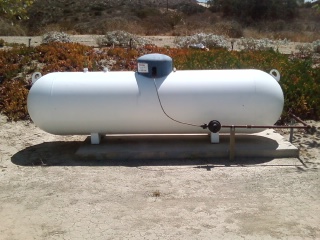
Published new equipment-only references are $1,950 above ground and $2,325 underground. An example horizontal tank has the following dimensions:
| Specification | Representative measurement |
|---|---|
| Nominal capacity | 250 gallons |
| Propane at 80% fill | 200 gallons |
| Diameter | 30 inches |
| Overall length | 7 ft 10 in |
| Empty weight | Around 470 lb |
At $4.412 per gallon, a hypothetical 200-gallon fill costs $882.40 before taxes or fees. If your household uses 50 gallons per month, the 150-gallon operating window between 80% and 20% lasts about three months.
250 vs. 500 Gallons
| Factor | 250-gallon | 500-gallon |
|---|---|---|
| Propane at 80% | 200 gal | 400 gal |
| Fuel from 80% to 20% | 150 gal | 300 gal |
| New equipment reference | $1,950 | $2,900 |
| Full-fill fuel cost at $4.412 | $882.40 | $1,764.80 |
I would evaluate a 250-gallon tank for cooking, hot water and occasional fireplace use, but also compare 500-gallon storage for primary heating. The installer should assess vaporization capacity, not just total gallons.
7. How Much Do Small Propane Tanks Cost in Connecticut?
Small propane equipment includes both portable cylinders and compact stationary vessels. They cannot automatically be substituted for one another because mounting, fittings, intended use and regulatory requirements differ.
| Size | Approximate propane | Typical application |
|---|---|---|
| 20-lb cylinder | 4.7 gal | Grill |
| 30-lb cylinder | 7.1 gal | RV appliances |
| 100-lb cylinder | 23.5 gal | Auxiliary equipment |
| 50-gallon stationary tank | 40 gal | Specialty uses |
| 120-gallon stationary tank | 96 gal | Cooking and limited residential use |
BLT Tanks’ published reference for a new 120-gallon above-ground tank is $985; an underground model was listed around $1,770. At $4.412 per gallon, 96 gallons costs about $423.55, excluding taxes and fees.
A household using 20 gallons monthly could theoretically get 4.8 months from 96 gallons. For planning deliveries between 80% and 20%, the operating quantity is about 72 gallons, or 3.6 months at that use rate. I would not rely on a small tank for substantial winter heating without professional assessment.
8. Small vs. Large Propane Tanks: Which Is Best for Connecticut?
I recommend choosing capacity based on expected consumption, winter conditions and delivery access. Small tanks cost less up front but need more frequent refills when fuel demand is high. Larger ones can reduce delivery frequency but cost more and require more installation space.
| Application | Tank size to evaluate |
|---|---|
| Grill or portable equipment | Approved portable cylinder |
| Cooking and limited hot water | 120–250 gallons |
| Multiple appliances | 250–500 gallons |
| Primary propane heating | 500–1,000 gallons |
| Regular generator operation | Manufacturer-calculated capacity |
| High-demand rural home | 500–1,000 gallons |
These are conversation starters, not definitive designs. A qualified installer should check the combined BTU demand, expected cold-weather vaporization and the actual refill schedule.
9. What Are the Dimensions of Propane Tanks in Connecticut?
The tank’s footprint is only part of the space required. You must also account for setbacks, building openings, delivery truck access, technician access, and snow clearance.
| Tank size | Approximate diameter | Approximate length |
|---|---|---|
| 120 gallons | 24 inches | 5–6 ft |
| 250 gallons | 30 inches | 7 ft 10 in |
| 500 gallons | 38–41 inches | 9–10 ft |
| 1,000 gallons | About 41 inches | About 16 ft |
These are illustrative manufacturer-model dimensions, not universal specifications. I recommend requesting the exact model drawing before planning a pad, trench or installation point. A narrow side yard may simply be unsuitable for the required clearances even when the tank itself appears to fit.
10. How Does Connecticut’s Winter Weather Affect Propane Tanks?
Connecticut’s winter weather increases heating fuel consumption and can reduce the vaporization rate of liquid propane. The practical problem is usually low tank pressure or insufficient vapor supply, not liquid propane freezing solid at ordinary winter temperatures.
Can a Tank Still Have Fuel but Fail to Supply a Furnace?
Yes. A tank can contain liquid propane and still struggle to vaporize it at the rate required by a high-input appliance during very cold weather. Available liquid surface area, tank size, fill level, ambient temperature and appliance load all matter. I would have the installer check maximum hourly demand at the winter design temperature.
Keeping Tanks Accessible in Snow
Maintain access to valves, gauges, regulators and delivery connections. Follow the supplier’s instructions for safe snow clearing and never use a flame or improvised heater to thaw propane equipment. Call a professional if a regulator or other component appears damaged or blocked.
Winter Reserve Planning
| Daily consumption | Seven-day fuel need | Fourteen-day fuel need |
|---|---|---|
| 3 gallons | 21 gal | 42 gal |
| 5 gallons | 35 gal | 70 gal |
| 8 gallons | 56 gal | 112 gal |
| 12 gallons | 84 gal | 168 gal |
These are arithmetic examples, not mandated minimum reserves. I recommend accounting for supplier lead time and unusually cold weather before deciding when to reorder.
11. Above-Ground vs. Underground Propane Tanks in Connecticut
Both arrangements can be appropriate when the tank and installation meet applicable requirements. Above-ground systems are typically easier to inspect and involve less excavation. Underground tanks have less visual impact but require specialized protection, installation and inspection practices.
| Consideration | Above ground | Underground |
|---|---|---|
| Equipment cost | Usually lower | Usually higher |
| Excavation | Typically limited | Required |
| Visibility | Exposed vessel | Mostly concealed |
| Inspection | Exterior readily visible | More specialized |
| Corrosion control | Exterior upkeep | Burial-rated protection |
| Snow access | Keep fittings clear | Keep service dome accessible |
| Site preparation | Often simpler | Can be complicated by rock or groundwater |
Connecticut sites may have shallow bedrock, rocky soils or drainage challenges that increase excavation costs. For an underground tank, I would obtain a separate site and excavation estimate before committing. Unless the site has a good reason to conceal the tank, I generally investigate the above-ground option first.
12. Where Can You Refill a Propane Tank in Connecticut?
A portable grill cylinder may be refilled at a participating retail station. Stationary residential tanks are typically filled by a bulk delivery truck at the property. Don’t assume a supplier office also accepts walk-in cylinders; call to verify.
Hartford, Waterbury and Southwestern Connecticut
Around Hartford, ask residential suppliers such as A-1 Propane and Connecticut Propane & Petroleum about delivery coverage. Hocon Gas lists a Waterbury location at 20 Railroad Hill Street, Waterbury, CT 06708, and Connecticut Propane & Petroleum identifies Waterbury as one of its operating areas. Santa Energy serves portions of Fairfield and New Haven Counties. These mentions do not guarantee retail cylinder refills at any branch.
Connecticut Fuel Cost Examples
Using the EIA’s $4.412 per gallon average for November 16, 2026:
| Gallons delivered | Calculated cost |
|---|---|
| 50 | $220.60 |
| 100 | $441.20 |
| 150 | $661.80 |
| 200 | $882.40 |
| 300 | $1,323.60 |
| 400 | $1,764.80 |
| 600 | $2,647.20 |
| 800 | $3,529.60 |
The surveyed residential average excludes taxes, and each actual supplier may quote a different rate. For additional guidance, see my propane refill cost per gallon guide.
Refill vs. Exchange
Some retail exchange programs provide 15 pounds of propane in a cylinder commonly marketed as a 20-pound size. Refilling an eligible cylinder may provide more propane for the money. Compare fuel quantity and unit price, not only the headline charge. An exchange can still be convenient when a cylinder is no longer suitable for refilling.
13. What Are Connecticut’s Propane Tank Installation Regulations?
Connecticut’s building and fire-code framework governs permanent propane installations. As of November 24, 2026, Connecticut’s official code-adoption materials indicated that the planned 2026 codes had been delayed pending legislative approval. The state’s 2022 building and fire-code framework remained an important reference. I recommend confirming the currently enforced edition with your town on the date the application is filed.
Do You Need a Permit?
A permanent installation can require local building, mechanical, plumbing or fire-related approval, depending on the capacity, property and work. Contact your town’s building department and fire marshal before ordering a tank. A possible exemption from one permit does not automatically waive other safety requirements.
How Far Must a Propane Tank Be From the House?
| Tank size | Common NFPA 58-style above-ground planning reference |
|---|---|
| 120 gallons | Small-container rules and exceptions apply |
| 250 gallons | Often 10 feet |
| 500 gallons | Often 10 feet |
| 1,000 gallons | Often 25 feet, subject to exceptions |
This is not a universal Connecticut approval chart. The actual required separation depends on the adopted code, tank grouping, building openings, property lines, installation configuration and exceptions. A qualified professional and local authority must approve the final position.
Can You Install a Tank Yourself?
For a substantial permanent system, I recommend an appropriately qualified professional. Installation may involve a pressure vessel, regulator sizing, gas piping, appliance connections and leak testing. Incorrect work can cause fire, explosion or carbon-monoxide hazards.
Recertification and Inspection
Portable DOT cylinders and large stationary ASME tanks have different inspection and qualification rules. Certain portable cylinders require periodic requalification; stationary tanks follow a different service framework. Learn more in my article on who recertifies propane tanks.
Retail Propane Dealer Protections in Connecticut
Connecticut’s Department of Consumer Protection registers retail home-heating propane dealers and provides guidance about fuel contracts. It also states that dealers may not require a minimum delivery quantity of home-heating propane. This does not guarantee that every supplier serves every property or that all contract rates are the same. Review price terms, automatic delivery, tank rental, service obligations, cancellation and removal charges before signing.
14. Which Propane Tank Brands Are Available in Connecticut?
I recommend selecting equipment based on its intended use, certification, warranty, dimensions and the local installer’s ability to maintain it. A famous brand alone does not prove that a particular tank suits your home.
| Brand | Typical product emphasis | What to verify |
|---|---|---|
| Manchester Tank | Portable cylinders and stationary ASME tanks | Model drawing and approved configuration |
| Quality Steel | Stationary storage vessels | Construction, burial rating and warranty |
| Worthington Enterprises | Portable cylinder products | Cylinder rating and compatibility |
| Flame King | Portable and specialty tanks | Intended application and valves |
The company supplying and maintaining a permanent residential tank should confirm the exact product model. Portable cylinders and stationary vessels are not interchangeable simply because their capacities look similar.
15. How Much Does It Cost to Operate a Propane Tank in Connecticut?
Fuel consumption may cost more over several years than the original tank. I recommend estimating annual gallons before choosing a vessel or a supply contract.
Propane Consumption Formula
Gallons per hour = appliance BTU input per hour ÷ 91,500.
For example, a furnace with a 90,000 BTU-per-hour fuel input uses around 0.98 gallons per hour while operating at that input. Eight hours of equivalent full-input operation is approximately 7.9 gallons; at $4.412 per gallon, that is roughly $34.86 before applicable charges. Real heating bills depend on insulation, thermostat settings, weather and equipment cycling.
Annual Fuel Expense at One Dated Price
| Annual usage | Cost at $4.412 per gallon |
|---|---|
| 200 gal | $882.40 |
| 400 gal | $1,764.80 |
| 600 gal | $2,647.20 |
| 800 gal | $3,529.60 |
| 1,200 gal | $5,294.40 |
| 1,500 gal | $6,618.00 |
These are calculations using a single November 2026 average, not a forecast of 2027 fuel prices.
Five-Year Ownership Example
Suppose the tank costs $2,900 and delivery/installation allowance is $1,400, for a $4,300 initial outlay. If the home consumes 800 gallons annually at a hypothetical five-year average of $4.00 per gallon, annual fuel is $3,200 and five years of fuel totals $16,000. Total initial equipment plus five-year fuel is therefore $20,300, before taxes, maintenance, additional fees and financing. Compare this with the total cost of a supplier lease.
I would also consider improving insulation, maintaining heating equipment, comparing dealer price plans, monitoring winter levels and retaining signed contracts and delivery receipts.
16. What Size Propane Tank Do You Need for Your Connecticut Home?
Square footage alone cannot determine the best tank. A home with electric heating and only a propane range may use far less fuel than a similar-sized house with a propane furnace, water heater, dryer and backup generator.
Cooking, Water Heating and Home Heating
For limited propane demand, I would evaluate 120–250 gallons. For multiple appliances and primary home heating, I would examine 500–1,000 gallons with a qualified installer. Peak demand, cold-weather vaporization and supplier delivery schedules may change the recommendation.
Standby Generator Example
If a particular generator consumes three gallons per hour at a stated load, then 24 hours uses 72 gallons, 48 hours uses 144 gallons, and 72 hours uses 216 gallons. Check the manufacturer’s actual consumption table and add any simultaneous furnace demand before selecting the tank. My propane tank size chart for generators explains how to evaluate generator storage.
500 vs. 1,000 Gallons at Six Gallons Daily
| Planning factor | 500-gallon tank | 1,000-gallon tank |
|---|---|---|
| Propane at 80% | 400 gal | 800 gal |
| Fuel between 80% and 20% | 300 gal | 600 gal |
| Days between deliveries at 6 gal/day | 50 days | 100 days |
| Published new equipment reference | $2,900 | $4,750 |
The larger tank doubles the theoretical interval in this example, but costs more upfront and requires more room. I would ask the installer about peak winter demand and available service access before making that investment.
Buying Checklist
- Confirm tank capacity, model, manufacturer and condition.
- Establish ownership and warranty terms.
- Confirm current local code, permits and placement setbacks.
- Compare above-ground and underground site costs.
- Check regulators, piping, appliance demand and vaporization.
- Verify winter delivery access and the dealer’s service area.
- Request the propane price, contract terms and maintenance responsibilities in writing.
- Confirm that the intended supplier accepts customer-owned or refurbished equipment.
17. Frequently Asked Questions About Propane Tanks in Connecticut
How Much Does a 500-Gallon Tank Cost?
A published new above-ground equipment reference is about $2,900. Connecticut installation, delivery and first fill add to the total, so get a written local quote.
Where Can I Buy a Tank Near Me?
Check registered suppliers serving your ZIP code. Hocon Gas, Connecticut Propane & Petroleum, Santa Energy and A-1 Propane advertise relevant tank or installation services, subject to their actual coverage.
How Much Does a 250-Gallon Tank Cost?
A published new equipment reference is about $1,950 above ground, excluding delivery and installation.
How Much Does a 1,000-Gallon Tank Cost?
The published above-ground equipment reference is around $4,750, excluding local installation costs.
How Much Does Propane Cost Per Gallon in Connecticut?
The EIA’s surveyed residential average for the week of November 16, 2026 was $4.412 per gallon, excluding taxes. Individual supplier quotes and future rates differ.
Is 500 Gallons Enough for Winter Heating?
It may be for many homes. Calculate fuel consumption, refill intervals and the peak cold-weather vaporization requirement rather than relying on size alone.
Do I Need a Permit?
Requirements depend on your town, installation and tank configuration. Ask the local building department and fire marshal before work begins.
Can I Buy a Used Tank?
Yes, but confirm legal ownership, physical condition, manufacturer markings and acceptance by the installer and propane supplier.
Can I Install a Tank Underground?
Yes, when approved for burial and installed in compliance with applicable rules. Consider excavation, soil, drainage and corrosion protection.
Is Buying Better Than Leasing?
Ownership can provide flexibility; leasing often lowers initial equipment spending. Compare total costs, fuel pricing, repairs, fees and contract restrictions.
Does Every Tank Expire After 12 Years?
No. Certain portable DOT cylinders have periodic requalification requirements, while stationary ASME tanks have a different inspection and maintenance framework.
When Should I Schedule a Refill?
Reorder before fuel is critically low, using the supplier’s recommended level and your expected winter consumption. A 20% gauge reading is one planning example, not a universal mandate.
18. Final Thoughts: Choosing the Best Propane Tank in Connecticut
If you’re buying a propane tank in Connecticut, I recommend starting with actual appliance demand, property layout and delivery reliability. A 120- or 250-gallon tank may be suitable for modest cooking and water-heating needs. A 500-gallon system offers more storage for multiple appliances, while a 1,000-gallon tank is worth considering for substantial heating demand or less convenient winter deliveries.
Capacity is only one factor. Compare fuel pricing, buying versus leasing, the contractor’s installation plan, town permits, safe placement, winter vaporization and the supplier’s ability to service the equipment.
The most useful propane tank is not necessarily the biggest or cheapest: it is the one that meets your fuel demand safely, fits your property and has manageable lifetime costs.
Editorial source checks: BLT Tanks new equipment pricing; U.S. EIA residential propane prices; Connecticut Department of Consumer Protection; Connecticut building code information. Verify current details before publishing.

Mike is an experienced propane technician with over 15 years of professional experience in the field. He has dedicated his career to helping customers with their propane needs, from installation to maintenance and repair. Together with Jeremy, he co-founded this website to provide useful information and guidance to customers seeking reliable propane services.