

If you’re planning to buy or install a propane tank in Kansas, I recommend looking beyond the advertised equipment price. The tank is only one part of your investment: delivery, professional installation, regulators, gas lines, permits, inspections, and the first propane fill can all affect your final expense.
Kansas has several challenges that make propane planning especially important. Freezing winter temperatures, strong winds, and rural delivery routes can increase heating demand or complicate fuel deliveries. A homeowner near Wichita may only need fuel for hot water or a generator, while a family outside Salina may depend on propane for heat. A farm near Dodge City could consume substantially more propane for livestock buildings and agricultural operations.
I’ll compare tank sizes, published equipment reference prices, refill calculations, buying versus leasing, Kansas suppliers, installation requirements, and cold-weather planning. I want you to choose enough storage for your needs without paying for unnecessary equipment.


Pricing note: This 2027 guide uses information available as of November 24, 2026. Equipment prices below are published references from an out-of-state seller, not installed Kansas quotations. Fuel examples use the EIA Kansas residential average of $2.293 per gallon for November 16, 2026, excluding taxes. Actual dealer prices and charges can differ.
Quick Answer: How Much Does a Propane Tank Cost in Kansas?
The price depends on capacity, equipment condition, location, installation type, and whether you buy or lease. BLT Tanks, based in Oklahoma, publishes the following equipment-only estimates for new above-ground stationary vessels.
| Tank size | New above-ground equipment estimate | Propane at 80% fill |
|---|---|---|
| 120 gallons | $985 | 96 gallons |
| 250 gallons | $1,950 | 200 gallons |
| 320 gallons | $2,350 | 256 gallons |
| 500 gallons | $2,900 | 400 gallons |
| 1,000 gallons | $4,750 | 800 gallons |
These are not delivered or installed Kansas prices. At the EIA’s dated $2.293-per-gallon residential average, 400 gallons of propane would cost approximately $917.20 before taxes and other charges.
For primary home heating, I would start by comparing 500- and 1,000-gallon tanks. For cooking or limited water heating, 120- or 250-gallon storage may be adequate. My recommendation: Estimate annual and peak-winter consumption and compare complete written quotes from at least two propane suppliers that actually serve your address.


1. How Much Does a Propane Tank Cost in Kansas?
Installation expenses can differ across Wichita, Topeka, Kansas City, Salina, Hutchinson, Garden City, and remote farming communities. A tank installed beside an accessible house with an existing gas line may cost less than one at a rural site requiring extensive piping or excavation.
Factors that affect the total price
- Capacity: Larger vessels generally have a higher purchase price but allow more propane between refills.
- Condition: Refurbished tanks may cost less, but inspection and repair expenses can reduce the savings.
- Location: Transport distance, truck access, and unloading requirements affect delivery expenses.
- Construction: Underground tanks need burial-rated construction, excavation, and corrosion protection.
- Site preparation: Support pads, grading, drainage, and protection from vehicles may be necessary.
- Piping and permits: Regulators, fuel piping, tests, inspections, and approvals must be budgeted.
Worked example: installing a 500-gallon tank
| Expense | Illustrative budget |
|---|---|
| New 500-gallon above-ground tank | $2,900 |
| Delivery and site preparation | $450 |
| Regulators, piping, labor, and testing | $950 |
| Initial 400-gallon fill at $2.293 | $917.20 |
| Illustrative total | $5,217.20 |
This is a hypothetical project budget, not an installer quotation. The equipment figure is a published reference; the installation allowances are assumed; the fuel calculation uses a dated state survey. Request an itemized local quote before committing.
How much do refurbished tanks cost?
| Refurbished size | Advertised out-of-state equipment range |
|---|---|
| 250 gallons | $795–$1,095 |
| 500 gallons | $1,575–$1,895 |
| 1,000 gallons | $2,755–$3,195 |
These are October 2026 advertised references, not guaranteed Kansas inventory. I would verify proof of ownership, the manufacturer’s nameplate, vessel condition, and whether the chosen supplier will service it.
2. Where Can You Buy Propane Tanks in Kansas?
Kansas has independent propane dealers and cooperatives serving homeowners and agricultural operations. Some sell tanks outright; others specialize in leasing or delivery. I recommend confirming whether a company serves your exact ZIP code before comparing prices.
Leavenworth County Cooperative Association
This northeast Kansas cooperative advertises propane system installation and service, plus 500- and 1,000-gallon tanks for sale or lease. It also advertises route and will-call delivery and prepay arrangements. I would contact it for a written buy-versus-lease comparison around Leavenworth and Lansing.



Miller Bros Propane
Based around Independence in southeast Kansas, Miller Bros advertises above-ground and underground tanks for sale or rent, plus fuel delivery. Ask about tank sizes, current inventory, and installation costs in your service area.
Jim’s Propane
Jim’s Propane, located in Leon, advertises tank leasing, residential delivery, and 325-, 500-, and 1,000-gallon equipment. It also lists will-call, automatic-fill, and budget-plan arrangements.
Central Gas Service
Central Gas Service serves the Garden Plain area and advertises tank leasing and automatic delivery. Its advertised service terms have included a free first lease year and no separate delivery or hazmat fees. Verify current eligibility and details before relying on these offers.
AV Energy
AV Energy advertises propane tank sales and leasing, with service in Dodge City, Cimarron, Jetmore, Spearville, and nearby southwest Kansas communities. I would ask for both residential and agricultural delivery options.


Redigas
Redigas, based in McPherson, advertises propane deliveries to communities including Hutchinson, Lindsborg, Hesston, and Salina. Contact it for delivery availability and equipment arrangements.
| Supplier | Area to investigate | Services to ask about |
|---|---|---|
| Leavenworth County Cooperative | Northeast Kansas | Tank sales, leasing, installation, delivery |
| Miller Bros Propane | Southeast Kansas | Above-ground and underground tanks |
| Jim’s Propane | Butler County | Leasing, automatic and will-call delivery |
| Central Gas Service | Garden Plain area | Leasing and automatic delivery |
| AV Energy | Southwest Kansas | Tank sales, leasing, home and farm delivery |
| Redigas | Central Kansas | Propane delivery and equipment options |
These are supplier leads, not rankings or guarantees of current stock. Before buying, ask whether the quote includes unloading, tank supports, regulators, piping, safety testing, and the first fill.
3. Buying vs. Leasing a Propane Tank in Kansas
Buying and leasing have different long-term implications. When you buy the tank, you own the equipment but may pay more upfront. With a lease, the supplier normally retains ownership and may restrict which dealer is permitted to fill it.
| Factor | Buying | Leasing |
|---|---|---|
| Upfront equipment cost | Higher | Often lower |
| Ownership | Homeowner | Supplier |
| Choice of fuel dealer | Potentially more flexible | Often restricted |
| Rental payments | Usually none | May apply |
| Maintenance obligations | Contract-dependent | Contract-dependent |
| Removal on termination | Owner handles equipment | Lease terms control |
Can another dealer refill a leased tank? Do not assume so. Some Kansas propane companies, including Wayman Oil, specifically warn against filling supplier-owned tanks without authorization. Read the lease agreement and confirm ownership before arranging another delivery.
Five-year equipment cost example
Suppose the purchase price is $2,900, while leasing costs a hypothetical $120 per year.
| Expense | Buy | Lease |
|---|---|---|
| Equipment purchase | $2,900 | $0 |
| Five years’ rent | $0 | $600 |
| Total before fuel and maintenance | $2,900 | $600 |
If leased-tank fuel is hypothetically $0.25 per gallon more and you burn 900 gallons annually, the extra fuel costs $1,125 over five years. Leasing would then total $1,725 before other expenses. These figures are examples only. Compare actual contracts including maintenance, emergency service, minimum purchases, and removal fees.
4. What Propane Tank Sizes Are Available in Kansas?
Portable propane cylinders are normally specified in pounds; stationary tanks use nominal gallons of water capacity. A 100-pound cylinder does not hold 100 gallons of propane.
| Tank size | Approximate liquid propane | Typical application |
|---|---|---|
| 20-pound cylinder | 4.7 gallons | Grills and portable equipment |
| 30-pound cylinder | 7.1 gallons | RVs and camping |
| 100-pound cylinder | 23.5 gallons | Auxiliary equipment |
| 50-gallon stationary | 40 gallons | Limited specialty uses |
| 120-gallon stationary | 96 gallons | Cooking and hot water |
| 250-gallon stationary | 200 gallons | Moderate home demand |
| 500-gallon stationary | 400 gallons | Home heating |
| 1,000-gallon stationary | 800 gallons | High-demand homes and farms |
Stationary quantities use an approximate 80% fill for budgeting. Filling procedures must follow the applicable safety rules. For limited appliance use, I would investigate a 120- or 250-gallon tank; for regular heating, a 500- or 1,000-gallon tank may be more useful. The installer must also confirm cold-weather vaporization and maximum BTU-per-hour demand.
5. How Much Does a 1,000-Gallon Propane Tank Cost in Kansas?
A 1,000-gallon vessel can suit larger homes, farms, and properties where longer intervals between winter deliveries are valuable. It normally stores about 800 liquid gallons at 80% fill.
| Configuration | New-equipment price reference |
|---|---|
| Above-ground 1,000-gallon | $4,750 |
| Underground 1,000-gallon | $5,250 |
| Specification | Approximate value |
|---|---|
| Water capacity | 1,000 gallons |
| Liquid propane at 80% | 800 gallons |
| Diameter | Around 41 inches |
| Overall length | Around 16 feet |
| Empty weight | Often above 1,500 pounds; varies by model |
The above prices exclude Kansas delivery and installation. The exact manufacturer’s drawing controls physical dimensions.
What does a fill cost?
At $2.293 per gallon, 800 gallons cost $1,834.40. A refill from 30% to 80% adds about 500 gallons, costing $1,146.50 at that rate. Both figures exclude additional charges.
How long can the tank last?
If a home consumes eight gallons daily, the 800-gallon supply theoretically lasts 100 days. Planning deliveries from an 80% fill to a 20% reorder level leaves 600 gallons, or 75 days between planned fills. This is an illustration; winter consumption varies substantially.
6. How Much Does a 500-Gallon Propane Tank Cost in Kansas?
A 500-gallon tank is one of the first capacities I would compare for a home with propane space heating, water heating, or multiple appliances. It holds about 400 gallons at 80% fill.
| Configuration | New-equipment reference |
|---|---|
| Above-ground 500-gallon | $2,900 |
| Underground 500-gallon | $3,325 |
| Specification | Approximate value |
|---|---|
| Water capacity | 500 gallons |
| Liquid propane at 80% | 400 gallons |
| Diameter | 38–41 inches |
| Overall length | Around 9–10 feet |
| Empty weight | Often 900–1,000 pounds |
500-gallon propane refill cost chart
| Fuel price per gallon | Cost to deliver 400 gallons |
|---|---|
| $1.75 | $700 |
| $2.00 | $800 |
| $2.293 (dated Kansas EIA average) | $917.20 |
| $2.50 | $1,000 |
| $3.00 | $1,200 |
| $3.50 | $1,400 |
Only $2.293 is the cited survey average; other rates are hypothetical examples. At five gallons per day, the 300 gallons available from 80% to 20% last 60 days. I would check historic bills and winter delivery reliability before deciding whether this tank provides enough storage.
7. How Much Does a 250-Gallon Propane Tank Cost in Kansas?
A 250-gallon tank is often worth investigating when the home has moderate demand or only a few propane appliances. It stores around 200 gallons at 80% fill.
| Configuration | New-equipment reference |
|---|---|
| Above-ground 250-gallon | $1,950 |
| Underground 250-gallon | $2,325 |
| Specification | Approximate value |
|---|---|
| Water capacity | 250 gallons |
| Fuel at 80% | 200 gallons |
| Diameter | Around 30 inches |
| Overall length | Around 7–8 feet |
| Empty weight | Around 470 pounds |
At the dated $2.293-per-gallon average, 200 gallons would cost $458.60. If you consume 50 gallons monthly, the 150 gallons available from 80% to 20% offer about three months between planned refills.
| Comparison | 250-gallon tank | 500-gallon tank |
|---|---|---|
| Fuel at 80% | 200 gal | 400 gal |
| Fuel from 80% to 20% | 150 gal | 300 gal |
| New equipment reference | $1,950 | $2,900 |
| Fuel at $2.293/gal for an 80% fill | $458.60 | $917.20 |
For year-round heating, the extra storage of a 500-gallon tank may justify its higher initial cost.
8. How Much Do Small Propane Tanks Cost in Kansas?
Portable cylinders and small stationary tanks are used for cooking, grilling, RVs, and other limited applications. Don’t confuse a 20-pound grill cylinder with a permanent home-heating tank.
| Container | Approximate propane capacity |
|---|---|
| 20-pound cylinder | 4.7 gallons |
| 30-pound cylinder | 7.1 gallons |
| 100-pound cylinder | 23.5 gallons |
| 50-gallon stationary tank | 40 gallons |
| 120-gallon stationary tank | 96 gallons |
A new above-ground 120-gallon tank has a published equipment reference of $985; an underground version is listed at $1,770. At $2.293 per gallon, an assumed 96-gallon delivery costs $220.13, rounded. At a hypothetical use rate of 20 gallons monthly, the 72 gallons available from 80% to 20% last 3.6 months.
A 100-pound cylinder holds about 23.5 gallons, while a 100-gallon stationary vessel holds around 80 gallons at 80% fill. See my propane tank versus cylinder guide for the distinction.
9. New vs. Used Propane Tanks for Sale in Kansas
A used tank may be cheaper, but I would not buy it without proof of ownership and a clear service history. Some tanks on private property actually belong to propane suppliers under lease agreements.
| What to inspect | What to confirm |
|---|---|
| Legal ownership | Seller can transfer the tank |
| Manufacturer nameplate | Identification is readable |
| Corrosion and damage | Vessel is suitable for continued service |
| Valves and fittings | Condition is acceptable |
| Repairs | Known maintenance and inspection history |
| Freight | Safe loading and unloading |
| Supplier policy | Local dealer will inspect and fill the tank |
For example, an illustrative refurbished 500-gallon tank at $1,800 plus $350 freight, $400 service work, and $850 installation totals $3,400 before fuel. Compare that against a new installed quote. See my guide on how frequently propane tanks should be replaced.
10. How Does Propane Delivery Work in Kansas?
Homeowners can use automatic delivery, scheduled routes, or will-call service. I recommend selecting a delivery arrangement that matches the household’s consumption and the supplier’s actual coverage.
Automatic and route delivery
With automatic delivery, a supplier estimates usage or uses tank monitoring data to schedule a fill. Some companies also operate regular geographic delivery routes. Leavenworth County Cooperative advertises route delivery. I would consider this arrangement for a home that depends on propane heating.
Will-call delivery
With will-call, you monitor the gauge and order propane. This gives you more control but requires planning. Ask the supplier for expected lead times, especially during winter storms and harvest-season demand.
| Factor | Automatic or route delivery | Will-call |
|---|---|---|
| Scheduling | Supplier generally manages | Customer requests |
| Monitoring | May use estimates or monitors | Customer monitors gauge |
| Convenience | Often higher | Requires more attention |
| Timing | Supplier route and terms | Depends on request and availability |
| Winter suitability | Helpful for regular heating demand | Needs advance planning |
Ask about per-gallon prices, minimum delivery quantities, rental fees, hazmat or administrative charges, and emergency service. If the tank runs empty, contact the propane supplier: safe restoration may require professional leak checking. Never bypass a safety control.
11. Where Can You Get Propane Delivery or Refills in Kansas?
Delivery coverage varies by county and local route. Confirm the specific address instead of assuming the closest office serves the property.
Wichita and Butler County
Jim’s Propane advertises leasing and delivery around Butler County. Central Gas Service serves the Garden Plain area west of Wichita. I would compare their lease terms, fuel plans, and automatic or will-call delivery policies.
Northeast Kansas
Leavenworth County Cooperative advertises tank sales, leases, and fuel delivery around Leavenworth and Lansing. Ask about its route schedules and whether it accepts customer-owned tanks.
Southwest Kansas
AV Energy serves the Dodge City area and surrounding communities. For farm equipment or higher seasonal demand, request an agricultural delivery estimate.
Central and Southeast Kansas
Redigas advertises central Kansas delivery near McPherson, Hutchinson, and Salina; Miller Bros Propane advertises service around Independence in the southeast.
| Area | Supplier lead | Main service to confirm |
|---|---|---|
| Wichita / Butler County | Jim’s Propane | Leasing, residential deliveries |
| Garden Plain | Central Gas Service | Leasing and automatic delivery |
| Leavenworth / Lansing | Leavenworth County Cooperative | Sales, leases, delivery |
| Dodge City | AV Energy | Home and agricultural delivery |
| McPherson / Hutchinson / Salina | Redigas | Bulk propane delivery |
| Independence | Miller Bros Propane | Sales, rental, delivery |
What does a portable 20-pound cylinder refill cost?
A standard 20-pound propane cylinder holds roughly 4.7 gallons when filled to its rated capacity. Kansas retailers that offer refilling, such as participating Tractor Supply stores, may have different rates and hours. Verify the specific store fills rather than only exchanges cylinders.
| Hypothetical retail rate | Cost for 4.7 gallons |
|---|---|
| $3.00/gal | $14.10 |
| $3.50/gal | $16.45 |
| $4.00/gal | $18.80 |
| $4.50/gal | $21.15 |
| $5.00/gal | $23.50 |
These are not confirmed Kansas station prices. Read my propane refill cost per gallon guide for additional calculations.
12. What Are the Dimensions of Propane Tanks in Kansas?
The physical tank footprint is only one part of the space requirement. Code clearances, safe service access, and delivery-truck access also matter.
| Nominal tank capacity | Approximate diameter | Approximate length |
|---|---|---|
| 120 gallons | 24 inches | About 5–6 feet |
| 250 gallons | 30 inches | About 7–8 feet |
| 500 gallons | 38–41 inches | About 9–10 feet |
| 1,000 gallons | Around 41 inches | About 16 feet |
These are representative dimensions, not substitutes for the manufacturer’s drawings. Check tank support, building setbacks, openings, ignition sources, and property lines with the installer.
For farms, I would also evaluate areas where tractors, grain trucks, or other machinery could strike the tank. Approved vehicle-impact protection may be required where exposure exists.
13. Above-Ground vs. Underground Propane Tanks in Kansas
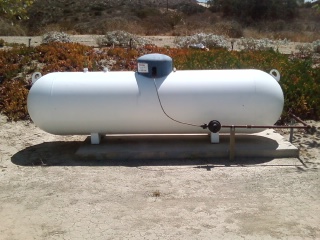
An above-ground tank is generally easier to inspect and costs less to install because it avoids most excavation. A buried tank can be less visually intrusive, but it requires appropriate burial-rated equipment, excavation, corrosion protection, and access to fittings.
| Size | Above-ground equipment reference | Underground equipment reference |
|---|---|---|
| 120 gallons | $985 | $1,770 |
| 250 gallons | $1,950 | $2,325 |
| 500 gallons | $2,900 | $3,325 |
| 1,000 gallons | $4,750 | $5,250 |
These are equipment-only references; underground installation can substantially increase total project cost. Soil conditions, groundwater, drainage, and corrosion risk should be evaluated before selecting a buried tank.
Can you bury a standard above-ground tank? No. Use a vessel specifically approved for underground service, with appropriate coatings and corrosion protection. I would ask the installer who is responsible for future cathodic protection inspection and upkeep.
14. What Are Kansas’s Propane Tank Installation Requirements?
Kansas regulates liquefied petroleum gas under the Kansas Propane Safety and Licensing Act (K.S.A. Chapter 55, Article 18), administered by the Kansas Office of the State Fire Marshal. The state’s LPG rules appear in Kansas Administrative Regulations Article 22-8. The state fire marshal’s published adopted-code listing identifies NFPA 58 (2008 edition) and NFPA 54 (2002 edition), as reviewed in November 2026. Code adoptions can change, so I would verify the operative rules with the authority having jurisdiction before construction.
Does an installer need a license?
Kansas establishes multiple LPG licensing classes. Its Class 8 covers LPG system installation and service. I would confirm the contractor holds the applicable business license and that qualified personnel perform the work.
| Kansas LPG license class | Broad activity |
|---|---|
| Class 1 | Retail propane distribution |
| Class 2 | Bulk storage site |
| Class 3 | Cylinder transport |
| Class 4 | Cylinder filling |
| Class 5 | RV fueling |
| Class 6 | Cylinder exchange cabinet |
| Class 7 | Self-service dispensing |
| Class 8 | LPG installation and service |
This is a simplified overview; specific license definitions and exceptions should be checked against state rules.
Does a residential tank need a permit?
State review can apply to qualifying LPG facilities, including marketer-owned or operated facilities with aggregate water capacity exceeding 2,000 gallons, and additional regulated operations such as cylinder filling. A typical single 500- or 1,000-gallon residential tank is below that particular facility threshold, but is not exempt from applicable fire and fuel-gas codes or any local permit and inspection requirements.
| Installation | Planning consideration |
|---|---|
| Single 250-gallon residential tank | Below cited facility threshold |
| Single 500-gallon residential tank | Below cited facility threshold |
| Single 1,000-gallon residential tank | Below cited facility threshold |
| Tank group exceeding 2,000 gallons aggregate | Facility review may apply |
| Cylinder-filling location | Additional licensing and approval requirements |
| Larger commercial LPG site | State review may apply |
How far from a house must the tank be?
Separation requirements depend on tank water capacity, location, surrounding structures and hazards, and applicable exceptions. For very preliminary planning, certain individual above-ground tanks commonly have the following NFPA 58-based reference distances:
| Tank capacity | General planning distance |
|---|---|
| Less than 125 gallons | Special smaller-container provisions may apply |
| 125–500 gallons | Commonly 10 feet |
| 501–2,000 gallons | Commonly 25 feet, subject to exceptions |
This is not an approval chart. Setbacks may differ for underground installations, tank groups, protected installations, openings, ignition sources, and property boundaries. Ask the installer and local fire authority to verify the exact requirements.
Permanent systems also require compliant piping and appropriate pressure or leak testing. I recommend a qualified professional for tank installation and service. Certain DOT portable cylinders require periodic requalification, while stationary ASME vessels have different inspection requirements. See who recertifies propane tanks.
15. How Does Kansas Winter Weather Affect Propane Tanks?
Kansas winters bring freezing temperatures, strong winds, and sudden weather changes. Heating consumption can rise quickly, especially in drafty homes or exposed rural buildings. I recommend monitoring your gauge and arranging winter deliveries before the tank becomes nearly empty.
Can propane freeze?
Pure propane freezes at around −306°F, far below Kansas weather. The practical winter concern is lower vapor pressure and reduced vaporization capacity. The tank may contain liquid propane but not deliver enough vapor for high-demand appliances if improperly sized.
How does tank size affect vapor supply?
Vaporization depends on tank size, liquid level, surface area, and temperature. Have the installer verify the maximum BTU-per-hour appliance demand under cold-weather conditions; tank storage volume alone doesn’t guarantee enough supply.
Winter reserve planning
| Daily propane use | Seven-day consumption | Fourteen-day consumption |
|---|---|---|
| 3 gallons | 21 gallons | 42 gallons |
| 5 gallons | 35 gallons | 70 gallons |
| 8 gallons | 56 gallons | 112 gallons |
| 12 gallons | 84 gallons | 168 gallons |
These are consumption examples, not legal reserves. Keep valves, gauges, and filling connections accessible. Never use a torch or open flame to thaw propane fittings. Contact the supplier if equipment is damaged or malfunctioning.
16. How Much Propane Do Kansas Farms Need?
Farm propane use differs from ordinary residential heating. Livestock buildings, drying equipment, irrigation engines, and multiple outbuildings may create high peak loads or concentrated seasonal consumption.
| Application | Primary sizing consideration |
|---|---|
| Farmhouse heating | Household winter consumption |
| Livestock buildings | Continuous heating and ventilation demand |
| Crop-drying equipment | Seasonal peak burner input |
| Irrigation engine | Hourly fuel consumption and runtime |
| Multiple buildings | Combined maximum equipment demand |
| Standby generator | Required runtime and connected load |
I would ask an agricultural supplier about peak-season deliveries, fuel contracting, vaporization capacity, pressure regulation, and emergency support. Substantial agricultural installations should be professionally designed rather than sized from a residential tank chart.
17. Which Propane Tank Brands Are Available in Kansas?
I would select equipment by its exact model, approval, specifications, condition, and support from the chosen propane installer rather than relying only on the brand name.
| Brand | General equipment focus | What to verify |
|---|---|---|
| Manchester Tank | Portable cylinders and ASME stationary tanks | Capacity, dimensions, warranty |
| Quality Steel | Stationary storage tanks | Design and underground rating |
| Worthington Enterprises | Portable cylinders | Certification and valve fittings |
| Flame King | Portable and specialty cylinders | Approved application |
These are product manufacturers and categories, not a guarantee that a specific model is in stock at Kansas retailers. I would confirm that my installer can inspect, connect, and service the selected tank.
18. How Much Does It Cost to Operate a Propane Tank in Kansas?
For a heating household, yearly fuel expenditure can exceed the equipment cost over time. Propane provides approximately 91,500 BTU per liquid gallon. To estimate an appliance’s fuel consumption:
Gallons per hour = Appliance input BTU per hour ÷ 91,500
A 90,000-BTU-per-hour furnace uses about 0.98 gallons per hour when operating at rated input. Eight hours at that input consume around 7.87 gallons, costing about $18.04 at $2.293 per gallon. Real use depends on furnace cycling, insulation, wind, and thermostat settings.
| Annual propane consumption | Calculated fuel cost at $2.293/gal |
|---|---|
| 200 gallons | $458.60 |
| 400 gallons | $917.20 |
| 600 gallons | $1,375.80 |
| 800 gallons | $1,834.40 |
| 1,000 gallons | $2,293 |
| 1,500 gallons | $3,439.50 |
| 2,000 gallons | $4,586 |
This is one dated state average, not a price prediction for 2027.
Five-year ownership example
Suppose a 500-gallon tank costs $2,900 and installation another hypothetical $1,400: initial equipment and installation equal $4,300. If the home consumes 900 gallons annually at an assumed average of $2.50 per gallon, annual fuel expense is $2,250, or $11,250 over five years. Adding $4,300 yields $15,550, excluding taxes, maintenance, other fees, and price changes.
To save money, I would compare full delivered-price quotes, check prepay or budget arrangements, improve insulation, and maintain heating appliances. Don’t compare per-gallon prices without checking rental and delivery fees.
19. What Size Propane Tank Do You Need for Your Kansas Home?
House size alone is not enough to choose a tank. Two similarly sized homes may have entirely different fuel loads depending on whether propane supplies cooking, hot water, heating, clothes drying, and standby generation.
| Application | Sizes worth evaluating |
|---|---|
| Grill or portable appliance | Approved cylinder |
| Cooking and limited hot water | 120–250 gallons |
| Several household appliances | 250–500 gallons |
| Primary space heating | 500–1,000 gallons |
| Standby generator | Size from manufacturer fuel-use data |
| Rural home with limited winter delivery | Larger storage if demand justifies it |
| Agricultural heating or drying | Professionally designed system |
For a generator using three gallons per hour at a particular load, 24 hours require 72 gallons, 48 hours 144 gallons, and 72 hours 216 gallons. Add any other appliances sharing the tank. Read my propane tank size chart for generators.
500- vs. 1,000-gallon storage example
At six gallons daily, the usable planning window between 80% and 20% is about 300 gallons for a 500-gallon tank and 600 gallons for a 1,000-gallon tank. That corresponds to 50 versus 100 days between planned fills.
| Factor | 500-gallon tank | 1,000-gallon tank |
|---|---|---|
| Fuel at 80% fill | 400 gal | 800 gal |
| Fuel from 80% to 20% | 300 gal | 600 gal |
| Days at 6 gal/day | 50 | 100 |
| New equipment reference | $2,900 | $4,750 |
My Kansas propane tank buying checklist
- Confirm exact tank capacity, model, and manufacturer.
- Confirm whether the vessel is new or refurbished and who legally owns it.
- Review lease restrictions and possible supplier-switching costs.
- Have a qualified installer verify code clearances and site suitability.
- Confirm Kansas licensing and applicable local permits.
- Ask about foundation, excavation, and vehicle protection.
- Require regulators, piping, and testing in the written scope.
- Verify winter delivery truck access and emergency service.
- Compare current delivered fuel prices and added charges.
- Confirm whether suppliers will fill a customer-owned tank.
I would compare written quotations describing the same equipment and services before paying a deposit.
20. Frequently Asked Questions About Propane Tanks in Kansas
How much does a 500-gallon propane tank cost in Kansas?
A published new above-ground equipment reference is $2,900. Actual delivered and installed Kansas prices depend on the site and supplier.
How much does a 250-gallon tank cost?
A published above-ground equipment reference is $1,950, excluding installation.
How much does a 1,000-gallon tank cost?
The published above-ground equipment reference is $4,750. Freight and installation are extra.
What is the average propane price in Kansas?
The EIA reported a Kansas residential average of $2.293 per gallon for November 16, 2026, excluding taxes.
Where can I buy a propane tank near me?
Leavenworth County Cooperative, Miller Bros Propane, and AV Energy advertise tank sales or equipment arrangements in parts of Kansas. Confirm delivery coverage and inventory for your property.
Can I lease a tank in Kansas?
Yes. Jim’s Propane, Central Gas Service, and Leavenworth County Cooperative are among businesses advertising leasing arrangements.
Is buying better than leasing?
Buying can provide more ownership flexibility; leasing may reduce initial expenditure. Compare rental charges, fuel prices, equipment maintenance, and contract terms.
How much does a 500-gallon tank cost to fill?
At the dated Kansas price of $2.293 per gallon, an assumed 400-gallon delivery costs $917.20 before other applicable charges.
Do I need a permit?
Requirements depend on the installation. Certain LPG facilities require Kansas State Fire Marshal review, and local permits may apply to smaller residential systems.
How far must a tank be from the house?
The precise distance depends on capacity, configuration, nearby hazards, and the applicable code. The installer should verify the site against Kansas requirements.
Can I bury a propane tank?
Yes, when a burial-rated tank and compliant underground installation are used. Ordinary above-ground tanks should not be buried.
Can I buy a used propane tank?
Yes, but verify legal ownership, inspect the vessel, and obtain the intended supplier’s approval.
Can Kansas winters affect tank performance?
Yes. Low temperatures reduce vapor pressure and may limit vaporization capacity, while wind can increase heating consumption.
Is automatic delivery better than will-call?
Automatic delivery may be more convenient for regular heating demand. Will-call requires you to monitor the tank and request fills in advance.
Do tanks expire after 12 years?
Certain portable DOT cylinders need periodic requalification. Stationary ASME tanks follow different inspection and maintenance rules.
What size tank is best for a standby generator?
Use the generator manufacturer’s hourly fuel consumption at your expected load and required runtime, plus demand from any connected household appliances.
Final Thoughts: Choosing the Best Propane Tank in Kansas
If you’re planning to purchase propane storage in Kansas, start with actual fuel consumption. A 120- or 250-gallon tank may be enough for limited cooking and hot-water use. A 500-gallon tank is worth comparing for residential heating, while 1,000 gallons may offer greater convenience for larger homes, rural properties, or some agricultural applications.
I wouldn’t select a tank only because it has the lowest advertised equipment price. Compare ownership and lease conditions, installation charges, winter delivery reliability, and all applicable state and local safety requirements. Obtain written quotes and have the location assessed by a qualified professional.
The best propane tank safely meets your fuel demand, fits your property, and provides dependable storage at a manageable long-term cost.

Mike is an experienced propane technician with over 15 years of professional experience in the field. He has dedicated his career to helping customers with their propane needs, from installation to maintenance and repair. Together with Jeremy, he co-founded this website to provide useful information and guidance to customers seeking reliable propane services.