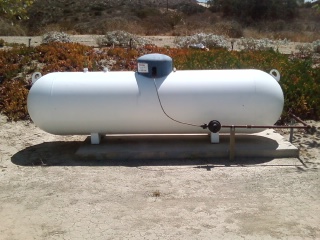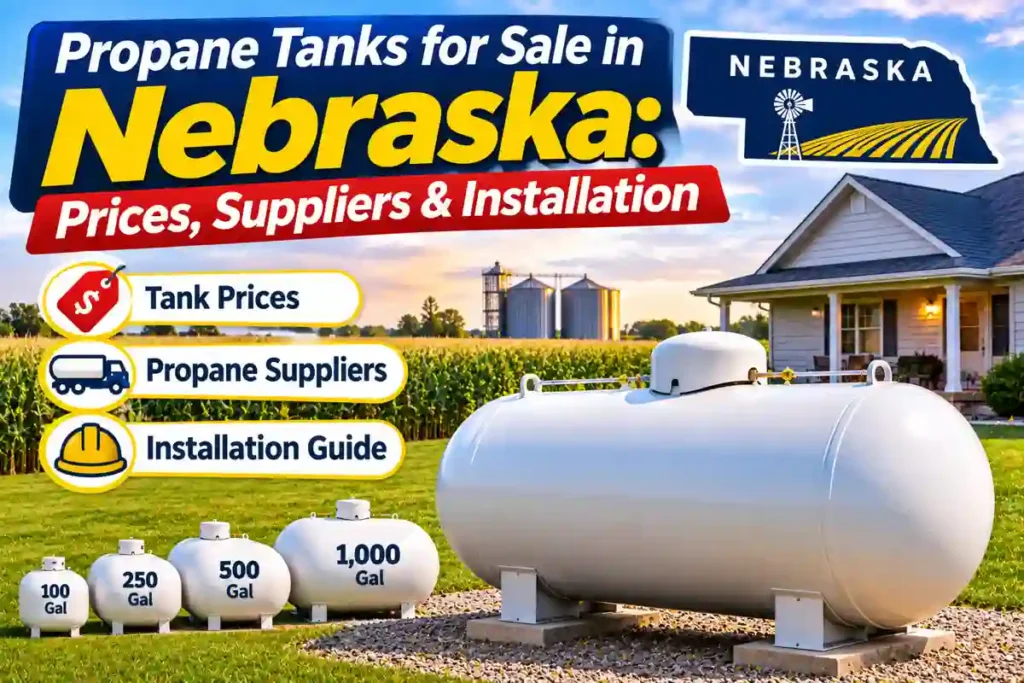


If you’re looking for propane tanks for sale in Nebraska, I’ll help you compare equipment prices, tank sizes, local suppliers, and installation expenses before making a purchase.
Whether you live in Omaha, Lincoln, Grand Island, Kearney, North Platte, or a rural farming community, the right tank depends on your fuel consumption, budget, and delivery access.
In this guide, I’ll explain where to buy new and refurbished tanks, how much propane costs, whether buying or leasing makes more sense, and what installation requirements you should check.


Quick Answer: Where Can You Buy Propane Tanks, and What Do They Cost?
You can buy or lease propane tanks through local propane suppliers, independent dealers, agricultural cooperatives, and equipment distributors. A new 500-gallon above-ground tank has a published equipment-price reference of approximately $2,900, while a 1,000-gallon tank is around $4,750 before delivery and installation.
These are published prices from BLT Tanks in Oklahoma—not verified Nebraska dealer quotations.
| Tank size | New above-ground price reference | Fuel at 80% |
|---|---|---|
| 120 gallons | $985 | 96 gallons |
| 250 gallons | $1,950 | 200 gallons |
| 320 gallons | $2,350 | 256 gallons |
| 500 gallons | $2,900 | 400 gallons |
| 1,000 gallons | $4,750 | 800 gallons |
The U.S. Energy Information Administration reported a Nebraska residential propane average of $1.842 per gallon on November 16, 2026, excluding taxes.
At that price, filling an empty 500-gallon tank to 80% costs approximately $736.80, while filling a 1,000-gallon tank to 80% costs approximately $1,473.60.


These fuel calculations are based on one historical statewide average, not guaranteed supplier prices or 2027 forecasts.
My recommendation: For a home that uses propane as its main heating fuel, compare 500- and 1,000-gallon tanks. For cooking and water heating, a 120- or 250-gallon tank may be sufficient. I would request at least two fully installed quotations before purchasing.
How Much Do New Propane Tanks Cost?
When comparing equipment prices, I recommend separating the tank purchase from delivery, installation, and fuel. An advertised equipment price doesn’t necessarily include unloading, supports, regulators, piping, inspection, or an initial propane fill.
New Above-Ground and Underground Tank Prices
| Capacity | Above-ground tank | Underground tank |
|---|---|---|
| 120 gallons | $985 | $1,770 |
| 250 gallons | $1,950 | $2,325 |
| 320 gallons | $2,350 | $2,650 |
| 500 gallons | $2,900 | $3,325 |
| 1,000 gallons | $4,750 | $5,250 |
These are BLT Tanks’ published equipment estimates, excluding freight, installation, and fuel. The supplier sells primarily in load quantities and does not advertise single-tank delivery. For that reason, I would use these figures as a comparison benchmark rather than assuming an individual homeowner can purchase one tank at the advertised price.
What Affects the Final Purchase Price?
- Tank capacity: Larger vessels generally cost more upfront.
- Above-ground or underground design: Burial-rated equipment often costs more.
- Tank condition: Refurbished equipment may be less expensive.
- Shipping distance: Large tanks require suitable transportation and unloading equipment.
- Local availability: Dealers may have different inventory and pricing.
- Installation scope: Trenching, regulators, and foundation work can increase the total expense.
I would request a written quotation listing these items separately.



What Propane Tank Sizes Are Available?
Propane containers range from small portable cylinders to large stationary tanks used for residential heating, generators, farms, and commercial operations. Portable cylinders are commonly measured by the weight of propane they hold in pounds. Stationary tanks are generally described by their water capacity in gallons.
Propane Tank Size and Capacity Chart
| Tank size | Approximate usable propane | Typical application |
|---|---|---|
| 20-pound cylinder | 4.7 gallons | Grills |
| 30-pound cylinder | 7.1 gallons | RVs |
| 100-pound cylinder | 23.5 gallons | Auxiliary appliances |
| 120-gallon stationary tank | 96 gallons | Cooking and water heating |
| 250-gallon stationary tank | 200 gallons | Moderate residential demand |
| 320-gallon stationary tank | 256 gallons | Several household appliances |
| 500-gallon stationary tank | 400 gallons | Residential heating |
| 1,000-gallon stationary tank | 800 gallons | Larger homes and farms |
The stationary capacities assume an approximate 80% liquid fill.
Why Don’t Propane Tanks Hold Their Full Rated Gallons?
A stationary propane tank’s gallon rating refers to its water capacity. Liquid propane expands as its temperature rises, so the tank must retain appropriate vapor space. A 500-gallon stationary tank therefore commonly contains approximately 400 gallons of liquid propane at an 80% fill.
How Would I Select the Right Size?
I would begin with the home’s annual fuel consumption and the appliances being supplied. A cooking-only household may use relatively little fuel, while a home with propane heating and a standby generator can consume much more. The installer must also verify maximum hourly demand, not just total storage capacity.


For additional guidance, see my propane tank versus cylinder comparison.
Where Can You Find Propane Tanks for Sale in Nebraska?
The most practical purchasing option is often a local supplier that can sell or lease the tank, deliver it, and complete the installation. Nebraska also has independent companies specializing in rural residential and agricultural propane service. Here are several suppliers I would investigate.
OOP Inc. — Tank Sales and Leasing
OOP Inc. advertises propane tanks for sale and lease, ranging from 20-pound cylinders to large 5,000-gallon vessels. The company also advertises installation services, including underground tank installations. I would ask which sizes are available to residential buyers and whether the quoted price includes delivery, site preparation, and installation.
Great Plains Service — Ashland Area
Great Plains Service operates in Ashland, between Omaha and Lincoln. The company advertises propane tank installation, appliance service, and residential, commercial, and agricultural propane services. For customers in eastern Nebraska, I would contact the company about installation availability and tank ownership arrangements.
Otte Oil & Propane — Lincoln and Eastern Nebraska
Otte Oil & Propane provides propane-related services and equipment, including regulators, hoses, gauges, valves, and replacement parts. Its customer information describes tank rental arrangements and ongoing equipment maintenance. I would compare its rental program with purchasing a customer-owned tank.
CPI Cooperative — South-Central Nebraska
Cooperative Producers, Inc. (CPI) advertises residential propane delivery, tank installation, leak checks, regulator replacement, and line testing. For customers in south-central Nebraska, I would request a quotation for the complete installation and fuel service.
Dan’s Propane — Rural Nebraska
Dan’s Propane advertises propane delivery, tank arrangements, and installation or repair of exterior vapor systems. For rural properties, I would ask about winter delivery routes, available tank sizes, and new-customer installation.
Supplier Comparison
| Supplier | Area or service focus | What to ask about |
|---|---|---|
| OOP Inc. | Tank sales, leasing and installations | New and underground tanks |
| Great Plains Service | Ashland and nearby eastern areas | Residential installation |
| Otte Oil & Propane | Lincoln and eastern Nebraska | Rentals and equipment service |
| CPI Cooperative | South-central Nebraska | Installation and delivery |
| Dan’s Propane | Rural Nebraska | Tank placement and fuel service |
These are supplier leads, not guarantees of inventory or coverage at every address. I would contact each company directly to confirm service availability.
How Much Does a 500-Gallon Propane Tank Cost?
A 500-gallon tank is one of the first sizes I would compare for a Nebraska home using propane heating. At an 80% fill, it stores approximately 400 gallons.
Purchase and Fuel Costs
| Item | Reference amount |
|---|---|
| New above-ground tank | $2,900 |
| New underground tank | $3,325 |
| Refurbished tank | $1,575–$1,895 |
| Fuel at 80% | 400 gallons |
| Full-fill cost at $1.842/gallon | $736.80 |
The refurbished equipment range comes from a BLT Tanks advertisement published in October 2026.
How Long Does a 500-Gallon Tank Last?
Suppose your household consumes six gallons daily during winter. A full 400-gallon supply theoretically lasts about 67 days. However, I recommend planning a refill before the tank is empty. Between the 80% and 20% levels, approximately 300 gallons are available.
300 ÷ 6 = 50 days between planned refills.
When Would I Choose This Size?
I would consider it for a year-round residence with a propane furnace, water heater, cooking appliances, or generator. For a larger farmhouse or a remote property, I would also compare the 1,000-gallon option.
Is a 1,000-Gallon Tank Worth Buying?
A 1,000-gallon propane tank can be useful for high-consumption homes, agricultural properties, and locations where frequent fuel deliveries are inconvenient. It holds approximately 800 gallons at an 80% fill.
Large Tank Price Comparison
| Item | Reference amount |
|---|---|
| New above-ground tank | $4,750 |
| New underground tank | $5,250 |
| Refurbished tank | $2,755–$3,195 |
| Fuel at 80% | 800 gallons |
| Full-fill cost at $1.842/gallon | $1,473.60 |
How Long Does a 1,000-Gallon Tank Last?
Suppose a household uses eight gallons daily. A full 800-gallon supply theoretically lasts 100 days. Using the planned fuel range between 80% and 20%, approximately 600 gallons are available.
600 ÷ 8 = 75 days between planned deliveries.
Would I Choose This Tank for a Farm?
I would consider it when the property has substantial heating demand or needs a larger fuel reserve. However, farm applications such as grain drying may require entirely different equipment capacities and professionally designed systems. The final decision should follow an accurate fuel-consumption calculation.
How Much Does a 250-Gallon Tank Cost?
A 250-gallon tank may suit a smaller home, seasonal property, or household using propane for limited appliances. It contains approximately 200 gallons at an 80% fill.
Equipment and Refill Cost
| Item | Reference amount |
|---|---|
| New above-ground tank | $1,950 |
| New underground tank | $2,325 |
| Refurbished tank | $795–$1,095 |
| Fuel at 80% | 200 gallons |
| Full-fill cost at $1.842/gallon | $368.40 |
How Long Does It Last?
Suppose your household uses 40 gallons monthly. A full 200-gallon supply theoretically represents five months of fuel. Between 80% and a planned 20% refill point, approximately 150 gallons are available.
150 ÷ 40 = 3.75 months between planned refills.
I would evaluate this size for moderate propane demand rather than a large home relying entirely on propane heating.
Should You Buy a New or Refurbished Tank?
Used and refurbished tanks can offer savings, but the purchase requires additional care. A refurbished vessel should be inspected, suitable for its intended service, and acceptable to the company that will install and refill it.
New vs. Refurbished Comparison
| Factor | New tank | Refurbished tank |
|---|---|---|
| Initial equipment price | Generally higher | Often lower |
| Condition | New manufacture | Previously used |
| Warranty | Manufacturer terms | Seller-dependent |
| Inspection history | New equipment records | Confirm documentation |
| Cosmetic appearance | Usually new finish | May have been repainted |
| Availability | Dealer-dependent | Inventory-dependent |
What Would I Inspect Before Buying Used Equipment?
I would verify the manufacturer’s nameplate, serial information, visible condition, valves, fittings, and legal ownership. Corrosion, dents, damaged supports, or signs of unauthorized modification deserve professional evaluation. I would also ask the supplier whether it accepts privately owned refurbished tanks.
Can a Used Propane Tank Be Recertified?
Certain portable DOT cylinders require periodic requalification. Large stationary ASME propane vessels follow different inspection and maintenance requirements. I would not assume that a stationary tank expires in the same way as a portable cylinder.
For more information, read my guide to propane tank replacement and service life.
Is Buying or Leasing a Tank Better?
Buying and leasing have different financial consequences. Buying provides equipment ownership, while leasing often reduces upfront costs. However, supplier-owned tanks may limit your ability to purchase fuel from competing dealers.
Buying vs. Leasing
| Feature | Buying | Leasing |
|---|---|---|
| Initial equipment cost | Higher | Often lower |
| Ownership | Homeowner | Propane company |
| Choice of fuel supplier | Potentially more flexible | Often restricted |
| Rental fees | Usually none | May apply |
| Maintenance | Owner and contract dependent | Contract dependent |
| Switching suppliers | New supplier may require inspection | May require tank removal |
Five-Year Cost Example
Suppose a 500-gallon tank costs $2,900 to purchase. Alternatively, assume a hypothetical annual rental charge of $125. Five years of rental would cost $625.
Now suppose the leased arrangement costs an additional $0.25 per gallon, and the household consumes 900 gallons each year.
900 × $0.25 × 5 = $1,125 in additional fuel expense.
Adding the rental charges produces $1,750 in hypothetical five-year lease-related costs.
This example excludes costs common to both arrangements, as well as differences in installation and maintenance. I would compare the full contract rather than assuming buying always costs less.
Can Another Supplier Fill a Leased Tank?
Generally, supplier-owned equipment is subject to ownership and contractual restrictions. I would verify the tank owner and obtain the necessary authorization before arranging a delivery from another company.
How Much Does Propane Cost to Refill in Nebraska?
Propane prices change with market conditions, location, delivery volume, and contract type. The EIA reported a statewide residential average of $1.842 per gallon for the week of November 16, 2026, excluding taxes. I use that figure as a comparison benchmark rather than an actual quotation.
Propane Refill Cost Chart
| Tank capacity | Gallons at 80% | Fuel cost at $1.842/gal |
|---|---|---|
| 120 gallons | 96 | $176.83 |
| 250 gallons | 200 | $368.40 |
| 320 gallons | 256 | $471.55 |
| 500 gallons | 400 | $736.80 |
| 1,000 gallons | 800 | $1,473.60 |
These calculations assume an empty tank filled to 80%.
What If Your Tank Isn’t Empty?
Suppose your 500-gallon tank is at 30%. At that level, it contains approximately 150 gallons. To reach 80%, it needs another 250 gallons.
250 × $1.842 = $460.50.
The amount billed will depend on the gallons delivered and any applicable charges.
How Do Changing Prices Affect Your Budget?
| Propane price per gallon | Cost of 400 gallons |
|---|---|
| $1.50 | $600 |
| $1.842 | $736.80 |
| $2.00 | $800 |
| $2.50 | $1,000 |
| $3.00 | $1,200 |
Only $1.842 is the dated statewide survey price. The other prices illustrate possible cost scenarios. I recommend requesting a current delivered quote before scheduling a large refill.
For additional calculations, see my propane refill cost per gallon guide.
What Does Professional Tank Installation Cost?
The equipment purchase is only part of the total project. Installing a stationary tank may involve unloading, foundation preparation, regulators, gas piping, testing, and local approvals. I recommend having the installer inspect the property before preparing the final estimate.
Illustrative 500-Gallon Installation Budget
| Expense | Hypothetical cost |
|---|---|
| New above-ground tank | $2,900 |
| Delivery and unloading | $350 |
| Tank supports and site preparation | $250 |
| Gas piping and regulators | $600 |
| Professional labor and testing | $500 |
| Initial 400-gallon fill at $1.842 | $736.80 |
| Illustrative project total | $5,336.80 |
The equipment and fuel amounts are published-price calculations. Delivery, site preparation, piping, and labor costs are assumptions, not confirmed contractor quotations.
What Increases Installation Costs?
A long distance between the tank and house may require additional gas piping. Rocky soil or difficult excavation can increase labor expenses. Remote properties may also involve transportation charges. A buried tank requires excavation, burial-rated equipment, corrosion protection, and potentially specialized anchoring.
For an accurate estimate, I would ask for an itemized quotation showing the work included and excluded.
Can You Install an Underground Propane Tank?
Yes. Underground propane storage is possible where site conditions and applicable requirements allow it. However, I wouldn’t bury an ordinary above-ground tank. The vessel must be approved for underground use, and the installation must follow the applicable safety standards.
Advantages of Underground Storage
Underground installation can reduce visual impact and provide a cleaner-looking yard. The surrounding soil also moderates temperature fluctuations.
Disadvantages of Underground Storage
Excavation increases the cost. Groundwater and soil conditions must be assessed. Buried metal equipment also requires appropriate corrosion protection and ongoing maintenance.
Above-Ground vs. Underground Comparison
| Factor | Above-ground tank | Underground tank |
|---|---|---|
| Equipment price | Generally lower | Generally higher |
| Excavation | Limited | Required |
| Appearance | Visible | Mostly hidden |
| Inspection access | Easier | More limited |
| Corrosion protection | Exterior maintenance | Specialized underground protection |
| Groundwater concerns | Drainage and support | Buoyancy and corrosion assessment |
What About Nebraska’s Soil and Groundwater?
Conditions vary considerably across the state. A property with sandy soil may present different challenges from one with heavy clay or high groundwater. For underground installation, I would have the contractor assess excavation stability, drainage, and flotation hazards.
What Are Nebraska’s Propane Tank Installation Regulations?
Propane storage and installation are regulated through the Nebraska State Fire Marshal’s fire-safety framework and applicable local requirements. Nebraska Revised Statute §81-503.01 authorizes the State Fire Marshal to adopt rules governing the design, construction, location, installation, and operation of liquefied petroleum gas equipment.
The State Fire Marshal’s published adopted-NFPA-code listing identifies NFPA 58, 2011 edition, for liquefied petroleum gas. I recommend confirming the code currently applicable to the specific installation and whether a local authority has additional requirements.
Do You Need a Permit?
A new stationary propane installation may require local fire, building, mechanical, or other approval, depending on the location and system. For example, the City of Lincoln maintains a specific Liquefied Petroleum Gases Permit application for tanks and cylinders.
Its published 2026 application lists a $105 installation permit fee and requests a site plan showing tank and piping locations and setback distances. That is a Lincoln-specific fee, not a statewide residential permit rate.
Important Distinction: Petroleum Storage-Tank Permits
Nebraska Administrative Code Title 153, Chapter 17, contains installation-permit requirements for certain above-ground petroleum storage tanks. However, those requirements should not automatically be applied to an ordinary residential propane vessel. The regulatory programs for liquid petroleum storage and LPG systems are not identical.
I recommend confirming the correct permitting category with the State Fire Marshal or local fire authority.
How Far Must a Propane Tank Be From a House?
Required distances depend on the vessel’s water capacity, installation arrangement, nearby buildings, property lines, and ignition sources. For initial planning, commonly referenced NFPA 58 distances for certain individual above-ground tanks include:
| Tank water capacity | General planning reference |
|---|---|
| Under 125 gallons | Smaller-container provisions may apply |
| 125–500 gallons | Commonly 10 feet |
| 501–2,000 gallons | Commonly 25 feet, subject to exceptions |
This is not a complete Nebraska installation approval chart. The exact requirements must be verified against the adopted code and local regulations. Underground tanks, multiple vessels, and special configurations may be subject to different rules.
Installation Safety Checklist
| Requirement | What to verify |
|---|---|
| Approved tank | Suitable vessel for intended use |
| Placement | Required separation distances |
| Foundation | Stable supports and drainage |
| Regulators | Correct pressure and capacity |
| Gas piping | Approved materials and installation |
| Leak testing | Required checks before service |
| Permits | Applicable local and state approvals |
| Underground storage | Corrosion protection and suitable excavation |
| Vehicle traffic | Impact protection where required |
| Delivery access | Safe access for fuel trucks |
I recommend using a qualified propane installer who can explain the applicable code requirements and complete the necessary testing.
How Do Nebraska Winters Affect Propane Storage?
Winter weather matters because propane consumption generally increases when homes rely on propane heating. Extremely cold temperatures can also reduce the tank’s vaporization capacity.
Can Propane Freeze?
Pure propane freezes at approximately minus 306°F—far below ordinary winter temperatures. The more practical concern is reduced vapor pressure. A tank can contain liquid propane but still struggle to supply enough vapor for high-demand appliances during severe cold.
Why Does Tank Size Matter?
Vaporization depends on the size of the tank, its liquid level, exposed surface area, and surrounding temperature. I would ask the installer to size the system for the coldest expected operating conditions and peak appliance demand.
Winter Fuel Reserve Planning
| Daily propane use | 7-day supply | 14-day supply |
|---|---|---|
| 3 gallons | 21 gallons | 42 gallons |
| 5 gallons | 35 gallons | 70 gallons |
| 8 gallons | 56 gallons | 112 gallons |
| 12 gallons | 84 gallons | 168 gallons |
These figures are planning examples, not mandatory fuel reserves. For a rural property, I would arrange refills before reaching a critically low level.
How Much Propane Does a Furnace Use?
To estimate heating consumption, start with the furnace’s propane input rating. Propane contains approximately 91,500 BTU per liquid gallon.
Use: Gallons per hour = Furnace input BTU per hour ÷ 91,500
Suppose your furnace has a 90,000-BTU-per-hour input rating. 90,000 ÷ 91,500 = approximately 0.98 gallons per hour.
If it operates at that input for eight hours, it uses about 7.87 gallons. At $1.842 per gallon, the fuel cost is approximately $14.49.
Furnace Fuel Consumption
| Furnace input | Propane use at full input |
|---|---|
| 40,000 BTU/hour | 0.44 gal/hour |
| 60,000 BTU/hour | 0.66 gal/hour |
| 80,000 BTU/hour | 0.87 gal/hour |
| 100,000 BTU/hour | 1.09 gal/hour |
| 120,000 BTU/hour | 1.31 gal/hour |
Actual daily use varies because furnaces cycle on and off. I recommend using past fuel-delivery records whenever possible.
What Size Tank Do You Need for a Standby Generator?
A propane-powered standby generator can require substantial fuel during an extended outage. I would use the manufacturer’s fuel-consumption specifications before purchasing storage equipment.
Suppose a generator consumes 2.5 gallons per hour at the expected electrical load.
Generator Fuel Requirements
| Runtime | Propane required |
|---|---|
| 8 hours | 20 gallons |
| 24 hours | 60 gallons |
| 48 hours | 120 gallons |
| 72 hours | 180 gallons |
| 120 hours | 300 gallons |
Runtime by Tank Capacity
Using the fuel available between 80% and 20%:
| Tank capacity | Available fuel | Runtime at 2.5 gal/hour |
|---|---|---|
| 120 gallons | 72 gallons | 28.8 hours |
| 250 gallons | 150 gallons | 60 hours |
| 500 gallons | 300 gallons | 120 hours |
| 1,000 gallons | 600 gallons | 240 hours |
These are theoretical calculations assuming constant consumption and no other appliance demand. For additional guidance, see my propane tank size chart for generators.
How Can You Save Money When Buying a Propane Tank?
I recommend comparing the complete installation and service package rather than simply selecting the lowest advertised equipment price.
Compare Multiple Local Suppliers
Ask at least two suppliers for quotations covering the same tank capacity and installation scope. A lower equipment price may be offset by delivery or piping charges.
Consider Refurbished Equipment
A professionally evaluated refurbished tank may cost less than a new vessel. However, condition and supplier acceptance are essential.
Evaluate Leasing
Leasing can reduce upfront expense, but rental fees and fuel purchasing restrictions may affect long-term costs.
Plan Installation Before Winter
Scheduling work before the coldest weather may help avoid frozen-ground excavation and reduce scheduling difficulties.
Compare Fuel Contracts
Ask about automatic delivery, prebuy arrangements, budget billing, and minimum delivery quantities.
Savings Comparison
| Strategy | Potential benefit |
|---|---|
| Compare installed quotations | Identify total project cost |
| Review refurbished options | Lower equipment expense |
| Evaluate tank leasing | Reduce upfront payment |
| Plan installation early | Avoid difficult weather conditions |
| Compare delivery contracts | Manage ongoing fuel expenses |
| Improve home insulation | Reduce annual propane demand |
Which Tank Size Should You Choose?
I wouldn’t select a tank solely because it is the most popular model. The best size depends on fuel consumption, property type, available space, and delivery logistics.
Nebraska Tank Size Decision Guide
| Property or use | Sizes worth comparing |
|---|---|
| Grill or portable appliance | Approved portable cylinders |
| Cooking and limited hot water | 120–250 gallons |
| Seasonal cottage | 120–500 gallons, depending on use |
| Several residential appliances | 250–500 gallons |
| Primary home heating | 500–1,000 gallons |
| Large farmhouse | 500–1,000 gallons or professionally sized |
| Standby generator | Based on actual hourly fuel use |
| Agricultural operation | Professionally designed system |
My Buying Checklist
Before purchasing, I would verify the tank’s condition, ownership, full installed price, current fuel cost, supplier acceptance, separation distances, permit requirements, and future maintenance responsibilities.
I would also ask about winter delivery reliability and emergency service. A tank is a long-term investment, so the quality of the supplier relationship matters as much as the initial equipment price.
Frequently Asked Questions
Where Can I Buy a 500-Gallon Propane Tank in Nebraska?
Start with local companies such as OOP Inc., Great Plains Service, and other suppliers serving your ZIP code. Confirm whether they sell tanks outright or primarily lease them.
How Much Does a New 500-Gallon Tank Cost?
A published out-of-state equipment estimate is approximately $2,900 for an above-ground model, excluding Nebraska delivery and installation.
How Much Does a 1,000-Gallon Tank Cost?
A published new-equipment reference is approximately $4,750 for an above-ground tank.
What Is the Average Propane Price?
The EIA reported $1.842 per gallon for Nebraska residential propane on November 16, 2026, excluding taxes.
How Much Does It Cost to Fill a 500-Gallon Tank?
At that dated average, 400 gallons would cost approximately $736.80 before applicable charges.
Can You Buy Used Propane Tanks?
Yes, but ownership, condition, inspection, and acceptance by the intended propane supplier must be confirmed.
Is Buying Better Than Leasing?
Buying provides ownership and potentially greater supplier flexibility. Leasing can reduce initial costs but may involve rental fees and delivery restrictions.
Can You Bury a Propane Tank?
Yes, where the equipment and site meet applicable requirements. Underground tanks require approved construction, corrosion protection, and professional installation.
Do You Need an Installation Permit?
Requirements depend on the jurisdiction and installation. Lincoln, for example, publishes a specific LPG tank and cylinder permit application.
Are Propane Tanks Filled When Purchased?
Not always. Large stationary tanks are often priced separately from the initial propane fill. Ask the supplier what the quotation includes.
How Long Does a 500-Gallon Tank Last?
At six gallons daily, the 300 gallons between an 80% fill and a 20% planned reorder point would last approximately 50 days.
Do Propane Tanks Need Recertification?
Certain portable DOT cylinders require periodic requalification. Stationary ASME tanks follow different inspection and maintenance requirements. Read my guide to who recertifies propane tanks to understand the differences.
Final Thoughts: Finding the Best Propane Tank for Your Property
If you’re shopping for propane tanks in Nebraska, I recommend beginning with your actual fuel consumption and the suppliers serving your address.
A 120- or 250-gallon tank may be sufficient for cooking and limited hot water. A 500-gallon tank is worth comparing for residential heating, while a 1,000-gallon vessel may suit larger homes, agricultural properties, and high-demand installations.
However, I wouldn’t make the final decision based only on advertised equipment prices. Compare delivery access, installation costs, ownership terms, state and local requirements, and ongoing fuel expenses.
Before buying, obtain written quotations from qualified suppliers and have the proposed installation location evaluated.
The best propane tank is one that safely meets your fuel needs, fits your property, and provides reliable storage at a manageable long-term cost.

Mike is an experienced propane technician with over 15 years of professional experience in the field. He has dedicated his career to helping customers with their propane needs, from installation to maintenance and repair. Together with Jeremy, he co-founded this website to provide useful information and guidance to customers seeking reliable propane services.