

If you’re planning to install a propane tank in New Hampshire, I’ll help you understand the costs, permits, safety clearances, and inspections involved before starting the project.
Whether you live in Manchester, Nashua, Concord, Portsmouth, or a rural community in the White Mountains, installation expenses depend on your property, the distance to your home, soil conditions, and local requirements.
In this guide, I’ll focus on the installation process rather than repeating general tank purchase prices. I’ll cover above-ground and underground installations, municipal permit fees, licensed gas fitters, winter conditions, and the steps I recommend before hiring a contractor.


Quick Answer: How Much Does Propane Tank Installation Cost?
For preliminary budgeting, I would allow approximately $600–$2,500 for a relatively straightforward residential installation project, with more complex underground installations potentially costing several thousand dollars more.
These are broad national cost references, not verified New Hampshire contractor quotations. Published estimates don’t always include the same equipment or services, so you must check whether the price includes the tank itself.
For the examples below, I’ll separate installation work from equipment purchase and propane fuel.
| Installation expense | Illustrative budget allowance |
|---|---|
| Tank delivery and unloading | $150–$450 |
| Foundation and site preparation | $150–$500 |
| Regulators, fittings and connections | $150–$450 |
| Gas piping and ordinary trenching | $300–$1,500 |
| Professional labor and testing | $300–$1,000 |
| Additional underground excavation | $700–$2,500+ |
| Local permits and inspections | Municipality-dependent |
These are hypothetical component allowances, not statewide price averages. Some contractors include multiple services in a single charge, so the figures should not automatically be added together.


Local permit fees are easier to verify. For example, Laconia’s published fee schedule lists $50 for an above-ground LP-gas tank, $75 for a below-ground tank, and another $50 for gas piping.
My recommendation: Ask at least two licensed propane contractors for an itemized installation quotation. Before approving the location, confirm the responsible fire and building authorities, required setbacks, piping route, inspection schedule, and delivery-truck access.
What Does a Complete Propane Tank Installation Include?
I recommend looking at installation as a complete fuel-supply system rather than simply placing a metal vessel beside a building.
The tank must be positioned safely, supported correctly, connected to appropriate piping and regulators, and inspected before service.
Site Inspection
The contractor should examine the proposed tank location and the area surrounding the house. Important considerations include building openings, property boundaries, ignition sources, vehicle traffic, snow accumulation, and delivery access.



For an underground installation, soil and groundwater conditions also matter.
Tank Placement and Support
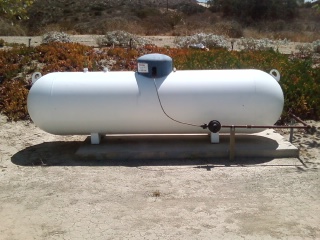
An above-ground vessel needs a firm, stable foundation or manufacturer-approved support arrangement. The installation may require properly prepared pads, blocks designed for the application, or another approved supporting system.
I would never rely on loose landscaping materials or improvised supports.
Gas Piping and Regulators
The system requires piping and regulators sized for the appliances it supplies. A furnace, water heater, range, and standby generator may operate at the same time.


The contractor should evaluate their combined maximum fuel demand, not just the tank’s storage capacity.
Testing and Startup
Before the installation enters service, the contractor should complete all applicable pressure testing, leak checks, regulator verification, and appliance startup procedures. I would request a record of the final inspections and testing.
What Does Above-Ground Installation Cost?
Above-ground installation is often simpler than burying a tank because it generally requires less excavation. For properties with adequate space and reasonable delivery access, this would be my starting point.
Worked Example: Installation Beside a House
Suppose you’ve already purchased an approved 500-gallon stationary tank. Your property has relatively level ground, and the tank can be placed a suitable distance from the home without complicated excavation.
| Expense | Hypothetical cost |
|---|---|
| Delivery and unloading | $250 |
| Foundation preparation | $250 |
| Regulators and fittings | $300 |
| Gas piping and trenching | $650 |
| Labor and testing | $500 |
| Illustrative installation total | $1,950 |
This example excludes equipment purchase, initial fuel, taxes, permits, and any appliance modifications.
What Could Increase the Cost?
A longer piping run, rocky ground, restricted vehicle access, or the need to relocate existing utilities can raise installation expenses. Additional permits and inspections may also be necessary.
For a narrow residential lot, meeting the required separation distances may be more challenging than it would be on a larger rural property.
Should You Choose the Cheapest Contractor?
I wouldn’t choose based on price alone. I would compare the scope of work, licensing, equipment specifications, permit responsibilities, testing, and warranties.
A lower quotation may exclude excavation, appliance connections, or final inspections.
What Does Underground Installation Cost?
Underground propane installations require more planning because the vessel is buried and has different protection and access requirements. A tank approved only for above-ground service must not be buried.
Underground Installation Budget Example
Suppose you already own a tank specifically approved for underground use.
| Work item | Hypothetical cost |
|---|---|
| Excavation and equipment | $1,300 |
| Approved bedding and backfill | $450 |
| Corrosion protection components | $350 |
| Site preparation and anchoring | $550 |
| Gas piping and trenching | $750 |
| Connections, labor and testing | $900 |
| Illustrative installation total | $4,300 |
This example is not a contractor quotation or an established statewide average. Actual costs depend on site conditions and the installation design.
What Additional Work Is Required?
Underground storage may involve special coatings, anode systems, corrosion-protection testing, suitable backfill, and approved access to valves and fittings.
The contractor should determine the exact requirements from the applicable code and manufacturer’s instructions.
Can Groundwater Cause Problems?
Yes. High groundwater can create buoyancy and corrosion concerns. An inadequately secured buried vessel may move under certain conditions.
I would ask the installer to assess drainage and any need for an engineered anchoring system.
Would I Choose Underground Installation?
I would consider it when appearance is important and the property is suitable for excavation. However, I would compare the full installed cost and long-term maintenance responsibilities with an above-ground option.
Do You Need a Permit to Install a Propane Tank?
Yes, many municipalities require permits for propane tank installations, gas piping, or related heating equipment. The exact process depends on the town or city.
New Hampshire’s building and fire-code framework allows local authorities to administer applicable permits and inspections.
I wouldn’t assume that a permit issued in Manchester has the same conditions or fees as one in Nashua or Laconia.
Examples of Local Permit Requirements
| Municipality | Published requirement or example |
|---|---|
| Laconia | Separate listed fees for above-ground tanks, below-ground tanks, and gas piping |
| Nashua | Permit required for underground propane installation; inspection before backfill |
| Epping | Fire Department offers a propane tank permit application |
| New Hampton | Building and fire approval requirements for installation or reinstallation of fuel-fired heating systems |
| Newmarket | Permit requirements for oil or propane burner installation |
| Concord | Fire Department permit system includes underground storage-tank installation and removal |
This table demonstrates local differences rather than a complete list of requirements.
What Does a Permit Application Usually Need?
I would prepare a site plan showing the proposed tank location, buildings, boundaries, piping route, and relevant separation distances.
The contractor may also need to provide tank specifications, installation details, and licensing information. For buried equipment, the authority may request excavation and corrosion-protection details.
Who Should Apply for the Permit?
Some contractors handle permits as part of the installation agreement. Others expect the homeowner to obtain certain approvals.
I recommend confirming this responsibility in writing before paying a deposit.
Can You Start Excavating Before Approval?
I wouldn’t. A permit application or site review may require changes to the proposed location.
Beginning excavation before approval can create unnecessary expenses if the installation must be moved.
How Much Do Local Propane Permit Fees Cost?
New Hampshire does not have a single municipal propane permit price that applies to every property. Fees vary by jurisdiction, tank configuration, and the work being performed.
Example: Laconia Permit Fees
The City of Laconia publishes the following amounts in its propane and oil permit requirements.
| Permit item | Published fee |
|---|---|
| Above-ground LP-gas tank | $50 per tank |
| Below-ground LP-gas tank | $75 per tank |
| Gas piping | Additional $50 |
Example Permit Calculations
For one above-ground tank plus a separately permitted piping installation: $50 + $50 = $100.
For one underground tank plus piping: $75 + $50 = $125.
These calculations reflect Laconia’s published fees, not a statewide charge. Other permits or fees may also apply.
Are Permit Fees the Biggest Expense?
Usually, the permit itself is not the largest cost in a residential installation. Excavation, piping, labor, and equipment can be much more significant.
However, failing to obtain the required approval can lead to expensive rework or delayed service.
I would include the permit process in the initial project schedule.
What State Regulations Apply in 2027?
New Hampshire uses a combination of state building codes, fire codes, fuel-gas standards, licensing rules, and municipal enforcement procedures.
The state building code under RSA 155-A was updated to reference the 2024 International Residential Code, 2024 International Mechanical Code, and related 2024 building codes, with state amendments effective July 1, 2026.
The state fire-code framework under RSA 153 also identifies the 2024 editions of NFPA 1 and NFPA 101, with adopted state amendments.
Propane-specific design and installation requirements may incorporate NFPA 58, while fuel-gas piping and appliances are governed by applicable NFPA 54 and other code provisions.
I recommend confirming the editions and amendments enforced for your particular project.
Which Agency Is Responsible?
The New Hampshire State Fire Marshal administers the state fire-safety framework. Local fire chiefs and building officials also perform important enforcement and approval functions.
Licensing of fuel-gas fitters is governed by state law and the applicable mechanical-licensing rules.
What Does NFPA 58 Cover?
NFPA 58, the Liquefied Petroleum Gas Code, addresses the safe storage and handling of propane. It includes requirements relevant to tank construction, placement, separation distances, and equipment.
What Does NFPA 54 Cover?
NFPA 54, the National Fuel Gas Code, addresses fuel-gas piping and appliances. It is particularly relevant when the propane supply connects to a furnace, water heater, range, fireplace, or similar equipment.
Regulatory Overview
| Regulation or authority | Main relevance |
|---|---|
| RSA 155-A | State building-code framework |
| RSA 153 | State fire code and fuel-gas licensing |
| 2024 International Residential Code | Relevant residential construction provisions |
| 2024 International Mechanical Code | Mechanical installations |
| NFPA 1 | Fire-code requirements |
| NFPA 58 | Propane storage and handling |
| NFPA 54 | Fuel-gas piping and appliances |
| Saf-FMO 300 | State fire-code amendments |
| Mechanical licensing rules | Qualifications for gas-fitting work |
| Municipal ordinances | Local permit and inspection procedures |
I would ask the installer to explain which provisions apply to the exact work being performed.
Do Propane Installers Need a License?
New Hampshire regulates fuel-gas fitting under RSA 153:27–38 and related licensing rules.
The licensing framework includes specialty qualifications for fuel-gas piping installers, installation technicians, and service technicians.
Businesses performing regulated fuel-gas fitting work may also need an appropriate mechanical business-entity license.
What Should You Verify?
I would ask the contractor for its business name, applicable license information, and the qualifications of the person supervising the work.
I would also ask whether it is insured for the services being performed.
Can a General Contractor Install Propane Piping?
A general contractor’s ordinary construction experience does not automatically establish the required gas-fitting qualifications.
I recommend verifying that the person completing regulated fuel-gas work holds the necessary license or is working under an authorized arrangement.
Can Homeowners Install Their Own Tanks?
The rules applicable to homeowner work can depend on the particular activity and circumstances.
However, a permanent propane system involves pressurized flammable gas, safety clearances, regulators, and testing.
For that reason, I recommend hiring a properly licensed professional and obtaining the required local approvals.
How Far Must a Propane Tank Be From a House?
Tank separation distances depend on vessel capacity, configuration, buildings, property lines, openings, and ignition sources.
The installer must verify the requirements of the applicable code and local authority.
General Planning Distances
For certain individual above-ground stationary tanks, commonly referenced NFPA 58 provisions include:
| Tank water capacity | Preliminary planning reference |
|---|---|
| Less than 125 gallons | Smaller-container provisions apply |
| 125–500 gallons | Commonly 10 feet |
| 501–2,000 gallons | Commonly 25 feet, subject to exceptions |
These are general planning references, not an installation approval chart.
The code includes special configurations, exceptions, and different provisions for underground vessels and other hazards.
What About Property Lines?
Required separation can apply to adjoining property lines that may be built upon. On a smaller residential lot, the available space may limit your installation options.
I would confirm the exact boundaries and have the installer prepare a compliant layout.
What About Windows and Doors?
Openings, air intakes, ignition sources, and other building features can influence tank placement. The fill connection and relief-valve arrangements may have additional requirements.
What About a Garage or Shed?
A detached building can affect the placement requirements. The contractor should evaluate all relevant structures, not only the main house.
Can You Bury a Propane Tank on Residential Property?
Yes. Underground propane tanks can be installed when the equipment, site, permits, and applicable safety requirements allow it.
However, municipal inspection procedures can be strict.
Nashua’s Underground Inspection Requirement
Nashua specifically states that underground propane tank installation requires a permit.
It also instructs applicants not to backfill a tank or associated gas tubing before inspection by the Fire Marshal’s Office.
I would treat this as an important example of why excavation and inspection scheduling must be coordinated.
What About Tank Removal?
An old underground tank may require special removal procedures and local permits. If you are evaluating aging equipment, my guide to propane tank replacement and service life explains the differences between portable and stationary vessels.
For example, Concord publishes underground storage tank installation and removal as permit categories.
Before abandoning or removing buried equipment, I would contact the local fire authority and qualified propane contractor.
Underground Installation Checklist
- Verify the vessel is approved for burial.
- Obtain the required municipal approvals.
- Confirm excavation and utility locations.
- Assess drainage and groundwater.
- Provide suitable bedding and backfill.
- Install corrosion protection.
- Maintain approved access to fittings.
- Arrange inspection before backfill where required.
- Complete the applicable pressure and leak tests.
- Retain installation and maintenance records.
I would not cover an underground tank or piping until the responsible inspector has authorized the next stage of work.
How Do You Install Underground Gas Piping?
A stationary propane tank may connect to the home through underground piping. The correct materials, installation depth, regulator arrangement, and testing depend on the applicable code and design.
I recommend letting a licensed gas-fitting contractor specify and install the system.
How Deep Should the Gas Line Be Buried?
There isn’t one burial depth I would recommend for every New Hampshire installation.
The required depth can depend on the approved piping material, surface conditions, vehicle traffic, and applicable code provisions.
A gas line crossing a driveway, for example, may need different protection from one installed across a lawn.
Can You Use Plastic Gas Piping?
Approved underground polyethylene gas piping may be used in suitable applications when installed with the required fittings and transitions.
However, ordinary plumbing pipe is not an acceptable substitute.
The contractor should use materials approved for the intended fuel and installation conditions.
What About Underground Utilities?
Before excavation, contact Dig Safe at 811 to request utility marking.
Private underground lines may require separate locating arrangements.
I would also identify sprinkler systems, drainage pipes, septic components, and other buried infrastructure.
Gas-Line Cost Example
Suppose the approved piping route is 75 feet long.
At a hypothetical installed allowance of $20 per foot, the project would cost: 75 × $20 = $1,500.
At $30 per foot, it would cost $2,250.
These are illustrative budgeting scenarios, not established local contractor rates.
For a property with ledge or difficult terrain, I would obtain a separate trenching quotation.
How Does Granite and Rocky Soil Affect Installation?
New Hampshire’s rocky terrain can make excavation more challenging than homeowners expect.
The effects are particularly noticeable when preparing an underground tank excavation or a long trench.
What Happens If the Contractor Encounters Ledge?
Bedrock can require specialized excavation equipment, drilling, or other approved methods.
This may increase labor expenses and project duration.
I recommend asking how unexpected rock excavation is priced before signing the agreement.
Can You Install an Above-Ground Tank on Rocky Land?
Potentially, yes.
A stable site may still be suitable for an above-ground vessel, provided it meets foundation and safety requirements.
In some cases, choosing an approved above-ground location can avoid extensive excavation.
How Would I Compare Locations?
I would ask the contractor to evaluate at least two possible tank locations when space permits.
One may require a longer gas line but offer easier equipment access.
Another may be closer to the house but involve difficult excavation or unacceptable safety clearances.
The best location is the one that satisfies safety requirements and produces a practical long-term installation.
How Do Winters Affect Tank Placement and Safety?
Winter conditions are an important consideration for propane installations across New Hampshire.
Heavy snow, freezing temperatures, ice, and snowplowing operations can affect access and equipment safety.
Can Propane Freeze?
Pure propane freezes at approximately minus 306°F, far below normal New Hampshire winter temperatures.
The more realistic concern is reduced vapor pressure and vaporization capacity at low temperatures.
A tank can contain liquid propane but still struggle to supply enough vapor for large appliances when temperatures are extremely low.
Can Snow Damage Regulators?
Heavy snow and ice can obstruct regulator vents or interfere with equipment.
I recommend keeping the tank and service components accessible according to the supplier’s safety instructions.
Do not use an open flame or improvised heating equipment to thaw regulators or valves.
What About Falling Ice?
Snow and ice sliding from rooftops can damage exposed piping, regulators, and tanks.
I would evaluate rooflines before choosing the installation location.
Snowplow Hazards
The Lebanon Fire Department specifically warns about incidents involving underground propane tanks being struck by snowplows.
This makes the location of underground tank access covers particularly important.
I would avoid placing these components where routine plowing could damage them.
Winter Installation Checklist
| Winter condition | Installation consideration |
|---|---|
| Extreme cold | Adequate vaporization capacity |
| Heavy snowfall | Access to valves and fittings |
| Roof ice | Protection from falling snow and ice |
| Snowplowing | Prevent vehicle impact |
| Frozen ground | Excavation and scheduling |
| Rural roads | Delivery vehicle access |
| Generator demand | Sufficient tank and piping capacity |
What Size Tank Should You Install?
I would choose tank capacity based on actual fuel demand rather than house size alone.
A home using propane only for cooking and water heating has different requirements from a home using propane for a furnace and backup generator. When estimating ongoing fuel costs, I also recommend reviewing my propane refill cost per gallon guide.
Tank Size Planning Guide
| Application | Capacities to evaluate |
|---|---|
| Cooking and limited hot water | 120–250 gallons |
| Several household appliances | 250–500 gallons |
| Primary residential heating | 500–1,000 gallons |
| Seasonal cabin | Depends on winter use |
| Standby generator | Manufacturer-based sizing |
| Large rural home | Professionally calculated storage |
| Commercial property | Engineered system |
These are preliminary starting points, not final equipment specifications.
How Much Fuel Can a Tank Hold?
Stationary propane tanks are described by their water capacity.
A common planning assumption is filling to approximately 80%.
| Tank water capacity | Propane at 80% |
|---|---|
| 120 gallons | 96 gallons |
| 250 gallons | 200 gallons |
| 500 gallons | 400 gallons |
| 1,000 gallons | 800 gallons |
The installer must also verify the tank’s ability to provide sufficient propane vapor during winter.
For additional background, read my propane tank versus cylinder comparison.
How Much Propane Will Your Furnace Use?
The amount of propane a furnace consumes depends on its input rating and operating time.
Propane contains approximately 91,500 BTU per liquid gallon.
To estimate full-input fuel consumption:
Gallons per hour = Furnace input BTU per hour ÷ 91,500
For example, a furnace rated at 90,000 BTU per hour consumes approximately 0.98 gallons per hour while operating at that input.
If it runs for eight hours at full input, it would consume approximately 7.87 gallons.
Actual daily consumption varies because furnaces cycle on and off.
Furnace Consumption Comparison
| Furnace input | Approximate propane use |
|---|---|
| 40,000 BTU/hour | 0.44 gal/hour |
| 60,000 BTU/hour | 0.66 gal/hour |
| 80,000 BTU/hour | 0.87 gal/hour |
| 100,000 BTU/hour | 1.09 gal/hour |
| 120,000 BTU/hour | 1.31 gal/hour |
For a permanent installation, I would ask the contractor to estimate annual consumption and maximum hourly demand before selecting equipment.
What About Standby Generator Installations?
A standby generator can place substantial demand on a propane supply system.
The tank must store enough fuel for the desired runtime and provide adequate vapor under expected operating conditions.
Generator Fuel Calculation
Suppose a generator uses 2.5 gallons per hour at the expected electrical load.
| Runtime | Propane required |
|---|---|
| 8 hours | 20 gallons |
| 24 hours | 60 gallons |
| 48 hours | 120 gallons |
| 72 hours | 180 gallons |
| 120 hours | 300 gallons |
These figures are hypothetical calculations. Actual consumption varies by generator model and electrical load.
Example Runtime by Tank Size
Using the amount of fuel between an 80% fill and a planned 20% reorder level:
| Tank capacity | Fuel available | Runtime at 2.5 gal/hour |
|---|---|---|
| 250 gallons | 150 gallons | 60 hours |
| 500 gallons | 300 gallons | 120 hours |
| 1,000 gallons | 600 gallons | 240 hours |
If the same tank supplies a furnace or other appliances, the generator has less fuel available.
I would also coordinate the mechanical and electrical contractors before installation.
For more information, read my propane tank size chart for generators.
Who Installs Propane Tanks in New Hampshire?
Several established regional companies provide propane delivery and related equipment services.
I recommend checking the exact service area and asking whether the company performs installations using customer-owned tanks.
Eastern Propane & Oil
Eastern Propane & Oil serves customers across New Hampshire and other New England states.
The company advertises propane delivery, tank monitoring, and related residential services.
I would investigate its new-customer installation arrangements and equipment ownership policies.
Dead River Company
Dead River Company supplies propane and heating oil in northern New England.
I would ask about service availability, tank installation, rental options, and heating fuel programs.
Irving Energy
Irving Energy operates in New Hampshire and Maine.
Its published 2026 residential terms identify leased propane equipment and related installation fees.
I would review the contract carefully, particularly when comparing leasing against customer-owned equipment.
Rymes Propane & Oil
Rymes Propane & Oil, associated with Superior Plus, serves a range of New Hampshire communities.
I would compare its delivery territory, equipment arrangements, and installation services with other local providers.
Local Propane Contractors
Independent gas-fitting contractors may also provide piping and appliance installation services.
For a complex project, I would verify the contractor’s license and whether it coordinates directly with the propane supplier.
Supplier Comparison
| Supplier | Service to investigate |
|---|---|
| Eastern Propane & Oil | Tank arrangements, delivery and monitoring |
| Dead River Company | Residential propane and installation options |
| Irving Energy | Leased equipment and installation terms |
| Rymes Propane & Oil | Delivery and equipment service |
| Licensed local gas fitter | Piping, appliance connections and testing |
These are supplier leads, not confirmed installation quotations.
Is It Better to Buy or Lease the Tank?
Buying and leasing can affect installation expenses and long-term fuel costs.
With a purchased tank, you own the equipment.
With a leased tank, the supplier retains ownership and may impose rental or fuel-purchase conditions.
Ownership Comparison
| Factor | Buying | Leasing |
|---|---|---|
| Initial equipment cost | Higher | Often lower |
| Tank ownership | Homeowner | Supplier |
| Installer choice | Subject to qualifications and acceptance | Often supplier-managed |
| Fuel supplier choice | Potentially broader | Often restricted |
| Annual rental charge | Usually none | May apply |
| Maintenance responsibility | Owner and contract dependent | Contract dependent |
| Equipment removal | Owner responsibility | Contract dependent |
What Would I Ask?
I would request the complete installation fee, tank rental charges, minimum annual fuel purchases, and conditions for cancellation.
I’d also ask what happens to the tank if the property is sold.
A low installation fee can be attractive, but the long-term contract may matter more.
How Can You Reduce Installation Costs?
I recommend looking for legitimate savings through site planning rather than reducing safety measures.
Compare Complete Quotations
Request at least two estimates covering the same tank location, piping length, excavation, inspections, and testing.
Choose an Accessible Location
Good delivery and installation access may reduce equipment handling. However, code compliance must take priority over convenience.
Avoid Unnecessary Trenching
A properly located tank may require less piping and excavation. I would compare locations with the installer rather than selecting the shortest route myself.
Coordinate Other Construction
If you are already building a new home or installing other utilities, coordinating permitted work may reduce duplicate excavation.
The contractor must still comply with gas-line separation and installation requirements.
Schedule Before Winter
When possible, I would arrange site work before ground conditions become difficult. Frozen soil and snow can complicate excavation and access.
Installation Savings Guide
| Strategy | Potential advantage |
|---|---|
| Compare itemized quotations | Identify unnecessary charges |
| Select a compliant, accessible site | Reduce equipment handling |
| Minimize unnecessary pipe runs | Reduce materials and labor |
| Coordinate approved construction | Avoid duplicate excavation |
| Review supplier lease terms | Reduce upfront cost |
| Schedule before severe winter | Improve installation flexibility |
What Inspections Should Be Completed Before Use?
I recommend asking for documentation showing that the required inspections and safety tests have been completed.
Depending on the project, inspections may be conducted by the contractor, local authority, or both.
Final Installation Checklist
- Tank is approved for the intended installation.
- Correct permits have been obtained.
- All applicable separation distances are satisfied.
- Foundation or underground supports are suitable.
- Regulators and valves are properly selected.
- Piping materials and routing meet requirements.
- Required pressure testing is completed.
- Leak checks are performed.
- Underground work is inspected before backfill where required.
- Appliance connections and startup are completed safely.
- Ventilation and exhaust provisions are verified.
- Delivery access and snow protection are addressed.
- The homeowner receives relevant inspection documentation.
- Ownership and maintenance responsibilities are clear.
If an installer cannot explain the required testing or inspection process, I would resolve that concern before accepting the work.
For related information, read my guide to propane tank recertification and inspections.
Frequently Asked Questions
How Much Does Installation Cost?
A straightforward residential project may fall within a broad $600–$2,500 planning range, depending on what’s included. Underground installations and complex sites can cost considerably more.
Do You Need a Permit?
Many municipalities require tank, piping, heating-system, or fire-department approvals. Confirm the requirements for your address.
Does Nashua Require an Underground Tank Permit?
Yes. Nashua explicitly requires a permit and instructs that the tank and associated gas tubing not be backfilled before inspection.
How Much Is the Permit in Laconia?
Its published fees include $50 per above-ground LP-gas tank, $75 per below-ground tank, and an additional $50 for gas piping.
Can You Bury a Tank?
Yes, when the tank is approved for underground use and the site, permits, inspections, and applicable code requirements are satisfied.
What Code Applies in 2027?
New Hampshire’s building-code framework includes the 2024 International Residential and Mechanical Codes, effective July 1, 2026, with state amendments. The applicable fire-code and propane standards must also be checked.
Does the Installer Need a License?
Regulated fuel-gas fitting work is subject to the state’s licensing requirements. Verify the contractor’s applicable credentials.
Can You Install a Tank Near a Property Line?
Only if the proposed arrangement satisfies the applicable separation and other requirements.
Should Underground Piping Be Inspected Before Burial?
Where the local authority requires it, yes. Nashua specifically requires inspection before backfill.
Can an Existing Tank Be Relocated?
Potentially, but ownership, condition, transportation, the new location, permits, and testing must be addressed professionally.
Can Snowplows Damage Underground Tanks?
Yes. The Lebanon Fire Department has warned about incidents involving underground propane equipment and snowplows.
Does Propane Freeze During Winter?
Pure propane freezes far below normal winter temperatures. Reduced vapor pressure and vaporization capacity are the more practical concerns.
Does a New Installation Need a Leak Test?
Applicable gas-system requirements address pressure and leak testing. Have the qualified installer perform the required checks before use.
Can I Use a Refurbished Tank?
Potentially, if the tank is suitable for continued service and accepted by the contractor and supplier following appropriate evaluation.
What Happens if I Change Propane Suppliers?
The process depends on tank ownership and the service contract. Supplier-owned tanks may need to be removed or replaced.
Final Thoughts: Planning a Safe Installation
If you’re installing a propane tank in New Hampshire, I recommend beginning with the property’s characteristics rather than concentrating only on the installation price.
The tank’s location, ground conditions, gas piping, permits, and winter access can affect both the upfront expense and future maintenance.
An above-ground installation may be simpler where sufficient space is available.
An underground installation may improve appearance, but it requires additional excavation, corrosion protection, and inspection planning.
Before starting the project, confirm the local permits, use a properly licensed contractor, compare written quotations, and ensure the required inspections are completed.
A properly planned propane installation should provide safe fuel storage, reliable appliance operation, practical delivery access, and manageable long-term maintenance costs.

Mike is an experienced propane technician with over 15 years of professional experience in the field. He has dedicated his career to helping customers with their propane needs, from installation to maintenance and repair. Together with Jeremy, he co-founded this website to provide useful information and guidance to customers seeking reliable propane services.