

If you’re planning to install a propane tank in New Mexico, I’ll help you understand installation costs, permit requirements, safety clearances, and the regulations that apply before work begins.
Whether your property is in Albuquerque, Santa Fe, Las Cruces, Farmington, or a remote mountain community, installation expenses depend on the tank location, terrain, gas piping, and accessibility.
In this guide, I’ll focus on the installation process rather than repeating general tank purchase prices. I’ll cover above-ground and underground systems, state permits, licensed contractors, inspections, and the practical steps I recommend before starting your project.


Quick Answer: How Much Does Propane Tank Installation Cost?
For preliminary planning, I would budget approximately $600–$2,500 for a straightforward residential propane installation, while a complicated underground project may cost several thousand dollars more. These are broad national project benchmarks, not verified New Mexico contractor quotations.
Some published installation estimates include the tank itself, while others separate equipment, labor, excavation, and piping. Make sure you compare quotations covering the same work. For the examples in this guide, I’ll focus on installation expenses rather than the tank purchase or the initial propane fill.
| Installation expense | Illustrative allowance |
|---|---|
| Tank delivery and unloading | $150–$500 |
| Foundation and site preparation | $150–$600 |
| Regulators and fittings | $150–$500 |
| Gas piping and ordinary trenching | $300–$1,500 |
| Professional installation and testing | $300–$1,200 |
| Additional underground excavation | $700–$2,500+ |
| Permits and inspections | Depends on the project and jurisdiction |
These are hypothetical component allowances. Some contractor packages combine several services, so the figures should not automatically be added together.
New Mexico’s Regulation and Licensing Department publishes a $20 fee for a Form 1 LP-gas installation, test, or modification inspection request. That is a specific inspection-request charge, not a complete statewide permit price for every installation.


My recommendation: Before purchasing equipment, have a qualified propane contractor inspect your property. Request a written estimate covering tank placement, foundations, piping, permits, testing, and the work required to connect your appliances.
What Does a Complete Installation Include?
Installing a permanent propane system requires more than placing a storage tank beside the home. The tank must be positioned safely and connected to properly designed piping, regulators, and appliances. I recommend approaching the project as a complete fuel-supply installation.
Evaluating the Property
The contractor should begin by identifying a suitable location. This includes examining nearby buildings, property boundaries, windows, ventilation openings, electrical equipment, and other potential hazards. The location must also allow access for fuel deliveries and future maintenance.
Preparing the Site
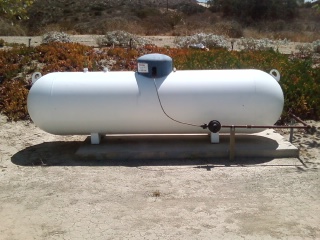
An above-ground tank needs stable, approved support. The supporting structure may involve manufacturer-approved legs, pads, or other suitable arrangements. The contractor should evaluate the soil, slope, drainage, and equipment weight.
Installing Regulators and Gas Piping
Propane is stored under pressure, while household appliances typically operate at much lower pressures. The system requires properly selected regulators and piping. The contractor should calculate the combined maximum demand from connected appliances.



Completing Safety Tests
Before using the installation, the contractor should perform all required checks. These may include pressure testing, leak checks, regulator verification, and appliance startup. I would ask for a record of the completed work.
How Much Does Above-Ground Installation Cost?
An above-ground installation is often less complicated because the tank doesn’t need to be buried. For a property with sufficient space and suitable access, this would be my starting point.
Worked Example: Residential Installation
Suppose you already own an approved 500-gallon propane tank. Your property has level ground and a suitable location relatively close to the house.
| Expense | Hypothetical cost |
|---|---|
| Tank delivery and placement | $300 |
| Site preparation and supports | $250 |
| Regulators and fittings | $350 |
| Gas piping and trenching | $700 |
| Professional labor and testing | $550 |
| Illustrative installation total | $2,150 |
This example excludes equipment purchase, fuel, taxes, permits, and appliance modifications. It is not a local contractor quotation.


What Increases the Cost?
Long gas lines, difficult excavation, rocky ground, steep slopes, and restricted access can increase expenses. A remote property may also involve additional transportation charges. I would ask the contractor to identify which expenses are fixed and which may change after excavation begins.
Should You Choose the Cheapest Quote?
Not automatically. I would compare professional qualifications, installation scope, permits, materials, testing, and warranties. A lower estimate may exclude important services that another contractor includes.
How Much Does Underground Installation Cost?
An underground propane tank can reduce the visible impact of large fuel-storage equipment. However, underground installation requires additional excavation, corrosion protection, and inspection planning. The tank must be specifically approved for underground service.
Underground Installation Budget Example
Suppose you’ve already purchased a burial-rated propane tank.
| Work item | Hypothetical cost |
|---|---|
| Excavation and machinery | $1,500 |
| Bedding and backfill | $500 |
| Corrosion protection | $400 |
| Site preparation and anchoring | $600 |
| Gas piping and trenching | $850 |
| Professional connections and testing | $950 |
| Illustrative installation total | $4,800 |
These are hypothetical budgeting allowances, not established statewide prices. The final amount depends on excavation, soil conditions, groundwater, piping, and installer requirements.
What Additional Equipment Is Needed?
Underground tanks typically require protective coatings, suitable corrosion protection, approved access to fittings, and proper backfill. The contractor must follow the applicable standards and manufacturer’s installation instructions.
Can Groundwater Cause Problems?
Yes. Groundwater can create buoyancy that may displace an improperly secured underground vessel. I would ask whether the installation requires suitable anchoring or other protective measures.
Would I Choose Underground Storage?
I would consider it when appearance is important and the site is suitable. However, underground installation usually requires more extensive work and future corrosion-protection maintenance. For many rural properties, I would compare the full installed cost of an above-ground alternative.
Do You Need a Permit to Install a Propane Tank?
New Mexico generally requires applicable permits for regulated LP-gas work, unless a specific statutory or regulatory exemption applies.
Under 14.5.2.8 NMAC, regulated LP-gas, mechanical, plumbing, and electrical work requires appropriate permits from the authority having jurisdiction. The rules distinguish LPG permits from permits for other construction trades. The New Mexico Regulation and Licensing Department’s Construction Industries Division administers the state’s LP Gas Bureau.
Which Agency Should You Contact?
The New Mexico LP Gas Bureau oversees LP-gas safety, qualifications, and inspection activities. A building or mechanical permit may also be relevant when the project involves appliances, building alterations, or other construction work. For municipalities with their own permitting authority, I would confirm the applicable local process.
What Information Does a Permit Application Need?
I would prepare the following information for the contractor and authority:
- Property address and owner information.
- Tank capacity and manufacturer details.
- Proposed tank location.
- Distances to buildings and property boundaries.
- Gas piping route.
- Description of connected appliances.
- Contractor license information.
- Underground installation details, if applicable.
- Applicable site plan.
- Inspection arrangements.
The exact application requirements depend on the work.
Can You Start Installing Before the Permit Is Issued?
I wouldn’t begin regulated work without the necessary authorization. Starting early can create problems if the proposed location or piping design doesn’t satisfy applicable requirements. Ask the contractor to confirm approval before excavation or installation.
How Much Are LP-Gas Permit and Inspection Fees?
There isn’t one total installation permit price that applies to every property and type of project. However, the state publishes specific fees for certain LP-gas inspection requests.
Published LP-Gas Inspection Fees
| Inspection request | Published fee |
|---|---|
| Form 1 — installation, test, or modification | $20 |
| Cargo tank and equipment inspection | $45 |
| Bulk plant or dispenser inspection | $45 |
These are fees published by the New Mexico Regulation and Licensing Department. The cargo-tank and bulk-plant charges generally concern different activities from an ordinary residential installation.
Does the $20 Fee Cover Everything?
No. The Form 1 fee should not be confused with the total cost of all permits, labor, inspections, and installation work. A project involving mechanical alterations, electrical work, or other regulated construction may require separate approvals and charges.
Who Requests the LP-Gas Inspection?
The department explains that an LP-gas licensee may request the appropriate inspection form from the LP Gas Bureau. I recommend asking the contractor whether the inspection request is included in its quotation.
What About Local Fees?
Municipal fees may apply to other aspects of the project. I would ask the responsible permitting office for the current fee schedule before finalizing the budget.
What State Regulations Apply in 2027?
The principal LP-gas rules are found in 19.15.40 NMAC, the New Mexico Liquefied Petroleum Gas Standard. These regulations govern installation activities, containers, safety requirements, licensing, and inspection procedures. The state also adopts national safety standards for propane storage and fuel-gas systems.
Which Edition of NFPA 58 Applies?
Under 19.15.40.24 NMAC, the state adopts the 2020 edition of NFPA 58, the Liquefied Petroleum Gas Code. NFPA 58 addresses tank location, handling, equipment, storage, and installation. The newest published NFPA edition does not automatically become the state’s adopted edition. I recommend verifying the rules in effect when the project is permitted.
Which Edition of NFPA 54 Applies?
The same regulation adopts the 2021 edition of NFPA 54, the National Fuel Gas Code. NFPA 54 addresses piping systems, appliance connections, and related fuel-gas safety requirements.
What About New Mechanical Codes?
The state adopted its 2024 New Mexico Mechanical Code, effective August 1, 2026. A transition period allows permits under either the previous or new mechanical code until January 1, 2027. After that date, the state’s published guidance says permits must use the new mechanical code. The corresponding 2024 Plumbing Code follows the same transition schedule. This is particularly relevant to projects involving new appliances or piping work beyond the storage tank itself.
Regulatory Overview
| Regulation or agency | Main responsibility |
|---|---|
| 19.15.40 NMAC | New Mexico LPG requirements |
| NFPA 58 (2020) | Propane storage and handling |
| NFPA 54 (2021) | Fuel-gas piping and appliances |
| 14.5.2 NMAC | Construction permit administration |
| 2024 New Mexico Mechanical Code | Applicable mechanical installations |
| 2024 New Mexico Plumbing Code | Applicable plumbing work |
| LP Gas Bureau | LPG safety and inspection |
| Local construction authority | Applicable local permits and inspections |
I would ask the contractor to identify which regulations apply to the proposed system.
Do Propane Installers Need a License?
New Mexico regulates propane installation and service activities through the Construction Industries Division and LP Gas Bureau. Contractors performing regulated work must hold the appropriate license or operate under a legally authorized arrangement.
What Is an LP-5 License?
The state’s LP-5 classification concerns installation, service, and repair of certain LP-gas equipment. Other classifications govern different types of propane activity. For example, LP-4 addresses specified work on propane piping and appliances within residences and commercial buildings. I would verify the scope of the contractor’s license rather than relying only on a statement that the company handles propane.
What Should You Ask the Contractor?
| Question | Why it matters |
|---|---|
| What license do you hold? | Confirm authorization |
| Does the license cover this installation? | Check scope of work |
| Who obtains the permits? | Assign responsibility |
| Who requests inspection? | Avoid delays |
| Are you insured? | Understand protection |
| Who performs pressure testing? | Confirm safety work |
| Is appliance startup included? | Avoid incomplete installation |
Can Homeowners Install Their Own Tanks?
Regulated LP-gas work is subject to state qualification and permit requirements, with any applicable exemptions determined by law. I recommend professional installation for a permanent residential system. Propane is a pressurized flammable fuel, and incorrect tank placement, piping, or regulator selection can create serious hazards.
How Far Must a Propane Tank Be From a House?
Required separation distances depend on the tank’s water capacity, configuration, nearby buildings, property lines, openings, and ignition sources. The correct location must satisfy the adopted code and any additional requirements.
Preliminary Separation Planning
For certain individual above-ground stationary tanks, commonly referenced NFPA 58 provisions include:
| Tank water capacity | General planning distance |
|---|---|
| Less than 125 gallons | Special smaller-container provisions |
| 125–500 gallons | Commonly 10 feet |
| 501–2,000 gallons | Commonly 25 feet, subject to exceptions |
This table is not a complete installation approval chart. The adopted code contains exceptions and additional provisions for different tank arrangements. Underground vessels, grouped containers, openings, and other site features may be governed by different requirements.
What About Property Lines?
Separation distances can apply to property boundaries as well as buildings. I would confirm property dimensions before selecting the installation location.
What About Windows and Doors?
Building openings, ventilation equipment, ignition sources, and other components may affect placement. The installer should verify relevant clearances for the tank, filling connection, and relief-valve arrangement.
Can a Tank Be Installed Beside a Garage?
Potentially, but only when all applicable requirements are satisfied. Vehicle traffic, ignition sources, and nearby structures should be included in the site evaluation.
What Rules Apply to Underground Tanks?
Underground propane systems require appropriate equipment, corrosion protection, excavation, and testing. I would never bury a tank intended only for above-ground service.
Corrosion Protection
Buried metal vessels may require protective coatings, cathodic protection, and periodic testing. The applicable installation requirements depend on the approved tank design and adopted standards. I would ask the contractor for documentation of the corrosion-protection system.
Underground Access
Valves, fittings, and other service components must remain accessible through approved arrangements. The installer should account for soil settlement, surface drainage, and future maintenance.
Excavation and Backfill
The excavation must meet the manufacturer’s requirements and applicable code. Appropriate bedding and backfill help protect the vessel and surrounding equipment.
Underground Installation Checklist
- Confirm burial approval for the tank.
- Obtain the required permits.
- Locate utilities before digging.
- Verify required separation distances.
- Evaluate soil and groundwater.
- Prepare the approved excavation.
- Install corrosion protection.
- Provide necessary anchoring where required.
- Complete inspections before backfill when applicable.
- Retain documentation of installation and testing.
I would not cover regulated work before the contractor and inspector authorize the next stage.
How Does Rocky Soil Affect Installation?
New Mexico has varied terrain, including rocky ground, mountain slopes, sandy areas, and high-desert properties. These conditions can significantly affect excavation and installation costs.
Rocky Ground and Caliche
Some properties have hard, compacted soil or caliche layers that are difficult to excavate. A trench that is straightforward in loose soil may require specialized equipment in harder ground. I would ask the contractor how unexpected excavation difficulties are charged.
Steep or Uneven Properties
A sloped site may require additional work to create stable tank supports. The contractor must also consider erosion and drainage. I wouldn’t use improvised blocks or loose soil to level a large stationary tank.
Remote Mountain Properties
A tank installed outside a major population center may involve longer transportation distances. Narrow access roads, steep driveways, and limited turnaround areas can complicate delivery. I recommend having the propane supplier confirm access before the tank arrives.
Site Condition Comparison
| Property condition | Potential installation impact |
|---|---|
| Level, accessible ground | Simpler placement |
| Rocky soil | Higher excavation expense |
| Caliche | Difficult trenching |
| Steep slope | Additional foundation preparation |
| Sandy soil | Drainage and stability assessment |
| High groundwater | Buoyancy and corrosion concerns |
| Remote access | Transportation and unloading complications |
How Does Desert Heat Affect Propane Tanks?
The state’s hot summers and strong sunlight deserve consideration during installation planning. Propane pressure increases as the liquid warms. Approved tanks are designed to operate within their specified pressure limits and use required safety devices.
Should a Propane Tank Be Painted White?
Above-ground tanks commonly use light-colored, reflective coatings. Dark finishes may absorb more solar heat. I recommend following the manufacturer’s coating requirements and consulting the supplier before repainting a stationary tank.
Can You Put a Tank in Direct Sunlight?
Approved above-ground propane tanks may be installed outdoors in exposed locations when the installation meets applicable requirements. However, I would not build an improvised enclosure around a tank. Service access, required ventilation, and safety clearances must be maintained.
What About Dust and Wind?
Dust, debris, and windblown materials can affect exposed equipment. I recommend periodic visual checks for damaged coatings, obstructed access, and other obvious problems. A qualified technician should evaluate any equipment damage.
How Does Winter Affect Propane Installation?
Although much of the state experiences warm weather, higher-elevation communities can have cold winters and heavy snowfall. This affects fuel demand, delivery access, and propane vaporization.
Can Propane Freeze?
Pure propane freezes at approximately minus 306°F, far below normal winter conditions. The more realistic concern is reduced vapor pressure and vaporization capacity at low temperatures.
Why Does Tank Size Matter?
The ability of a tank to supply propane vapor depends on several factors, including size, fuel level, temperature, and appliance demand. The contractor must verify that the installation can supply enough fuel during expected operating conditions.
Winter Planning Table
| Daily propane consumption | 7-day requirement | 14-day requirement |
|---|---|---|
| 3 gallons | 21 gallons | 42 gallons |
| 5 gallons | 35 gallons | 70 gallons |
| 8 gallons | 56 gallons | 112 gallons |
| 12 gallons | 84 gallons | 168 gallons |
These are theoretical fuel calculations, not legally required storage reserves. For remote mountain homes, I would schedule refills before severe weather interrupts access.
How Much Does Underground Gas Piping Cost?
The cost of buried propane piping depends on the distance between the tank and building, approved materials, trenching conditions, and installation requirements.
Worked Piping Example
Suppose the approved gas-line route is 75 feet long. At a hypothetical installed allowance of $20 per foot:
75 × $20 = $1,500.
At $35 per foot:
75 × $35 = $2,625.
These are illustrative budgeting calculations, not local contractor rates. A property with rocky soil or difficult excavation may require additional work.
What Materials Are Used?
The contractor should select piping approved for propane service. Depending on the installation, this may include suitable underground polyethylene gas piping or appropriately protected metallic piping. Ordinary water pipe should never be substituted for approved gas piping.
How Deep Should the Line Be Buried?
The appropriate burial depth depends on the applicable code, piping material, location, and site conditions. I wouldn’t select a universal depth without the contractor’s approval.
Do You Need Utility Marking?
Before excavation, contact New Mexico 811 to arrange for participating utilities to mark their underground facilities. Private buried services may require separate locating. I would also identify septic systems, irrigation lines, electrical services, and drainage infrastructure.
What Size Tank Should You Install?
I recommend selecting tank capacity based on actual fuel consumption and connected appliances. Tank purchase prices are not the focus here; the objective is choosing a vessel that the installation can support safely.
Residential Tank Capacity
| Tank water capacity | Approximate liquid propane at 80% |
|---|---|
| 120 gallons | 96 gallons |
| 250 gallons | 200 gallons |
| 500 gallons | 400 gallons |
| 1,000 gallons | 800 gallons |
Which Size Fits Different Applications?
| Application | Tank sizes to evaluate |
|---|---|
| Cooking and limited hot water | 120–250 gallons |
| Several household appliances | 250–500 gallons |
| Primary home heating | 500–1,000 gallons |
| Seasonal cabin | Based on actual consumption |
| Standby generator | Based on manufacturer specifications |
| Large rural property | Professionally sized system |
| Agricultural use | Professionally designed storage |
These are preliminary planning suggestions, not final specifications. For the difference between portable cylinders and stationary vessels, see my propane tank versus cylinder guide.
Can You Install a Tank for a Standby Generator?
Yes. A propane tank can supply an appropriately designed standby generator. However, generator installations may require additional gas piping, electrical work, permits, and appliance testing. I would coordinate the generator installer with the propane contractor.
Generator Fuel Consumption Example
Suppose a generator consumes 2.5 gallons of propane per hour at a particular electrical load.
| Operating time | Propane required |
|---|---|
| 8 hours | 20 gallons |
| 24 hours | 60 gallons |
| 48 hours | 120 gallons |
| 72 hours | 180 gallons |
| 120 hours | 300 gallons |
These are hypothetical calculations. Actual fuel demand varies by generator model and electrical load.
Runtime by Tank Capacity
Using the fuel available between an 80% fill and a planned 20% reorder point:
| Tank capacity | Fuel available | Runtime at 2.5 gal/hour |
|---|---|---|
| 250 gallons | 150 gallons | 60 hours |
| 500 gallons | 300 gallons | 120 hours |
| 1,000 gallons | 600 gallons | 240 hours |
These estimates assume that the generator is the only appliance consuming propane. The contractor must also verify vaporization capacity, regulator selection, and piping size. For further calculations, see my propane tank size chart for generators.
Who Installs Propane Tanks in New Mexico?
I would start with a properly licensed propane contractor serving the property’s exact location. Several regional and national providers offer propane-related installation services.
Ortega’s Propane Service — Albuquerque
Ortega’s Propane Service advertises tank installation and gas-line installation in Albuquerque. Its published services describe handling installation requirements and preparing residential properties for propane service. I would investigate the company for a project in the Albuquerque area.
Pinnacle Propane — Selected Locations
Pinnacle Propane has business listings in Albuquerque and Las Cruces. I would contact the company to confirm the types of residential installation it offers and whether it serves the specific address.
Other Regional Suppliers
Independent propane dealers may serve Santa Fe, Farmington, Roswell, and rural communities. Some primarily provide fuel delivery, while others also offer tank placement and gas piping. I recommend asking whether the company handles the complete installation or coordinates with another licensed contractor.
Contractor Comparison
| Provider | Area to investigate | Work to confirm |
|---|---|---|
| Ortega’s Propane Service | Albuquerque | Tank and gas-line installation |
| Pinnacle Propane | Albuquerque and Las Cruces | Residential installation and delivery |
| Licensed local LPG contractor | Regional communities | Tank placement, piping and testing |
| Independent propane supplier | Rural service territories | Tank arrangements and fuel delivery |
These are potential service providers, not confirmed quotations or guarantees of coverage.
Is Buying or Leasing Better for Installation?
Buying and leasing can change the upfront installation expense and long-term responsibilities. When you purchase a tank, you own the equipment. When you lease, the propane supplier generally retains ownership.
Ownership Comparison
| Factor | Buying | Leasing |
|---|---|---|
| Tank ownership | Homeowner | Supplier |
| Initial equipment expense | Higher | Often lower |
| Installation fee | Contract-dependent | Contract-dependent |
| Fuel supplier flexibility | Potentially broader | Often restricted |
| Maintenance | Owner and contract dependent | Supplier and contract dependent |
| Tank removal | Owner responsibility | Contract-dependent |
Does the State Restrict Filling Someone Else’s Tank?
Yes. Under 19.15.40.20 NMAC, transferring propane into or out of a container requires the owner’s authorization. If the tank belongs to the supplier, I wouldn’t arrange a competing delivery without the required permission.
What Would I Compare?
I would request the installation charges, rental fees, fuel-purchase terms, maintenance responsibilities, and removal conditions in writing. A low initial installation cost doesn’t necessarily mean the contract is less expensive over several years. For ongoing fuel budgeting, see my propane refill cost per gallon guide.
Can You Replace or Relocate an Existing Tank?
A stationary tank may be replaced or relocated when the equipment is suitable and the work complies with applicable requirements. However, I recommend verifying ownership before making arrangements.
What Should Be Inspected?
A qualified professional should evaluate the vessel, identification plate, valves, corrosion, supports, piping, and regulators. A replacement may require additional modifications to meet applicable standards.
What About Older Tanks?
New Mexico’s LPG regulations contain provisions concerning the service and movement of certain older ASME containers. Whether an older tank can be reused depends on its design, history, condition, and the applicable state rules. I wouldn’t purchase or relocate an old tank without professional confirmation.
What About Portable Cylinders?
Certain DOT propane cylinders require periodic requalification. Stationary ASME tanks have different inspection and maintenance requirements. For more information, read my propane tank replacement guide.
How Can You Reduce Installation Costs?
I recommend reducing unnecessary construction expenses rather than compromising safety.
Compare Complete Quotations
Obtain at least two itemized bids covering the same installation scope.
Choose a Suitable Location
A location with good access and a practical gas-line route may reduce expenses. However, required clearances must always take priority.
Coordinate Excavation
If approved construction work is already underway, coordinating excavation may reduce repeated mobilization. All gas piping must still meet applicable requirements.
Plan Ahead
Scheduling the work before severe winter conditions or other access problems arise may simplify installation.
Cost-Saving Strategies
| Strategy | Potential benefit |
|---|---|
| Compare contractor quotations | Better cost visibility |
| Confirm permits early | Avoid expensive corrections |
| Use an efficient piping route | Reduce unnecessary trenching |
| Select accessible placement | Simplify equipment delivery |
| Coordinate approved construction | Avoid repeated excavation |
| Review lease terms | Understand long-term costs |
What Should You Check Before Accepting the Installation?
Before considering the work complete, I recommend confirming:
- The tank is approved for its intended use.
- The contractor holds the proper qualifications.
- Required permits have been obtained.
- Safety separation distances are satisfied.
- The foundation or underground supports are suitable.
- Corrosion protection is installed where required.
- Gas piping and regulators match the approved design.
- Applicable inspections are complete.
- Required pressure and leak testing has been performed.
- Connected appliances have been commissioned safely.
- Tank ownership is documented.
- Maintenance and service responsibilities are clear.
I would keep the installation documents for future repairs, supplier changes, and property transactions. For related information, read my guide to propane tank inspections and recertification.
Frequently Asked Questions About Installation
How Much Does Propane Tank Installation Cost?
A straightforward residential project may fit within a broad $600–$2,500 national planning range, depending on what’s included. Underground installations and difficult terrain can cost more.
Do You Need a Permit?
Regulated LP-gas work generally requires the applicable permit, unless an exemption applies.
Which Agency Regulates Propane Installations?
The New Mexico LP Gas Bureau, within the Construction Industries Division of the Regulation and Licensing Department.
Which NFPA 58 Edition Applies?
19.15.40.24 NMAC adopts NFPA 58 (2020).
Which NFPA 54 Edition Applies?
The same regulation adopts NFPA 54 (2021).
Is the 2024 Mechanical Code in Effect?
Yes. It became effective August 1, 2026, with a permit transition period ending January 1, 2027.
How Much Is the LP-Gas Inspection Request?
The state’s published fee for a Form 1 installation, test, or modification inspection request is $20.
Can You Bury a Propane Tank?
Yes, when the vessel is approved for underground use and the installation meets the applicable requirements.
How Far Must a Tank Be From a House?
Required separation depends on tank capacity, configuration, and nearby hazards. A qualified installer must verify the exact requirements.
Do Propane Installers Need a License?
Regulated LPG installation and service activities require the appropriate state qualifications and authorization.
Can You Install a Tank on a Slope?
Potentially, but the foundation, stability, access, and safety clearances must be appropriately designed.
Does a New Installation Need a Leak Test?
Applicable codes require appropriate inspection and testing. Have the qualified installer complete the required checks before use.
Can You Move a Leased Tank?
Do not move supplier-owned equipment without authorization and professional handling.
Can You Use a Refurbished Tank?
Potentially, if it is approved for continued service and accepted by the installer and fuel supplier after evaluation.
Can Desert Heat Damage a Tank?
Approved tanks are designed for their specified operating conditions, but damaged coatings, improper equipment, and obstructed safety devices can create problems.
Can You Install a Tank for a Generator?
Yes, provided the tank, piping, regulators, and connected equipment are properly designed and the required approvals are obtained.
Final Thoughts: Planning a Safe Installation
If you’re planning propane tank installation in New Mexico, I recommend starting with a detailed assessment of the property.
Tank placement, terrain, underground conditions, permit requirements, and contractor qualifications can all influence the installation.
An above-ground system may be simpler where sufficient space and access are available. An underground system can reduce visual impact but requires excavation, corrosion protection, and additional planning.
Before beginning, verify the applicable permits, hire an appropriately qualified propane contractor, and obtain a complete written quotation.
A well-planned propane installation should provide safe fuel storage, dependable appliance operation, compliant placement, and manageable long-term maintenance costs.

Mike is an experienced propane technician with over 15 years of professional experience in the field. He has dedicated his career to helping customers with their propane needs, from installation to maintenance and repair. Together with Jeremy, he co-founded this website to provide useful information and guidance to customers seeking reliable propane services.