

If you’re planning to buy a propane tank in Missouri, I’ll help you compare available sizes, equipment prices, refill costs, and installation requirements before spending your money.
Whether you live in Springfield, Kansas City, St. Louis, Columbia, or a rural community, the right tank depends on your appliances, annual fuel consumption, and property conditions.
In this guide, I’ll cover everything from small camping cylinders to large residential tanks, including buying versus leasing, underground installation, local suppliers, and important regulations.


Quick Answer: How Much Does a Propane Tank Cost?
A new stationary propane tank can cost approximately $985 for a 120-gallon model, $1,950 for a 250-gallon tank, $2,900 for a 500-gallon tank, or $4,750 for a 1,000-gallon tank, before delivery and installation.
These are published equipment-price references from BLT Tanks, an Oklahoma supplier, rather than quotations from local dealers.
| Tank size | New above-ground price | Propane at 80% fill |
|---|---|---|
| 120 gallons | $985 | 96 gallons |
| 250 gallons | $1,950 | 200 gallons |
| 320 gallons | $2,350 | 256 gallons |
| 500 gallons | $2,900 | 400 gallons |
| 1,000 gallons | $4,750 | 800 gallons |
For fuel costs, the U.S. Energy Information Administration reported an average residential propane price of $2.310 per gallon on November 16, 2026, excluding taxes.
At that benchmark, filling an empty 500-gallon tank to 80% would cost approximately $924. A 1,000-gallon tank would require about $1,848 worth of propane.


Actual costs depend on the delivery quantity, supplier, location, and contract.
My recommendation: If you’re heating an entire home, start by comparing 500- and 1,000-gallon tanks. For cooking and occasional water heating, a 120- or 250-gallon tank may be enough. Always obtain a written installation quotation before buying equipment.
Price note: This 2027 buying guide uses published equipment references and a November 16, 2026 statewide propane average. These are not guaranteed 2027 prices.
What Propane Tank Sizes Can You Buy?
The first thing I would determine is how much propane you actually need. A tank that’s too small requires frequent deliveries. A tank that’s too large can tie up money unnecessarily.
Portable cylinders are commonly measured by the weight of propane they hold in pounds. Large stationary vessels are described by their water capacity in gallons.



Propane Tank Size Chart
| Tank size | Approximate propane capacity | Common use |
|---|---|---|
| 1-pound cylinder | About 0.24 gallon | Camping stoves |
| 5-pound cylinder | About 1.2 gallons | Portable cooking |
| 20-pound cylinder | 4.7 gallons | Grills |
| 30-pound cylinder | 7.1 gallons | RVs |
| 100-pound cylinder | 23.5 gallons | Auxiliary appliances |
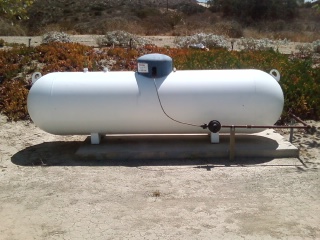
| 120-gallon stationary tank | 96 gallons | Cooking and hot water |
| 250-gallon stationary tank | 200 gallons | Moderate residential use |
| 500-gallon stationary tank | 400 gallons | Home heating and generators |
| 1,000-gallon stationary tank | 800 gallons | Large homes and farms |
The stationary tank capacities assume an approximate 80% liquid fill.
What Size Should You Choose?
For a grill, I’d use an approved portable cylinder. For a house with only a propane stove and water heater, I’d investigate 120- or 250-gallon equipment. For a home relying on propane heating, I’d compare 500- and 1,000-gallon tanks.
However, tank sizing isn’t just about how much fuel you can store. A qualified installer must also check whether the system can supply the appliances’ maximum hourly demand.
How Much Does a 500-Gallon Propane Tank Cost?
A 500-gallon tank is one of the first sizes I would investigate for a house using propane heating, several gas appliances, or standby power. It holds approximately 400 gallons when filled to 80%.


Equipment Price Comparison
| Configuration | Published price estimate |
|---|---|
| New above-ground tank | $2,900 |
| New underground tank | $3,325 |
| Refurbished above-ground tank | $1,575–$1,895 |
The refurbished range comes from an October 2026 equipment advertisement. These are out-of-state reference prices, not local delivered quotations.
How Much Does a Full Refill Cost?
Using the statewide residential benchmark of $2.310 per gallon:
400 × $2.310 = $924.
If the tank is already 30% full, approximately 250 gallons would be needed to reach 80%.
250 × $2.310 = $577.50.
How Long Does It Last?
Suppose you use five gallons daily. A full 400-gallon supply theoretically lasts 80 days.
But if you arrange delivery at 20%, you have approximately 300 gallons between an 80% fill and that reorder point.
300 ÷ 5 = 60 days between planned deliveries.
I would consider this capacity for a year-round residence with regular propane demand.
How Much Does a 1,000-Gallon Propane Tank Cost?
Larger tanks are worth comparing for farms, high-consumption homes, and rural properties where frequent deliveries are inconvenient. At an 80% fill, a 1,000-gallon vessel stores approximately 800 gallons of propane.
Large Tank Price Comparison
| Configuration | Published price estimate |
|---|---|
| New above-ground tank | $4,750 |
| New underground tank | $5,250 |
| Refurbished tank | $2,755–$3,195 |
These equipment references exclude local delivery, foundation work, piping, testing, and fuel.
How Much Does It Cost to Fill?
800 × $2.310 = $1,848.
A top-up from 30% to 80% would require approximately 500 gallons.
500 × $2.310 = $1,155.
Is a Large Tank Worth It?
Suppose a household consumes eight gallons daily. The 600 gallons available between the 80% and 20% levels would last:
600 ÷ 8 = 75 days.
That is twice the operating storage of a 500-gallon tank under the same planning assumptions. For a rural property needing dependable winter heating or generator fuel, fewer deliveries can be valuable.
However, I wouldn’t buy this size without comparing the full installation costs.
How Much Does a 250-Gallon Tank Cost?
A 250-gallon tank can be suitable for smaller houses, moderate appliance demand, and seasonal properties. At 80% fill, it stores approximately 200 gallons.
Price and Fuel Capacity
| Item | Reference amount |
|---|---|
| New above-ground tank | $1,950 |
| New underground tank | $2,325 |
| Propane at 80% | 200 gallons |
| Full-fill fuel cost at $2.310 | $462 |
Suppose your home uses 40 gallons monthly. A full 200-gallon supply theoretically provides five months of fuel.
If you arrange a refill at 20%, approximately 150 gallons are available between deliveries.
150 ÷ 40 = 3.75 months.
For a cooking-only household, I’d evaluate this tank alongside a 120-gallon model.
How Much Does a Small Propane Tank Cost?
Small propane tanks are useful for grills, camping, RVs, patio heaters, and limited residential applications. Unlike stationary vessels, portable cylinders are generally purchased through hardware stores, home-improvement retailers, RV suppliers, and propane dealers.
Small Tank Comparison
| Container | Approximate fuel capacity | Best suited for |
|---|---|---|
| 1-pound cylinder | 0.24 gal | Portable camping stoves |
| 5-pound cylinder | 1.2 gal | Compact camping equipment |
| 20-pound cylinder | 4.7 gal | Backyard grills |
| 30-pound cylinder | 7.1 gal | RVs |
| 100-pound cylinder | 23.5 gal | Approved larger portable applications |
| 120-gallon stationary tank | 96 gal | Residential appliances |
For portable cylinders, I would compare purchase price, refill availability, valve type, and certification requirements.
For a small stationary tank, a published new-equipment reference is $985 for an above-ground 120-gallon model.
A 100-pound cylinder is not the same product as a 100-gallon stationary tank. For more details, see my propane tank versus cylinder guide.
Where Can You Buy Propane Tanks for Sale?
I recommend contacting a propane company before purchasing a large tank from an online seller. Some companies sell customer-owned tanks, while others mainly provide leased equipment.
You should also confirm whether the intended supplier will install and fill a third-party tank.
MFA Oil
MFA Oil operates propane service locations throughout the state, including communities such as Columbia-area towns, Stockton, Eldon, Sullivan, and Carthage.
It offers propane delivery, equipment leasing, and service arrangements. I would contact MFA Oil when comparing long-term residential delivery and tank rental options.
Myers Propane
Myers Propane serves parts of southwest Missouri and advertises 500- and 1,000-gallon tanks for sale. Its customer information also discusses safety leak testing before filling certain customer-owned tanks.
If you’re purchasing your own equipment, I would ask about available tank sizes, installation, and service fees.
M&M Propane
M&M Propane advertises propane delivery and equipment sales. Its published information lists 330-, 500-, and 1,000-gallon tanks and states that refurbished 500- and 1,000-gallon vessels are kept in stock.
I would confirm current availability and condition before buying.
Ray-Carroll Fuels
Ray-Carroll Fuels advertises residential propane delivery and rental of 500- and 1,000-gallon tanks. I would compare the company’s rental terms with purchasing a privately owned tank.
Supplier Comparison
| Supplier | Equipment or service to ask about |
|---|---|
| MFA Oil | Leasing, installation and delivery |
| Myers Propane | 500- and 1,000-gallon tanks for purchase |
| M&M Propane | New or refurbished stationary tanks |
| Ray-Carroll Fuels | 500- and 1,000-gallon tank rental |
| Local independent dealers | Tank sales, refills and service |
Buying Online vs. Buying Locally
An online listing may show a lower equipment price, but freight and unloading can be expensive.
For example, BLT Tanks publishes prices for new vessels but states that it delivers full semi-truck loads rather than individual tanks.
I would request the complete delivered price before comparing an online listing with a local dealer. My preference is to buy from a company that can provide installation, inspection, and ongoing service.
Do Propane Tanks Come Filled?
Usually, large stationary propane tanks are quoted separately from the initial fuel delivery. However, some dealer installation packages may include an initial fill or promotional fuel allowance.
Portable cylinders can also be sold empty, prefilled, or through exchange programs. I would never assume the advertised purchase price includes propane.
What to Expect
| Purchase type | Fuel commonly included? |
|---|---|
| New large stationary tank | Usually priced separately |
| Used stationary tank | Verify condition; often transferred empty |
| New refillable 20-pound cylinder | Often sold empty |
| Cylinder exchange | Usually contains propane |
| Camping fuel canister | Often sold prefilled |
| Complete installation package | Depends on quotation |
For stationary tanks, request the equipment price and initial fill as separate line items.
If a seller advertises a prefilled portable cylinder, check the net propane weight rather than assuming every cylinder contains the same quantity.
Are Propane Tanks Universal?
No. Propane containers aren’t universally interchangeable. They differ in size, construction standards, valve arrangements, service orientation, and intended applications.
A tank designed for residential vapor withdrawal is not automatically suitable for a forklift requiring liquid propane. Similarly, a small camping canister may use a completely different connection from a grill cylinder.
Tank Compatibility Guide
| Application | Typical equipment | Main concern |
|---|---|---|
| Backyard grill | 20-pound DOT cylinder | Correct valve and regulator |
| RV | Approved RV cylinder or mounted tank | Compatible pressure and mounting |
| Residential furnace | Stationary vapor-service tank | Proper system sizing |
| Forklift | Liquid-withdrawal cylinder | Correct orientation and fittings |
| Camping stove | Manufacturer-approved canister | Fuel and connector compatibility |
I recommend checking the appliance manual and using only approved containers, hoses, and regulators. Never force incompatible connections or modify a tank valve.
How Much Does It Cost to Fill a Propane Tank?
Fuel prices vary by supplier, region, delivery quantity, and contract.
The EIA reported an average residential rate of $2.310 per gallon on November 16, 2026, excluding taxes. I use that figure as a benchmark, not as an actual quote from a nearby dealer.
Propane Fill Cost Chart
| Tank size | Gallons at 80% | Cost at $2.310/gal |
|---|---|---|
| 120 gallons | 96 | $221.76 |
| 250 gallons | 200 | $462 |
| 320 gallons | 256 | $591.36 |
| 500 gallons | 400 | $924 |
| 1,000 gallons | 800 | $1,848 |
These calculations assume an initially empty tank filled to 80%.
For a tank that’s partially full, the delivery charge is generally based on the gallons actually supplied, subject to the supplier’s contract and charges.
How Do Prices Change?
Suppose you need 400 gallons.
| Price per gallon | Fuel cost |
|---|---|
| $1.75 | $700 |
| $2.00 | $800 |
| $2.310 | $924 |
| $2.50 | $1,000 |
| $3.00 | $1,200 |
| $3.50 | $1,400 |
Only $2.310 is the dated statewide survey average. Other prices are hypothetical comparisons.
How Can You Get a Better Refill Price?
I would ask suppliers for the delivered rate at different quantities. Compare 150-, 250-, and 400-gallon orders, if offered.
Also ask about minimum delivery charges, tank rental, payment arrangements, and automatic delivery programs.
For more calculations, read my propane refill cost per gallon guide.
Buying vs. Leasing: Which Is Better?
One of the biggest decisions is whether to own the tank or rent it from a supplier.
Buying requires more money initially, but you own the equipment. Leasing may reduce upfront costs while restricting the choice of fuel supplier.
Ownership Comparison
| Factor | Buying | Leasing |
|---|---|---|
| Upfront equipment cost | Higher | Often lower |
| Tank ownership | Homeowner | Supplier |
| Supplier flexibility | Potentially greater | Often restricted |
| Annual rental | Usually none | May apply |
| Maintenance | Owner and contract dependent | Contract dependent |
| Changing supplier | New supplier may inspect tank | Removal or replacement may be required |
Five-Year Example
Suppose a 500-gallon tank costs $2,900. Alternatively, assume a hypothetical rental fee of $125 per year.
Five years of rent = $625.
Now suppose leased propane costs an additional $0.25 per gallon, and your household uses 900 gallons annually.
900 × $0.25 × 5 = $1,125.
The rent and additional fuel cost would total $1,750 over five years, excluding fuel costs common to both arrangements.
This comparison doesn’t establish that buying or leasing is always cheaper. Installation, maintenance, rental policies, and contract terms can change the outcome.
Important Ownership Rule
State law restricts unauthorized filling, moving, and handling of tanks owned by someone else.
Before purchasing a home with a stationary tank, I would ask for written proof of ownership. If the vessel belongs to a propane company, do not have another dealer fill it without the legally required permission.
Can You Bury a Propane Tank?
Yes. Underground propane tanks are permitted when the installation meets applicable safety standards and site requirements.
However, you cannot simply bury an ordinary above-ground vessel.
The tank must be approved for underground use, and the installation needs appropriate excavation, corrosion protection, clearances, and access to service fittings.
Underground Installation Considerations
I would examine soil conditions and drainage before purchasing an underground model.
Rocky ground increases excavation difficulty. High groundwater can create flotation risks.
The installation may also require protective coatings, cathodic protection, and periodic inspections.
Above-Ground vs. Underground Tank Costs
| Tank size | Above-ground equipment | Underground equipment |
|---|---|---|
| 120 gallons | $985 | $1,770 |
| 250 gallons | $1,950 | $2,325 |
| 320 gallons | $2,350 | $2,650 |
| 500 gallons | $2,900 | $3,325 |
| 1,000 gallons | $4,750 | $5,250 |
These prices exclude excavation, piping, delivery, and installation.
Would I Choose Underground Storage?
I would consider it when yard appearance is important and the property is suitable for excavation.
For easier inspection and generally lower installation expense, I would compare above-ground equipment first.
The final location and construction should be determined by a qualified installer.
What Are Missouri Propane Tank Regulations?
The principal state regulator is the Missouri Propane Safety Commission.
The state’s propane laws and administrative regulations establish requirements for qualified businesses, equipment installation, storage, handling, and safety practices.
Missouri’s current published rules under 2 CSR 90-10.040 incorporate the 2024 edition of NFPA 58, which addresses LPG storage and handling.
2 CSR 90-10.020 incorporates NFPA 54 (2024) for fuel-gas piping and appliance installations.
These editions matter because using an older code chart without checking the current rules can lead to incorrect installation decisions.
Do Propane Installers Need to Be Registered?
Businesses and professionals performing regulated propane installation and servicing work must comply with state registration requirements.
The Missouri Propane Safety Commission provides registration categories for different LPG activities. I would confirm the contractor’s applicable registration and training before hiring them.
Does Every Tank Need a State Installation Permit?
Not every ordinary residential tank should be treated like a large commercial bulk-storage facility.
The Commission has a separate application and plan-review process for applicable bulk installations.
Local building or fire officials may also require permits or inspections for residential work. I would confirm requirements for the exact address and tank configuration.
How Far Must a Tank Be From a House?
Required separation depends on the tank’s capacity, configuration, nearby buildings, property lines, openings, and ignition sources.
For initial planning, common NFPA 58 references for certain individual above-ground installations include:
| Tank water capacity | General planning distance |
|---|---|
| Under 125 gallons | Specific smaller-container provisions |
| 125–500 gallons | Commonly 10 feet |
| 501–2,000 gallons | Commonly 25 feet, subject to exceptions |
This table is not a complete code-compliance or installation approval chart.
Underground tanks, grouped vessels, and specific site conditions can have different requirements. I would have the contractor verify every clearance using the applicable adopted code and local rules.
Additional State Requirements
Missouri’s rules also address containers moved at a consumer’s property and require certain disconnected vessels to be placed on firm foundations, with openings appropriately capped or plugged.
The regulations distinguish smaller portable cylinders from certain stationary containers. I wouldn’t move or reposition a large stationary tank myself.
Installation Checklist
| Requirement | What to verify |
|---|---|
| Tank construction | Approved vessel for intended use |
| Contractor | Appropriate state registration |
| Separation distances | Compliance with applicable code |
| Supports | Firm and stable foundation |
| Piping | Approved materials and connections |
| Regulators | Correct sizing and pressure |
| Testing | Required leak and pressure checks |
| Underground installation | Corrosion protection and drainage |
| Local approval | Building and fire requirements |
| Delivery access | Safe filling and maintenance access |
Before installation, I would ask the contractor which inspections and documents are included in the quoted price.
What Are the Dimensions of Common Propane Tanks?
Tank dimensions matter because the vessel must fit your property while maintaining required safety clearances.
I recommend requesting the exact manufacturer’s specifications before preparing a foundation.
Typical Stationary Tank Dimensions
| Tank capacity | Approximate diameter | Approximate length |
|---|---|---|
| 120 gallons | 24 inches | 5–6 feet |
| 250 gallons | 30 inches | 7–8 feet |
| 500 gallons | 38–41 inches | 9–10 feet |
| 1,000 gallons | Around 41 inches | Around 16 feet |
Measurements vary by manufacturer and tank model.
An appropriate installation location must also accommodate delivery trucks and future maintenance. For smaller residential properties, I would ask the installer to verify whether the available space meets all separation requirements before buying.
Which Propane Tank Brands Should You Consider?
I wouldn’t choose a tank based on the brand name alone. Construction quality, approvals, warranty, equipment condition, and local service compatibility matter more.
Common Manufacturers
| Manufacturer | Equipment category |
|---|---|
| Manchester Tank | Portable cylinders and stationary tanks |
| Quality Steel | Above-ground and underground stationary tanks |
| Worthington Enterprises | Portable propane cylinders |
| Flame King | Portable and specialty cylinders |
For permanent residential storage, I would look for an appropriately constructed ASME vessel and verify that the selected supplier will install and service it.
For camping, grilling, and RV equipment, I would confirm that the portable container meets the appropriate specifications.
Are Blue or Black Propane Tanks Different?
Color alone does not determine tank compatibility or quality.
You may encounter blue portable cylinders, black-painted cylinders, white residential tanks, or tanks with other manufacturer finishes.
A black tank exposed to direct sunlight may absorb more heat than a light-colored tank, depending on the coating.
Large stationary propane tanks are commonly finished in light, reflective colors for thermal performance.
I would not repaint a stationary tank black or another dark color without approval from the supplier or qualified propane professional.
For equipment comparison, focus on certification, condition, approved use, and fittings rather than appearance.
How Do You Find a Propane Tank Near You?
When searching for a nearby tank, I would begin with a dealer serving the property’s ZIP code.
A tank may be listed for sale in another part of the state, but transporting it can add considerable expense. For a 500- or 1,000-gallon vessel, delivery and unloading often require specialized equipment.
Buying Options Compared
| Where to shop | Main advantage | What to check |
|---|---|---|
| Local propane dealer | Installation and service | Tank ownership and pricing |
| Equipment refurbisher | Potentially lower equipment cost | Condition and inspection |
| Online tank supplier | Broader inventory | Freight and unloading |
| Agricultural equipment dealer | Availability near rural properties | Suitability and ownership |
| Private seller | Potential discount | Legal title and condition |
| Hardware retailer | Convenient portable cylinders | Fill status and certification |
If you’re buying a tank online, I would obtain written confirmation of the exact model, shipping cost, and delivery arrangements before paying.
For a used stationary tank, arrange professional inspection rather than relying on listing photographs.
Should You Trust Online Reviews?
I would read reviews of both the equipment seller and the company providing fuel.
Useful feedback concerns delivery reliability, billing accuracy, installation quality, maintenance, and customer support.
I wouldn’t base the decision on star ratings alone. A supplier that performs well for one town may have different delivery coverage in another.
How Do You Replace an Old Propane Tank?
Tank replacement may be necessary when a vessel has unacceptable corrosion, damage, unsuitable fittings, or other safety concerns.
However, age alone does not necessarily mean that a stationary ASME tank must be replaced. I would begin with a qualified professional’s inspection. I also explain the difference between aging and replacement in my guide to when propane tanks should be replaced.
Replacement Checklist
- Confirm who owns the existing tank.
- Determine whether repair or replacement is appropriate.
- Check the manufacturer plate and service history.
- Obtain a quotation for removal and replacement.
- Verify that the new vessel meets the required capacity and design.
- Confirm any applicable permits and inspections.
- Arrange safe disconnection, transport, installation, and testing.
If the tank belongs to a propane supplier, the lease agreement may govern replacement and removal.
Portable DOT cylinders follow different requalification rules from large stationary ASME vessels.
For more information, read my guide to propane tank recertification.
What Propane Tank Should You Use for Camping?
For camping, I would select a portable container specifically approved for the stove, heater, or other equipment.
Small one-pound canisters are convenient for compatible portable appliances. Refillable five-pound cylinders can be useful for longer trips when the equipment supports them.
Twenty-pound cylinders provide greater capacity but are heavier and less convenient to transport.
Camping Tank Comparison
| Container | Main benefit | Best use |
|---|---|---|
| 1-pound canister | Compact and lightweight | Short camping trips |
| 5-pound refillable cylinder | Reusable, moderate capacity | Extended outdoor cooking |
| 20-pound cylinder | Large fuel supply | Base camps and compatible appliances |
Never use a propane appliance inside a tent, vehicle, or other enclosed space unless the manufacturer explicitly approves that application and all ventilation and safety requirements are met.
For ordinary camping equipment, I recommend outdoor use and following the appliance instructions.
Transport cylinders secured upright when required, protect the valves, and avoid leaving them in excessively hot enclosed vehicles.
How Much Propane Should You Store for Winter?
Winter heating requirements depend on the home, furnace, insulation, thermostat settings, and outdoor temperature.
I would estimate propane consumption from actual delivery records whenever possible.
Propane contains approximately 91,500 BTU per liquid gallon.
You can estimate fuel consumption using:
Gallons per hour = Appliance input BTU per hour ÷ 91,500
For example, a 90,000-BTU-per-hour furnace consumes approximately 0.98 gallons per hour when operating at its rated input.
Actual daily consumption depends on how long it runs.
Winter Consumption Example
| Daily use | 7-day fuel requirement | 14-day requirement |
|---|---|---|
| 3 gallons | 21 gallons | 42 gallons |
| 5 gallons | 35 gallons | 70 gallons |
| 8 gallons | 56 gallons | 112 gallons |
| 12 gallons | 84 gallons | 168 gallons |
These are planning calculations, not required reserves. I would arrange deliveries based on expected consumption and the supplier’s lead time.
What Size Tank Do You Need for a Standby Generator?
A standby generator may use considerably more propane than cooking appliances.
I recommend checking the manufacturer’s hourly fuel-consumption chart at the expected electrical load.
Suppose a generator consumes 2.5 gallons per hour.
| Runtime | Propane consumption |
|---|---|
| 8 hours | 20 gallons |
| 24 hours | 60 gallons |
| 48 hours | 120 gallons |
| 72 hours | 180 gallons |
| 120 hours | 300 gallons |
Using a planned storage range from 80% to 20%, a 500-gallon tank provides approximately 300 gallons.
300 ÷ 2.5 = 120 hours.
A 1,000-gallon tank provides approximately 600 gallons over the same operating range, or 240 hours.
These are theoretical examples. Actual runtime depends on generator load, temperature, fuel availability, and other appliances sharing the tank.
For more details, read my propane tank size chart for generators.
Frequently Asked Questions
How Much Does a 500-Gallon Tank Cost?
A published equipment reference is $2,900 for a new above-ground model, before local delivery and installation.
How Much Does a 1,000-Gallon Tank Cost?
A published new-equipment estimate is $4,750 for an above-ground model, excluding installation and fuel.
Can You Buy a Used Propane Tank?
Yes, but verify legal ownership, condition, manufacturer identification, and whether the intended supplier will accept it.
Can You Bury a Propane Tank?
Yes, provided the vessel is approved for underground use and the installation satisfies applicable safety requirements.
Are All Propane Tanks Universal?
No. Containers have different valves, fittings, service configurations, construction standards, and approved uses.
Do New Propane Tanks Come Filled?
Not necessarily. Large stationary tanks are commonly priced separately from the initial propane delivery, and many new portable refillable cylinders are sold empty.
What Is the Average Propane Price?
The EIA reported $2.310 per gallon for residential deliveries during the week of November 16, 2026, excluding taxes.
Can a Different Company Fill a Leased Tank?
Generally, the tank owner’s permission is required. Do not arrange an unauthorized refill.
What Does It Cost to Fill a 500-Gallon Tank?
At $2.310 per gallon, 400 gallons would cost approximately $924 before applicable fees and taxes.
Do You Need a Permit to Install a Tank?
Depending on the installation, state and local approvals may apply. Ask a properly registered installer and the local authority before starting work.
Are Underground Tanks Safe?
They can be safe when properly designed, installed, inspected, and protected against corrosion and flotation hazards.
How Long Does a 500-Gallon Tank Last?
At five gallons daily, the 300 gallons available between 80% and 20% would last about 60 days.
Does Tank Color Matter?
Color can affect solar heat absorption, but the approved vessel construction, equipment condition, and intended application are more important.
Is Buying Better Than Leasing?
Buying may provide more flexibility, while leasing reduces upfront equipment expense. Compare the complete long-term costs.
Final Thoughts: Choosing the Right Tank
If you’re buying a propane tank, I recommend beginning with your actual fuel consumption rather than choosing the largest equipment available.
For cooking and limited water heating, a 120- or 250-gallon stationary tank may be enough.
For regular heating or several appliances, a 500-gallon tank is worth comparing.
A 1,000-gallon vessel may be appropriate for high-demand households, farms, standby generators, or properties where fewer deliveries are desirable.
However, I wouldn’t purchase equipment based only on its advertised price.
Check ownership, supplier acceptance, installation requirements, maintenance, fuel delivery, and long-term costs.
Before placing an order, obtain complete written quotations and have the installation location evaluated by an appropriately registered propane professional.
The best tank is one that safely meets your fuel requirements, fits your property, and gives you reliable storage without unnecessary expense.

Mike is an experienced propane technician with over 15 years of professional experience in the field. He has dedicated his career to helping customers with their propane needs, from installation to maintenance and repair. Together with Jeremy, he co-founded this website to provide useful information and guidance to customers seeking reliable propane services.