
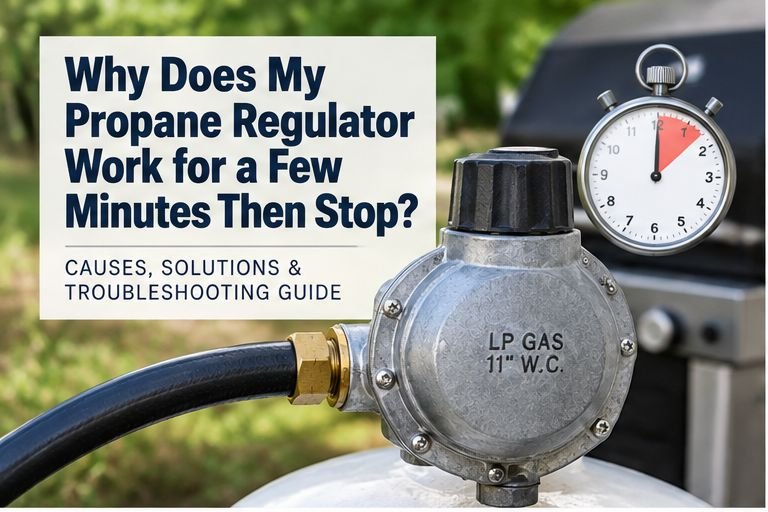
If your propane regulator works for a few minutes and then gas flow stops, the most likely causes are a restricted supply, excessive appliance demand, insufficient propane vaporization, regulator freeze-up, an activated excess-flow device, or a fault in the appliance rather than the regulator itself. The timing is an important clue: a system that starts normally but fails after several minutes is often able to supply the initial demand but cannot maintain the required gas flow or pressure. If you smell propane or suspect a leak, stop troubleshooting, leave the area, and contact your propane supplier from a safe location.
What Does “Works for a Few Minutes Then Stops” Tell You?
A delayed shutdown can overlap with a propane regulator that keeps shutting off. If the system also shows weak flames or poor appliance performance, compare the common causes of low propane regulator pressure.
Intermittent operation usually points to a condition that changes after gas begins flowing. A completely blocked line may prevent startup altogether. By contrast, a marginally sized regulator, undersized line, cold cylinder, icing problem, or appliance control can allow normal ignition and then fail as demand continues.


| Pattern | Possible Cause | Useful Clue |
|---|---|---|
| Starts, then all appliances weaken | Supply/regulator/piping capacity | Problem affects whole system |
| Only one appliance stops | Appliance or branch-line issue | Other appliances remain normal |
| Stops when second appliance starts | Insufficient system capacity | Total load triggers pressure drop |
| Worse in freezing weather | Vaporization or freeze-up | Cold tank/regulator, possible frost |
| Happens immediately after tank change | Excess-flow restriction / connection issue | Very low flame after opening valve |
1. Your Propane System Cannot Maintain the Appliance Load
A propane system can light an appliance successfully yet fail once sustained demand pulls downstream pressure too low. Regulator capacity is normally expressed in BTU per hour, and the piping must also be able to carry the required gas volume at the design pressure.
Imagine a furnace rated at 100,000 BTU/h and a water heater rated at 40,000 BTU/h. If both operate together, the supply system may need to support roughly 140,000 BTU/h for those two appliances alone, plus any other simultaneous loads. A regulator, pipe, fitting, or tank vaporization rate that is marginal may work when only a small burner is running and fail when the larger load starts.
RegO’s service guidance recommends checking delivery pressure with appliances operating and confirming that pressure is maintained at full load. This is a job for trained personnel using a manometer or suitable gauge.
2. The Propane Tank Cannot Vaporize Fuel Fast Enough
If the problem becomes obvious when another appliance starts, see why propane pressure drops when an additional appliance turns on. A similar supply limitation can also explain why a propane flame gets smaller as the tank empties.


A cylinder or tank may contain propane but still be unable to produce vapor at the rate your appliances demand. Liquid propane must absorb heat to boil into vapor. Vaporization capacity falls as ambient temperature drops and as the amount of liquid propane—and therefore wetted tank surface—decreases.
This explains a frustrating pattern: the appliance lights, runs for several minutes, and then weakens. After sitting unused, the system may appear to “recover” because the tank has time to absorb heat and produce more vapor. When the appliance starts again, the cycle repeats.
Small cylinders feeding high-BTU heaters and burners are especially sensitive to vaporization limits. Connecting a larger load does not make a small cylinder produce unlimited vapor. Tank selection should consider appliance BTU demand, outdoor temperature, propane level, and expected run time.
3. An Excess-Flow Device Is Restricting Gas
An excess-flow device may restrict propane when flow suddenly exceeds its closing threshold. These devices are intended to reduce flow under certain abnormal high-flow conditions. RegO describes excess-flow valves as surge-sensitive, so a sudden rush of gas can cause closure more readily than a gradual flow.
On portable equipment, opening a cylinder valve rapidly or connecting a high-flow appliance can contribute to this symptom. Do not bypass or modify the safety device. Turn equipment off and follow the manufacturer’s prescribed reset/startup sequence. If the condition repeats, have the equipment inspected rather than continually resetting it.

4. The Regulator or Piping Is Freezing
If the trouble appeared immediately after installing a fresh cylinder, compare it with an appliance that will not stay lit after changing tanks.
Moisture or contamination can freeze and interfere with regulator operation, producing normal flow at first and restricted flow later. Propane pressure reduction also creates cooling, so visible frost does not by itself prove internal failure.
Do not use a torch, open flame, boiling water, heat gun, or other improvised heating method on a propane regulator. A recurring freeze-up needs professional evaluation. The technician may need to determine whether moisture entered the system, whether the regulator vent is positioned correctly, and whether contamination or system design is contributing.
5. The Regulator Vent Is Obstructed
A regulator needs its venting arrangement to function as designed because the diaphragm must respond to pressure changes. Dirt, insects, ice, paint, or debris around a vent can interfere with operation. Outdoor regulators also need to be installed in the orientation and location required by their manufacturer and applicable codes.


Do not plug the vent. A visual check for obvious external obstruction is reasonable, but dismantling or probing a regulator is not. If the vent is damaged, heavily corroded, or repeatedly icing, call your propane supplier.
6. Dirt or Foreign Material Is Affecting the Regulator Seat
Foreign material can prevent a regulator seat from sealing and controlling pressure correctly. RegO identifies debris from upstream piping as a known cause of lock-up and creeping problems. The result may be unstable pressure rather than a clean, predictable failure.
Regulator internals are safety-critical components. Homeowners should not take the regulator apart to clean the seat or diaphragm. A qualified technician can perform pressure tests and determine whether replacement or manufacturer-approved service is appropriate.
7. The Gas Line Is Undersized
An undersized gas line can deliver enough propane for ignition but not enough for sustained high-load operation. Gas piping is sized using factors including pipe material, inside diameter, length, supply pressure, fittings, and appliance demand.
This problem often appears after a homeowner adds another propane appliance. A line originally designed for a water heater may not automatically have enough capacity for a new furnace, generator, fireplace, or pool heater. Increasing regulator pressure is not a safe shortcut for incorrectly sized piping.
8. A Valve Is Not Fully Open
A partially opened service valve or another restriction can reduce available flow and imitate a regulator problem. Some propane valves and excess-flow arrangements are designed to operate with the service valve fully open during normal service. RegO specifically warns that throttling certain valves can restrict flow and interfere with proper excess-flow operation.
Only operate valves you are authorized and instructed to operate. Do not force a stuck valve. If you are unsure which valves should be open, contact the supplier.
9. The Regulator Is Undersized or Incorrect for the Application
A regulator must match the application, inlet pressure, required outlet pressure, flow capacity, gas type, and system configuration. Two regulators that look similar can have very different pressure ranges and capacities.
For example, RegO lists residential first-stage regulators designed to reduce container pressure to approximately 10 psig, while typical final low-pressure residential delivery is commonly around 11 inches water column before appliance-specific regulation. These pressures are not interchangeable. Installing a regulator because the threads fit can create unsafe or nonfunctional conditions.
10. The Appliance Is Shutting Itself Down
If only one appliance stops while the rest of the propane system works, investigate the appliance before blaming the main regulator. Furnaces, fireplaces, water heaters, dryers, and other gas appliances use controls that can shut the burner down when ignition, flame sensing, combustion air, venting, temperature, or another safety condition is not satisfied.
Check the appliance manual for fault codes or indicators, but do not bypass safety controls. A qualified HVAC or gas-appliance technician may be the right professional when the supply pressure is normal and the fault is isolated to one appliance.
How a Technician Diagnoses an Intermittent Propane Problem
A technician normally diagnoses this problem by observing pressure and flow under the conditions that make the failure occur. Static pressure alone may look normal. The important information is often what happens when the system is carrying a realistic load.
- Verify propane supply and tank condition.
- Identify total connected appliance load in BTU/h.
- Confirm regulator model, stage, capacity, inlet and outlet requirements.
- Measure delivery pressure under partial and full load.
- Check lock-up behavior after appliances shut off.
- Inspect piping for restrictions, damage and sizing issues.
- Inspect regulator vent position and condition.
- Determine whether the failure affects one appliance or the entire system.
RegO states that a common low-pressure residential target is about 11 inches water column at the appropriate test location, but the correct pressure must always come from the specific system and appliance specifications. Appliance regulators may have different downstream settings.
What Is Lock-Up Pressure?
Lock-up pressure is the pressure that develops downstream after gas demand stops and the regulator closes against its seat. RegO’s service manual says a slight pressure rise is normal and describes a lock-up limit of no more than 130% of the regulator’s set delivery pressure in the procedure it outlines. A creeping pressure rise can indicate that the seat is not closing properly.
This measurement requires proper equipment and trained interpretation. It should not be attempted by loosening fittings or improvising a pressure connection.
Safe Checks Before Calling for Service
You can collect useful information without opening the propane system. Record the outdoor temperature, tank level, which appliances are operating, how long the system runs before stopping, whether flames become weak first, and whether the issue disappears after the system rests.
| Observation | Why It Helps |
|---|---|
| All appliances affected | Points toward common supply side |
| One appliance affected | Points toward appliance/branch |
| Only during high demand | Suggests capacity/pressure-drop issue |
| Only in very cold weather | Suggests vaporization/freeze-up |
| After cylinder replacement | Suggests startup, connection or excess-flow issue |
When to Stop Troubleshooting Immediately
Stop using the system if you smell propane, hear uncontrolled gas escaping, see fire damage, find a broken regulator or line, or suspect a leak. Avoid flames, smoking, electrical switches, engines, and anything else that could create an ignition source. Leave the area and follow your propane supplier’s emergency instructions from a safe location.
Frequently Asked Questions
Why does my propane work again after sitting for 10 or 20 minutes?
A recovery after resting can be consistent with limited vaporization, icing, or another flow-related condition, but it does not prove the cause. The tank may have time to absorb heat and generate more vapor, or a restricted device may equalize. Repeated cycling needs diagnosis.
Can a bad regulator work intermittently?
Yes, regulator faults can be intermittent, but so can piping, supply, tank-vaporization, and appliance problems. Pressure testing under load is much more useful than replacing parts by guesswork.
Will a full propane tank fix the problem?
It may improve vaporization capacity, especially in cold weather, but it will not fix an undersized regulator, blocked vent, restricted line, damaged component, or appliance fault.
Should I buy a higher-pressure regulator?
No—not unless the equipment and system are specifically designed for that pressure. Regulator pressure is an engineering requirement, not a performance upgrade.
Bottom Line
A propane regulator that works briefly and then seems to stop is often revealing a flow or capacity problem that only appears after the system is under load. Check the pattern rather than guessing at the part: whether all appliances fail, whether cold weather matters, whether adding another appliance triggers the problem, and whether the issue started after a cylinder change. Those clues can quickly point a qualified technician toward tank vaporization, regulator capacity, piping pressure drop, excess-flow restriction, freeze-up, contamination, or an appliance safety shutdown.
Technical references: RegO LP-Gas Serviceman’s Manual, RegO regulator field guidance, and RegO excess-flow valve guidance. Always follow the instructions for your specific equipment and local requirements.

Mike is an experienced propane technician with over 15 years of professional experience in the field. He has dedicated his career to helping customers with their propane needs, from installation to maintenance and repair. Together with Jeremy, he co-founded this website to provide useful information and guidance to customers seeking reliable propane services.


