
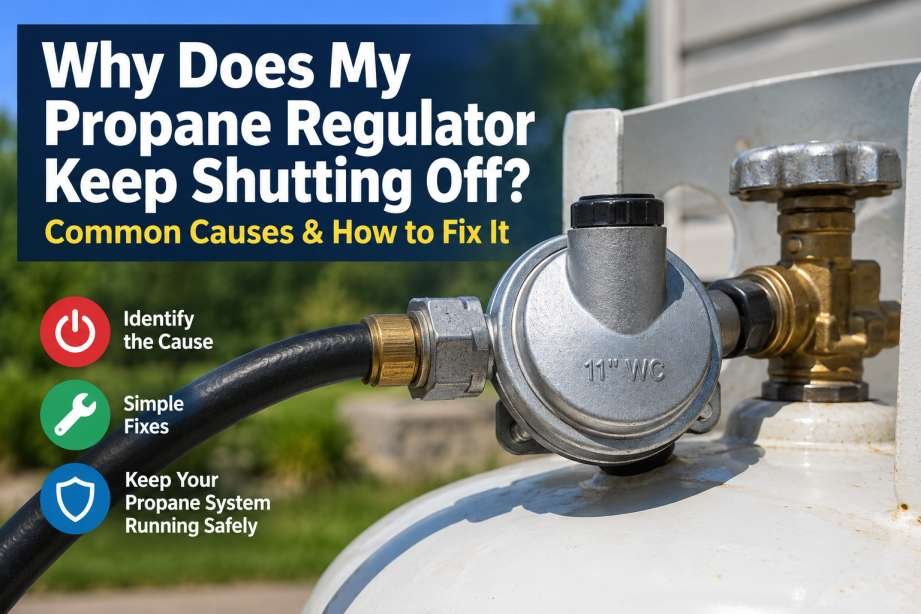
A propane regulator that keeps shutting off usually means gas flow has been restricted by a safety device, the cylinder valve was opened too quickly, demand is greater than the system can supply, or the regulator or piping has a fault. Start with the simple possibilities: turn off the appliances, close the propane supply, wait several minutes, and follow the appliance and regulator manufacturer’s restart instructions. If you smell propane, hear gas escaping, see regulator damage, or the problem returns, stop using the system and contact your propane supplier or a qualified gas technician.
Why Does a Propane Regulator Keep Shutting Off?
If the regulator starts normally but fails after running for a while, compare the pattern with a propane regulator that works for a few minutes then stops. If flow collapses immediately when the cylinder valve is opened, review why a propane regulator trips when the tank valve opens.
A propane regulator does not normally have an everyday “on/off” function like a switch. Its job is to reduce changing container pressure to a controlled downstream pressure that appliances can use. What homeowners often describe as the regulator “shutting off” may actually be an excess-flow device limiting gas, insufficient inlet pressure, regulator freeze-up, a blocked vent, an undersized system, or an appliance safety control closing.
This distinction matters because repeatedly resetting or replacing the regulator without finding the real cause may not solve anything. A propane system includes the container valve, regulator, piping, fittings, appliance controls, and sometimes separate first- and second-stage regulators. A restriction anywhere along that path can look like a regulator failure.
| What You Notice | Likely Area to Check | Typical Clue |
|---|---|---|
| Gas stops after opening tank | Excess-flow device / rapid valve opening | Very weak or no flame |
| Works with one appliance but not several | Capacity or piping | Pressure drops as load increases |
| Problem appears in cold weather | Vaporization / freeze-up | Frost or ice may be visible |
| Regulator works, then repeatedly stops | Regulator, vent, contamination, system restriction | Problem returns after reset |
| Only one appliance shuts down | Appliance control or branch line | Other appliances work normally |
1. The Cylinder Valve Was Opened Too Quickly
Opening a propane cylinder valve too quickly can create a sudden surge of gas that causes an excess-flow device to restrict flow. This is common with portable-cylinder systems such as grills, heaters, and other equipment. The user may then see a tiny flame or believe the regulator has completely shut down.
Excess-flow devices are designed to react when flow rises above a predetermined rate. RegO notes that these devices are surge-sensitive, meaning sudden flow can make them close faster than a steady flow. That is useful during certain line failures, but a rapid startup can sometimes imitate the conditions the device is intended to detect.
Do not defeat, remove, or modify an excess-flow device. Follow the equipment manufacturer’s shutdown and restart procedure. In many portable applications this involves turning appliances off, closing the cylinder valve, allowing pressure to equalize, and reopening the valve slowly. The exact procedure depends on the equipment.


2. Gas Demand Is Greater Than the Regulator Can Supply
If the trouble started after changing cylinders, the issue may resemble an appliance that will not stay lit after changing tanks. When the main symptom is weak appliance performance, also compare the causes of low propane regulator pressure.
An undersized regulator can cause low downstream pressure when several appliances operate at the same time. Regulators are rated by capacity, commonly expressed in BTU per hour. The regulator must be able to supply the connected appliance load under the expected inlet-pressure and temperature conditions.
For example, a house might have a 100,000-BTU/h furnace, 40,000-BTU/h water heater, 65,000-BTU/h range, and 30,000-BTU/h fireplace. That represents a connected load of about 235,000 BTU/h before applying the sizing rules appropriate to the installation. A regulator or piping system that cannot support the required load may appear normal when one small appliance runs but suffer a large pressure drop when the furnace and water heater operate together.
RegO recommends checking regulator delivery pressure under load and then operating all appliances to confirm pressure is maintained. This is a technician-level test because it requires a manometer or pressure gauge and knowledge of the system’s specified pressures.
3. The Propane Piping Is Too Small or Restricted
A regulator may seem to shut off when the actual problem is pressure loss through undersized, damaged, or restricted piping. Pipe diameter, length, fittings, gas pressure, and total appliance load all affect how much propane vapor can reach the appliances.
A long line does not automatically mean a problem, but a line sized for a small appliance may become inadequate after additional appliances are installed. Kinked tubing, flattened sections, contamination, partially closed valves, and other restrictions can also reduce flow. RegO’s service guidance specifically recommends looking for kinks, flats, and other restrictions when excessive pressure drop occurs at full load.
4. Cold Weather Is Reducing Propane Vaporization
If a pressure gauge looks acceptable but appliances still are not receiving enough gas, see the guide to good propane pressure with little or no flow.
Cold weather can reduce the amount of propane vapor a container can produce, especially when the tank is small or the liquid level is low. Appliances consume propane vapor, and the liquid propane inside the container must absorb heat from its surroundings to boil into additional vapor. Lower outdoor temperatures and lower liquid levels reduce this vaporization capacity.
This can create a situation where a system works during mild weather but struggles when a large furnace starts on a very cold day. The regulator may be blamed even though the container cannot vaporize propane quickly enough for the load. Larger tanks generally provide more wetted surface area and therefore greater vaporization capacity under the same conditions.
5. The Regulator Is Freezing
Regulator freeze-up can interrupt proper pressure control when moisture or contaminants freeze inside the regulator. Frost on the outside, however, does not automatically prove the regulator is defective. Propane pressure reduction produces cooling, and external frost can occur under some operating and weather conditions.
Internal freezing is different. Water or foreign material can interfere with moving components or the regulator seat. Do not apply an open flame, torch, heat gun, or other uncontrolled heat source to a propane regulator. A recurring freeze-up should be evaluated by the propane supplier or a qualified technician.
6. The Regulator Vent Is Blocked or Improperly Positioned
A blocked regulator vent can interfere with diaphragm movement and prevent the regulator from controlling outlet pressure correctly. Depending on the regulator and installation, insects, dirt, ice, paint, debris, or water may obstruct the vent.
The vent is a functional part of the regulator and must be installed according to the manufacturer’s instructions and applicable code. Never plug a regulator vent to stop insects or water. Regulators installed in locations requiring vent piping or special orientation must use the manufacturer-approved arrangement.
7. Foreign Material Is Inside the Regulator
Dirt or debris on the regulator seat can prevent the regulator from controlling gas properly. RegO identifies foreign material from upstream piping as a cause of regulator lock-up and creeping problems. Contamination can affect the seat disc and inlet components and may produce pressure behavior that seems intermittent.
This is not a good DIY cleaning project for a homeowner. Disassembling a gas regulator can change its calibration or damage safety-critical components. Regulators should be serviced or replaced according to the manufacturer’s instructions by qualified personnel.
8. The Regulator Is Damaged or Worn
A worn diaphragm, damaged seat, corrosion, impact damage, or deterioration can cause unreliable regulator operation. Regulators live outdoors in many installations and may experience rain, snow, insects, corrosion, temperature changes, and accidental impact over many years.
Visible damage, heavy corrosion, a damaged vent, evidence of fire exposure, or a regulator of unknown history deserves professional inspection. Replacement regulators must match the required inlet pressure, outlet pressure, capacity, connection type, application, and installation configuration. A regulator should not be selected simply because its threads appear to fit.
9. The Propane Tank Is Nearly Empty
A very low propane level can contribute to supply problems, particularly during high demand or cold weather. Tank pressure is primarily related to propane temperature rather than the percentage-full reading, but the amount of liquid in the container affects available vaporization capacity.
If a high-demand system repeatedly loses performance as the tank gets low, have the supplier evaluate both fuel level and system sizing. Do not assume filling the tank permanently fixes the problem if symptoms repeatedly return.
10. An Appliance Safety Device Is Actually Shutting the Gas Off
If only one appliance stops working, the problem may be at the appliance rather than the main propane regulator. Modern gas appliances can use flame sensors, thermocouples, ignition controls, pressure switches, appliance regulators, and other safety systems.
A useful diagnostic clue is whether every propane appliance is affected. If the stove, furnace, and water heater all lose gas together, investigate the common supply system. If only the fireplace shuts down while everything else operates normally, the fireplace and its branch supply deserve attention first.
What Can You Safely Check Yourself?
You can make basic visual and operational checks without dismantling the propane system. Confirm that the container is not empty, appliances are turned off before restarting the supply, accessible valves are in the position specified by the manufacturer, and the regulator is not visibly damaged or buried in debris.
- Check the tank gauge or cylinder fuel level.
- Look for obvious regulator damage, corrosion, ice, or blocked ventilation.
- Determine whether one appliance or all appliances are affected.
- Note whether the problem happens only during cold weather.
- Note which appliances were operating when flow stopped.
- Follow the manufacturer’s approved restart instructions.
Do not adjust regulator pressure, dismantle the regulator, intentionally vent propane, perform improvised leak tests with a flame, or bypass a safety device.
When Should You Call a Propane Professional?
Call your propane supplier or qualified gas technician when the shutdown keeps returning, pressure needs to be measured, the regulator is damaged, or you suspect a leak. A technician can measure inlet, flow, and lock-up pressure; calculate connected load; inspect piping; verify regulator capacity; check venting and orientation; and determine whether the regulator is actually at fault.
If you smell propane, extinguish ignition sources if this can be done safely, avoid operating electrical switches or creating sparks, leave the area, and contact the propane supplier or emergency services from a safe location. Follow your supplier’s emergency instructions.
Propane Regulator Shutdown Troubleshooting Summary
| Possible Cause | Why Flow Stops or Falls | Best Next Step |
|---|---|---|
| Valve opened rapidly | Safety device may restrict sudden flow | Follow approved reset procedure |
| Regulator undersized | Cannot maintain required flow under load | Have system capacity calculated |
| Pipe restriction | Excessive pressure drop | Professional piping inspection |
| Cold / low vaporization | Tank cannot produce vapor fast enough | Evaluate tank size, level and load |
| Freeze-up | Moisture/contamination interferes with regulator | Professional inspection |
| Blocked vent | Diaphragm cannot respond normally | Correct per manufacturer instructions |
| Internal wear or contamination | Seat/diaphragm cannot regulate correctly | Service or replace as appropriate |
Frequently Asked Questions
Can a propane regulator shut itself off?
The regulator itself normally regulates pressure rather than acting as a simple shutoff valve. What feels like a regulator shutdown may be an excess-flow restriction, loss of supply pressure, freeze-up, regulator malfunction, or an appliance safety control.
Why does propane work after I reset it and then stop again?
A problem that returns after a reset suggests the underlying cause has not been corrected. High gas demand, restricted piping, regulator capacity, contamination, freeze-up, or a safety device may be involved. Repeated resetting is not a substitute for diagnosis.
Can I adjust the regulator to get more gas?
Do not increase regulator pressure unless the manufacturer permits adjustment and the work is being performed by qualified personnel using proper test equipment. Excessive pressure can create unsafe appliance operation.
Does a bigger regulator fix low propane pressure?
Not necessarily. Low pressure can come from undersized piping, low vaporization capacity, restrictions, incorrect regulator staging, or appliance problems. The regulator should be sized as part of the complete system.
Bottom Line
A propane regulator that repeatedly appears to shut off is a symptom that deserves diagnosis, not repeated guessing. Rapid valve opening and excess-flow restriction are common on portable-cylinder equipment, while residential systems may also suffer from insufficient capacity, undersized piping, cold-weather vaporization limits, regulator freeze-up, contamination, or worn components. Basic visual checks can help narrow the problem, but pressure testing, regulator adjustment, internal service, and gas-system modifications should be left to qualified personnel.
Technical references used for this article include RegO’s LP-Gas Serviceman’s Manual and RegO guidance on excess-flow valve operation and regulator troubleshooting. Always follow the instructions for your specific regulator and applicable local codes.

Mike is an experienced propane technician with over 15 years of professional experience in the field. He has dedicated his career to helping customers with their propane needs, from installation to maintenance and repair. Together with Jeremy, he co-founded this website to provide useful information and guidance to customers seeking reliable propane services.


