
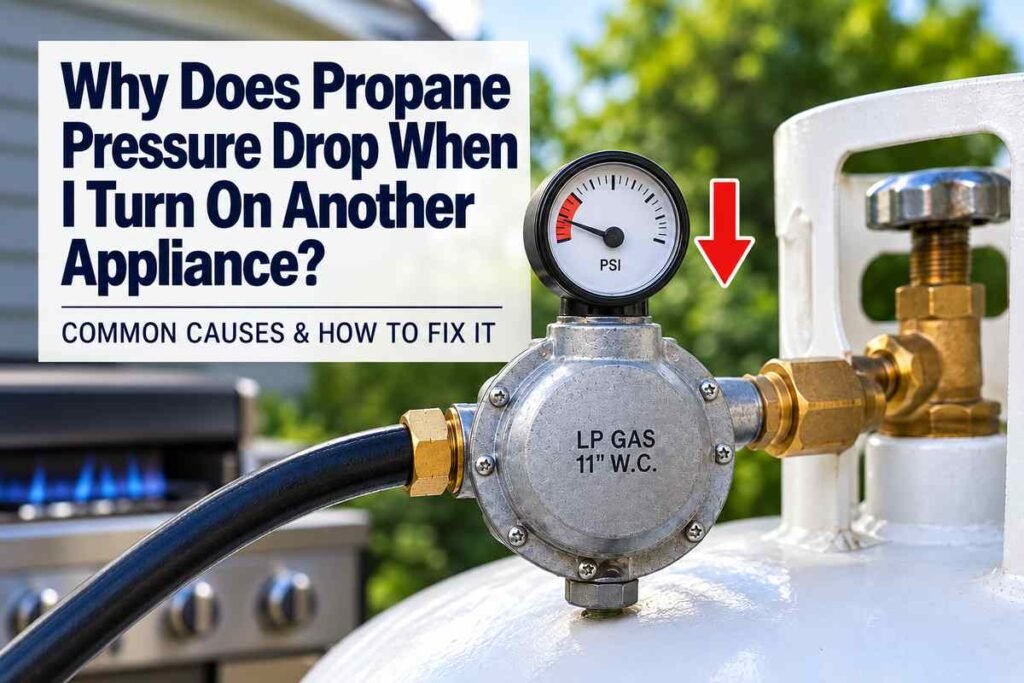
Propane pressure drops when another appliance turns on when the added gas demand exceeds what some part of the supply system can deliver without excessive pressure loss. Common causes include an undersized regulator, undersized or overly long piping, insufficient tank vaporization, restrictions, or a regulator that cannot maintain outlet pressure as flow increases.
What Changes When a Second Appliance Starts?
If the whole system already seems weak before a second appliance starts, compare it with low propane regulator pressure. If pressure appears normal at rest but flow collapses under demand, see good pressure with little or no propane flow.
| Example | Load |
|---|---|
| Furnace | 80,000 BTU/h |
| Water heater | 40,000 BTU/h |
| Range | 60,000 BTU/h |
| Combined potential load | 180,000 BTU/h |
The regulator and piping must be sized for the load expected to operate simultaneously, not just one appliance at a time. Actual appliance ratings vary, so use nameplate values rather than these examples for sizing.


Regulator Droop
Regulator droop is the reduction in outlet pressure that occurs as flow increases. Some change is inherent in regulator operation, but excessive drop can cause appliance problems and may mean the regulator is improperly selected, adjusted, or failing.
Pipe Pressure Loss
If pressure loss becomes worse as the tank level falls, compare it with a propane flame that gets smaller as the tank empties. If combustion also turns abnormal, review whether a bad propane regulator can contribute to a yellow flame.
Gas loses pressure as it moves through pipe, tubing, valves, elbows, and fittings. Longer runs and smaller diameters generally create greater pressure loss at a given flow rate.
Tank Vaporization Limits
The propane container itself can become the bottleneck during high demand. Cold weather, low liquid level, and small cylinders reduce the rate at which liquid propane can absorb heat and become vapor.


Restrictions and Excess-Flow Devices
If the pressure drop is severe enough to extinguish a standing flame, see whether a propane regulator can cause a pilot light to keep going out.
A partially closed valve, kinked hose, damaged connector, debris, or activated excess-flow device can make pressure collapse as demand rises. A system may appear normal with one small burner operating and fail when a larger load starts.
How Technicians Diagnose the Problem
Pressure should be measured with a manometer while appliances are operating. Comparing static pressure with pressure under increasing load can reveal whether the drop originates at the regulator, supply, piping, or appliance.
Why 11 Inches W.C. Matters
Many low-pressure propane appliances are designed around approximately 11 inches of water column supply pressure, although exact requirements vary. Eleven inches W.C. is roughly 0.4 psi. Always follow the appliance manufacturer’s specified inlet-pressure range.
FAQ
Does a pressure drop always mean a bad regulator?
No. Piping, tank vaporization, valves, connectors, and appliance demand can produce the same symptom.

Will a bigger regulator fix it?
Not necessarily. A larger-capacity regulator cannot fix undersized piping, a restricted valve, or insufficient tank vaporization.
Why does my stove flame shrink when the furnace starts?
The combined load may be exposing inadequate gas supply or excessive pressure drop. Have the system evaluated rather than adjusting appliance controls.
Why Pressure Drops When Another Appliance Turns On
Propane pressure drops when another appliance turns on because total gas demand suddenly increases and the tank, regulator, or piping cannot maintain the same pressure at the higher flow rate. A properly designed system should handle normal simultaneous appliance use without a major pressure drop. If pressure falls enough to weaken flames or shut appliances off, the system needs to be evaluated.
| What Happens | Likely Cause | What It Suggests |
|---|---|---|
| One appliance works fine by itself | System is adequate at low flow | Capacity problem may appear only at higher demand |
| Pressure drops when a second appliance starts | Undersized regulator, pipe, or tank vaporization | Total demand is exceeding one part of the system |
| Only one branch has low pressure | Branch restriction or undersized line | Main regulator may be working normally |
| Problem is worse in cold weather | Reduced tank vaporization | Container size or fuel level may be contributing |
| Pressure recovers after appliances turn off | Flow-related pressure drop | Static pressure alone may hide the problem |
Total BTU Load Matters
Every propane appliance adds to the total BTU-per-hour demand on the system. A furnace, range, clothes dryer, fireplace, water heater, and generator can each operate normally alone but overload a marginal system when several run together.


For example, an 80,000-BTU furnace plus a 199,000-BTU tankless water heater can create nearly 280,000 BTU per hour of demand before adding a range, fireplace, or dryer. The regulator must pass that flow, the tank must produce enough vapor, and the piping must carry it with acceptable pressure loss.
How Pipe Size and Length Affect Pressure
Longer and smaller gas lines create more pressure drop as flow increases. A line that is adequate for one small appliance may be too restrictive for several larger appliances. Pipe sizing charts account for material, length, pressure, and BTU load, so simply measuring pipe diameter does not tell the whole story.
Additional fittings, flexible connectors, elbows, valves, and branch tees also add resistance. If the pressure drop occurs only at an appliance far from the tank, the branch line may need closer inspection.
Can the Regulator Be Too Small?
Yes. A regulator that is correctly set but undersized for the connected load can show normal pressure at low flow and poor pressure at high flow. Regulator capacity is published for specific inlet and outlet pressure conditions. A large BTU number printed in a catalog does not guarantee adequate performance in every installation.
In two-stage propane systems, both stages matter. If the first-stage regulator cannot supply enough gas to the second stage, changing only the second-stage regulator will not solve the problem.
Tank Vaporization Can Be the Hidden Limit
The propane tank itself must turn liquid propane into vapor fast enough to supply all operating appliances. Vaporization depends on tank size, propane level, outdoor temperature, and the amount of heat the container can absorb from its surroundings.
A pressure problem that appears only on cold mornings or when the tank is low often points toward vaporization capacity. Larger tanks generally support higher continuous vapor loads than small cylinders in the same weather.
Why Static Pressure Can Look Fine
A system can show normal pressure with all appliances off and still fail under load. Static pressure tells you what the regulator is holding when very little gas is moving. Working pressure reveals whether the system can maintain pressure while gas is actually flowing.
This is why a technician may test pressure while deliberately operating several appliances. The goal is to reproduce the condition that causes the complaint rather than taking a single reading at idle.
What You Can Observe Safely
You can gather useful information without adjusting or disassembling the regulator. Note exactly which appliance causes the pressure drop, whether the effect is immediate or delayed, and whether weather or tank level changes the symptom.
- Does the furnace weaken the range flame?
- Does the water heater shut down when the dryer starts?
- Does the problem disappear after a propane delivery?
- Is the issue worse at the farthest appliance?
- Does the regulator frost heavily during the pressure drop?
These details help separate regulator capacity issues from piping, appliance, or vaporization problems.
What a Technician Will Check
A qualified propane technician will usually compare pressure at different flow conditions and locations. Testing may include first-stage pressure, second-stage outlet pressure, appliance inlet pressure, lock-up pressure, regulator capacity, pipe size, total BTU load, and tank vaporization capability.
The technician may also inspect for partial restrictions, damaged flexible connectors, undersized shutoff valves, contamination, or a blocked regulator vent. A complete diagnosis prevents replacing a regulator when the actual problem is an undersized line or low-vaporization tank.
How to Prevent Pressure Drop Problems
Pressure-drop problems are best prevented by sizing the propane system for the maximum realistic simultaneous load. When adding a tankless water heater, generator, pool heater, or other large appliance, do not assume the existing regulator and piping can automatically handle it.
Have the propane supplier review the system whenever major appliances are added. It may be necessary to increase pipe size, change regulator capacity, use a different pressure stage, or increase propane storage.
Frequently Asked Questions
Should the flame change when another appliance turns on?
A tiny momentary change may occur, but a large or sustained reduction is not normal. Significant flame shrinkage suggests pressure or flow is falling too much.
Can a bigger regulator fix the problem?
Sometimes, but only if the regulator is the limiting component. If the tank or piping is undersized, a larger regulator will not solve the underlying problem.
Why is the problem worse in winter?
Cold weather reduces propane vaporization capacity. A system that is marginal in warm weather may show obvious pressure loss when temperatures fall.
A Simple Example of Simultaneous Demand
Pressure problems often appear only when appliances overlap. A furnace may run normally by itself, and a tankless water heater may also run normally by itself, but the system can struggle when both operate together. Add a range or fireplace and the total demand can increase quickly.
This is why propane system design is based on expected simultaneous load rather than the rating of a single appliance. If a new appliance was recently added and the pressure-drop problem began afterward, have the regulator and piping recalculated for the new total BTU demand.
When a System Upgrade May Be Needed
A persistent pressure drop may require more than a regulator replacement. Depending on the diagnosis, the solution could involve larger piping, a different regulator arrangement, a larger propane tank, or relocating a regulator stage to reduce pressure loss. A complete load calculation is the safest way to choose the right upgrade.
Practical tip: Write down which appliances are running when the pressure drop occurs. A repeatable combination makes it much easier to identify whether the limiting factor is regulator capacity, piping, or tank vaporization.
Bottom Line
A pressure drop when another appliance starts usually means the propane system cannot maintain required pressure at the higher flow rate. Correct diagnosis requires evaluating the entire fuel path from tank vaporization through regulators and piping to the appliances.

Mike is an experienced propane technician with over 15 years of professional experience in the field. He has dedicated his career to helping customers with their propane needs, from installation to maintenance and repair. Together with Jeremy, he co-founded this website to provide useful information and guidance to customers seeking reliable propane services.


