
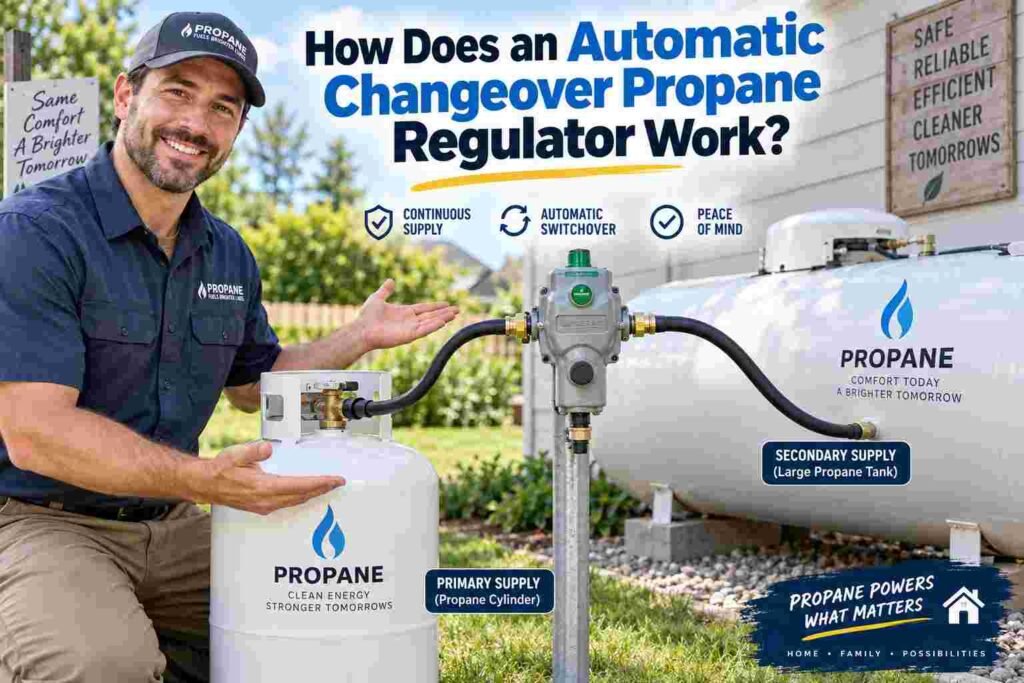
If you have ever wondered how an RV can keep the furnace running after one propane bottle empties, the automatic changeover regulator is the part that makes it possible. I like these regulators because they solve two problems at once: they help prevent an unexpected gas outage, and they give you a simple way to remove an empty cylinder without shutting down the entire propane system.
The important part is understanding that automatic changeover does not mean both cylinders are normally being emptied equally. In normal operation, one cylinder is designated as the service or primary cylinder. The second cylinder waits as the reserve. The regulator changes over only when the pressure on the service side drops enough to trigger the reserve side.
Automatic Changeover Propane Regulator: Technical Details
| Specification | Typical RV / Two-Cylinder Detail | Why It Matters |
|---|---|---|
| Regulator type | Two-stage automatic changeover | Combines cylinder switching with pressure reduction |
| Number of cylinder inlets | 2 | One service cylinder and one reserve cylinder |
| Typical RV outlet pressure | About 11 in. w.c. | Common low-pressure supply to RV appliances |
| 11 in. w.c. in PSI | About 0.397 psi | Shows how low final appliance pressure is |
| Maximum inlet pressure example | Up to 250 psi on Marshall Excelsior MEGR-253 series | The regulator must tolerate full cylinder vapor pressure |
| Primary capacity example | 225,000 BTU/hr on MEGR-253 | Must cover the connected appliance load |
| Reserve capacity example | 150,000 BTU/hr on MEGR-253 | Reserve capacity can be lower than primary capacity |
| Indicator | Typically green during normal service, red after changeover | Shows when the service cylinder needs attention |
How Does an Automatic Changeover Propane Regulator Work Step by Step?
I think the easiest way to understand the regulator is to follow the gas from the cylinders to the RV.
1. You Select the Service Cylinder
The regulator has a lever, knob, or pointer. I point it toward the cylinder I want to use first. That cylinder becomes the service cylinder, sometimes called the primary cylinder. The cylinder on the opposite side becomes the reserve.
On current Marshall Excelsior automatic changeover regulators, the arrow on the lever identifies the primary side. RegO uses a similar service/reserve concept with its indicator pointing toward the service cylinder.
2. Both Cylinder Valves Are Opened
For automatic changeover to work, both connected cylinders normally need to be available to the regulator. I open both valves slowly. The regulator then senses pressure from both sides but gives priority to the cylinder selected as the service side.
Opening cylinder valves slowly is important. RV cylinder connections may include excess-flow protection that can restrict flow if a valve is opened too quickly and the system suddenly sees a large pressure differential.


3. The Regulator Uses the Service Cylinder First
As long as the service cylinder can maintain enough pressure, the regulator continues drawing propane from it. The reserve cylinder stays available but is not normally the main source.
This is the advantage over simply teeing two cylinders together. A changeover regulator gives you a controlled service/reserve arrangement, so you know which bottle is being depleted first and which one is waiting in reserve.
4. The Service Cylinder Pressure Falls
As the service cylinder empties, its vapor pressure eventually falls below the regulator’s changeover threshold. At that point, the regulator’s internal mechanism allows the reserve side to begin supplying propane.
RegO’s 7525-series field guidance explains that the regulator is designed to switch internally from the service cylinder to the reserve cylinder without interrupting service when both cylinder valves are open. On that series, the indicator turns red when the service cylinder is effectively empty and the reserve cylinder is supplying gas.
5. The Reserve Cylinder Takes Over Automatically
The key word is automatically. I do not need to go outside in the middle of the night and manually move a valve just to keep the furnace running. The reserve side opens as the service side pressure falls, maintaining propane flow downstream.
Some designs can also allow the reserve cylinder to supplement the service cylinder during severe cold or unusually high demand. That can help prevent an outage when the selected cylinder cannot vaporize propane fast enough by itself.
6. The Indicator Changes Color
Once changeover occurs, the visual indicator lets me know the selected service cylinder needs attention. On many popular RV regulators, green means the selected service cylinder still has adequate pressure, while red means the regulator has switched to the reserve supply.
The red indicator does not mean the entire propane system is empty. In fact, one of the main benefits of the system is that you may still have propane flowing normally from the reserve cylinder when the indicator turns red.
7. You Move the Selector Before Removing the Empty Cylinder
This step is easy to overlook. When the original service cylinder is empty, I first move the selector toward the cylinder that is now supplying gas. That makes the reserve cylinder the new service cylinder.
Then I close the valve on the empty cylinder, disconnect it, refill or replace it, reconnect it, and slowly reopen its valve. The refilled cylinder now becomes the reserve.
Does an Automatic Changeover Regulator Use Both Tanks at the Same Time?
Under normal conditions, I would not describe it as a system that intentionally drains both cylinders evenly. One cylinder is designated for service and the other for reserve.
However, regulator design matters. Some automatic changeover models allow the reserve side to supplement the service side when demand is extreme or temperatures are very low. RegO specifically lists this as a feature of its 7525B series. That does not change the normal operating strategy: one side remains designated as service and the other as reserve.
| Situation | Service Cylinder | Reserve Cylinder |
|---|---|---|
| Normal operation | Main supply | Standing by |
| Service cylinder near empty | Pressure falls | Begins supplying automatically |
| After changeover | Needs refill/replacement | Supplies appliances |
| Extreme demand/cold on some designs | Continues supplying what it can | May supplement flow |
How Does the Regulator Reduce Propane Pressure?
Automatic changeover is only one function. Many RV automatic changeover regulators are also integral two-stage regulators.
The first stage takes high and temperature-dependent cylinder pressure and reduces it to an intermediate pressure. Marshall Excelsior describes its high-capacity MEGR-253H as reducing container pressure to roughly 10 to 15 psig in the first stage. The second stage then reduces that intermediate pressure down to approximately 11 inches of water column for the RV’s appliance piping.
If you want a deeper explanation of that pressure relationship, see my article on inlet pressure vs. outlet pressure on a propane regulator.
| Location | Typical Pressure | Purpose |
|---|---|---|
| Cylinder | Variable; depends strongly on temperature | Stores propane under vapor pressure |
| After first stage on some integral models | About 10–15 psig | Intermediate pressure reduction |
| Final RV regulator outlet | About 11 in. w.c. | Supplies low-pressure appliances |
| 11 in. w.c. converted to PSI | About 0.397 psi | Illustrates how low appliance pressure is |
You can also see my explanation of what 11 inches water column means for propane.
What Does the Green and Red Indicator Mean?
The indicator is there to tell me the status of the selected service cylinder. On many RV automatic changeover regulators, green means the service cylinder has adequate pressure. When that cylinder can no longer maintain the changeover pressure, the regulator shifts to the reserve side and the indicator changes toward red.
What I do not do is treat the color indicator as a precision tank-level gauge. It does not tell me that a cylinder is 50% full or 25% full. It is mainly a service-status indicator.
| Indicator Condition | What It Usually Means | What I Would Do |
|---|---|---|
| Green | Selected service cylinder is supplying normally | Continue normal use |
| Red | Service cylinder has dropped low enough that reserve is supplying | Move selector to the supplying cylinder, then refill/replace the empty one |
| Red immediately after setup | Possible closed valve, empty cylinder, blocked pigtail, excess-flow restriction, or regulator issue | Check the basic supply conditions before assuming the regulator is bad |
How Much BTU Capacity Does an Automatic Changeover Regulator Need?
I size an automatic changeover regulator the same basic way I size other propane regulators: I add the input ratings of the appliances that may operate at the same time and make sure the regulator can deliver that load under the expected pressure conditions.
One detail that matters with changeover regulators is that reserve-side capacity can be lower than primary-side capacity. Marshall Excelsior’s current recreational automatic-changeover catalog gives a good example.
| Model | Primary Capacity | Reserve Capacity | Outlet |
|---|---|---|---|
| MEGR-253L | 150,000 BTU/hr | 100,000 BTU/hr | 11 in. w.c. |
| MEGR-253 | 225,000 BTU/hr | 150,000 BTU/hr | 11 in. w.c. |
| MEGR-253H | 350,000 BTU/hr | 200,000 BTU/hr | 11 in. w.c. |
That means I would not choose a regulator solely because its primary rating is higher than the RV’s connected load. I also want enough reserve-side capacity for the furnace, water heater, refrigerator, range, and any other propane appliances that may run after changeover.
For the full sizing process, see how to calculate the BTU capacity needed for a propane regulator.
Why Automatic Changeover Regulators Are Common on RVs
They are especially useful on travel trailers and fifth wheels because those RVs often carry two removable DOT cylinders. If I had a manual system, one cylinder could run empty at 2 a.m. and the furnace would stop until I went outside and manually changed over to the second bottle.
With an automatic system, the reserve bottle takes over. That gives me time to refill the empty bottle without interrupting normal propane service.
Automatic changeover also makes propane management easier because I can intentionally run one cylinder down before refilling it. I do not have to guess which bottle is partially used if I keep the selector positioned consistently.
Why Must the Regulator Vent Face Downward?
The regulator diaphragm needs atmospheric reference through its vent. Water, dirt, insects, snow, or ice can interfere with that vent if the regulator is installed improperly.
That is why current manufacturer instructions emphasize mounting the regulator so its vent points downward or in the orientation specified for the model. I would not rotate an RV regulator simply because it makes the hoses fit more conveniently.
A blocked vent can contribute to poor pressure regulation, erratic operation, icing, or unsafe behavior. If you are already having cold-weather problems, see why an RV propane regulator keeps freezing.
Common Automatic Changeover Regulator Problems
| Symptom | Possible Cause | What It Means |
|---|---|---|
| Indicator stays red with full cylinders | Closed valve, excess-flow restriction, bad pigtail, selector issue, regulator fault | Selected side may not be reaching the regulator correctly |
| No automatic changeover | Reserve valve closed, blocked hose, regulator failure | Reserve supply is unavailable or mechanism is not switching |
| Weak flames after changeover | Reserve capacity too low, cold cylinder, restriction, droop | Reserve side may not support full load |
| Propane smell or hissing | Loose fitting, leaking pigtail, vent leak, damaged regulator | Treat as a possible leak and shut down safely |
| Switches too early | Cold-weather vaporization limits, low cylinder pressure, restriction, faulty regulator | Service side pressure is falling before the cylinder is physically empty |
If you are troubleshooting a suspected failure, my article on how to know when an RV propane regulator is bad walks through the pressure and appliance clues.
Can I Replace an Automatic Changeover Regulator with a Manual Regulator?
Technically, some propane systems can be configured with manual changeover hardware, but I would not casually replace an RV automatic-changeover regulator with a different style just because the fittings seem compatible. The replacement needs the correct inlet arrangement, outlet pressure, BTU capacity, relief characteristics, listing, mounting orientation, and connection sizes for the RV.
For most two-cylinder RVs, replacing a failed automatic changeover regulator with another properly sized two-stage automatic-changeover regulator is the simplest way to preserve the original operating logic.
Can I Run an Automatic Changeover Regulator with Only One Cylinder Connected?
Some RV owners temporarily operate with one cylinder, but I would follow the regulator and RV manufacturer’s instructions before doing so. An unused inlet must not be left as an open path for propane to escape, and a missing reserve cylinder obviously removes the automatic backup function.
If the system was designed as a two-cylinder changeover installation, I prefer keeping both sides correctly connected and leak-tested.
How Do I Know Which Cylinder Is Being Used?
I look at two things: the direction of the selector and the status indicator. The selector identifies the service side. If the indicator is green, that selected side is normally still supplying. If it has turned red, the regulator has generally transferred supply to the opposite cylinder and the selected cylinder needs attention.
This is why I do not immediately rotate the selector every time I look at the regulator. The pointer is part of the service/reserve management system. I change its position as part of the proper cylinder-replacement sequence.
Does Automatic Changeover Mean I Never Have to Check My Propane?
No. The system prevents many sudden outages, but it can also make it easy to forget that the reserve cylinder is now doing all the work. If I never check the indicator, I can eventually empty both cylinders.
I make a habit of checking the regulator indicator whenever I inspect the RV propane compartment or before a trip. If it has changed to red, I deal with the empty service bottle before the reserve bottle is also depleted.
Frequently Asked Questions
Does an automatic propane regulator switch tanks by itself?
Yes. With both cylinder valves open and the regulator set up correctly, it automatically changes supply from the selected service cylinder to the reserve cylinder when service-side pressure falls below its operating threshold.
Do I need to turn the selector after it automatically changes over?
Yes, as part of the cylinder-change procedure. The regulator has already begun using the reserve cylinder, but moving the selector toward that cylinder designates it as the new service cylinder before you disconnect the empty one.
Why is my indicator red if I still have propane?
Because the red indication generally means the selected service cylinder has gone low enough for the regulator to switch to the reserve cylinder. You may still have plenty of propane in the reserve bottle.
Should both propane tank valves be open?
Normally yes for true automatic changeover operation, because the regulator needs access to the reserve cylinder when the service side becomes depleted. Follow the instructions for your specific regulator and RV.
What pressure should an RV automatic changeover regulator deliver?
Many common RV two-stage changeover regulators are set to about 11 inches of water column at the outlet. Always confirm the regulator specification and the RV appliance requirements rather than assuming every system is identical.
Can the reserve cylinder have less BTU capacity than the primary side?
Yes. Manufacturer data can list different primary and reserve capacities. That is why I compare the RV’s expected appliance load against both ratings when selecting a regulator.
Can cold weather cause early changeover?
Yes. A cylinder can still contain liquid propane while its available vapor pressure and vaporization rate become too low to support a heavy load. That pressure drop can cause the regulator to bring the reserve side into service before the first cylinder is physically bone-dry.
Why does my automatic changeover regulator hiss?
A brief sound during pressure equalization can occur, but persistent hissing or propane odor should be treated as a possible leak. See my guide on why an RV propane regulator may be leaking.
My Bottom Line
An automatic changeover propane regulator is basically a smart two-cylinder supply manager combined, in many RV applications, with two-stage pressure regulation. I select one cylinder as the service bottle and leave the other available as reserve. The regulator uses the service side first, monitors the pressure available from that side, and automatically opens the reserve supply when the service cylinder can no longer maintain the required pressure.
The color indicator is what tells me that changeover has occurred. I then make the cylinder that is currently supplying gas the new service side, remove and refill the empty cylinder, reconnect it as the reserve, and leak-test the connection according to the manufacturer’s procedure.
The system is convenient, but it still has to be sized and installed correctly. Outlet pressure, primary and reserve BTU capacity, vent orientation, pigtail condition, cylinder valves, and leak-free fittings all matter. If the regulator will not change over properly, will not hold pressure, leaks from the vent, or causes repeated appliance problems, I recommend having a qualified RV or LP-gas technician diagnose it rather than adjusting internal settings by trial and error.
Technical Sources
I based the technical operating details in this article on current manufacturer documentation, including Marshall Excelsior automatic changeover regulator information, the current MEGR-253 recreational regulator specifications, and RegO automatic changeover operating guidance.

Mike is an experienced propane technician with over 15 years of professional experience in the field. He has dedicated his career to helping customers with their propane needs, from installation to maintenance and repair. Together with Jeremy, he co-founded this website to provide useful information and guidance to customers seeking reliable propane services.


