
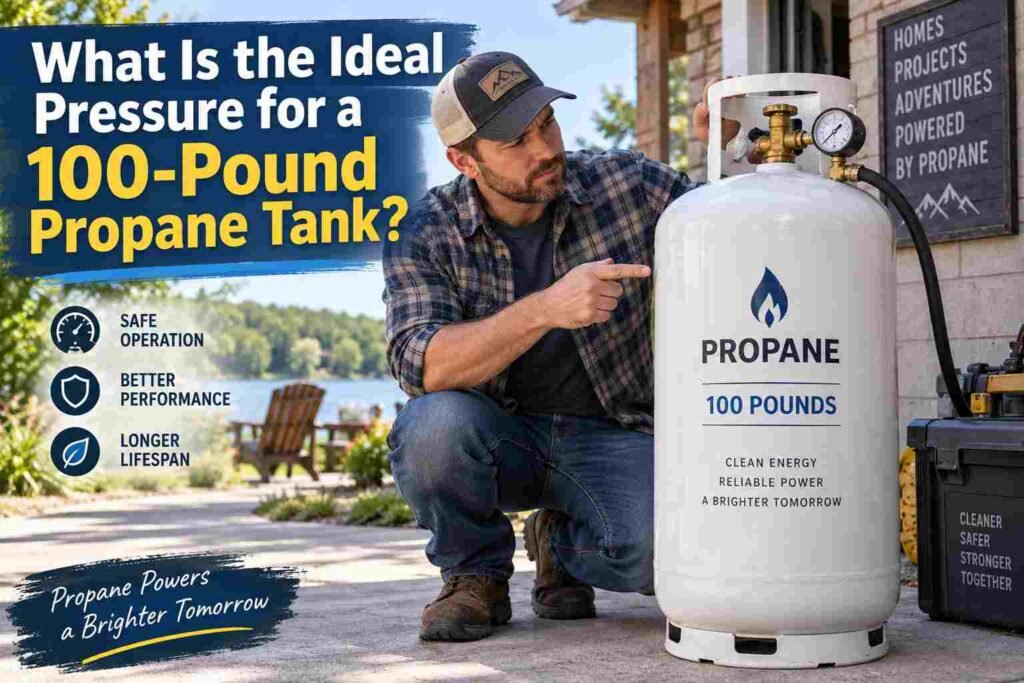
When someone asks me, “What is the ideal pressure for a 100-pound propane tank?” I first separate two completely different pressures: pressure inside the cylinder and pressure after the regulator.
The cylinder pressure is not something I set with a screw or valve. If the cylinder contains liquid propane with vapor space above it, the internal pressure is mainly controlled by the temperature and composition of the propane. As the propane gets warmer, vapor pressure rises. As it gets colder, vapor pressure falls.
The regulator is what turns that changing cylinder pressure into a much lower, controlled pressure for the appliance system. That is why a cylinder can be at well over 100 psi while the appliance line may be operating at less than half of one psi.

100-Pound Propane Tank Pressure: Technical Details
| Item | Typical Value or Condition | What It Means |
|---|---|---|
| Cylinder size | 100 lb propane capacity | DOT cylinder commonly used for homes, cabins, mobile applications, and standby loads |
| Cylinder vapor pressure | Varies with propane temperature | Not a single fixed “ideal” PSI |
| Approximate pressure near 70°F | Roughly 100–120+ psig, depending on propane composition/reference data | Normal vapor-pressure range, not appliance pressure |
| Common low-pressure appliance supply | About 11 in. w.c. | About 0.397 psi or 2.74 kPa |
| Common integral two-stage regulator range | Often 9–13 in. w.c. adjustable range on selected models | Exact appliance/system specification controls |
| Example RegO 100-lb-cylinder regulator class | LV404B family, 11 in. w.c. factory outlet | Designed for small ASME tanks and 100–420 lb DOT cylinders |
Why a 100-Pound Propane Tank Does Not Have One Ideal PSI
Propane is stored as both liquid and vapor inside the cylinder. The vapor above the liquid creates pressure. When you draw propane vapor from the cylinder, more liquid propane boils to replace the vapor that leaves. That process helps the cylinder restore its equilibrium pressure, provided there is enough heat available for vaporization.
This means the pressure depends strongly on temperature. PERC explains that propane tank pressure varies with temperature, and gives roughly 109–120 psig around 70°F for HD-5 propane depending on the exact composition and reference point. RegO’s current LP-Gas catalog likewise shows tank pressure around 120 psig at 70°F, about 140 psig at 80°F, and around 165 psig at 90°F in one of its propane examples.
So if I see a 100-pound cylinder at 70°F and the pressure is around 110 or 120 psi, I do not try to “correct” it to 50 psi or 100 psi. That pressure is simply a physical result of the propane temperature.
Approximate Propane Cylinder Pressure by Temperature
The following table is a practical approximation compiled from propane-industry vapor-pressure charts. Exact pressure varies with fuel composition and the actual liquid temperature, so I use it as a reference—not as a pass/fail test by itself.


| Propane Temperature | Approximate Cylinder Pressure | What I Expect |
|---|---|---|
| 0°F (-18°C) | About 24–28 psig | Low pressure due to very cold propane |
| 20°F (-7°C) | About 40–47 psig | Cold-weather pressure |
| 40°F (4°C) | About 63–72 psig | Normal for cool propane |
| 60°F (16°C) | About 92–102 psig | Common mild-weather range |
| 70°F (21°C) | About 109–127 psig | Typical warm-weather vapor pressure |
| 80°F (27°C) | About 128–140 psig | Pressure continues to rise with temperature |
| 90°F (32°C) | About 149–165 psig | Normal hot-weather increase |
| 100°F (38°C) | About 170–196 psig | High vapor pressure caused by hot propane |
The ranges above are intentionally approximate. Different industry charts use slightly different propane mixtures and test bases. PERC notes that pressure can vary with fuel mixture, while RegO and Marshall Excelsior charts show the same basic relationship: warmer propane means higher tank pressure.
Does a 100-Pound Tank Have Higher Pressure Than a 20-Pound Tank?
No—not simply because it is larger. If a 20-pound cylinder and a 100-pound cylinder contain the same propane mixture and both are at the same liquid temperature, their vapor pressures are approximately the same.
The 100-pound cylinder holds more propane and has more wetted surface area, so it can usually support a larger continuous vapor load. But the static vapor pressure comes primarily from temperature and propane composition, not cylinder capacity.
This is an important distinction. A bigger tank does not automatically mean more PSI. It usually means more fuel storage and better vaporization capability.
What Pressure Should Come Out of a 100-Pound Propane Tank Regulator?
For many homes, cabins, heaters, ranges, water heaters, and other ordinary low-pressure LP-gas systems, I expect the final regulated supply to be around 11 inches water column. That equals only about 0.397 psi.

RegO’s current LV404B compact twin-stage regulator family is specifically described for small ASME tanks and 100- to 420-pound DOT cylinders. Those models reduce full container pressure to an 11-inch-water-column delivery pressure. The listed adjustment range on selected models is 9 to 13 inches w.c., with a factory delivery setting of 11 inches w.c. at 100 psig inlet.
That does not mean I recommend adjusting a regulator yourself. The actual pressure must match the appliance and system design, and regulator adjustment should be handled according to the manufacturer instructions by a qualified propane professional.
Tank Pressure vs. Regulator Pressure: Do Not Confuse Them
I treat the pressure before and after the regulator as two completely different parts of the system. The cylinder may be at 120 psig on a mild day, but an appliance may need only 11 inches w.c. The regulator safely reduces and controls that pressure.
| Location in System | Pressure Example | Purpose |
|---|---|---|
| Inside 100-lb cylinder | Temperature-dependent; often over 100 psig in mild/warm weather | Stores propane as liquid and vapor |
| After first-stage regulator in a two-stage system | Often around 10 psig | Intermediate distribution pressure |
| After integral two-stage regulator | Commonly about 11 in. w.c. (0.397 psi) | Feeds low-pressure appliance piping |
| Appliance manifold | Manufacturer-specific | Controls burner input at the appliance |
If you want a deeper explanation of these pressure stages, see my guide on inlet pressure vs. outlet pressure on a propane regulator.


Why Does Pressure Drop When the Weather Gets Cold?
Cold propane produces less vapor pressure. That is normal physics, but there is another effect that matters in real use: vaporization itself cools the liquid propane.
When you draw vapor from the cylinder, liquid propane must boil to replace it. Boiling requires heat. The cylinder pulls heat from the surrounding air through the steel wall, but if gas demand is high and the weather is cold, the liquid can cool faster than heat enters the cylinder. The vapor pressure then drops even more.
This is why a 100-pound cylinder that works fine in mild weather may struggle to supply a large furnace, tankless heater, generator, or several appliances at once during very cold weather.
How Much Propane Can a 100-Pound Cylinder Vaporize?
RegO’s current LP-Gas Serviceman’s Manual includes a vaporization chart for 100-pound cylinders. The exact capacity depends on both temperature and how much propane remains in the cylinder. A full cylinder has more wetted surface area than a nearly empty one and can usually vaporize propane faster.
| Propane Remaining in Cylinder | 0°F | 20°F | 40°F | 60°F | 70°F |
|---|---|---|---|---|---|
| 100 lb | 113,000 BTU/hr | 167,000 | 214,000 | 277,000 | 300,000 |
| 50 lb | 64,000 BTU/hr | 94,000 | 125,000 | 154,000 | 167,000 |
| 20 lb | 36,000 BTU/hr | 51,000 | 68,000 | 83,000 | 92,000 |
Those numbers explain why I do not diagnose a winter fuel problem from static PSI alone. A cylinder may still contain propane, but it may not be able to vaporize gas fast enough for the connected load.
RegO also provides a conservative rule of thumb for continuous service where temperature can reach 0°F: assume roughly 50,000 BTU/hr per 100-pound cylinder when planning multi-cylinder installations. That rule deliberately leaves margin for changing fill level and real operating conditions.
Does Low Tank Pressure Mean My 100-Pound Cylinder Is Empty?
Not necessarily. Low pressure can simply mean the propane is cold. This is why I do not use a high-pressure tank gauge as a reliable fuel-level gauge.
As long as liquid propane remains in the cylinder, vapor pressure is primarily controlled by temperature. A nearly full cylinder and a nearly empty cylinder can show similar static pressure if both contain liquid propane at the same temperature.
Pressure begins to behave more like a simple gas-volume reading only after the liquid propane is gone and the cylinder contains vapor alone. By that point, the useful liquid fuel reserve is essentially exhausted.
If you need to know how much propane remains, I prefer a method intended to measure quantity—such as weighing the cylinder or using an appropriate level-measuring device—rather than trying to estimate fuel percentage from PSI.
What If the Tank Has 100 PSI?
A reading around 100 psig can be completely normal. In fact, pure-propane vapor-pressure tables place roughly 100 psi in the neighborhood of the low-to-mid 60s°F, depending on the fuel mixture and chart.
I would not call 100 psi “too low” or “too high” without knowing the propane temperature. At 70°F it might be somewhat lower than one reference chart expects, while at 60–65°F it may be right where I expect it. Temperature must be part of the diagnosis.
Is 120 PSI Normal for a 100-Pound Propane Tank?
Yes, around mild room-temperature conditions it can be entirely normal. RegO gives a 70°F tank-pressure example of approximately 120 psig. PERC’s HD-5 discussion places 70°F vapor pressure approximately in the 109–120 psig area, depending on mixture.
Again, that is pressure inside the cylinder. It is not the pressure I want at the furnace, range, or water heater.
Is 150 PSI Too High?
Not automatically. A propane cylinder in warm weather can naturally reach around 150 psi or more. Industry vapor-pressure charts put propane in roughly the 150–165 psig range around 90°F.
What matters is whether the cylinder is approved, in good condition, properly filled, kept upright, and not exposed to abnormal heat. I never recommend cooling, venting, or manipulating a cylinder just to force its vapor pressure to a chosen PSI.
If a cylinder appears swollen, damaged, severely corroded, leaking, or exposed to fire or excessive heat, I treat that as a safety issue and contact the propane supplier or emergency services rather than trying to diagnose it by gauge reading.
What Regulator Pressure Is Ideal for a 100-Pound Propane Cylinder?
For many low-pressure domestic applications, the answer is about 11 inches water column after the final regulator. That is the pressure range I see on many propane furnaces, ranges, water heaters, fireplaces, and similar systems.
RegO specifically lists its LV404B compact twin-stage regulators for 100- to 420-pound DOT cylinders. Those regulators are designed to reduce full container pressure to an 11-inch-water-column delivery pressure, with selected models providing up to 450,000 BTU/hr of propane vapor capacity under their published rating conditions.
| Example Regulator Detail | RegO LV404B Series Example |
|---|---|
| Application | Small ASME tanks and 100–420 lb DOT cylinders |
| Factory outlet pressure | 11 in. w.c. at 100 psig inlet |
| Adjustment range | 9–13 in. w.c. |
| Published vapor capacity | 450,000 BTU/hr on selected compact models |
| Outlet connection | 1/2 in. FNPT on selected models |
The exact regulator still needs to match the appliance load, connections, pipe size, and local code requirements. If you are choosing a regulator for a 100-pound cylinder, see my detailed guide on how to know which propane regulator you need.
How Do I Know If the Regulated Pressure Is Too Low?
I look at how the system behaves under load, not just at a no-flow reading. Possible low-pressure symptoms include weak burner flames, a furnace that starts and then shuts down, multiple appliances losing performance at the same time, or pressure that drops sharply when another appliance turns on.
Low regulated pressure can come from several causes besides the regulator itself: cold-weather vaporization limits, an undersized cylinder bank, a kinked pigtail, excess-flow restriction, undersized piping, low inlet pressure, contamination, or a regulator that is too small for the load.
If the problem appears only when demand increases, I would also consider regulator droop and system pressure drop.
How Do I Know If the Regulated Pressure Is Too High?
High downstream pressure is more serious. Signs can include unusually large flames, yellow flames, soot, roaring burners, pilot instability, or appliance behavior that changes across several propane appliances.
I do not recommend adjusting the regulator by trial and error. A qualified technician should verify outlet pressure with the proper instrument, check lock-up pressure, confirm the regulator model and set point, and inspect the piping and appliance regulators if applicable.
My guide on checking propane regulator pressure explains the difference between tank-side pressure measurements and low-pressure manometer readings.
Can I Check a 100-Pound Propane Tank With a Pressure Gauge?
Yes, a suitable high-pressure gauge can measure container-side pressure, but I do not consider that a good DIY method for deciding how much propane is left or whether the tank is “set correctly.” The gauge and fittings must be rated for propane service and the pressure involved.
Low-pressure appliance-side testing uses a completely different instrument range. A water-column manometer that is appropriate for checking an 11-inch-w.c. outlet is not the tool I would use on the high-pressure cylinder side.
This difference is important: the cylinder side may be over 100 psi while the final appliance side may be less than 0.4 psi.
Does Fill Level Change the Pressure?
As long as liquid propane remains and the cylinder is at thermal equilibrium, static vapor pressure does not change much simply because the cylinder goes from full to half full. Temperature has a much bigger effect on static pressure.
What fill level changes dramatically is vaporization capacity. A fuller cylinder has more liquid touching the steel wall, giving it more surface area through which it can absorb heat. As the fuel level falls, the maximum continuous BTU/hr the cylinder can vaporize also falls.
That is why a nearly empty 100-pound cylinder may run a small stove but struggle with a large furnace on a cold night even though a pressure gauge still shows propane pressure.
Should I Ever Try to Increase Tank Pressure?
No. I do not recommend heating a propane cylinder, placing it near a fire, using a heat gun, pouring hot water over it, wrapping it with an unapproved heater, or otherwise trying to raise pressure manually.
If a cylinder cannot supply enough vapor in cold weather, the proper solution is usually system design: more cylinder capacity, multiple approved cylinders manifolded correctly, lower peak demand, suitable piping, or a larger storage container selected by a propane professional.
Frequently Asked Questions
What PSI should a 100-pound propane tank have at 70°F?
I expect roughly around 100–120+ psig depending on the propane mixture and reference chart. PERC discusses approximately 109–120 psig at 70°F, while RegO gives a 120-psig example.
What PSI should a 100-pound propane tank have in winter?
There is no single winter PSI. Around 20°F, propane vapor-pressure references are roughly in the 40–47 psig range; near 0°F, roughly 24–28 psig is plausible. Under heavy load, the cylinder can cool further and pressure can fall more.
Is 11 PSI correct for a 100-pound propane tank?
Not as normal cylinder vapor pressure in typical mild weather. You may be confusing PSI with inches of water column. Many low-pressure propane systems use about 11 inches w.c., which is only about 0.397 psi.
Should a 100-pound propane tank be regulated?
Yes, when it supplies equipment that requires regulated propane pressure. The regulator must match the appliance pressure, total BTU load, inlet pressure, connections, and system design.
Can a 100-pound cylinder run a whole house?
It can supply some residential loads, but whether one cylinder is enough depends on total BTU demand, outdoor temperature, fill level, and duration of use. RegO’s vaporization data shows a full 100-pound cylinder at 0°F can provide far less continuous BTU/hr than the same cylinder at 70°F.
Why does my 100-pound propane tank frost up?
Frost can form because vaporization removes heat from the liquid propane and cools the cylinder wall. Heavy demand, cold weather, and a falling liquid level make this more likely. Frost does not automatically mean the tank pressure is “wrong,” but repeated loss of flow means the system should be evaluated.
Bottom Line: What Is the Ideal Pressure for a 100-Pound Propane Tank?
There is no single ideal internal pressure for a 100-pound propane cylinder. The tank pressure should naturally follow the propane temperature. Around 70°F, roughly 100–120+ psig can be normal; around 20°F, pressure may be only around 40–47 psig; and in hot weather it can climb well above 150 psig.
The pressure I care most about for appliances is the regulated outlet pressure. In many low-pressure domestic systems using a 100-pound cylinder, that is approximately 11 inches water column, or 0.397 psi. The exact appliance and regulator specifications always take priority.
Technical Sources

Mike is an experienced propane technician with over 15 years of professional experience in the field. He has dedicated his career to helping customers with their propane needs, from installation to maintenance and repair. Together with Jeremy, he co-founded this website to provide useful information and guidance to customers seeking reliable propane services.


