
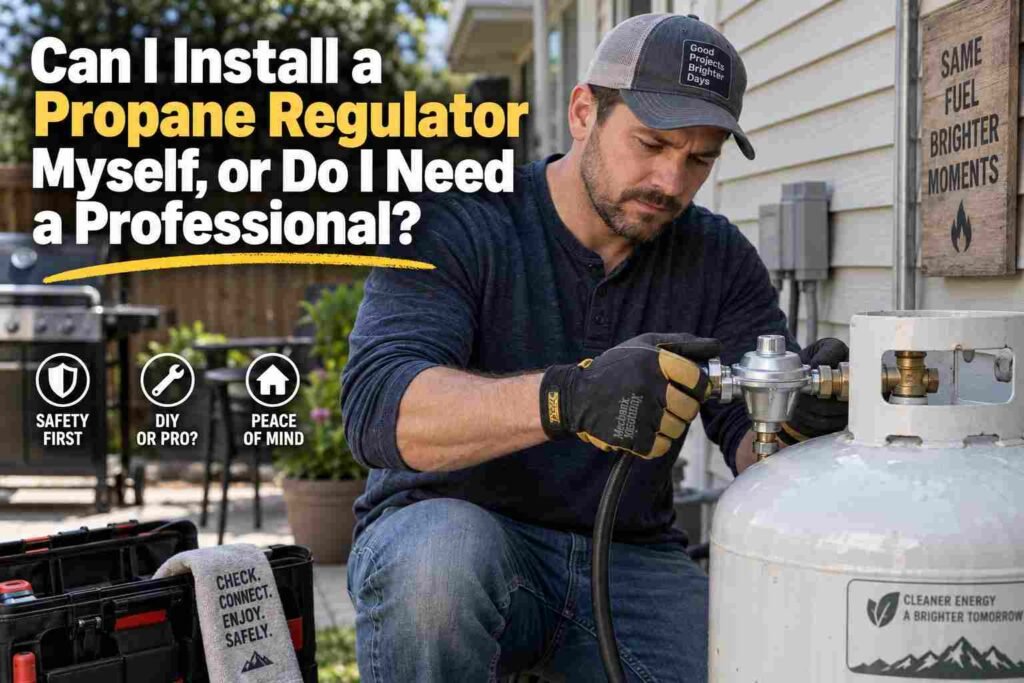
If you are asking, “Can I install a propane regulator myself, or do I need a professional?” my answer depends on what you mean by installation.
There is a big difference between screwing a factory-made regulator-and-hose assembly onto a portable grill exactly as the appliance manual instructs and replacing a regulator in a residential, RV, mobile-home, generator, or hard-piped propane system.
Once the work involves selecting the regulator, changing pipe fittings, matching inlet and outlet pressure, sizing for BTU demand, positioning the vent, performing a pressure test, checking lock-up, or leak-testing the completed system, I treat it as professional propane work.

Propane Regulator Installation: Technical Overview
| Installation Situation | DIY or Professional? | Why |
|---|---|---|
| Factory grill hose/regulator assembly replaced exactly per appliance manual | Manufacturer instructions control | No field pressure adjustment or hard-piping modification should be involved |
| RV main two-stage regulator | Professional recommended | Correct pressure, vent orientation, pigtails, leak test, and system pressure test matter |
| 100-lb cylinder feeding a house/cabin | Professional | Regulator capacity, connections, piping, venting, and appliance pressure must all be correct |
| Residential first-stage regulator | Professional | High inlet pressure and downstream pressure control are involved |
| Residential second-stage regulator | Professional | Final appliance pressure must be verified under load |
| 2-PSI system or line regulator | Professional | Multiple pressure stages and downstream regulation must be coordinated |
| High-pressure commercial/industrial regulator | Professional | Higher pressures and overpressure protection create greater consequences if installed incorrectly |
Why I Do Not Treat a Propane Regulator Like an Ordinary Plumbing Part
A propane regulator is a safety-critical pressure-control device. It has to do much more than “fit the pipe.”
The regulator must accept the available inlet pressure, deliver the correct outlet pressure, carry the connected BTU load, remain stable under changing demand, lock up safely when appliances stop drawing gas, vent correctly, and work with the surrounding piping and relief system.
That means two regulators with the same thread size can still be completely incompatible.
For example, a first-stage regulator may reduce tank pressure to around 10 psig. A second-stage regulator may reduce that to around 11 inches water column. A 2-PSI regulator may intentionally feed 2 psig into a distribution system that has additional line regulators downstream. A high-pressure burner regulator may operate at several PSI or more.


Those are not interchangeable just because the fittings happen to match.
What Current Propane Safety Guidance Says
PERC’s current consumer safety booklet says certain propane-system tasks should be handled by a qualified professional. Its examples include work on gas distribution systems, tanks, cylinders, piping, system components, appliance connectors, and propane appliances.
RegO’s current safety literature points to NFPA 58 training requirements for personnel whose duties fall within the scope of the LP-Gas Code. The emphasis is on training that matches the person’s work and includes proper handling and emergency-response procedures.
Fisher/Emerson regulator manuals likewise state that only qualified personnel should install or service regulators and that installation must follow applicable codes, regulations, and the manufacturer’s instructions.
For me, that makes the practical decision easy: if the job involves the propane distribution system itself, I use a qualified installer.

Can I Install a Propane Regulator Myself on a Grill?
A portable grill is the closest thing to an exception, but I am careful with the wording.
If the grill manufacturer sells a complete listed replacement hose/regulator assembly and the owner’s manual specifically tells you how to connect that assembly to the cylinder and appliance, following that exact consumer procedure is different from field-installing a separate regulator into a gas piping system.
I do not mix brands or improvise a regulator just because the connector fits. I match the appliance manufacturer’s required pressure and replacement part specification.
I also do not remove a fixed regulator from a grill manifold, change orifices, add adapters to create a different pressure system, or install a generic adjustable high-pressure regulator on an appliance designed for low-pressure propane.


Can I Replace an RV Propane Regulator Myself?
An RV main regulator looks simple, but I treat it as system work.
Most conventional RV propane systems use a two-stage regulator delivering about 11 inches water column to the appliance manifold. Dual-cylinder travel trailers and fifth wheels often use an automatic-changeover two-stage regulator.
A correct replacement has to match:
- outlet pressure;
- BTU capacity;
- inlet and outlet connection types;
- pigtail arrangement;
- automatic-changeover design if used;
- mounting position;
- vent orientation;
- system leak and pressure-test requirements.
That is why I recommend professional installation for the RV main regulator. A regulator can appear to work and still have an unsafe leak, incorrect lock-up pressure, or wrong vent orientation.
If you are selecting an RV regulator, see my guide on what type of propane regulator an RV needs.
Can I Install a Regulator on a 100-Pound Propane Cylinder?
If the 100-pound cylinder is feeding a fixed heater, cabin, home, generator, or multiple appliances, I consider that a propane-system installation and use a qualified professional.
RegO currently lists compact twin-stage regulators specifically for 100- to 420-pound DOT cylinders, but choosing the right model still requires more than matching the cylinder size. The installer has to account for BTU demand, outlet pressure, connection type, piping length and diameter, winter vaporization limits, and appliance requirements.
You can read more about those sizing factors in how to know which propane regulator you need.
Why Correct Regulator Pressure Matters
One of the biggest risks in DIY regulator installation is installing the wrong pressure class.
| Pressure | Approximate Equivalent | Typical Context |
|---|---|---|
| 11 in. w.c. | 0.397 psi / 2.74 kPa | Many residential and RV low-pressure systems |
| 2 psi | 55.4 in. w.c. | 2-PSI distribution before line regulators |
| 10 psi | 276.8 in. w.c. | Common first-stage outlet example |
That table is why I do not treat “10 psi” and “11 inches water column” as nearly the same thing. Ten psi is roughly 25 times higher than 11 inches water column.
What a Qualified Installer Checks Before Installing the Regulator
A professional installation starts before a wrench ever touches the piping. I expect the installer to verify the application and regulator specifications first.
That includes the regulator’s maximum inlet pressure, required outlet pressure, BTU capacity, connection sizes, flow direction, venting requirements, and whether the system needs first-stage, second-stage, integral two-stage, automatic-changeover, or 2-PSI regulation.
| Professional Check | Why It Matters |
|---|---|
| Connected appliance BTU load | Determines required regulator and piping capacity |
| Minimum expected inlet pressure | Regulator capacity changes as inlet pressure changes |
| Required outlet pressure | Must match downstream regulator/appliance specifications |
| Pipe size and length | Prevents excessive pressure drop under load |
| Regulator vent location | Vent must remain unobstructed and protected from weather |
| Regulator flow direction | Many regulators are directional and must be installed correctly |
| Fittings and piping condition | Corroded, cracked, or mismatched fittings can leak |
| Overpressure protection | Some regulator arrangements require additional relief or pressure-limiting protection |
Why Vent Orientation Is a Professional Installation Issue
The regulator vent is not just a little hole in the housing. The diaphragm uses atmospheric pressure on the vented side to control outlet pressure.
RegO’s current installation guidance says regulators exposed to weather should have the vent facing vertically downward when they are not installed under a protective cover. RegO also recommends mounting second-stage regulators above expected snow accumulation.
Fisher similarly says the spring-case vent must remain unobstructed and that outdoor regulators should be positioned so water, ice, and foreign material cannot enter.
That means I do not install a regulator in whatever orientation makes the pipe fitting easiest. Vent position is part of the installation design.
Why Pipe Fittings Matter More Than They Look
One of the easiest DIY mistakes is overtightening or using the wrong sealing method.
RegO warns that bad piping connections can result from loose joints or excessive wrenching that stresses or cracks the regulator body. It also cautions against using too much pipe sealant because excess material can move downstream and interfere with regulator operation.
I also remember that not every connection is sealed the same way. Tapered pipe threads, flare fittings, POL connections, Type 1/QCC cylinder connectors, and other propane fittings each have their own sealing method and torque requirements.
I do not add thread sealant to a fitting simply because I see threads. Some propane connections seal on a flare or gasket rather than on the threads themselves.
Why a Leak Test Is Required After Installation
A regulator can be perfectly sized and still be dangerous if one joint leaks.
RegO says regulator connections should be leak-tested at installation. PERC’s training framework also treats testing gas piping and leak checks as separate required competencies in propane-system installation.
A professional does not stop once the regulator is physically attached. The completed system has to be checked for leakage before normal use.
I avoid treating a quick sniff test as sufficient. Propane odorant is an important warning system, but a pressure/leak test verifies the integrity of the installation rather than waiting for a leak to become obvious.
Why Pressure Testing Matters After a Regulator Is Installed
The regulator’s outlet pressure has to be verified under the conditions specified by the manufacturer.
For many low-pressure residential and RV systems, the final delivery pressure is around 11 inches water column. But I do not assume that number applies to every installation.
A qualified technician may check:
- inlet pressure;
- flowing outlet pressure;
- full-load performance;
- lock-up pressure;
- regulator creep;
- system pressure drop.
RegO’s service guidance recommends checking delivery pressure with a meaningful appliance load operating and then verifying full-load performance. It also checks lock-up after appliance flow stops.
That is more than “turn the gas on and see if the stove lights.”
What Is Lock-Up Pressure, and Why Should an Installer Check It?
When downstream demand stops, the regulator valve closes and outlet pressure rises slightly. That is normal lock-up.
RegO’s general service guidance says lock-up pressure should not exceed 130% of the set delivery pressure. For an 11-inch-water-column set point, 130% is about 14.3 inches water column.
| Set Pressure | 130% Lock-Up Example |
|---|---|
| 10 in. w.c. | 13.0 in. w.c. |
| 11 in. w.c. | 14.3 in. w.c. |
| 12 in. w.c. | 15.6 in. w.c. |
If pressure keeps creeping upward rather than stabilizing, that can indicate dirt, seat damage, or internal regulator failure. A DIY installer who checks only whether gas flows can miss that problem.
Do Local Codes Require a Professional?
Licensing, permitting, and inspection rules vary by state, county, municipality, and application, so I do not make a blanket statement that the same license is required everywhere.
What is consistent is that propane work has to comply with applicable codes and manufacturer instructions. RegO’s current safety literature cites NFPA 58 personnel-qualification requirements, and Fisher says regulator installation and service should be performed by qualified personnel in accordance with applicable codes and regulations.
Some jurisdictions may require a permit, inspection, licensed gas fitter, licensed plumber, propane technician, or other credential for certain installations. Your propane supplier will usually know the local rules.
Does Homeowners Insurance Care Who Installed the Regulator?
Insurance requirements vary by policy, but I would not assume an insurer will treat undocumented DIY fuel-gas work the same way it treats a permitted professional installation.
If a fire, explosion, or carbon-monoxide incident occurs, investigators may look at whether the fuel system was installed according to code and manufacturer instructions.
For a permanent home system, I consider documentation, permits, and a professional invoice part of the value of professional installation—not just the labor itself.
What About a Propane Generator Regulator?
Generator systems deserve extra caution because the regulator has to match the generator manufacturer’s required pressure and maximum fuel demand.
A standby generator can draw a large amount of propane at full electrical load. The regulator and piping may appear adequate when the generator is idling but fail when the engine reaches peak fuel demand.
I do not install a generic regulator based only on the generator’s connector size. I verify the generator input pressure range, BTU demand, line length, tank vaporization, and regulator performance.
What About Multiple Appliances on One Regulator?
One regulator can serve multiple appliances if it is properly sized and all downstream appliances are compatible with the same pressure.
The installer adds the appliance input ratings, checks regulator performance at the minimum expected inlet pressure, and sizes each pipe section for the load it carries.
If you are expanding an existing system, see whether one propane regulator can serve multiple appliances.
Can I Save Money by Installing the Regulator Myself?
You may save the labor charge, but that is not the whole cost equation.
A professional installation price covers more than physically screwing in the regulator. You are paying for correct regulator selection, safe shutdown, proper fittings, vent orientation, leak testing, pressure verification, system startup, and responsibility for the work.
As I explain in my guide on propane regulator replacement cost, the part itself may be relatively inexpensive compared with the service and testing required to install it correctly.
When I Would Definitely Call a Professional
I would not hesitate to use a qualified propane professional if any of the following applies:
- the regulator is part of a residential or commercial gas distribution system;
- the regulator connects to hard piping;
- the system uses separate first- and second-stage regulators;
- the regulator must be adjusted after installation;
- the installation uses a 2-PSI distribution system;
- the regulator serves several appliances;
- the propane tank or cylinder feeds a generator, furnace, water heater, or house;
- the regulator has to be vented remotely;
- the existing fittings are corroded, leaking, or damaged;
- the regulator is leaking from its vent or body;
- the system has been empty, disconnected, or modified;
- you are not certain of the inlet pressure, outlet pressure, or BTU load;
- local code requires a licensed or qualified installer.
If I have to ask whether a fitting needs sealant, whether the regulator should be first-stage or second-stage, or how to set the pressure without a manometer, that is a good sign I should not be doing the installation myself.
What Can Go Wrong With a DIY Propane Regulator Installation?
A regulator installation can look neat and still be wrong.
| DIY Mistake | Possible Consequence |
|---|---|
| Wrong pressure regulator | Underfiring, overfiring, soot, shutdowns, or unsafe appliance pressure |
| Regulator too small for BTU load | Pressure drops when several appliances operate |
| Vent facing the wrong direction | Water, ice, insects, or debris can interfere with regulator operation |
| Vent blocked by cover or insulation | Abnormal pressure control or unsafe venting condition |
| Wrong fitting/sealing method | Gas leak |
| Regulator body overstressed with a wrench | Cracked body or leaking connection |
| No pressure test after installation | Wrong set pressure may go unnoticed |
| No leak test | Small leak may remain undetected |
| Ignoring lock-up or regulator creep | High downstream pressure after appliances shut off |
Why Regulator Sizing Is More Complicated Than Matching the Thread
I size a regulator by performance, not appearance.
If a regulator serves several appliances, I add the input BTU/hr ratings of the connected loads. Then I confirm the regulator can deliver that flow at the expected minimum inlet pressure and required outlet pressure.
For example, a furnace rated at 100,000 BTU/hr, a water heater at 40,000 BTU/hr, a range at 65,000 BTU/hr, and a dryer at 22,000 BTU/hr create a connected load of 227,000 BTU/hr.
| Appliance | Example Input |
|---|---|
| Furnace | 100,000 BTU/hr |
| Water heater | 40,000 BTU/hr |
| Range/oven | 65,000 BTU/hr |
| Clothes dryer | 22,000 BTU/hr |
| Total | 227,000 BTU/hr |
A regulator rated above 227,000 BTU/hr may still not be suitable if the published capacity assumes a different inlet pressure or allows more pressure droop than the appliances can tolerate.
That is why I use manufacturer performance data rather than choosing the regulator with the biggest BTU number on the box.
Should I Replace the Pigtail When I Replace the Regulator?
RegO’s current installation tips recommend installing a new pigtail or hogtail when installing a new regulator. That makes sense because the hose is part of the supply path and can age, kink, become contaminated, or develop internal restrictions.
I would not automatically assume every system must be rebuilt at the same time, but I do expect the installer to inspect pigtails, hoses, fittings, and piping while the regulator is being replaced.
What If I Already Installed the Regulator Myself?
If you have already installed a regulator and are uncertain whether the installation is correct, I would not keep experimenting with it.
I would have a qualified propane technician inspect the regulator model, pressure class, flow direction, vent position, piping connections, BTU capacity, and downstream appliance requirements.
I would also ask for a proper leak check and pressure test before continuing normal use.
If the system shows any of the following symptoms, I would stop using it until it is checked:
- propane odor;
- continuous hissing;
- gas escaping from the regulator vent;
- yellow or oversized flames on several appliances;
- soot;
- weak flames across multiple appliances;
- pressure that rises after appliances shut off;
- regulator freezing or repeated shutdowns;
- visible damage to the regulator or fittings.
How Do I Choose a Qualified Propane Professional?
I look for someone who routinely works on LP-gas systems rather than simply anyone who owns pipe wrenches.
I ask whether the technician is trained and qualified for propane regulator installation and whether the company follows the applicable local code and manufacturer instructions.
For a permanent installation, I also ask:
- whether a permit or inspection is required;
- whether the technician will size the regulator from the connected load;
- whether pressure will be checked under operating load;
- whether the completed installation will be leak-tested;
- whether lock-up or system pressure will be verified where appropriate;
- whether the regulator vent location complies with the installation requirements;
- whether the work comes with documentation or warranty.
How Much Does Professional Regulator Installation Cost?
The cost depends on the regulator type, access, piping, service-call rate, and whether additional components need replacement.
For a simple RV or residential regulator replacement, the regulator itself may cost far less than the final installed price because the service also includes travel, labor, fittings, testing, and system startup.
As a 2026 planning range, I generally expect many RV regulator replacements to fall around $150–$450 installed and straightforward residential regulator replacements to fall around $250–$600, although complicated, high-capacity, emergency, or two-stage jobs can cost more.
See my full guide on the cost to replace a propane regulator for current pricing examples.
Can I Install a Higher-Capacity Regulator Than the Original?
A higher BTU rating is not automatically a problem, but I never choose a replacement based on capacity alone.
The new regulator still has to match the correct pressure class, inlet rating, outlet pressure, connection sizes, venting requirements, relief design, and application.
A 1-million-BTU regulator that delivers the wrong pressure is still the wrong regulator.
Can I Use an Adjustable Regulator Instead of the Original?
Only if the equipment manufacturer and system design specifically call for that regulator type.
I do not use an adjustable high-pressure regulator as a universal replacement for a fixed low-pressure regulator. The fact that a regulator can be “turned down” does not make it appropriate for an appliance designed around a different regulator class.
If you are trying to determine whether an existing regulator needs adjustment, see how to know if a propane regulator needs adjustment.
Can I Reuse the Old Fittings?
Sometimes fittings may remain serviceable, but I do not assume they should be reused simply to save money.
The installer should inspect them for corrosion, damaged threads, distorted flare seats, contamination, and compatibility with the replacement regulator.
If a fitting has been overtightened, cracked, or is the wrong connection type, it should be replaced rather than forced onto the new regulator.
What About Regulator Installation in Cold or Snowy Areas?
Weather protection is part of installation, not an afterthought.
RegO says second-stage regulators should be installed above snow accumulation and that vents should face downward when the regulator is exposed without a protective cover. Fisher similarly says outdoor regulators should be positioned so water, ice, and foreign material cannot enter the vent.
In cold climates, the installer also considers propane vaporization and first-stage pressure because extremely low temperatures reduce the available tank pressure.
My article on winterizing a propane regulator covers those issues in detail.
Frequently Asked Questions
Can a homeowner legally install a propane regulator?
That depends on the jurisdiction and type of installation. Local licensing, permit, and inspection rules vary. Even where a homeowner exemption exists for some work, the installation still has to comply with applicable codes and manufacturer requirements. PERC’s consumer safety guidance recommends using a qualified professional for propane-system installation and modification.
Can I install a propane regulator if I know how to do plumbing?
Plumbing experience helps with mechanical skills, but propane regulator work also requires knowledge of regulator stages, gas pressure, BTU sizing, venting, leak testing, lock-up, and applicable fuel-gas codes. I would not assume ordinary plumbing experience alone makes someone qualified for propane-system work.
Do propane regulators come preset?
Many do, but that does not eliminate the need to verify the installation. A preset regulator can still be the wrong model, installed backward, undersized, overpressured at the inlet, or connected to the wrong piping system.
Do I need to test a new propane regulator after installation?
Yes. A completed propane installation should be checked for leaks and verified for correct pressure and operation according to the applicable manufacturer instructions and code requirements.
Can I replace a regulator with the same model and skip testing?
No. Even an identical replacement can leak at a new connection, and the system still needs to be confirmed safe after the work.
Can I install a regulator upside down?
I follow the manufacturer’s permitted mounting position and vent requirements. Many outdoor LP-gas regulators require the vent to face downward or be protected from weather. I do not choose orientation based solely on convenience.
Can I install a propane regulator indoors?
Regulator location and venting requirements depend on the regulator type and application. Some installations require vent piping to a safe outdoor location. I would not install a propane regulator indoors unless the regulator and system design specifically allow it and applicable codes are followed.
Can I install a regulator without a pressure gauge?
The installer still needs an appropriate method to verify system pressure. Low-pressure propane systems are commonly checked with a manometer. A regulator should not be assumed correct simply because it is factory preset.
Do I need a professional for a regulator on a 100-pound cylinder?
If the cylinder feeds a fixed appliance, cabin, house, generator, or multiple appliances, I recommend professional installation. The regulator must match the BTU load, pressure requirement, piping, and cold-weather supply capability.
What is the biggest reason not to install a regulator myself?
The biggest issue is that a propane regulator can be installed in a way that appears to work while still being unsafe. A small gas leak, excessive lock-up pressure, wrong regulator stage, blocked vent, or undersized system may not be obvious until conditions change.
Bottom Line: Can I Install a Propane Regulator Myself?
For a fixed propane system, my answer is no—I use a qualified propane professional.
A propane regulator is not just a connector between a tank and an appliance. It is part of a pressure-control system that has to be selected for the correct inlet pressure, outlet pressure, BTU load, venting arrangement, piping, and application.
A professional installation also includes things that are easy to skip in a DIY job: correct vent orientation, proper fitting practices, leak testing, pressure verification, full-load performance checks, and confirmation that the regulator locks up safely.
A manufacturer-approved replacement hose/regulator assembly on a portable appliance may be designed for consumer connection according to that appliance’s manual. That is not the same as installing, modifying, or replacing the regulator in a fixed propane distribution system.
When the regulator serves a house, RV main system, 100-pound cylinder installation, generator, furnace, water heater, multiple appliances, or hard piping, I consider the cost of professional installation part of the safety equipment—not an optional extra.
Technical Sources
- Propane Education & Research Council – Safety Guide for Propane Users
- RegO – LP-Gas & NH3 Equipment Catalog and Safety Warnings
- RegO – LP-Gas Regulator Installation and Service Tips
- Emerson Fisher – Regulator Installation Guidance
- PERC – Propane Education Program: Regulator Installation and System Testing

Mike is an experienced propane technician with over 15 years of professional experience in the field. He has dedicated his career to helping customers with their propane needs, from installation to maintenance and repair. Together with Jeremy, he co-founded this website to provide useful information and guidance to customers seeking reliable propane services.


